


Corporate Legitimacy and Registration
Asia Mining Alliance (AMA) presents itself as a global venture investment and technology platform, but verifying its corporate legitimacy reveals a sparse footprint. The official website’s legal page indicates that the platform is “owned and operated by OtoCo DE LLC”, a Delaware-based shell company (registration number 3237114) formed on July 13, 2020. This means AMA does not appear as an independent corporation in name; instead it leverages a generic LLC service (OtoCo) as its legal wrapper. The Delaware registration provides a registered agent address in Wilmington but no evidence of physical offices, specific operating subsidiaries, or regulatory licenses beyond this formation. In other words, AMA’s formal corporate registration exists, but only in the most minimal sense – a common setup for online startups or projects that have yet to establish a tangible corporate presence.
The leadership team named on AMA’s site consists of Michael Buzin, Mark Wieser, and Dmitry Wieser, all listed as “Entrepreneur, Venture Investor, Visionary, Co-Founder” of the company. However, outside of AMA’s own pages, there is scant public information about these individuals’ professional histories. Michael Buzin, who styles himself as CEO, maintains a fledgling LinkedIn profile and has been active in promoting AMA online, but his background (aside from founding AMA) is not clearly documented. The same is true for Mark and Dmitry Wieser – their reputations seem to be self-described rather than backed by independent industry recognition. This raises questions because legitimate tech or investment firms typically highlight verifiable credentials or past successes of their founders, whereas AMA’s team is presented only in broad terms like “visionary” without concrete achievements cited.
Furthermore, no known registrations of AMA are found in other jurisdictions (e.g. no records of incorporation in Asia despite the name, nor in major financial hubs). The Delaware LLC structure can be created in minutes online, which doesn’t in itself prove nefarious intent, but it does underscore that AMA’s legal presence could be little more than a convenient shell, with operations that may not be subject to rigorous oversight. Notably, the site’s cookie policy explicitly states Delaware law governs the platform, implying users contract with that U.S. entity. Yet, there is no indication of oversight by financial regulators in the U.S. or elsewhere for the kind of investment activities AMA advertises. In summary, AMA’s corporate legitimacy rests on a one-member LLC with no public track record, and thus its bona fides as a robust, accountable organization remain unproven.
Cryptocurrency Investment Claims and Financial Architecture
AMA’s core business proposition revolves around cryptocurrency ventures and related financial services, but the structure of these offerings and the lofty claims made warrant a closer look. According to the official site, AMA provides “exclusive venture investments in crypto projects,” “professional node installation services,” and “automated airdrop participation” among its services. In effect, AMA is positioning itself as an all-in-one crypto investment club: it scouts early-stage blockchain startups for its investors, runs crypto mining operations and blockchain validator nodes (with a focus on Solana nodes, as mentioned on the site), and automates participation in cryptocurrency airdrops (free token distribution events) for its community.
The scale of AMA’s operations, as claimed, is ambitious. The website touts metrics such as “Over $3M in venture investments (30+ deals)” and “400+ Solana validators” under management. They project rapid growth, stating a plan to have 25,000 “residents” (community members) worldwide by the end of 2025. However, these figures are provided without supporting details – there is no public list of the supposed 30+ deals or evidence of managing that many validator nodes. A track record of $3M invested across dozens of crypto startups would normally be substantiated by announcements or partnerships, but AMA’s claims cannot be independently verified. The lack of transparency here is a red flag: credible venture funds or incubators usually disclose some portfolio companies or at least the sectors of investment, whereas AMA offers only aggregated numbers that prospective investors must take on faith.
Underpinning AMA’s financial model is a tiered membership and fee structure that is strikingly steep. The “Get Started” section of the site reveals that users are expected to purchase one of several subscription packages (named Newbie, Partner, Optima, VIP) costing between 120 USDT and 1750 USDT (USD-pegged Tether stablecoins). These membership tiers cap the size of venture deals one can participate in and, more importantly, dictate the profit-sharing: for example, a “Newbie” member is subject to a 45% performance fee on profits, while the highest “VIP” tier still incurs a 25% fee on any investment gains. Such fees are extraordinarily high by industry standards – even hedge funds typically charge 20% performance fees, and angel investment syndicates often charge around 5-20%. AMA’s lowest-tier investors giving up nearly half of their upside calls into question the fairness and sustainability of this model. AMA’s platform is structured to capture significant value for itself (through fees) even if the investor’s returns are uncertain. Additionally, AMA advertises an affiliate referral program for bringing in new clients, hinting at possible multi-level marketing dynamics. The financial architecture (pay-to-play access plus large fees and referral commissions) is more characteristic of a high-risk scheme or club than a traditional venture capital fund.
AMA’s outreach to investors also involves the creation of its own cryptocurrency, the “AMA token.” Public statements by the company in early 2025 announced the launch of this token as a “meme token” that nonetheless is “backed by tangible assets” in mining and venture investments. According to a LinkedIn post by CEO Michael Buzin, sales of the AMA token began on March 10, 2025, offering holders various benefits and “opening up new prospects for investors”. On the AMA website’s token page, the project is described as an ecosystem combining crypto mining farms (purportedly in regions with cheap electricity), a venture portfolio, and the token itself which would share in the revenues of those activities. In principle, this sounds like a tokenized investment fund. However, there is cause for skepticism about these claims. No independent audit of AMA’s “tangible assets” is provided; one must simply trust that mining profits and venture gains will flow into supporting the token’s value. The token is even branded as a meme coin, which usually implies a highly speculative, hype-driven asset – an odd choice if the intent is to emphasize stable, asset-backed value. The contradiction between calling it a meme token and claiming it has fundamental backing underscores a marketing approach aiming to tap into crypto hype while trying to allay serious investors’ fears. It is also noteworthy that AMA’s materials acknowledge common issues in the crypto market (volatility, lack of transparency, regulatory uncertainty), but the solution offered – the AMA token – essentially asks the public to trust that AMA’s team can overcome those issues by active management. Without third-party verification, this amounts to asking investors to send money into a black box.
Additionally, the mechanics of the token sale and any regulatory compliance around it are unclear. If the token indeed launched on March 10, 2025, it may have been listed on decentralized exchanges (possibly on Solana’s ecosystem, given AMA’s focus) or sold through the platform. AMA is not known to be registered under securities laws in the U.S. or other jurisdictions, yet it is effectively offering an investment product to the public, raising potential legal red flags–> the AMA token could be considered an unregistered security (since it’s tied to investment returns), and selling it widely could attract regulatory scrutiny. The company does include a standard “Risk Statement” on its site and heavy disclaimers, but that may not suffice legally.
AMA’s investment claims are grandiose but unverifiable, and its financial setup leans heavily in its own favor. The combination of expensive membership fees, very high profit commissions, and a self-issued token meant to encapsulate the venture’s value suggests that prospective investors carry most of the risk. The credibility of AMA’s financial offerings is therefore highly questionable – at best, it’s an experimental crypto-centric investment club with opaque operations; at worst, it may be a vehicle to enrich its operators under the guise of participatory investing.
Technical Feasibility of UAV and AI Capabilities
One of the more surprising aspects to scrutinize is the alleged mission of Asia Mining Alliance to develop drones with artificial intelligence and counter-UAV (unmanned aerial vehicle) systems. Such a mission would mark a drastic expansion from AMA’s cryptocurrency-centric business, and it immediately prompts the question: does AMA have any credible basis for this claim? Based on all available information, the answer appears to be no. Neither the official website (asiaminingalliance.tech) nor AMA’s published white-paper style content shows any mention of drones, AI defense systems, or military technology initiatives – the focus is consistently on blockchain ventures, crypto mining, and financial services. The company’s own description of its scope highlights diversified “digital asset” activities (mining, staking, investing in crypto startups), explicitly stating *“we do not limit ourselves to a single field: in addition to mining, venture investments, and launching test nodes, we are introducing our own AMA token”*. Conspicuously absent is any reference to developing hardware, let alone advanced autonomous drones or counter-drone systems.
If AMA or its representatives have at some point stated an intention to pursue AI-driven drone technology, this appears to be outside their publicly known operations and expertise. There is no evidence on record of AMA engaging in research & development for UAVs: no press releases about drone prototypes, no technical papers or patents filed, and no partnerships announced with aerospace or defense organizations that typically would be essential for such a venture. For a company to credibly work on “counter-UAV” systems (which are usually sophisticated defense technologies involving radar, signal jamming, or kinetic interceptors), it would need specialized engineers, facilities for testing, and likely government contracts or at least defense export licenses. AMA demonstrates none of the hallmarks of a company in the aerospace/defense tech sector. By contrast, firms known for AI drone development often showcase demos or participate in industry events; AMA has shown no such activity.
The stark disconnect strongly suggests that AMA’s purported drone ambitions, if they were indeed claimed, are not grounded in reality. The notion may have been created through a misunderstanding or an exaggerated statement in an “investor pitch” context rather than any concrete project. Given that AMA’s team does not publicize any background in AI or robotics (their profiles emphasize blockchain and finance), it’s unlikely they possess the capability to deliver cutting-edge drone systems. In technical terms, developing AI-driven UAVs is a resource-intensive endeavor requiring years of R&D – something a small outfit primarily busy with crypto investments is ill-equipped to undertake. Without any demonstrable progress or at least a roadmap released by AMA on this front, the claim lacks credibility.
Moreover, the specific mention of counter-UAV systems raises additional concern, because it implies a military application (counter-drone tech is typically used to disable or defend against drones in conflict zones or sensitive installations). If AMA were genuinely pursuing this, it would place them in the realm of defense contractors. Yet, there is no indication AMA has ties to defense agencies or clearances to handle such sensitive technology. This casts the “mission” as either fantastical or possibly a misdirection. In summary, the notion that Asia Mining Alliance is developing AI drones or anti-drone defenses finds no support in the evidence – it appears to be an unsupported claim, and any serious assessment would deem it not credible absent major proof to the contrary. Investors or partners hearing such claims should demand verifiable specifics; otherwise, it must be assumed to be promotional talk rather than a bona fide capability of the firm.
Dual-Use Technology Potential and Disinformation Risk Indicators
Even though AMA’s involvement in UAV technology seems unsubstantiated, it is worthwhile to consider why such a claim might arise and what it implies if true. If Asia Mining Alliance did attempt to position itself in dual-use technology (i.e. tech with both civilian and military applications), that could point to a strategic motive beyond simple crypto investing. One possibility is that AMA could be a front or shell attempting to mask activities geared toward sanctioned or sensitive industries. For instance, raising funds under the pretext of a crypto venture and then funneling them into defense-related R&D (like drone tech) would be a way to obtain capital from unsuspicious investors for ultimately military ends. This is speculative, but it’s the kind of scenario that prompts investigators to look for disinformation or obfuscation tactics.
Several risk indicators in AMA’s case align with patterns seen in less-than-transparent enterprises:
Lack of operational transparency: AMA provides virtually no hard data about its mining facilities or venture deals, and nothing about any tech hardware projects. This opacity can be a form of disinformation by omission. For example, AMA touts “global partnerships” and “mining capacities in regions with affordable electricity”, which sounds legitimate, but they never name the regions or partners. If those partnerships were with entities in sanctioned jurisdictions (hypothetically, a mining farm in a country like Iran or a tech partner in Russia), AMA’s broad wording conceals those details. Such vagueness prevents observers from knowing who is really involved or where funds flow.
Exaggerated or unfalsifiable claims: AMA’s marketing emphasizes exclusive access to opportunities that are “not available to the general public”, and a *“proven track record of stable results”* without offering proof of such a track record. This is a classic disinformation red flag in finance — promising high returns or secret deals that “only we can get you” in order to lure investors. By presenting itself as having inside connections and guaranteed outcomes, AMA encourages trust that may not be deserved. If questioned, the lack of public info is explained away as deals being confidential or “for chosen investors only,” which conveniently also hides whether those deals exist at all. This style of communication creates an aura of success while potentially misrepresenting reality.
Multi-domain hype: The sheer breadth of fields AMA claims to cover – from blockchain investing to running validator nodes to potentially AI drones – could itself be a form of narrative dispersion. Instead of focusing on one core competency, AMA’s messaging spans numerous buzzworthy tech sectors. This can be interpreted as casting a wide net to attract interest (someone interested in DeFi might join for the venture deals; a tech enthusiast might be intrigued by talk of AI or drones). Spreading across domains without demonstrated expertise in each is often a sign of a company trying to appear larger or more capable than it is. It can also be a tactic to pivot narratives: if one claim falls through or draws scrutiny, the emphasis can shift to another. For instance, should the investment scheme face skepticism, the company might suddenly talk up a “technology project” to maintain excitement.
Online behavior consistent with information operations
AMA and its team maintain a curated online presence that seems aimed at legitimization. Michael Buzin, the CEO, has answered questions on public forums (like Quora) wearing the hat of “CEO at Asia Mining Alliance” to presumably reassure readers about crypto investments. On Twitter (X) and Facebook, AMA’s accounts and associated individuals broadcast the company’s achievements in a polished manner. However, these efforts appear somewhat astroturfed. The official Twitter account, created in May 2024, had only ~200 followers by late 2024, indicating limited organic reach despite active posting. There are signs of aggressive marketing: for example, a now-suspended Twitter account affiliated with AMA repeatedly promoted their token launch with meme-like content (one post in May 2025 even bragged “We launch tokens, create hype, and you catch the pump,” accompanied by a graphic meme), which suggests the use of sensational or manipulative messaging to drive engagement. The suspension of that account hints that it may have violated platform rules, possibly for spam or misleading promotions. Such an incident reinforces the need to question AMA’s communications for authenticity and accuracy.
Targeting of specific communities
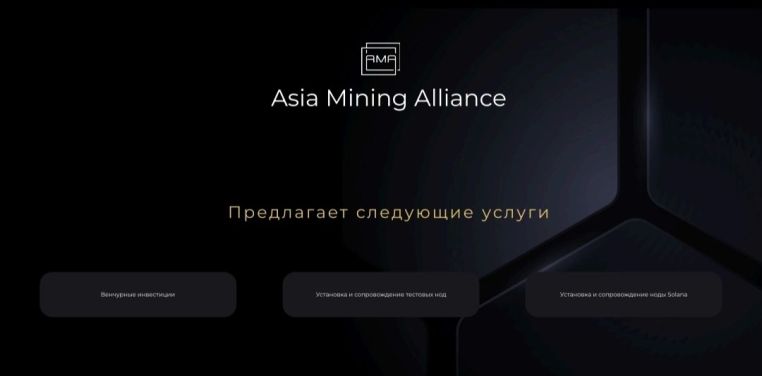
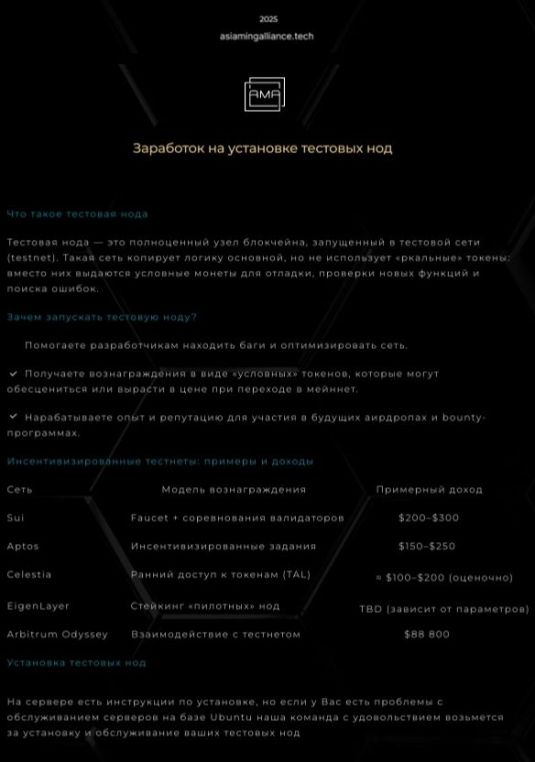
AMA evidently targets Russian-speaking investors in addition to an English-speaking audience. The company presentation deck (uploaded by the user) is entirely in Russian, explaining AMA’s services like venture capital in crypto and testnet node setup. In it, AMA pitches that it provides access to “exclusive investment opportunities, not available to the general public” and simplifies entry into crypto ventures. The existence of this Russian-language pitch suggests that AMA may be capitalizing on interest in crypto within the CIS region, possibly to draw funds from there. Given the economic sanctions environment (many Russian investors have turned to crypto as other avenues closed), AMA’s dual-language approach could be strategic. If any founders or key players are indeed from Russia or Eastern Europe – as names like Evgeny (Eugene) Popov, listed as a PR specialist, imply – one should scrutinize whether AMA has connections to sanctioned individuals or entities. So far, no specific known sanctioned actor is openly linked to AMA. However, in the opaque world of crypto, Russian nationals sometimes operate ventures that indirectly support sanctioned businesses (for example, through provision of mining services or technology transfer). Without clearer disclosure from AMA, the possibility cannot be ruled out that its crypto operations or any mooted tech projects might involve jurisdictions or partners under sanctions. This risk would be especially pertinent if AMA truly were attempting something like counter-UAV tech, since currently Russia and certain Middle East countries have high interest in such systems due to conflict needs, and many are under Western sanctions.
AMA has several characteristics that align with an information operation or at least a concerted marketing/disinformation campaign rather than a straightforward business. The blend of opacity, grandiose multi-domain claims, tailored messaging for different demographics, and heavy self-promotion with little independent corroboration all point to a need for caution. Prospective stakeholders should be aware that the narrative presented by Asia Mining Alliance may be partially or wholly engineered to obfuscate the true nature of the project, be that simply an overhyped investment scheme or something more clandestine.
Behavioral and Online Footprint Analysis
Examining AMA’s digital footprint and behavior provides further insight into its legitimacy. Asia Mining Alliance’s online presence only began emerging in mid-2024, which aligns with the creation of its social media accounts and presumably the website. The website’s domain (asiaminingalliance.tech) and its alternate (.cn) mirror were registered recently (the .tech domain was active by late 2024), indicating that the brand is new. There is no historical record of AMA prior to that – for instance, a search of older news and forums yields no mention of Asia Mining Alliance beyond this past year. This suggests that the organization has little to no proven history, and its perceived track record is self-constructed in a short time frame.
On social media and professional networks, AMA’s reach appears modest. The official Facebook page describes the company as specializing in *“cutting-edge cloud mining solutions”*, a phrasing that aligns with earlier crypto mining ventures. (Notably, “cloud mining” – where users buy into remote mining operations – has often been associated with scams in the crypto space; legitimate cloud mining exists but is rife with fraudulent schemes historically. AMA invoking this term on Facebook could be a vestige of an earlier strategy to attract customers with mining promises.) The Facebook page is not heavily trafficked, and user reviews or interactions are minimal (the page was “Not yet rated” as of its discovery). On Twitter (X), as mentioned, the follower count is under 300, and engagement on posts is low, which could mean AMA has not genuinely attracted a large community yet, or that it mostly communicates through closed channels like Telegram/Discord groups and private calls. Similarly, Michael Buzin’s LinkedIn following is tiny (just a dozen or so followers when last checked), implying that AMA’s leaders are not established influencers in either the tech or finance community at this point.
Content-wise, AMA’s pattern is to produce polished, optimistic articles and posts that echo common crypto industry talking points. They have published or shared articles about trends such as “Navigating Crypto Opportunities in 2024” and even unrelated topics like how to invest in SpaceX’s future stock – presumably to position themselves as savvy commentators on all things tech finance. This breadth again feels like an attempt to appear knowledgeable and credible. However, these writings typically recycle publicly available data and forecasts (for example, citing Bitcoin price predictions or industry research by third parties), rather than providing original insights from AMA’s team. In other words, the public communications show AMA more as a commentator and aggregator of hype, rather than a source of unique innovation or expertise aligning with the earlier observation that AMA might be trying to build legitimacy by association – referencing well-known firms (SpaceX, Andreessen Horowitz as “a16z” in the Sparsity deal context, etc.) and trending concepts, without demonstrating its own unique contributions.
Another behavioral aspect is how AMA deals with potential investors. According to the Russian-language presentation, they walk clients through a “simple step-by-step guide” to start venture investing with AMA. They emphasize hand-holding, market analysis by their “team of experienced analysts,” and promises of identifying the “next big success” in crypto for their clients. This almost consultancy-like approach, combined with the paid membership model, indicates that AMA targets less-experienced investors who feel they might miss out on exclusive crypto gains without insider help. The tone is aspirational and somewhat educational (they even advertise “Crypto Academy” features in their packages), which can build trust with newcomers. However, it’s important to note that all information flows from AMA itself – there’s no independent community or analyst coverage of AMA. The lack of external discussion about AMA on reputable crypto forums or tech news is telling: genuine projects that handle millions in investments usually garner attention, whereas AMA is mainly talked about on its own channels. The insulated nature of discourse around AMA could be deliberate, enabling the company to control the narrative and address skepticism in private rather than in open debate.
When evaluating AMA’s behavior, one should also consider the possibility of strategic rebranding or pivoting. The name “Asia Mining Alliance” might imply to some a focus on physical mining or a consortium of mining companies (as there are similarly named entities in the mineral extraction industry), but AMA has no relation to those. It chose a name that’s somewhat generic – possibly to sound established or to appeal to an Asian investor base. If the company’s crypto endeavors fail to gain traction, it’s conceivable they could pivot to another buzzword domain (for example, claiming to get into AI development, which might explain why drones/AI were mentioned to someone). This pattern of chasing what’s hot is consistent with the earlier notion of multi-domain hype and is a behavior observed in scams: they evolve their story to whatever is most likely to attract new funds.
AMA’s online and behavioral footprint is that of a nascent, self-promotional venture with carefully crafted messaging. AMA lacks organic validation – one doesn’t see testimonials from reputable partners or detailed case studies of successes. Instead, one sees a slick pitch in multiple languages, heavy emphasis on why AMA is unique, and controlled interactions via social media and forums. For a critical investigator, these patterns reinforce doubts about AMA’s legitimacy: the company appears more concerned with selling an image and recruiting investors than with demonstrating real, value-generating operations.
Overall Assessment
Bringing together all the findings, Asia Mining Alliance emerges as a highly dubious enterprise whose legitimacy is far from established. On the surface, AMA markets itself as an innovative cross-section between crypto finance and cutting-edge technology, but under scrutiny, nearly every facet of its narrative raises red flags:
Corporate registration is nominal – a Delaware LLC (via OtoCo) exists, but there’s no substantive corporate infrastructure or clear regulatory oversight. No evidence of licenses to manage investments or handle securities can be found. Essentially, AMA’s “company” is a shell legal entity underpinning a website and a few individuals.
Leadership credentials are unverified – the founders and team do not have known track records in the fields they claim to operate (crypto investing or especially aerospace tech). The lack of independent references to their past accomplishments suggests that investors are expected to take the team’s expertise on faith, an all-too-common scenario in fraudulent schemes.
The business model tilts toward extracting value from clients – through up-front fees and hefty profit cuts – which is inconsistent with how reputable investment firms operate. The promises of exclusive deals and high returns have no third-party validation, making them suspect. The introduction of the AMA token adds another layer of risk, as it encourages public speculation on an asset fundamentally controlled by AMA’s opaque performance and honesty. This tokenization of their venture effectively asks outsiders to fund AMA’s operations (and possibly the founders’ enrichment) under the allure of crypto gains.
The claims of branching into AI drone and counter-UAV technology are unfounded – nothing tangible supports those claims. If they were made to some audience, it likely served to embellish AMA’s image as a broad tech innovator. In reality, AMA has shown zero capability or progress in that arena. This inconsistency undermines trust: a legitimate company does not announce grand projects in completely unrelated domains without evidence or expertise. Such a disconnect is more typical of a front or scam trying to tick multiple boxes for potential investors (e.g., combining trendy sectors like crypto and AI and defense to maximize appeal).
No affiliations with credible institutions have been demonstrated. On the contrary, AMA’s few named associations (like citing an allocation in a project backed by a16z, or quoting industry experts in their posts) seem designed to borrow credibility. There is also no indication of backing by established venture capital, no audits by reputable firms, and no partnerships with well-known companies that one would expect if AMA truly had $3M+ deployed in the crypto market. The absence of such affiliations suggests AMA operates in isolation – or in a closed circle possibly involving regions and persons that don’t welcome scrutiny.
Potential ties to sanctioned jurisdictions or actors, while not confirmed, cannot be dismissed given the heavy Russian-language outreach and the current geopolitical climate of crypto being used as a financial conduit. If AMA were indeed a front, one scenario could be raising money from unsophisticated investors globally (including from the West and Asia) and channeling it to projects or persons in places like Russia or Iran for unauthorized purposes. That remains speculative, but what’s certain is that AMA has not been transparent enough to rule out such possibilities. This lack of transparency combined with ambitious claims is exactly what one would expect if disinformation or obfuscation were part of the strategy.
Overall, Asia Mining Alliance does not present a convincing picture of a legitimate, sustainable business. On the contrary, it exhibits many of the hallmarks of a scheme that could potentially be fraudulent or at best grossly overstated. The company’s legitimacy is unverified, its operations are unproven, and its claims range from questionable to unbelievable. Prospective investors or partners should approach AMA with extreme caution. Due diligence would likely reveal more inconsistencies, and until AMA can provide concrete proof of its legal compliance, financial performance, and technical achievements, it must be viewed as a high-risk, and possibly deceptive, venture rather than a credible enterprise.
Sources
1. Asia Mining Alliance – Cookie Policy (Delaware registration details)
2. Asia Mining Alliance – Official Website (Home Page and Team information)
3. Asia Mining Alliance – Official Website (Service offerings and metrics)
4. Asia Mining Alliance – Official Website (Membership tiers and fees)
5. Michael Buzin (CEO) – LinkedIn post announcing AMA token launch
6. Asia Mining Alliance – AMA Token page (description of ecosystem and assets)
7. Michael Buzin – LinkedIn post on SPARSITY deal (venture allocation and fees)
8. Asia Mining Alliance – Facebook page snippet (company description)
9. Asia Mining Alliance – Russian-language presentation (exclusive opportunities and track record claims)
10. Asia Mining Alliance – Twitter profile info (account start date and follower count)
You must be logged in to post a comment.