


Abstract
The armed forces of Ukraine and the Russian Federation institutionalized unmanned aerial operations between late 2024 and early 2026.
Commanders faced severe infantry and conventional artillery shortages. They shifted focus toward deep, technological defensive perimeters known as drone lines. The Unmanned Systems Forces in Ukraine and the Russian Rubicon Center now control the battlespace. Unmanned systems destroy approximately 80 percent of confirmed targets. The side that scales production and counters electronic interference will likely secure operational supremacy.
Introduction
The operational environment of the Russo-Ukrainian War shifted fundamentally between late 2024 and early 2026. Frontline troops discarded decentralized quadcopters. They built systematic, theater-wide defensive perimeters instead. Acute manpower deficits and diminishing artillery stockpiles forced commanders to substitute human infantry with dense technological walls. Unmanned platforms function as primary maneuver elements today. The Russian military and the Ukrainian armed forces completely reformed their command structures to manage massive drone fleets.
Ukraine’s Defensive Matrix
Ukrainian military leadership faced severe frontline fragmentation following a tactical loss at Avdiivka in early 2024. Traditional infantry units lacked sufficient numbers to man trenches. Planners established the Unmanned Systems Forces in June 2024 to consolidate volunteer detachments into a formalized military branch. President Volodymyr Zelensky appointed Major Robert Brovdi to command the new branch in June 2025. Zelensky dismissed the previous commander, Colonel Vadym Sukharevskyi, due to bureaucratic friction.
Brovdi established a unified electronic architecture for planning, coordination, and reporting. Ground Forces Commander Mykhailo Drapaty launched the Drone Line project simultaneously. The initiative forms a deep kill zone stretching up to 50 kilometers. Funding reached 4.6 billion hryvnias.
Planners divided the airspace into specific engagement sectors. Engagement zones sit at five to 10 kilometers, 10 to 15 kilometers, 15 to 20 kilometers, and an extended zone of 20 to 50 kilometers. Five elite regiments and brigades anchor the perimeter.
Unit Designation
Origin Unit
Primary Operational Function
414th Brigade (“Magyar Birds”)
Volunteer platoon
Conducts massive daily strikes and evades electronic defenses.
429th Brigade (“Achilles”)
92nd Assault Brigade
Neutralizes advancing armor during urban defense.
20th Brigade (“K-2”)
54th Mechanized Brigade
Specializes in tactical reconnaissance on contested fronts.
427th Brigade (“Rarog”)
24th Mechanized Brigade
Executes advanced intelligence gathering and strike coordination.
Phoenix Regiment
State Border Guard Service
Focuses on border defense and near-rear logistics interdiction.
Russian Symmetric Centralization
Russian officials recognized the severe attritional threat posed by Ukraine’s evolving tactics. Defense Minister Andrei Belousov directed the creation of the Center for Advanced Unmanned Technologies on August 02, 2024. Officials call the unit Rubicon. Headquartered near Moscow and commanded by Guards Colonel Sergei Budnikov, Rubicon expanded to roughly 5,000 personnel by November 2025.
Rubicon operates as a hybrid entity. Instructors test civilian industrial innovations. They train thousands of operators. They also deploy elite strike squads directly to the most intense sectors. Operators focus on destroying Ukrainian supply lines and hunting enemy pilots. Intelligence reports indicate a highly probable connection between Rubicon’s deployment and increased vehicle losses along the Pokrovsk axis.
Echeloned Operations of Russian Combined Arms Armies
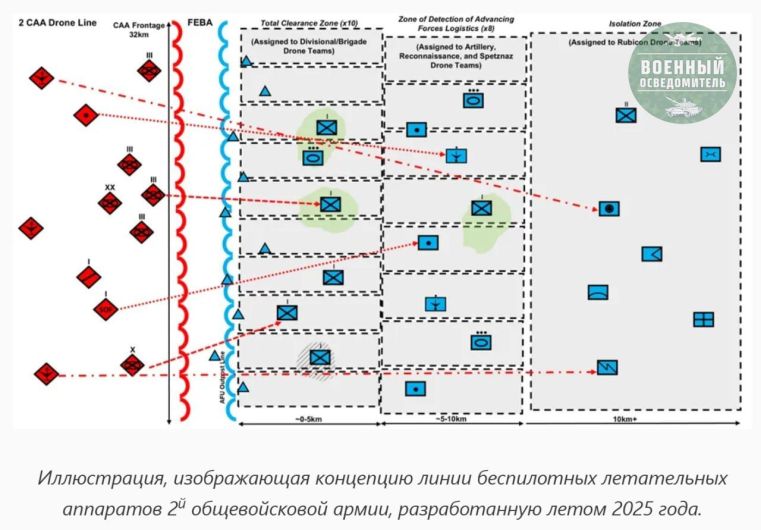
Frontline Russian formations translated Rubicon’s theories into rigid battlefield architecture. The 2nd Guards Combined Arms Army pioneered a structured matrix during the summer of 2025. Commanders divided their 32-kilometer frontline into three specific depth echelons. They further subdivided the echelons into 18 horizontal sectors. Permanent unmanned aerial vehicle crews occupied exact zones to eliminate airspace congestion.
The first echelon covered zero to five kilometers. Commanders labeled the area the zone of complete clearing. A dedicated force of 165 operators saturated forward trenches with explosive quadcopters. The second echelon reached from five to 10 kilometers. Here, 293 operators identified advancing reserves and disrupted immediate tactical supply routes. A third echelon handled targets beyond 10 kilometers.
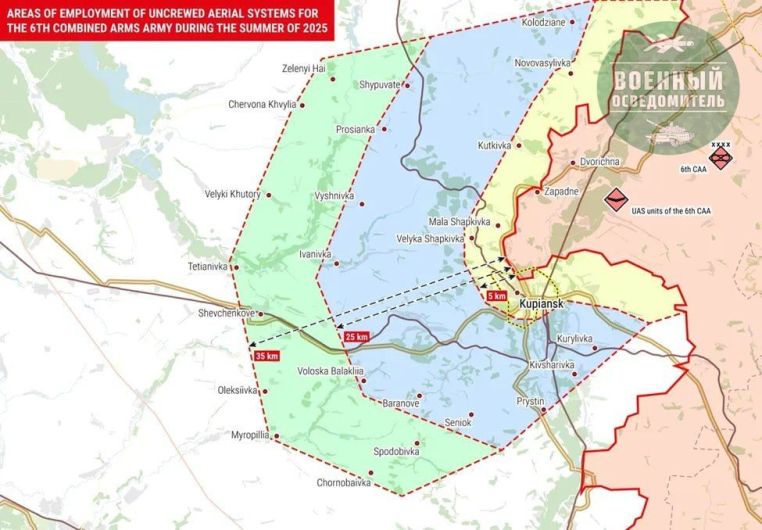
During the fall of 2025, the Center Group of Forces scaled the structure across 60 sectors. Commanders enforced a strict limit of 4,000 quadcopter and fixed-wing flights per day. The 6th Guards Combined Arms Army deployed a parallel system near Kupyansk simultaneously. First-echelon operators commanded 100 tactical units using bomber quadcopters and transformer airframes. Second-echelon personnel operated up to 25 kilometers deep. They focused on relay stations and electronic warfare arrays.
Rapid Platform Evolution
The physical machinery driving combat underwent severe transformation. Mass-produced fixed-wing assets replaced standard commercial quadcopters for mid-range missions.
The Molniya Family
Russian engineers developed the Molniya series to bridge the operational gap between short-range quadcopters and expensive loitering munitions. Constructed from plywood, extruded styrofoam, and aluminum poles, the platform costs approximately $300. The modernized Molniya-2 features twin wing-mounted propellers and carries payloads of three to six kilograms. Pilots achieve speeds of 80 kilometers per hour with an operational endurance of 40 minutes.
During late 2025, Rubicon introduced the Molniya-2R reconnaissance variant. Technicians integrated a Chinese SIYI ZR10 camera and a commercial Starlink satellite terminal directly into the airframe. Starlink integration provides near-total immunity to traditional electronic warfare. The upgrade extends the effective command range to 100 kilometers.
Fiber-Optic Systems
Electronic jamming previously disabled thousands of remote-controlled devices. To bypass signal suppression, Russian and Ukrainian technicians pioneered fiber-optic guided flight. Operators spool out a hair-thin cable from the aircraft. The tether maintains a physical data link with the ground station. Unaffected by electromagnetic interference, fiber-optic operators successfully destroyed heavily armored Western tanks outside Pokrovsk in early 2026.
Defensive Engineering
Combatants engineered physical defenses to survive relentless aerial bombardment. Russian mechanics welded massive corrugated metal structures over main battle tanks. Labeled turtle tanks, the modified vehicles absorbed dozens of explosive impacts while clearing minefields. To protect logistical corridors, combat engineers erected tall poles strung with monofilament nylon nets. Specialized infantry squads armed with shotguns and backpack jammers guarded the netting to intercept entangled aircraft.
Strategic Foresight and Threat Assessment
Institutionalized aerial bombardment generates severe second-order effects. Rubicon operators prioritize the isolation of the battlespace by striking Ukrainian ground lines of communication. Independent United Nations investigators concluded in October 2025 that Russian forces intentionally target civilian infrastructure in frontline-adjacent areas. Systematic depopulation strips Ukrainian forces of local logistical support. The tactic allows Russian infantry to advance into empty settlements.
Sustaining the necessary volume of flights strains industrial capacities. Ukraine established a goal to manufacture millions of units annually. The defense procurement agency drove delivery times from order generation to frontline deployment down to 10 days. Conversely, internal Russian records indicate the defense industrial base struggles with supply bottlenecks due to over-centralization.
The 2024 to 2026 period solidified warfare as an industrialized exchange of autonomous and remote systems. Ukraine offset immense artillery deficits by establishing an impenetrable defensive perimeter. The Russian military countered by forming the Rubicon Center and implementing rigid grid-based operational doctrines. Traditional armored maneuvers face highly likely failure without sustaining prohibitive losses. The conflict’s outcome depends entirely on rapid technological iteration and unmatched industrial output.
Works cited
1. ‘We don’t have infantry’: Ukraine’s war machine evolves into machine war – Defense News, https://www.defensenews.com/global/europe/2026/02/24/we-dont-have-infantry-ukraines-war-machine-evolves-into-machine-war/ 2. Russia Assails Ukraine’s Drone Wall – CEPA, https://cepa.org/article/russia-assails-ukraines-drone-wall/ 3. Ukraine’s drone wall is Europe’s first line of defense against Russia – Atlantic Council, https://www.atlanticcouncil.org/blogs/ukrainealert/ukraines-drone-wall-is-europes-first-line-of-defense-against-russia/ 4. Game of drones: the production and use of Ukrainian battlefield unmanned aerial vehicles, https://www.osw.waw.pl/en/publikacje/osw-commentary/2025-10-14/game-drones-production-and-use-ukrainian-battlefield-unmanned 5. Ukraine unites Unmanned Systems Forces with top ‘Drone Line’ units under new command group – The Kyiv Independent, https://kyivindependent.com/ukraine-creates-new-grouping-of-unmanned-systems-forces/ 6. «УП» раскрыла детали об украинском проекте «Линия дронов» – Новости Севастополя, https://sevastopol.su/news/raskryla-detali-ob-ukrainskom-proekte-liniya-dronov 7. Украина работает над внедрением системы «Линия дронов» – Наша версия, https://versia.ru/ukraina-rabotaet-nad-vnedreniem-sistemy-liniya-dronov 8. Я, честно говоря, пока не ощущаю выстрела под названием «Беспилотная авиация, как отдельный род войск России»… 2026 – VK, https://vk.com/wall-112759286_781984 9. Center for Advanced Unmanned Technologies “Rubicon” – Wikipedia, https://en.wikipedia.org/wiki/Center_for_Advanced_Unmanned_Technologies_%22Rubicon%22 10. Inside Rubicon, The Elite Russian Drone Unit Wreaking Havoc On Ukraine’s Troops, https://www.rferl.org/a/russia-drone-rubicon-secret-ukraine-war/33532804.html 11. Defense Forces Strike Location of Russian Rubicon UAV Unit With FP-2 Drones, https://militarnyi.com/en/news/defense-forces-strike-location-of-russian-rubicon-uav-unit-with-fp-2-drones/ 12. Russia’s Drone Campaign Uses Civilian Harm as Tool of War | ISW, https://understandingwar.org/research/russia-ukraine/russias-fpv-drone-campaign-in-ukraine-institutionalizes-intentional-civilian-harm-as-a-tool-of-war/ 13. Failed Ukrainian mechanized attack near Pokrovsk ignites online storm over assault regiment’s tactics, https://kyivindependent.com/failed-mechanized-attack-near-pokrovsk-ignites-online-storm-in-ukraine-over-assault-regiments-tactics/ 14. Russia’s Drone Line Experiment – Rob Lee : r/CredibleDefense – Reddit, https://www.reddit.com/r/CredibleDefense/comments/1sbj79f/russias_drone_line_experiment_rob_lee/ 15. Russian Offensive Campaign Assessment, July 30, 2024 | ISW, https://understandingwar.org/research/russia-ukraine/russian-offensive-campaign-assessment_30-4/ 16. “Линия Дронов”. В Украине запускают проект усиления пехоты беспилотниками, https://www.rbc.ua/ukr/news/liniya-droniv-ukrayini-zapuskayut-proekt-1739123559.html 17. Ukraine Tried to Raise Flag in Kupyansk Using Drones, https://voennoedelo.com/en/posts/id11503-ukraine-tried-to-raise-flag-in-kupyansk-using-drones 18. Russian Offensive Campaign Assessment, March 22, 2026 | ISW, https://understandingwar.org/research/russia-ukraine/russian-offensive-campaign-assessment-march-22-2026/ 19. Cheap but dangerous: how Russia’s plywood Molniya drone has become a big problem for Ukraine’s defence forces, https://www.pravda.com.ua/eng/articles/2026/01/15/8016293/ 20. Шахед для бедных». Россия бьет по прифронтовым городам Украины дронами Молния, которые сначала делала из фанеры — что это за беспилотники, https://nv.ua/ukraine/events/dron-molniya-sdelan-iz-fanery-ili-plastika-kakaya-dalnost-chem-vooruzhen-mozhno-li-ego-sbit-50506729.html 21. Five frontline innovations from Ukraine – European Security & Defence, https://euro-sd.com/2025/05/articles/44171/five-frontline-innovations-from-ukraine/ 22. Hypersonic Weapon Programmes – European Security & Defence, https://euro-sd.com/wp-content/uploads/2025/05/ESD_MDM_WEB.pdf 23. Ukrainian War&Sanctions Portal Reveals How russia Built Its New Molniya-2R Drone, https://en.defence-ua.com/weapon_and_tech/ukrainian_warsanctions_portal_reveals_how_russia_built_its_new_molniya_2r_drone-16928.html 24. Enemy adapted the “Molniya” drone for Aerial Reconnaissance — HUR – АрміяInform, https://armyinform.com.ua/en/2025/12/22/enemy-adapted-the-molniya-drone-for-aerial-reconnaissance-hur/ 25. Russia’s Quest to Intensify The Theater-Wide Battlefield Air Interdiction Campaign Against Ukraine’s Logistics – Institute for the Study of War, https://understandingwar.org/research/russia-ukraine/russias-quest-to-intensify-the-theater-wide-battlefield-air-interdiction-campaign-against-ukraines-logistics/ 26. Russian Force Generation and Technological Adaptations Update July 25, 2025, https://understandingwar.org/research/russia-ukraine/russian-force-generation-and-technological-adaptations-update-july-25-2025/

You must be logged in to post a comment.