



High pressure air is widely used in submarines for:
- Ensuring the use of weapons;
- Blowing out the tanks of the main ballast during the ascent of the submarine;
- Creation of an air cushion (back pressure) in the compartments when they are filled with water in case of an accident;
- Ensuring the use of emergency devices;
- Ensuring the operation of the ship’s hydraulic drive system, supplying the medium pressure air system and other needs;
- The pressure in the VVD system is 1.47107 ¬– 2.45107 (150 – 250 kgf/cm2)
- To store stocks of VVD, steel cylinders with a capacity of up to 400 liters are installed on the submarine. For ease of use and control of the compressed air system, as well as to ensure its survivability, all cylinders of the system are divided into groups. There are usually 2 to 6 balloons in a group. There are reserve groups, of which air is consumed only by order of the submarine commander.
- The placement of cylinders in compartments is carried out in such a way that certain reserves of high-pressure liquids are located in compartments adjacent to the central post and in shelter compartments. Inside the strong hull, the cylinders are installed along the sides in the hold or on the deck, outside the strong hull in the superstructure, in the keel and in the central gas cylinder, distributing evenly along the entire length of the strong hull of the submarine.
- The firing system of aerial torpedo tubes (Fig. 1) consists of firing cylinders, pipelines and valves that control the system. The pressure in the firing system of American diesel-electric submarines is 42 kg/cm2. The air system of hydraulic torpedo tubes, which is used on modern nuclear submarines, has a similar scheme, but the compressed air pressure in this system reaches 105-175 kg/cm2.
Figure 1 – Scheme of the firing system of aerial torpedo tubes

1 – torpedo tubes; 2 – firing valve; 3 – drainage of torpedo tubes; 4 – non-return valve; 5 – charging torpedoes; 6 – from the IVD system; 7 – separator; 8 – filter; 9 – to the torpedo tubes of the other side; 10 – firing cylinders
When fired, air enters the mine through a 175-mm poppet-type firing valve, while the air supply rate excludes the creation of pressures in the mine that exceed the allowable (60-70 kG/cm’^). The diameter of the air pipes connecting the firing cylinders with mines is 200-250 mm.
For example, consider the Polaris A-1 submarine launch silo ( fig. 2)
Figure 2 ¬ Polaris A-1 launch silo.
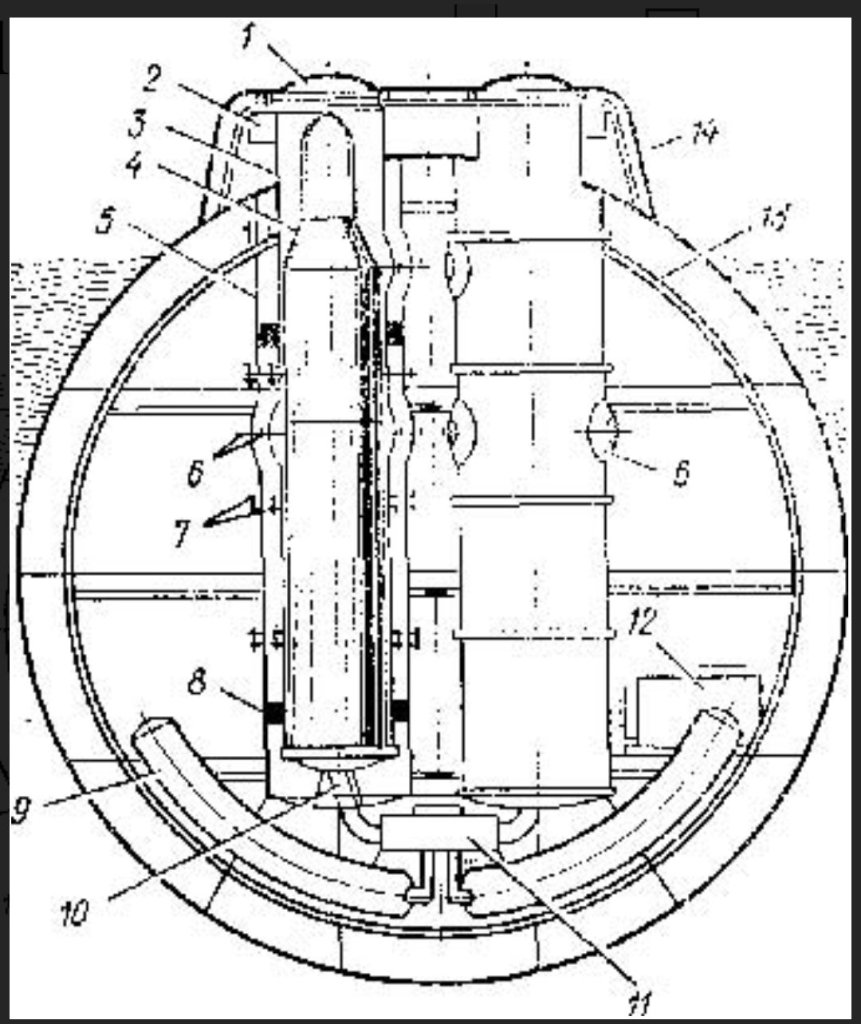
1 – durable cover of the launch shaft; 2 – cover opening mechanism; 3 – the inner cylinder of the launch shaft; 4 – rocket; 5 – outer cylinder of the launch shaft; 6 – inspection hatches; 7 – flange connections of shaft cylinder sections; 8 – shock absorbers; 9 – compressed air cylinders for launching missiles; 10 – centering device and axial support of the inner cylinder of the shaft; 11 – junction box of the starting air system; 12- electric compressor of the compressed air system for launching missiles.
The launch shaft is a double-walled steel structure of a cylindrical shape, closed from above with durable covers. The height of the shaft is 8.7 m, the diameters of the cylinders: internal – 1.45 m, external – 2.1 m. To access the systems serving the rocket, there are three necks in the walls of the mines, which are closed with lids. Access to the instrument compartment of the rocket is provided through the upper neck, and through the two lower ones – to the place where the engines of the first and second stages are docked. In a strong submarine hull, the inner cylinder of the launch shaft is mounted on 20-30 shoes supported by hydraulic shock absorbers. The rocket is installed in the mine on a special swinging support and is attached to it with a clamping ring. Inside the launch silos, air conditioning systems maintain the desired temperature and humidity.
A rocket is launched from a depth of 25-35 m with high-pressure compressed air, for which each of the mines is equipped with an autonomous air system. The air is stored in spherical cylinders with a diameter of 1.2 m. The capacity of the cylinder, designed for a pressure of 315 kg/cm2, is 0.9-0.95 m3; total supply of firing air on a submarine (George Washington type) 14 -15 .
The launch silos are equipped with a special blocking system that excludes the possibility of issuing a “Start” signal if the preparation for the launch of the rocket is not yet completed (for example, with the silo covers closed; if the pressure in the silo is not equalized or the retaining rings are not removed from the rocket, etc.) . The blocking system eliminates the possibility of turning on the engine in the mine or its self-ignition.
1.2 Layout and placement of GPA and torpedoes on submarines and other underwater mobile carriers.
Placing means of deception and fighter SBNA on carriers (submarines and NPA-hunters) requires the creation of separate specialized devices. This section will consider some of the technical solutions that ensure the basing of weapons on mobile underwater carriers.
Launchers (PU) for vehicles placed on mobile underwater carriers must solve a number of tasks that are not limited only to ensuring the launch process. The process of UUV self-exit from the launcher requires an increased diameter of the launch tube (to ensure the replacement of its volume released by the apparatus with water), as well as an almost complete “stop” of the carrier due to the high probability of launch failure or its undesirable contact with the carrier body in the presence of an oncoming water flow. All this makes the self-exit of UUVs based on mobile underwater objects (uninhabited vehicles or submarines) ineffective, which leads to the need to create specialized launchers aimed at solving a set of problems related to placing vehicles on a carrier and separating them from it. In this section, some existing similar systems will be considered, as well as several designs proposed with the participation of the author.
The main problem of UUV separation from a moving carrier is the need for sufficient energy not only for separation in compliance with the carrier safety requirements, but also for a guaranteed exit of the product to the programmed underwater trajectory of its movement.
The energy system of the launcher, which solves these problems, contains: an energy source, a system for its conversion and a system for generating the necessary buoyancy force in time. A feature of underwater launchers is the need to create a large buoyancy force with a relatively small total energy consumption. This imposes significant restrictions on the choice of rational schemes for power systems of starting devices.
It should also be noted that the launcher is very often also a place for long-term storage of an uninhabited underwater vehicle on board the carrier. Combined together, NPA and PU form the so-called transport and launch container (TPC), the main tasks of which, respectively, are to store the device in the stowed position and separate it from the carrier at the right time.
To create a power impulse necessary to push the apparatus out of the TPK, various energy sources are used, such as powder pressure accumulators, electricity, hydraulics, and so on. At the same time, the type of energy used has a significant impact on the relationship between the launcher and the carrier. In most cases, due to the limited power of the ship’s energy sources and the high impulse power of launchers, it is necessary to include autonomous sources, sometimes energy storage devices, in their power system. It can be quite confidently noted that one of the most simple, environmentally friendly, cheap and easily accessible energy sources is high pressure air (HP).
Usually it is stored in a separate cylinder, which is part of the TPK.
Since the separation of the apparatus from the carrier can be carried out at different depths, an important problem that the developer of the TPK needs to solve is the regulation of the buoyant force impulse depending on the hydrostatic pressure opposing the separation. At the same time, the accelerations experienced by the apparatus in the process of being pushed out of the container should not exceed certain limits determined by the strength of the equipment and devices of the UUV. At the same time, the power pulse must provide such an output speed of the device, which is necessary for its accident-free separation from the carrier and divergence from it.
Traditionally, when using HP as an energy carrier, the designated problem is solved by introducing a special pneumatic regulator into the design of the launcher, the change in the flow section of which is interconnected with the depth at which it is necessary to work. However, the currently widely used systems that regulate the opening law of the passage section depending on the hydrostatic pressure of the environment cannot be used in the developed launchers, primarily because of the weight and size characteristics, the strict requirements for limiting which are dictated by the small volume of carriers.


You must be logged in to post a comment.