


THE MAIN IT UNIVERSITY
IN THE FIELD OF TELECOMMUNICATIONS

Red Banner Academy of Communications
named after Marshal of the Soviet Union
S.M. Budyonny
Phones:
8 (812) 247-98-35 (on duty);
8 (812) 247-93-25 (admissions office, fax)ACADEMY BUILDINGS MAIN
ADDRESS:
Tikhoretsky Prospekt, 3
BUILDING NEAR THE CHERNYSHEVSKAYA METRO STATION:
Suvorovsky Prospekt, 32A
FIELD TRAINING BASE
Leningrad Region, Vsevolozhsk District, Sertolovo
TRAINING CENTER “IZHORA”
Leningrad Region, Gatchinsky District, Verevskoye Rural Settlement, Vayalovo Village, Vayalovo Tract
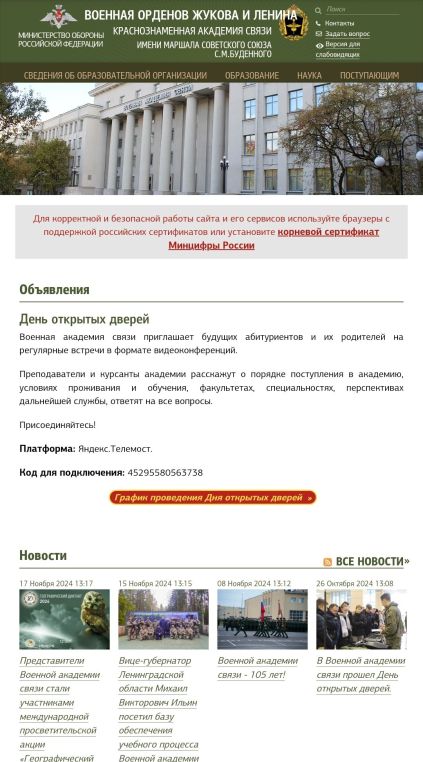
The Military Academy of Communications, based in Saint Petersburg, is actively recruiting candidates for the 2025 academic year, focusing on two critical specializations: Infocommunication Technologies and Special Communication Systems, as well as Application and Operation of Special-Purpose Automated Systems. These programs are indicative of the Russian Armed Forces’ sustained emphasis on advanced technological capabilities and secure communication infrastructures. By targeting candidates in these areas, the academy underscores its strategic intent to cultivate a workforce proficient in handling sophisticated communication networks and automated systems tailored to military objectives.
Eligibility requirements are meticulously crafted to ensure a broad yet selective pool of applicants. Candidates must be Russian citizens with either a secondary general or vocational education. The academy is open to both individuals who have completed military service by conscription and those who have not, as well as active-duty military personnel without officer ranks. Civilian applicants must fall within the age range of 16 to 22, while members of the high-grade reserve may apply up to the age of 24. Contract military personnel are afforded an extended age limit of up to 30. Importantly, applicants must possess a clean criminal record and have no dual citizenship or immediate family residing outside the Russian Federation, emphasizing security considerations in the selection process.
The academic threshold for admission is delineated by the minimum scores required on the Unified State Exam. Candidates must achieve at least 36 points in the Russian language and 27 points in advanced mathematics. Additionally, they may choose between physics, for which 36 points are required, or computer science, necessitating 40 points. These benchmarks reflect the academy’s prioritization of technical proficiency, analytical reasoning, and linguistic competency, all critical to the demands of the targeted specializations.
The academy’s focus on secure communication and automated systems aligns with the broader modernization goals of the Russian military. By preparing specialists in these fields, the institution is positioning itself as a cornerstone of the Armed Forces’ efforts to integrate advanced technologies into command-and-control frameworks. The inclusion of both theoretical and applied aspects in the curriculum likely aims to balance foundational knowledge with hands-on expertise, ensuring graduates are operationally ready.
For inquiries, the admissions office can be reached via telephone at 8(812)247-93-25. Additional details are accessible through the official website at vas.mil.ru or akademiyasvyazi.rf. These multiple points of contact indicate a strategic effort to enhance accessibility for prospective candidates while fostering engagement through both traditional and digital platforms.
The Military Academy of Communications is intensifying its recruitment efforts for programs that directly support Russia’s strategic imperatives in infocommunications and automated systems. The stringent eligibility criteria, combined with the emphasis on technical and operational excellence, demonstrates the academy’s critical role in sustaining and advancing the technological edge of the Russian Armed Forces.
The Military Academy of Communications named after Marshal of the Soviet Union S. M. Budyonny is one of the oldest military educational institutions in the country, training specialists in the field of telecommunications and automation for the Armed Forces of the Russian Federation, other ministries and departments. Over the years of its existence, the university has trained more than 50 thousand officers for the Armed Forces of our country, over 5 thousand officers for the armies of foreign states, more than 2 thousand candidates and more than 110 doctors of science. 8.5 thousand officers have completed training in the system of additional professional education.
For its merits in the training of officer cadres, the Academy was awarded the Order of the Red Banner, the Order of Zhukov, the Order of Lenin, as well as eight awards from foreign states.
The Academy carries out full-time (over 2 years) training of officers with higher military operational-tactical training. During their military service, officers of the signal troops undergo retraining at the Academy at the faculty of retraining and advanced training.
The Academy offers doctoral and postgraduate programs. Officers with higher education are admitted to the full-time postgraduate program on a competitive basis. Officers with a candidate of science degree are admitted to the Academy’s doctoral program on a competitive basis.
The high scientific potential of the Academy contributes to the high-quality training of masters and specialists. The Academy has ten scientific schools. 73% of the teaching staff have an academic degree and academic title, 38% have combat experience in the area of a special military operation.
Students are granted a 30-day summer vacation and a 15-day winter vacation annually. They have the opportunity to visit concert halls, museums, and exhibitions in St. Petersburg on preferential terms.
The Military Academy of Communications in Saint Petersburg, Russia, stands as a cornerstone in the nation’s efforts to advance technological and strategic capabilities within telecommunications and IT systems. Established as the oldest military educational institution specializing in communication systems, the academy has been pivotal in shaping the technological landscape of the Russian Armed Forces. Its reputation as “The Main IT University in the Field of Telecommunications” underscores its critical role in training specialists to meet the demands of modern warfare and secure communication networks.
The academy’s infrastructure is strategically located across various sites in Saint Petersburg and the Leningrad region, including the main campus on Tikhoretsky Prospekt and facilities near the Chernyshevskaya Metro Station. Training centers in Seltorovo and Izhora provide hands-on field experiences, enabling cadets to apply theoretical knowledge in real-world scenarios. The comprehensive network of academic buildings and dormitories ensures a conducive environment for rigorous study and practical application.
The curriculum at the academy is extensive, spanning telecommunications, IT, and specialized communication systems. Core areas of study include radio communication, satellite communication, multi-channel telecommunication systems, optical communication, and network administration. Advanced fields such as automated information processing, mathematical programming, and special-purpose switching systems form the backbone of the technical training. Specializations like infocommunication technologies, special-purpose radio systems, and the operation of automated systems ensure that graduates are well-equipped to manage and innovate within military IT infrastructures.
With over 60 professors, 200 doctors of science, and 12 academicians from the Russian Academy of Sciences, the faculty at the academy brings unparalleled expertise. Their focus is not only on imparting knowledge but also on fostering leadership qualities crucial for military operations. The academy’s emphasis on advanced methods and special training conditions nurtures essential qualities like critical decision-making, resilience, and strategic thinking, which are indispensable for future leaders.
The academy’s admissions process reflects its rigorous standards. Applicants undergo psychological testing, physical fitness assessments, and academic evaluations through the Unified State Exam. Admission is open to civilians up to 22 years old and military personnel up to 30 years old, ensuring a diverse cohort of candidates with varying levels of experience and expertise. The emphasis on physical and mental fitness, along with academic rigor, guarantees that only the most capable individuals are admitted.
The benefits for cadets are robust, including free housing, meals, and a monthly stipend exceeding 20,000 ₽. Graduates of the academy are not only provided with stable housing and a comprehensive social package but are also assured of fulfilling careers within the military or allied government departments. This stability, combined with the prestige of the academy, makes it a highly sought-after institution for individuals committed to national defense and technological excellence.
The academy’s vision extends beyond education, fostering a culture of connection, stability, patriotism, and opportunity. By integrating state-of-the-art technology with traditional military values, the academy ensures that its graduates are both technologically proficient and deeply committed to their country’s security and sovereignty. This dual focus on technological mastery and patriotic service positions the Military Academy of Communications as a vital institution in Russia’s defense and strategic framework.


You must be logged in to post a comment.