


The Popular Mobilization Forces (PMF), a state paramilitary organization within Iraq, operates under significant Iranian influence. This dual allegiance presents a complex challenge to Iraqi sovereignty and broader regional stability. Recent drone attacks targeting Iraqi Kurdistan mark a concerning escalation of tensions, occurring shortly after a ceasefire between Iran and Israel concluded. The Kurdistan Regional Government (KRG) attributes these attacks directly to PMF-affiliated groups, while Baghdad vehemently denies involvement. This stark disagreement underscores deep internal divisions and a fractured security environment. Understanding these dynamics requires a thorough examination of the PMF’s structure, its operational history, and the intricate web of regional and internal pressures that shape its actions. This assessment provides a foundational understanding for informed strategic responses.
The Popular Mobilization Forces- Formation, Structure, and Strategic Influence
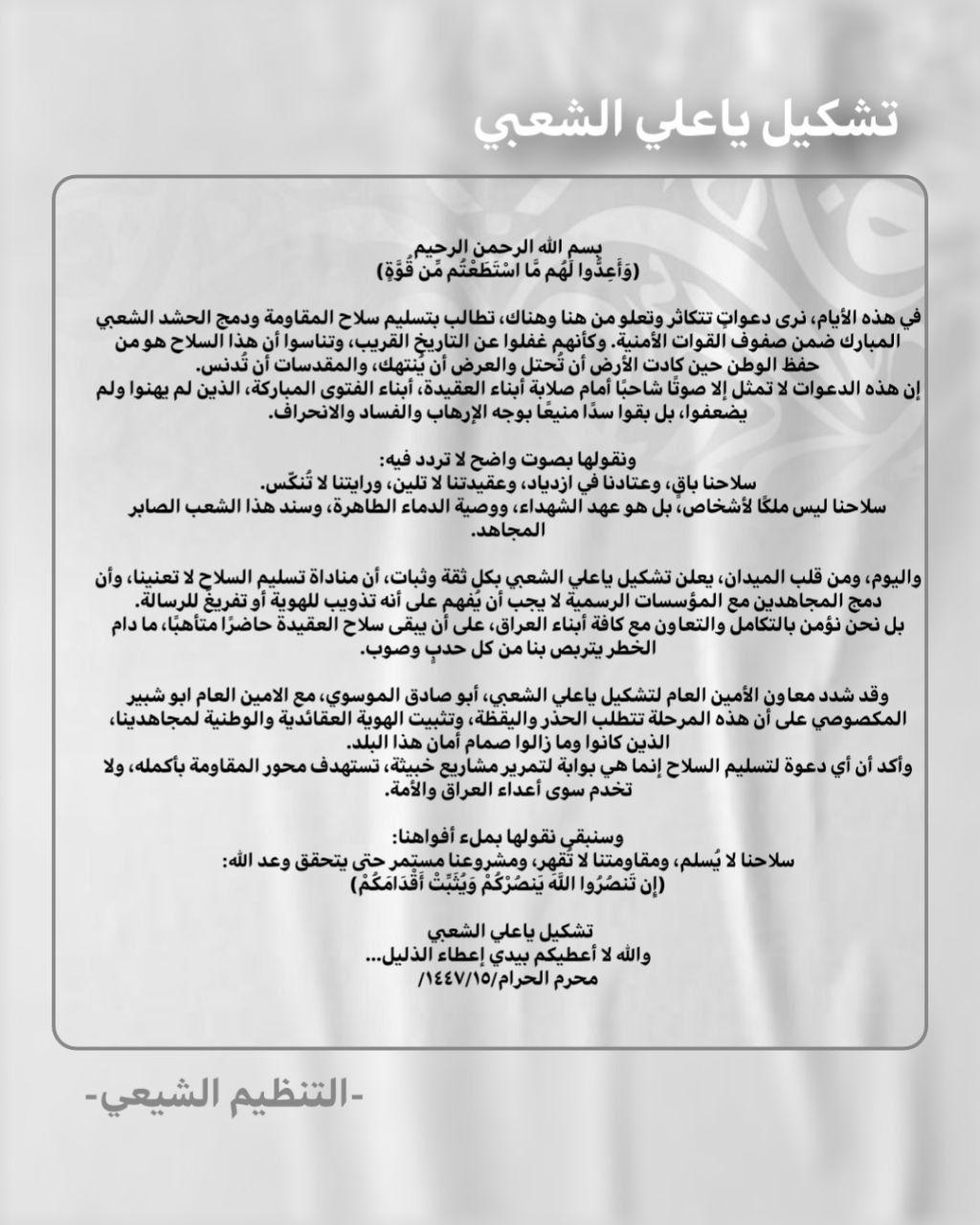
The Popular Mobilization Forces represent a formidable and complex entity within Iraq’s security architecture. Formed in 2014, the PMF rapidly evolved from a coalition of primarily Shia armed factions into a formally recognized governmental agency, the Popular Mobilization Commission (PMC), in December 2016. This legal recognition integrated them into the Iraqi Armed Forces, placing them nominally under the prime minister’s direct command. Despite this official status, the PMF maintains significant operational autonomy and a pronounced allegiance to Iran’s Supreme Leader, Ali Khamenei. Abu Fadak al-Mohammadawi, the PMF Chief of Staff, openly affirms this loyalty, and PMF chairman Falih al-Fayyadh collaborates with the Iranian Islamic Revolutionary Guard Corps (IRGC) to implement Iranian directives within Iraq.
The PMF comprises approximately 67 armed factions, with Iranian backing characterizing nearly all of them. These groups trace their origins to “Special Groups,” a term the United States used for Shiite insurgent groups supported and funded by Iran’s Quds Force during the Iraqi insurgency. These groups fought Coalition forces led by the United States and Sunni insurgents, marking their involvement in sectarian conflict. The PMF played a significant role in nearly every major battle against the Islamic State between 2013 and 2017. Following their reorganization in early 2018, some observers labeled them the “new Iraqi Republican Guard.” However, some states, including the United States, the United Arab Emirates, and Japan, designate certain PMF factions as terrorist groups. Accusations against PMF groups include promoting sectarian violence, perpetrating ethnic cleansing and displacement of Iraqi Sunnis, and committing war crimes, including abductions. During the 2019–2021 Iraqi protests, pro-Iran PMF groups faced accusations of killing and wounding numerous protesters and activists. Internal rivalries also exist, with pro-Iran groups clashing violently with pro-Sistani and Sadrist PMF groups in 2022. Since 2020, Iranian-backed PMF groups have launched attacks against American forces and their allies in the region, often claiming responsibility under the name of the Islamic Resistance in Iraq.
The PMF’s dual allegiance creates a fundamental contradiction within Iraq’s security apparatus. Although formally part of the Iraqi Armed Forces and reporting to the Prime Minister, PMF leaders act independently of state control, answering to Iran’s Supreme Leader. This arrangement compromises Baghdad’s ability to assert complete sovereign control over its security forces, leading to a parallel power structure that responds to external directives rather than purely national ones. Such a situation impedes unified national security policy and enforcement, fostering distrust between Baghdad and regional governments, such as the KRG, complicating international partnerships, and providing a persistent avenue for foreign interference. This dynamic could lead to internal fragmentation, proxy conflicts, or a weakening of the Iraqi state’s overall coherence and effectiveness.
The PMF gained legal status as a state entity in 2016 after fighting the Islamic State. This grants them formal legitimacy and access to state resources. However, their continued allegiance to Iran’s Supreme Leader and documented independent actions, including attacks on US forces and alleged human rights abuses, contradict their purported role as a purely national force. The formal integration of the PMF into the Iraqi state, despite its external loyalties and controversial actions, represents a pragmatic yet deeply problematic compromise by Baghdad. This arrangement grants the central government a degree of nominal control while simultaneously legitimizing and empowering a force that undermines its sovereignty. The compromise likely stems from a desire to avoid confrontation with powerful, Iranian-backed groups and to maintain a semblance of national unity against internal and external threats. This internal contradiction creates a persistent source of instability within Iraq, hindering genuine state-building efforts, complicating security sector reform, and perpetuating a cycle in which powerful non-state actors operate with state sanction, blurring the lines of authority and accountability. The long-term implication involves a weakened central government unable to project uniform authority across its territory, leaving it vulnerable to external manipulation and internal fragmentation.
PMF leaders openly declare allegiance to Khamenei, and the PMF chairman cooperates with the IRGC to implement Iranian instructions. PMF groups have launched attacks against American forces and allies, claiming them under the name of the Islamic Resistance in Iraq. This demonstrates the PMF functions as a significant instrument of Iranian foreign policy, extending Tehran’s influence deep into Iraq. Their actions, particularly against perceived adversaries like the United States and Israel, align directly with Iran’s regional strategic objectives. This relationship transforms the PMF from a purely Iraqi security force into a key component of Iran’s regional power projection. The PMF’s role as an Iranian proxy means that regional conflicts, such as the Iran-Israel conflict, directly translate into increased instability within Iraq. Iraq becomes a theater for external power struggles, undermining its sovereignty and diverting resources from internal development. This dynamic perpetuates a cycle of violence and prevents Iraq from achieving full self-determination and stability.
Key PMF Factions and Operational Allegiances
| Faction Type | Approximate Number of Factions | Primary Allegiance | Key Operational Roles | International Designations |
| Iranian-backed Shia | ~67 (majority) | Iran’s Supreme Leader | Anti-ISIS operations (historically); attacks on US forces and allies; alleged sectarian violence, ethnic cleansing, war crimes, abductions; suppression of 2019-2021 protests; drone attacks in Iraqi Kurdistan; internal clashes with other PMF groups | US, UAE, Japan (for some) |
| Pro-Sistani Shia | Minority | Grand Ayatollah Sistani | Anti-ISIS operations (historically); internal clashes with pro-Iran PMF groups | None |
| Sadrist Shia | Minority | Muqtada al-Sadr | Anti-ISIS operations (historically); internal clashes with pro-Iran PMF groups | None |
The PMF constitutes a large, diverse umbrella group. Listing the number of factions and their varying allegiances (Iranian-backed, pro-Sistani, Sadrist) immediately clarifies this complexity for the reader, moving beyond a monolithic perception. The display of different allegiances within the PMF, including internal clashes, reveals the absence of a single, unified command and highlights potential fault lines or points of leverage for external actors. Linking factions to their operational roles and international designations (for example, attacks on US forces, terrorist designations ) directly connects their stated allegiances to their real-world impact, demonstrating how external influence translates into specific actions. For decision-makers, understanding the internal composition and external loyalties of the PMF groups provides a clearer picture of who controls what, who influences whom, and where potential vulnerabilities or opportunities for engagement exist. This granular understanding proves essential for developing targeted policies.
Escalation in Iraqi Kurdistan- A Detailed Account of Drone Operations
The recent surge in drone attacks targeting Iraqi Kurdistan represents a significant and concerning escalation of violence. These attacks appeared to begin as a 12-day conflict between Iran and Israel concluded with a ceasefire. The Kurdistan Regional Government (KRG) has directly attributed these operations to the Popular Mobilization Forces, Iraq’s state paramilitary organization.
A precise chronology of these incidents reveals a pattern of increasing aggression. On June 24, attacks targeted radar installations at a minimum of four Iraqi military facilities across the country. Days later, on June 30, three rockets struck Kirkuk, with two Katyusha rockets landing in the military section of Kirkuk airport, injuring two personnel, and another hitting a house in Kirkuk city, causing material damage. The military sector of Kirkuk’s airport hosts bases for the Iraqi Army, federal police, and the PMF. The same evening, a drone reportedly targeted the Baiji oil refinery.
The attacks intensified on July 2, with reports of drone strikes on areas in Sulimaniyeh, one of the KRG’s largest cities. A drone seemingly targeted Unit 70 of the Peshmerga, a key KRG security force unit often associated with the Patriotic Union of Kurdistan (PUK) party. A subsequent incident on July 3 in Erbil triggered alarms at the US consulate, as local videos showed. On July 4, another attack reportedly occurred in Sulimaniyeh near a regional counter-terrorism base headquarters. Drone attacks escalated further on the same day, targeting an area near Erbil, the KRG capital.
The KRG’s Ministry of Interior stated that “These types of attacks are carried out by some groups affiliated with the Popular Mobilization Forces (Hashd al-Shaabi) for provocative purposes”. The KRG called on Baghdad to take legal action against the perpetrators and to “set limits on such destructive actions”. The KRG also denied rumors of a drone targeting an “Israeli” site, asserting, “There is no Israeli base in Kurdistan, nor has any such operation been carried out”. Iran has previously claimed to target “Mossad bases” in northern Iraq and launched missiles targeting Erbil in 2024.
The drone attacks continued over the next several days. On July 10, KRG security forces reported downing a drone approaching a military installation in al-Sulaymaniyah province, which hosts units of the US-led Global Coalition. No casualties or material damage occurred, and the drone’s origin and objective remained unknown. Just after midnight on July 11, another drone went down near Peshmerga forces north of Kirkuk.
The timing f these attacks, immediately following an Iran-Israel ceasefire, strongly suggests a retaliatory or deterrent motive. Iran, through its proxies, likely seeks to demonstrate its continued reach and capacity for asymmetric warfare in the region, even after a direct conflict. The attacks could serve as a message to Israel, the United States, or even internal Iraqi actors perceived as aligned with these powers. This strategic timing implies a calculated use of proxy forces to project power and influence without direct state-on-state confrontation. Iraq’s vulnerability as a theater for regional power struggles becomes evident, where internal stability becomes a casualty of external geopolitical maneuvering. The attacks also reveal a potential shift in Iranian strategy, moving from direct missile strikes (as in 2024 ) to deniable drone operations through proxies, complicating attribution and response.
The targeting of varied strategic sites, including military bases, energy infrastructure, and areas near international diplomatic presence, indicates a deliberate and sophisticated operational capability. The “provocative purposes” cited by the KRG suggest an intent to test boundaries, assert influence, or pressure specific actors within Iraq and the region. This moves beyond random acts of violence to a coordinated campaign. The PMF’s demonstrated capability to conduct such drone operations, coupled with their provocative intent, poses a direct threat to Iraq’s economic stability (oil refinery attacks) and international relations (attacks near US facilities). This operational sophistication, likely supported by external actors, escalates the security challenge beyond conventional ground engagements, requiring advanced counter-drone measures and a re-evaluation of regional security postures.
Timeline of Drone Incidents in Iraqi Kurdistan (June-July 2025)
| Date of Incident | Location | Target | Brief Description of Impact | Attribution |
| June 24 | Across Iraq | Radar installations at military facilities | Attacks on at least four facilities | No claim |
| June 30 | Kirkuk | Military section of the airport, residential house | Two Katyusha rockets injured two personnel at the airport; one rocket caused material damage to a house | No claim |
| June 30 (same evening) | Baiji | Oil refinery | Drone reportedly targeted refinery | No claim |
| July 2 | Sulimaniyeh | Areas near Unit 70 of Peshmerga | Reports of drone attacks; one drone seemingly targeted a Peshmerga unit | KRG blames PMF |
| July 3 | Erbil | Near the US consulate | Incident-triggered alarms; local videos showed activity | KRG blames PMF |
| July 4 | Sulimaniyeh | Near regional counter-terrorism base | Another attack reported | KRG blames PMF |
| July 4 (same day) | Erbil | Area near the KRG capital | Drone attacks escalated | KRG blames PMF |
| July 10 | Al-Sulaymaniyah province | Military installation hosting US-led Global Coalition units | KRG security forces downed a drone; no casualties or material damage; origin unknown | No claim |
| July 11 | North of Kirkuk | Near Peshmerga forces | Another drone was downed just after midnight | No claim |
A timeline organizes disparate events into a coherent sequence, allowing readers to grasp the rapid escalation of attacks and identify patterns over time. Listing various locations and targets demonstrates the widespread nature of the drone operations, showing they are not isolated incidents but a coordinated campaign across the region. Including attribution (KRG claims, Baghdad denials) directly within the timeline highlights the immediate political friction surrounding each incident, reinforcing the conflicting narratives at play. Presenting the data enables decision-makers to quickly identify the frequency, preferred targets, and geographical spread, which helps anticipate future actions and develop targeted defensive strategies.
Conflicting Narratives- Attribution, Denials, and Political Ramifications
The drone attacks in Iraqi Kurdistan have ignited a fierce dispute over attribution, exposing deep political fissures within Iraq. The Kurdistan Regional Government (KRG) has directly blamed the Popular Mobilization Forces (PMF) for these operations, explicitly stating, “These types of attacks are carried out by some groups affiliated with the Popular Mobilization Forces (Hashd al-Shaabi) for provocative purposes”. The KRG called upon Baghdad to take legal measures against the perpetrators and to “set limits on such destructive actions”. Furthermore, the KRG Ministry of Interior denied rumors of any “Israeli” site in Kurdistan, asserting no such operation occurred there, countering potential justifications for the attacks.
Baghdad’s response sharply contradicted the KRG’s assertions. Iraqi Armed Forces Spokesperson Brigadier General Sabah al Numan rejected and condemned the KRG’s accusation against an “official Iraqi security institution,” demanding evidence if any existed. This outright denial from the central government, despite the PMF’s formal integration into the Iraqi armed forces, highlights the complex and often contradictory nature of authority within Iraq’s security sector. No group or country has taken official responsibility for the drone attacks, further complicating efforts to assign definitive blame and pursue accountability.
Baghdad’s denial, despite the PMF’s documented Iranian allegiance and past actions, indicates a strategic decision to maintain a facade of state control and unity. This denial avoids acknowledging the PMF’s independent operational capacity and their external loyalties, which would expose the central government’s limited authority over its security forces. It also prevents internal friction with powerful PMF factions. This strategic denial perpetuates a cycle of impunity for PMF actions and undermines the rule of law within Iraq. It deepens distrust between the central government and the Kurdistan Regional Government, hindering efforts toward national reconciliation and unified security policies. Furthermore, it sends a message to regional actors that Iraq’s sovereignty remains compromised, potentially inviting further proxy activity and destabilization.
The KRG’s proactive denial of an “Israeli base” suggests an awareness that such a narrative serves as a common justification for attacks by Iranian-backed groups. This narrative provides a pretext for operations against targets in Iraqi Kurdistan, framing them as legitimate responses to perceived Israeli presence rather than attacks on Iraqi sovereign territory. Iran has previously claimed to target “Mossad bases” in northern Iraq and launched missiles targeting Erbil in 2024. The recurring “Israeli base” narrative, even if unsubstantiated, functions as a powerful propaganda tool for Iranian-backed militias. It allows them to legitimize their actions to their base, deflect international criticism, and potentially draw support from regional anti-Israel sentiments. This narrative complicates diplomatic efforts to de-escalate tensions, as it frames internal Iraqi security issues within a broader, intractable regional conflict.
Underlying Pressures- Regional Geopolitics and Internal Iraqi Tensions
The drone attacks in Iraqi Kurdistan unfold against a complex backdrop of regional geopolitical shifts and persistent internal Iraqi tensions. A significant factor involves the recent ceasefire between Iran and Israel, which concluded a 12-day conflict. This ceasefire likely influenced the timing and nature of subsequent proxy actions, as Iran frequently uses its allied militias to project power and respond to perceived threats or provocations without direct state involvement. Iran has a history of targeting Kurdish dissidents in northern Iraq and has previously launched missiles targeting Erbil, claiming to strike “Mossad bases”. This indicates a long-standing Iranian concern regarding elements within Iraqi Kurdistan that Tehran perceives as hostile or destabilizing to its security interests.
The ceasefire between Iran and Israel did not resolve underlying regional tensions but instead redirected them. With direct conflict paused, both sides, particularly Iran, are likely to have reverted to asymmetric warfare and proxy actions to maintain pressure and demonstrate their capabilities. The attacks in Kurdistan serve as a continuation of this broader regional struggle, using Iraqi territory as a proxy battleground. This pattern suggests that periods of de-escalation between major regional powers can paradoxically lead to increased instability in proxy states. Iraq’s inherent danger becomes apparent as its internal security becomes increasingly dependent on external power dynamics. Decision-makers must recognize that regional ceasefires do not equate to regional peace but often translate into intensified proxy conflicts, demanding proactive measures to shield Iraq from external pressures
Internal Iraqi dynamics further complicate the situation. Ongoing discussions between Baghdad and Erbil concerning contentious issues, including disputes over salaries and energy deals, remain unresolved. These economic and political disagreements create a fertile ground for instability and provide additional pretexts for various actors to assert influence or disrupt governance. On July 9, Kurdistan Region President Nechirvan Barzani and Iraqi National Security Advisor Qasim al-Araji affirmed the implementation of a joint security agreement between Iraq and Iran, an agreement primarily focused on border security issues. This agreement highlights Baghdad’s delicate balancing act between its relationship with Iran and its internal stability, particularly concerning the autonomous Kurdistan Region. Iran’s intensified crackdown on Kurdish dissident groups following the recent conflict with Israel further pressures the KRG, as Tehran frequently accuses the region of harboring these groups.
External security concerns, specifically Iran’s perceived threat from Kurdish dissidents, intersect with and exacerbate internal Iraqi political and economic disputes. Iran leverages its influence over PMF groups to pressure the KRG, potentially exploiting existing tensions between Baghdad and Erbil. The joint security agreement, ostensibly about border security, likely also serves Iran’s interest in controlling Kurdish groups, placing Baghdad in a difficult position of balancing its sovereign interests with a powerful neighbor’s demands. This complex interplay creates a multi-layered vulnerability for Iraqi Kurdistan and the Iraqi state as a whole. External actors exploit internal divisions, preventing a unified Iraqi front against foreign interference. Resolving internal disputes, such as those over salaries and energy, becomes more challenging when external forces influence the situation. A sustainable solution requires addressing both the internal political grievances and the external security pressures simultaneously, recognizing their deeply intertwined nature.
Analytical Observations- Implications for Stability and Security
The Popular Mobilization Forces’ continued evolution and their recent actions, particularly the drone attacks in Iraqi Kurdistan, present significant implications for Iraq’s stability and regional security. The PMF’s dual nature, operating as a state-sanctioned entity with strong external allegiances, inherently complicates Baghdad’s ability to assert complete sovereign control over the country. This fractured authority creates a permissive environment for non-state actors, even those formally integrated into the state, to pursue agendas that conflict with national interests. The timing of the drone attacks, immediately following an Iran-Israel ceasefire, strongly implies a calculated projection of Iranian influence through proxies, transforming Iraqi territory into a theater for broader regional power struggles.
The conflicting narratives surrounding attribution, with the KRG blaming the PMF and Baghdad denying it, further erode trust between the central government and the Kurdistan Region. This lack of accountability for violent acts perpetuates instability and hinders efforts towards national reconciliation. The persistent “Israeli base” narrative, despite KRG denials, functions as a powerful, if false, justification for attacks, allowing Iranian-backed groups to legitimize their actions and deflect international criticism. Underlying these events are deep-seated internal Iraqi disputes over resources and governance, which external actors readily exploit, preventing a unified national response to security challenges. The operational sophistication demonstrated by the drone attacks also raises concerns about the evolving threat landscape, requiring advanced countermeasures and a reassessment of regional security postures.
The PMF operates independently of state control while formally part of the Iraqi Armed Forces. PMF leaders pledge allegiance to Iran’s Supreme Leader. Baghdad denies KRG accusations against the PMF, calling them an “official Iraqi security institution”. The PMF’s dual allegiance and Baghdad’s inability or unwillingness to control its actions directly undermine Iraqi sovereignty. The central government appears to lack effective command over a significant portion of its security forces, rendering its authority incomplete. This situation creates a fragmented power structure where external actors exert influence through state-sanctioned proxies. This erosion of sovereignty has profound long-term implications for Iraq’s statehood. It hinders institutional development, discourages foreign investment, and perpetuates a cycle of internal conflict and external interference. A state unable to assert control over its armed forces struggles to guarantee security, enforce its laws, or effectively represent its national interests on the international stage.
Drone attacks occurred after an Iran-Israel ceasefire. PMF groups have launched attacks against American forces and allies, claiming them under the name of the Islamic Resistance in Iraq. The KRG states PMF-affiliated groups carry out attacks for “provocative purposes”. The increasing frequency and sophistication of drone attacks, particularly by groups acting as proxies, signify an escalation in asymmetric warfare across the region. These attacks represent a low-cost, deniable method for projecting power and inflicting damage, making them attractive to actors seeking to avoid confrontation and maintain their anonymity. The targets, including military installations and economic infrastructure, suggest a deliberate strategy to destabilize the region and pressure adversaries. The proliferation of such asymmetric capabilities, coupled with the willingness of state-sanctioned proxies to employ them, increases the risk of miscalculation and broader regional conflict. It creates a volatile environment where non-state actors can trigger significant international incidents, potentially drawing in major powers. This dynamic necessitates a re-evaluation of conventional defense strategies and a greater emphasis on intelligence sharing and coordinated counter-proliferation efforts.
Strategic Recommendations for Engagement and Mitigation
Addressing the complex challenge presented by the Popular Mobilization Forces and the escalating regional tensions requires a multi-pronged strategic approach. These recommendations aim to strengthen Iraqi sovereignty, mitigate external influence, and promote internal stability.
- Strengthen Baghdad’s Authority Over All Security Forces- The Iraqi central government must assert unequivocal control over all armed groups, including the PMF. This involves transparent integration processes, clear lines of command and accountability, and a firm stance against external allegiances that contradict national interests. International partners should support Baghdad’s efforts to professionalize and unify its security forces, providing aid contingent upon demonstrable progress in this area.
- Facilitate Dialogue and Reconciliation Between Baghdad and Erbil- Resolving long-standing disputes over budget allocations, energy revenue sharing, and security arrangements between the central government and the Kurdistan Regional Government remains paramount. A stable, unified Iraq presents a stronger front against external manipulation. Diplomatic efforts should focus on mediating these discussions, emphasizing shared national interests over divisive issues.
- Counter Proxy Operations Through Diplomatic and Intelligence Channels- Engage directly with regional actors, particularly Iran, to de-escalate tensions and discourage the use of proxy forces on Iraqi territory. Simultaneously, enhance intelligence sharing and technical assistance to Iraqi and KRG security forces to improve their capabilities in detecting, tracking, and neutralizing drone threats. This includes providing advanced counter-drone technologies and training.
- Expose and Counter Disinformation Narratives- Actively refute false narratives, such as the “Israeli base” claims, which serve as pretexts for destabilizing actions. Public diplomacy efforts should highlight the actual impact of these attacks on Iraqi sovereignty and civilian populations, fostering greater public understanding and reducing the effectiveness of propaganda.
- Reinforce International Support for Iraqi Sovereignty- The international community must consistently affirm Iraq’s sovereignty and territorial integrity. This involves clear statements condemning external interference and supporting Iraqi-led efforts to secure its borders and control its internal security landscape. Coordinated international pressure on actors supporting proxy groups can help deter future destabilizing actions.
These recommendations collectively seek to empower the Iraqi state, reduce its vulnerability to external pressures, and foster a more secure and stable environment for its people and the broader region.


You must be logged in to post a comment.