


The infographic from IZ.RU is an overview of a Russian underwater drone designed for mine clearance in maritime environments. The system enhances naval security by detecting and neutralizing underwater mines, ensuring safe navigation for military and civilian vessels. Russian defense contractors, including Roselectronics and Tactical Missile Weapons Corporation (KTRV), developed this system. Rostec’s involvement indicates that this technology integrates into broader military modernization programs, integrating with Russia’s strategic maritime defense objectives.
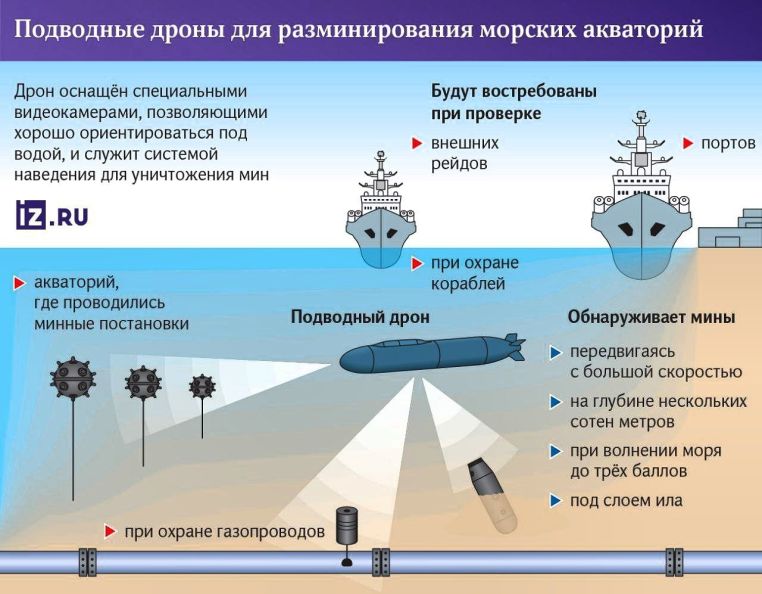
The underwater drone relies on high-resolution video cameras that maintain image clarity even at high speeds, distinguishing it from conventional mine detection systems. Traditional sonar-based methods struggle with visual fidelity, especially in murky or sediment-heavy waters. Advanced image processing software ensures real-time target recognition, allowing rapid identification of mines even under layers of silt.
Designed for deep-water operations, the drone operates at depths of several hundred meters. Many naval mines sit at varying depths, from near-surface tethered devices to deep-water influence mines. The drone offers an effective reconnaissance tool in hostile environments by moving swiftly and maintaining stability even in rough sea conditions (up to sea state three).
Operational Capabilities
Mine clearance remains a critical function for any navy, particularly in regions where adversaries deploy asymmetric warfare tactics. The infographic highlights the drone’s primary areas of operation:
Harbor and Port Security – Ensuring safe passage for commercial and military vessels by detecting mines in strategic waterways.
Escort for Naval Vessels – Screening routes ahead of warships or supply convoys, reducing the risk of mine-related threats.
Pipeline and Infrastructure Protection – Securing underwater gas and oil pipelines against sabotage or mining operations.
Post-Mine Deployment Surveys – Conducting clearance operations in areas where adversaries have previously laid mines.
The ability to detect explosives hidden under seabed sediment indicates a sophisticated sensor suite. Traditional sonar often struggles with bottom-buried mines, but advanced imaging and AI-powered classification improve detection rates. Russian developments in artificial intelligence likely contribute to the system’s capability to differentiate mines from underwater debris, minimizing false positives.
Strategic Context and Military Application
Russia has prioritized naval drone technology as part of its asymmetric maritime warfare doctrine. The deployment of underwater drones reduces reliance on manned mine countermeasure (MCM) vessels, which are expensive and vulnerable to attack. The drone’s capability to operate in contested waters without direct human involvement fits naval trends emphasizing unmanned systems.
Similar technology has seen rapid development in Western militaries. The U.S. Navy employs the Mk 18 Mod 2 Kingfish for mine detection, while European counterparts use the Saab Sea Wasp and Atlas Elektronik’s SeaFox for mine neutralization. Russia’s investment in indigenous mine clearance drones suggests a strategic push to counter NATO naval superiority, particularly in the Black Sea, Baltic, and Arctic regions.
Potential Weaknesses and Limitations
While the drone offers significant advantages, certain limitations exist. Autonomous systems remain vulnerable to electronic warfare and GPS jamming, both of which adversaries use to disrupt operations. Russia has advanced electronic countermeasures, but adversarial nations have also developed methods to interfere with autonomous naval systems.
The infographic does not specify whether the drone carries onboard explosive neutralization charges or merely relays mine locations to external disposal teams. If it lacks autonomous destruction capabilities, response times might increase, potentially allowing adversaries to relocate or reactivate mines before neutralization.
Another consideration involves endurance and battery life. Underwater drones require substantial energy reserves for prolonged missions, and operational range depends on recharge cycles. If the system lacks a robust power source, its effectiveness diminishes in large-scale clearance operations.
Future Developments
Rostec’s involvement suggests continuous improvement in underwater drone technology. Future upgrades may include:
Extended operational depth – Enhancing capabilities to counter deep-sea threats.
Integrated AI-driven target identification – Improving efficiency in distinguishing mines from non-threatening objects.
Swarm deployment – Coordinated drone fleets for broader minefield clearance.
Enhanced electronic counter-countermeasures (ECCM) – Strengthening resistance against jamming and hacking.
Russia’s strategic reliance on naval drones will likely expand beyond mine clearance. Underwater autonomous systems hold potential for intelligence gathering, anti-submarine warfare, and underwater sabotage operations.
The underwater drone technology designed for naval mine clearance possesses attributes that make it adaptable for underwater sabotage, specifically targeting submarine cables. Hybrid warfare involves infrastructure disruption, and undersea cables, which carry the bulk of global internet and communication traffic, represent prime targets. Russia has invested in undersea warfare capabilities, and the adaptation of mine-hunting drones for offensive cable attacks aligns with broader strategic interests.
Technical Methods for Cable Disruption
The drone’s ability to operate at depths of several hundred meters while maintaining stability under rough sea conditions allows it to navigate towards subsea cables undetected. Many submarine cables lie at depths ranging from 200 to 8,000 meters, with critical chokepoints near continental shelves. The drone’s high-speed movement, coupled with advanced imaging technology, enables precise positioning near a target cable without requiring external navigation inputs, reducing exposure to tracking systems.
The high-resolution video system, designed to detect mines under layers of silt, can be used to locate and differentiate fiber-optic and power cables from natural seabed formations. AI-powered classification algorithms, already embedded in mine-detection drones, ensure the system can identify the correct target among multiple underwater structures.
The drone could employ multiple methods to damage or disable undersea cables:
Attaching limpet mines or specialized shaped charges to the cable structure allows remote detonation, severing the connection.
A delayed fuse or remotely triggered explosive minimizes attribution risks, allowing the attacker to disengage before detection.
A high-torque cutting arm or plasma cutter could slice through fiber-optic and power cables without requiring explosives.
The cutter method is quieter and reduces the likelihood of immediate detection by cable-monitoring systems.
If equipped with electronic warfare capabilities, the drone could disrupt data transmission by emitting interference signals or injecting malicious code into data relays.
Rather than destroying the cable outright, the drone could displace sediment to bury a severed section, complicating repair operations. Disguising the sabotage as a natural seabed shift would delay detection and response times.
Russia has historically engaged in undersea warfare through assets such as the Losharik submarine and the Yantar intelligence vessel, both of which specialize in deep-sea cable operations. Adapting autonomous drones for this purpose offers several strategic advantages.
Unlike submarines, autonomous drones leave fewer electronic and acoustic signatures, making attribution difficult. Even if detected, distinguishing an unmanned drone from natural underwater objects poses challenges.
The majority of global undersea cables are owned by Western firms, making them attractive targets in a geopolitical conflict. Disrupting cables in the Atlantic, Pacific, or Mediterranean would impact financial transactions, military communications, and internet traffic.
Even limited attacks on undersea cables would create widespread panic in global markets. The cost of cable repairs is substantial, and delays in restoration create further economic instability.
Drone-based sabotage operations could complement broader hybrid warfare efforts. Coordinated cyberattacks on terrestrial network infrastructure alongside physical disruption of undersea cables would amplify the impact.
NATO and Western allies have increased surveillance on undersea assets, but countering autonomous underwater drones presents challenges. Effective defense strategies involve
deploying autonomous sensor networks capable of detecting unusual activity near critical infrastructure.
Using machine learning algorithms to detect anomalies in cable activity, identifying disruptions before they escalate.
Expanding alternative data transmission routes, including low-Earth orbit satellite networks, to mitigate reliance on vulnerable cables.
Underwater drones originally designed for mine clearance can be repurposed for sabotage operations against undersea cables. Their deep-water navigation, precision imaging, and payload adaptability allow for various attack methods, from explosives to mechanical cutting. Russia’s emphasis on hybrid warfare and infrastructure disruption suggests a high likelihood of future undersea cable targeting. Countering threats requires advanced monitoring and rapid response capabilities to secure global communication networks against emerging underwater threats.

You must be logged in to post a comment.