


Israeli intelligence agencies, specifically the Institute for Intelligence and Special Operations (Mossad) and Military Intelligence Directorate Unit 8200.
The evolution of recruitment, combat preparation, deep cover infiltration, and cyber-kinetic warfare integration.
Intelligence operations fundamentally restructure regional power dynamics and redefine deterrence mechanisms in the Middle East.
Recent shifts in Iranian nuclear capabilities, post-October 2023 conflict realities, and the 2024–2026 military campaigns demand new strategic frameworks.
Operations have severely degraded the adversary’s command structures, disrupted supply chains, and inflicted extensive physical damage on nuclear facilities.
Intelligence agencies will likely integrate autonomous drone networks with human intelligence assets to maintain operational superiority.
Intro
Intelligence operations dictate the survival of nations operating in hostile environments. The Middle East presents an unforgiving theater where strategic errors result in existential threats. Israeli intelligence agencies have historically relied on a blend of human ingenuity, extreme psychological endurance, and advanced technological capabilities to defeat adversaries. Recent events demonstrate an accelerated convergence of human espionage and electronic warfare. On September 17, 2024, thousands of communication devices detonated simultaneously across Lebanon. The blasts killed dozens and wounded thousands, throwing adversary command networks into chaos. Less than a year later, Operation Rising Lion combined autonomous drones with fifth-generation fighter jets to strike deeply into Iranian territory.
Such operations require years of meticulous preparation. Operatives must master languages, internalize false identities, and survive grueling physical assessments before deploying to hostile capitals. The preparation happens in total secrecy. The training academy, known as the Midrasha, transforms ordinary citizens into elite operatives capable of functioning independently in enemy territory.
The following report examines the lifecycle of Israeli intelligence operations. The analysis explores recruitment strategies, physical training, identity transformation, and technological warfare. Verified facts separate genuine capabilities from adversary claims, providing a comprehensive assessment of modern espionage.
Organizational Architecture and Mission Scope
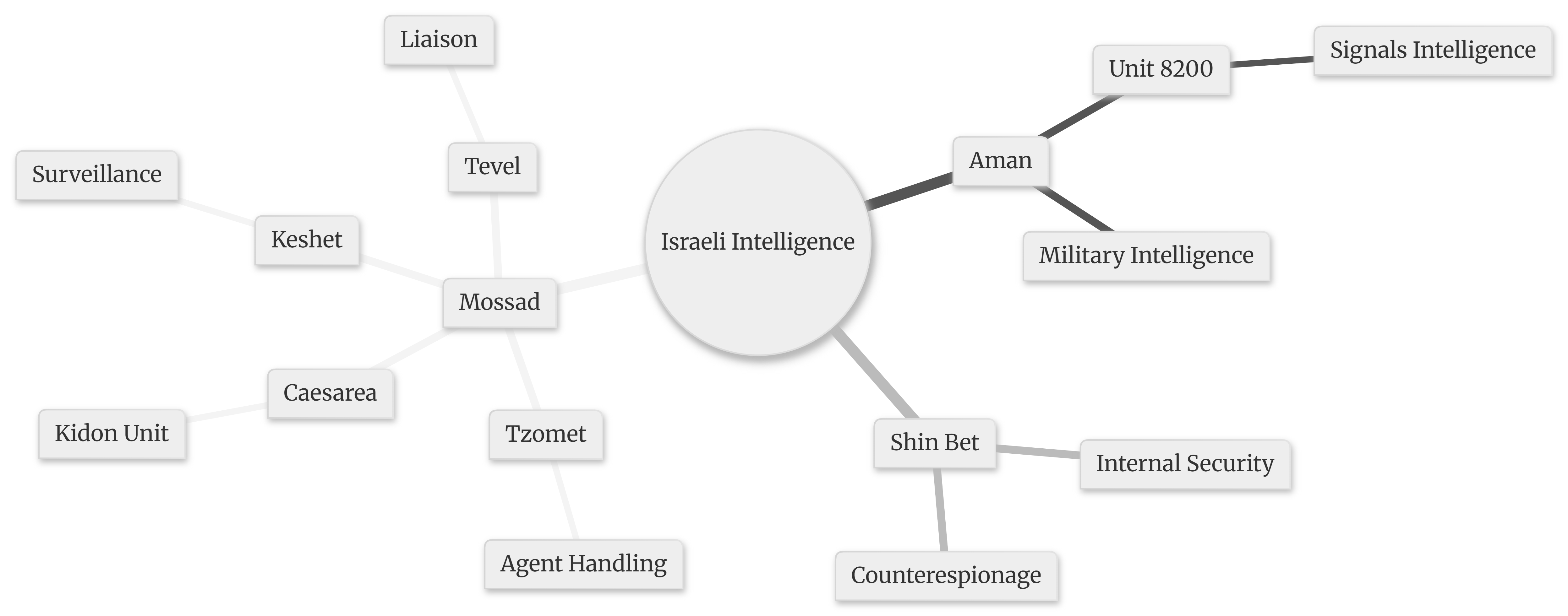
The Israeli intelligence community operates through three primary organizations. The strict division of labor ensures absolute specialization while fostering aggressive inter-agency competition.
Aman provides military intelligence, handles signals intelligence, and conducts tactical field operations. Shin Bet oversees internal security and counterespionage within Israeli borders. Mossad handles external operations, overseas espionage, and counterterrorism beyond Israeli territory.
Mossad divides its operational responsibilities among several specialized departments. The organization employs approximately 7,000 individuals and commands an annual budget approaching 2.73 billion US dollars. Directors answer directly to the Prime Minister. Unpaid Jewish civilians, known as Sayanim, provide crucial logistical support for covert actions abroad. They rent vehicles, secure safe houses, and blend seamlessly into local populations.
The Tzomet division functions as the largest department. Case officers within Tzomet recruit and manage foreign agents worldwide. The Caesarea division conducts special operations and houses the Kidon unit. Kidon operatives execute targeted eliminations and direct action missions. The Keshet division executes electronic surveillance, facility break-ins, and wiretapping.
The Political Action and Liaison Department maintains relationships with foreign intelligence services. Officers in the department require exceptional diplomatic capabilities. The Research Department analyzes intelligence, produces assessments for national leadership, and supports operational planning. The Technology Department supplies covert communications equipment and forged documents.
| Department Name | Primary Function | Operational Focus |
| Tzomet | Human Intelligence | Agent recruitment and handling in foreign nations. |
| Caesarea | Special Operations | Deep cover missions and direct action. |
| Kidon | Targeted Elimination | Precision assassinations and high-risk captures. |
| Keshet | Covert Surveillance | Wiretapping, tracking, and physical facility infiltration. |
| Tevel | Political Liaison | Coordination with allied foreign intelligence agencies. |
| Technology | Equipment Fabrication | Creating forged documents and secure communication tools. |
Recruitment Dynamics and Vulnerability Exploitation
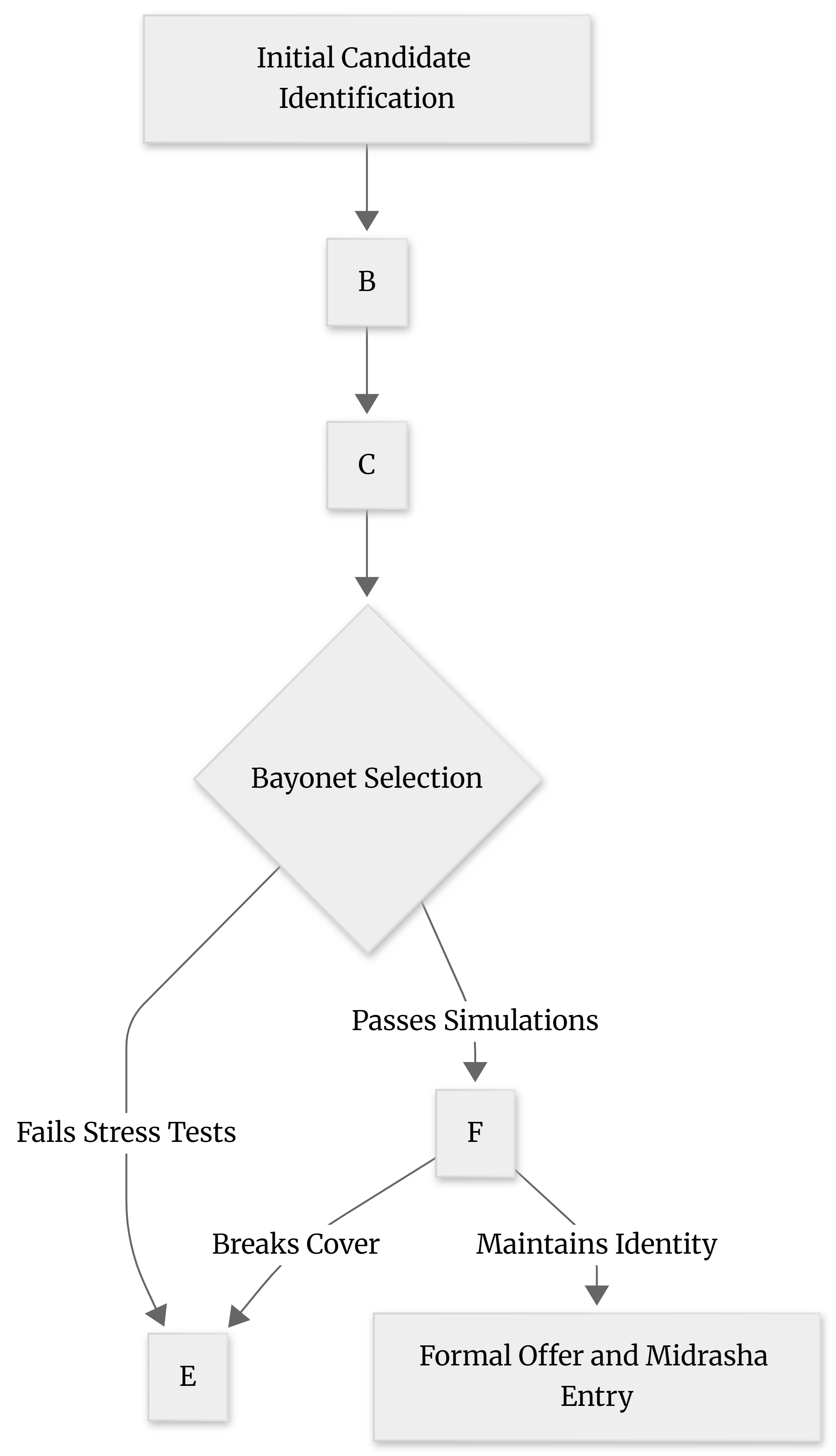
Legendary operational success begins with recruitment. The organization identifies individuals possessing rare combinations of linguistic aptitude, psychological resilience, and cultural adaptability. The recruitment pipeline filters thousands of applicants to find a handful of exceptional candidates.
The Bayonet Selection Process
Candidates undergo an intensive assessment known as the Bayonet selection. The phase tests recruits through realistic simulations rather than traditional classroom examinations. Assessors evaluate candidates in small cohorts of five to ten individuals.
The assessment prioritizes linguistic naturalism over academic study. The organization highly values candidates who learn languages quickly and reproduce accents flawlessly. Psychological resilience proves equally essential. Evaluators deliberately induce extreme stress to observe emotional equilibrium. Individuals lacking psychological stability fail operationally, regardless of their intellectual brilliance.
Assessors interview the recruits’ parents and close family members. The family must accept that their child will operate in enemy territory for years with minimal contact. Relatives must commit to lifelong secrecy about the candidate’s true employment.
Recruiting Foreign Nationals
Strategic shifts occurred roughly 15 years ago regarding operations inside Iran. Planners recognized that relying exclusively on Israeli operatives created unacceptable risks. The growing unpopularity of the Iranian regime provided a fertile environment for recruiting local dissidents.
Medical care functions as a highly effective recruitment tool. The agency maintains covert links with doctors and clinics across numerous countries. Recruiters establish websites offering assistance to Iranians suffering from life-threatening illnesses. Vulnerable individuals contact the numbers provided on the social media posts. Handlers arrange specialized medical treatment in third-party countries. The agency pays the medical bills discreetly.
Educational incentives also attract valuable assets. Recruiters offer academic placements in Western universities for candidates or their teenage children. Cash payments provide additional motivation. Handlers instruct recruits on precise methods for depositing funds to avoid raising suspicion.
The screening process for foreign assets is extremely rigorous. Handlers arrange initial meetings in accessible locations like Turkey, Armenia, or Thailand. Candidates undergo extensive psychological evaluations. Psychologists frequently observe subjects through one-way mirrors. Polygraph examinations verify loyalty continuously. Every subsequent action performed by the agent triggers another lie detector test to ensure operational integrity.
Handlers become surrogate family members for the recruits. They extract deeply personal secrets, including intimate details of relationships, to ensure the agent remains compliant. Instructors dictate minute lifestyle choices to the assets. They tell the recruits what clothes to wear and what cars to drive to avoid attracting the attention of local secret police.
The Midrasha Training and Survival Testing
Candidates who pass the Bayonet selection enter the Midrasha. The facility operates in an undisclosed location within the Negev Desert. Security measures include complete communications blackouts, roving patrols, and electronic perimeter defenses.
The training spans 12 to 15 months. The curriculum demands absolute dedication. Days begin at 5:00 AM with physical conditioning and routinely extend past midnight. Instructors intentionally deprive trainees of sleep to simulate realistic operational fatigue.
Physical conditioning focuses on solo endurance. Trainees run up to 15 kilometers before dawn. They swim long distances in freezing water while performing complex cognitive tasks. The Masada March requires recruits to hike 40 kilometers carrying 20-kilogram backpacks in under eight hours.
The 72-Hour Desert Survival Test
The signature foundation challenge tests every physical and mental limit. Instructors awaken trainees unexpectedly at two in the morning. Each recruit receives light clothing, a basic compass, a single liter of water, an emergency flare, and sealed coordinates.
The objective is to navigate 40 kilometers across the desert within 72 hours. The terrain presents extreme hazards. Dunes drain physical energy rapidly. Rocky wadis threaten severe ankle injuries. Daytime temperatures routinely exceed 40 degrees Celsius, while nighttime temperatures approach freezing.
Trainees must locate hidden water caches marked by subtle rock formations known as cairns. Missing a water point can lead to dangerous dehydration. The agency provides zero food. Trainees complete the entire exercise on a massive caloric deficit. Medical personnel shadow the candidates invisibly, intervening strictly when core temperatures reach lethal levels or when a recruit activates the emergency flare.
Those who survive the test emerge with profound confidence. Surviving the desert proves that the operative possesses the capacity to endure extreme isolation and physical misery without surrendering. Instructors debrief the survivors extensively, analyzing every navigational decision and physiological response.
Identity Transformation and Deep Cover Immersion
Operating in hostile territory requires perfect linguistic camouflage. The training transforms Jewish Israelis into convincing Arabs or Iranians. The process demands thousands of hours of immersive study.
Modern Standard Arabic provides the grammatical foundation. True fluency requires mastery of specific regional dialects. Levantine Arabic supports operations in Syria and Lebanon. Iraqi Arabic enables missions targeting proxy militias. Persian language training has expanded significantly to support Iranian operations.
The Arab Village Assessment
Language fluency means nothing without cultural authenticity. The Midrasha houses a detailed urban mockup known as the Arab Village. The facility features narrow streets, mosques, cafes, and markets. Authentic Arabic architecture and exclusive Arabic signage create total immersion.
Trainees enter the village and surrender all personal effects connecting them to their true identities. They receive completely fabricated backgrounds, forged documentation, and appropriate financial resources. For several weeks, they live exclusively as Iraqi merchants, Syrian students, or Palestinian businessmen.
The psychological toll crushes many recruits. Jewish trainees must perform Islamic prayers authentically. They memorize Quranic verses and master the physical movements of Sunni or Shia prayer rituals. They observe fasts during Ramadan. Instructors acting as residents continuously probe their knowledge. Counterintelligence role-players conduct sudden interrogations, demanding flawless explanations in the target dialect.
The exercise induces deliberate cognitive dissonance. Trainees inhabit identities representing historical enemies. Assessors watch for automatic responses. If a trainee starts and reacts in Hebrew, they fail. Success requires internalizing the false identity so deeply that the performance becomes an unconscious reality. Psychologists provide mandatory counseling after the exercise to help the operatives reconstruct their original personalities.
| Assessment Phase | Primary Objective | Psychological Challenge | Consequence of Failure |
| Linguistic Fluency | Master regional dialects and idioms. | Overcoming native accent constraints. | Immediate detection by locals. |
| Cultural Integration | Adopt local customs, etiquette, and mannerisms. | Suppressing natural behavioral instincts. | Arousal of suspicion among peers. |
| Religious Practice | Perform Islamic rituals authentically. | Managing extreme cognitive dissonance. | Exposure to religious authorities. |
| Hostile Interrogation | Defend the legend under severe pressure. | Maintaining emotional equilibrium. | Simulated arrest and program dismissal. |
Close-Quarters Combat and Survival Tactics
When intelligence operations fail, survival depends on immediate violence. Instructors teach Krav Maga adapted explicitly for espionage. The system ignores sporting rules and focuses entirely on neutralizing threats rapidly.
Operatives learn to strike vulnerable anatomical targets, including the eyes, throat, and groin. The training emphasizes simultaneous defense and attack. If an opponent throws a punch, the operative deflects the blow while simultaneously delivering a devastating counter-strike.
Confined space combat receives heavy emphasis. Operations frequently place agents in vehicles, narrow hallways, or small apartments. Traditional martial arts require space to generate power. Krav Maga teaches elbow strikes and close-range knee thrusts effective in tight environments.
Weapon retention and disarming form crucial components of the curriculum. Operatives often work unarmed to maintain their cover identities. If confronted by armed security personnel, they must understand how to strip pistols and knives from attackers. Instructors acknowledge that knife defense inevitably results in lacerations. Trainees learn to accept cuts to non-vital areas while protecting their arteries and organs.
Stress inoculation ensures techniques remain effective under adrenaline. The final gauntlet exercise forces trainees to fight multiple armed opponents consecutively with minimal rest. Instructors shout constantly and introduce unexpected weapons mid-fight. Extreme physical exhaustion tests whether the operative possesses the psychological capacity to fight for their life.
Targeted Eliminations and Direct Action Operations
Assassination operations remove specific individuals assessed as direct threats to national security. Planners target terrorist operatives, hostile military commanders, and enemy weapons scientists. The operations require extraordinary precision to prevent civilian casualties and maintain operational deniability.
The legal and ethical frameworks surrounding assassinations generate intense international debate. Defenders argue that preemptive strikes neutralize terrorists planning mass casualty events. Critics, including human rights organizations like B’Tselem, argue that the operations frequently harm innocent bystanders. Verified facts confirm that airstrikes in densely populated urban environments are highly likely to cause unintended collateral damage.
Elimination Methodologies
Operatives employ various methods depending on the target environment. Each technique demands specialized equipment and rigorous preparation.
Vehicle-borne explosives represent a highly favored tactic. Agents attach magnetic devices to the undercarriage of target vehicles. Remote detonation ensures the target occupies the vehicle during the blast. Operatives train extensively on covert vehicle approach and device placement. They learn to bypass locking mechanisms and attach explosives in seconds.
Precision marksmanship eliminates targets from a distance. Snipers engage targets from concealed positions at extended ranges. The tactic minimizes operative exposure but requires clear lines of sight. Trainees practice shooting from improvised urban platforms rather than ideal sniper hides.
Poisoning provides a silent elimination option. Chemical or biological agents infect targets through contaminated food or surfaces. The method requires intimate physical proximity, drastically increasing the risk of capture. Modern forensic analysis frequently detects toxins, rendering any plausible deniability moot.
Close-quarters elimination forces operatives to use suppressed firearms or manual strangulation. Agents use the tactic strictly when distance weapons prove impractical. The approach demands extreme psychological composure. Operatives must execute the target quietly and escape the immediate vicinity before security forces respond.
| Execution Method | Primary Advantage | Operational Vulnerability | Typical Target Profile |
| Vehicle Explosives | Remote detonation guarantees target proximity. | High risk of collateral damage to bystanders. | Military commanders in transit. |
| Precision Sniping | Keeps the operative far from immediate retaliation. | Requires unobstructed urban lines of sight. | High-visibility political figures. |
| Chemical Poisoning | A delayed reaction allows the operative to escape. | Requires extreme physical proximity to the target. | Insulated weapons scientists. |
| Close-Quarters | Guarantees visual confirmation of death. | Extreme risk of capture or physical struggle. | Isolated operatives in safe houses. |
Technical Espionage and Unit 8200 Operations
Human intelligence works synergistically with network exploitation. Unit 8200 serves as the primary signals intelligence and computer warfare organization. The unit collects roughly 90 percent of the intelligence material processed nationwide.
Field operatives deploy IMSI catchers near enemy compounds. The devices pretend to be legitimate cell towers. Enemy phones connect automatically, allowing agents to intercept calls instantly. The devices fit easily into standard backpacks, enabling mobile interception during fluid tactical situations.
Audio and video surveillance equipment relies on extreme miniaturization. Operatives conceal cameras inside smoke detectors, clocks, and electrical adapters. Listening devices draw power from ambient radio frequency energy, functioning indefinitely without batteries. Technical teams infiltrate hostile offices at night, picking locks and bypassing sophisticated alarm systems to plant the hardware.
Cloud Surveillance and Leadership Shifts
Network exploitation demands aggressive innovation and vast data storage. Brigadier General Yossi Sariel commanded Unit 8200 during a highly scrutinized period of expansion. Sariel met with Microsoft executive Satya Nadella in 2021. The meeting secured access to a customized segment of the Azure cloud platform. The military built a massive surveillance system to store millions of intercepted Palestinian phone calls daily.
Sariel later published a book titled “The Human Machine Team” under the pseudonym “Brigadier General YS”. The publication explored the integration of artificial intelligence into military operations. A massive security failure occurred shortly after publication. The electronic version of the book contained a hidden email address linking directly to his private Google account. The exposure damaged his credibility severely.
Following the severe intelligence failures of October 2023, pressure mounted rapidly on the intelligence hierarchy. Sariel initially resisted stepping down, calling the prospect an act of cowardice. However, public outrage intensified. Sariel resigned his command in September 2024. He acknowledged his failure to fulfill his mission expectations on the morning of the October attacks. Brigadier General “A”, an officer unassociated with the October intelligence lapses, assumed control of the elite unit shortly after the resignation.
Supply Chain Infiltration and the 2024 Communications Network Operation
The intelligence apparatus launched a historic strike in September 2024. Planners targeted the Hezbollah communication supply chain directly. The militant organization abandoned cellular phones to evade GPS tracking. They purchased pagers and walkie-talkies instead. The agency anticipated the shift and initiated a brilliant interception strategy.
Operatives established fake distribution companies across Europe. The front organizations positioned themselves as legitimate electronics vendors. They intercepted shipments from Taiwanese manufacturers such as Gold Apollo. The front companies sold over 16,000 compromised devices to the adversary.
Technical specialists manufactured heavily modified batteries inside secret facilities. They packed the power cells with highly volatile explosives and flammable liquids. The modifications evaded all standard airport security screening protocols. The manufacturing process required immense physical space. Agency directors converted their own physical fitness gymnasiums into assembly lines to meet rapid production demands. Handlers lured a specific operative into a trap to prevent him from prematurely exposing the compromised devices.
On September 17 and 18, 2024, communication devices exploded across Lebanon. Handlers transmitted a specific alphanumeric signal to the network. The signal detonated the explosive batteries simultaneously. The blasts killed 42 individuals instantly. The explosions injured approximately 4,000 people. Medical personnel reported severe facial lacerations and amputated hands. Lebanese hospitals struggled to process the sheer volume of traumatic injuries.
The strike removed 1,500 fighters from active combat duty immediately. Hostile sources complained about indiscriminate targeting. Verified facts confirm the devices belonged strictly to military personnel. The detonations occurred in public spaces, causing tragic collateral damage. Two children died during the explosions.
The psychological shock paralyzed the adversary completely. Militant commanders abandoned electronic communications entirely. The Lebanese Civil Aviation Authority banned all pagers and walkie-talkies from commercial flights at the Beirut airport. Major international airlines suspended flights to the region due to the security chaos.
Strategic Air Campaigns: Operation Rising Lion (2025)
The conflict escalated rapidly as Iran expanded its nuclear infrastructure. The Israeli military launched Operation Rising Lion on June 13, 2025. The 12-day campaign integrated autonomous drones with fifth-generation aircraft. The mission demonstrated unprecedented operational complexity and marked the most ambitious air offensive in Israeli history.
Act One commenced just after midnight. Covert human assets penetrated hostile borders months in advance. The operatives smuggled loitering munitions across porous borders. They established hidden drone bases near heavily defended targets. The agents deployed Rafael Spike Non-Line-Of-Sight missiles from concealed positions.
Ground operatives activated concealed launch systems deep inside hostile territory. Pre-positioned loitering munitions flew directly toward heavily fortified radar installations. The drones struck the targets simultaneously. The coordinated cyber-kinetic attacks completely neutralized the early-warning networks. The destruction opened a safe corridor for conventional strike aircraft. Squadrons of stealth fighter jets entered the newly cleared airspace without detection.
Act Two followed immediately. Over 200 Israeli fighter jets crossed into Iranian airspace. The fleet included F-35 Adir fighter jets. The pilots operated the aircraft in “Beast Mode”. The configuration requires carrying heavy ordnance on external wing pylons. The external weapons erode stealth characteristics but maximize destructive payload capacity. The aircraft carried Joint Direct Attack Munitions and Rafael one-ton bombs. Rampage missiles provided long-range standoff capabilities.
The fighter jets struck over 100 separate facilities. Bunker-busting munitions collapsed the underground enrichment halls at Natanz. The strikes destroyed electrical rooms and massive centrifuge arrays. The operation killed six senior nuclear scientists. The casualties included Mohammad Mehdi Tehranchi and Fereydoun Abbasi. Tehranchi directed the Islamic Azad University. Abbasi held a doctorate in nuclear physics and previously survived a 2010 assassination attempt.
The bombardment eliminated Mohammad Bagheri, the highest-ranking military official in the hostile nation. The tactical surprise achieved absolute success. The rapid destruction paralyzed Iranian decision-making. The citizens had not experienced such extensive aerial bombardment since the conclusion of the 1988 war.
Strategic Air Campaigns: Operation Roaring Lion (2026)
Hostilities resumed in early 2026. Operation Roaring Lion marked the largest Middle Eastern conflict since 2003. United States forces joined the Israeli coalition directly. The campaign inflicted massive tactical damage but failed to alter the strategic balance completely.
Adversary forces demonstrated alarming resilience. Iranian leaders decentralized their command structure to survive the decapitation strikes. They named Mojtaba Khamenei as Supreme Leader, preventing a catastrophic power vacuum. Engineers accelerated the construction of the Pickaxe Mountain facility. The deep-underground bunker protects sensitive nuclear materials from conventional airstrikes. They successfully rehabilitated the Fordow enrichment site.
The enemy significantly expanded its weapons manufacturing. Factories produced 125 ballistic missiles every month. The national stockpile grew from 1,500 to 2,500 missiles between the two military campaigns. Iran doubled the financial budget for Hezbollah to accelerate proxy recovery. Militant ground forces established a “Yellow Line” in southern Lebanon, exposing Israeli troops to continuous danger.
The military action successfully delayed the nuclear breakout timeline. Analysts assess it is highly likely that the air campaign pushed back the acquisition of weapons-grade fissile material by roughly six months. The failure to eliminate the core nuclear project highlights the limitations of aerial bombardment against subterranean fortresses. The closure of the Strait of Hormuz granted Iran immense global leverage, forcing the United States to prioritize energy security over military escalation.
Information Warfare and Psychological Operations
Information warfare degrades enemy effectiveness without firing a single weapon. Deception operations manipulate adversary perceptions, causing them to allocate resources inefficiently. Israeli doctrine emphasizes deception as an essential force multiplier.
Operatives conduct false flag missions routinely. They execute actions designed to appear as if rival militant factions carried them out. Agents leave specific forensic evidence suggesting a third-party nation orchestrated an attack. The fabricated clues ignite internal conflicts among hostile factions and prevent direct retaliation against Israel.
Notional organizations provide essential cover for clandestine activities. Front companies generate legitimate revenue while facilitating covert espionage. Setting up fake entities requires extensive patience. Handlers register the businesses, hire legitimate employees, and maintain realistic corporate websites.
Misdirection involves feeding accurate intelligence to enemy sources for years. The truthful information builds absolute trust. Once the adversary relies entirely on the source, operatives feed them a single, devastating lie. False data often shapes enemy troop deployments in Israel’s favor.
Psychological operations target organizational morale directly. Targeted eliminations remove capable commanders, yet the secondary effect proves equally valuable. Surviving leaders become terrified of exposure. They limit their communications, restrict their movements, and suspect their closest advisors of treason. The resulting paranoia drastically degrades the organization’s combat effectiveness.
Leadership Transitions and Strategic Outlook
Intense warfare requires aggressive intelligence leadership. David Barnea directed the Mossad through the most turbulent period in its modern history. Barnea publicly praised his operatives for penetrating the very core of enemy secrets. He oversaw the Hezbollah pager detonations and the intelligence gathering required for Rising Lion.
His term concludes in June 2026. The Senior Appointments Advisory Committee approved Major General Roman Gofman to succeed him. Gofman assumes command on July 2, 2026. High court petitions initially challenged the appointment, but judges dismissed the complaints after reviewing classified operational details.
Gofman inherits an agency navigating unprecedented technological shifts. Strategic foresight analysis indicates a highly likely integration of artificial intelligence into all operational planning. Machine learning algorithms will process massive data volumes, identifying patterns human analysts inevitably miss.
Quantum computing threatens current encryption models. Intelligence services recognize that future quantum machines will break the algorithms securing classified communications. The agency invests heavily in post-quantum cryptography to protect its networks. Autonomous systems will eventually replace human operatives in highly contested environments. Drone swarms will execute sabotage missions previously requiring human infiltrators.
Wrap Up
Israeli intelligence operations have evolved from rudimentary underground resistance efforts into the most sophisticated espionage apparatus on the globe. The training methodologies push human endurance beyond ordinary limits, ensuring operatives possess the psychological resilience to survive in actively hostile nations. The grueling desert tests and the immersive identity transformations forge agents capable of functioning flawlessly under extreme pressure.
Recent campaigns demonstrate a fundamental shift in military doctrine. The integration of cyber warfare, autonomous drone swarms, and precise human intelligence allows planners to dismantle heavily fortified adversary networks. Operations like Hezbollah’s pager detonations and the Rising Lion air offensive demonstrate that technological superiority significantly multiplies the effectiveness of covert assets.
Adversaries continually adapt to Israeli tactics. Hostile regimes bury nuclear facilities deeper underground and decentralize their command structures. Intelligence agencies must perpetually innovate to maintain their strategic edge. Despite rapid technological advancements, human judgment remains irreplaceable. Artificial intelligence lacks the capacity to assess the moral weight of a targeted elimination. Algorithms cannot build the profound emotional trust required to recruit an angry dissident. The survival of the nation depends on operatives who willingly bear the immense psychological and moral burdens required to execute these missions in the shadows.
Works cited
- Mossad Chief Unveils New Details on Israel’s Pager Attack in Lebanon, https://www.mtv.com.lb/news/1551869 2. Ungentlemanly Robots: Israel’s Operation Rising Lion and the New …, https://www.csis.org/analysis/ungentlemanly-robots-israels-operation-rising-lion-and-new-way-war 3. Mossad – Wikipedia, https://en.wikipedia.org/wiki/Mossad 4. Israel Secretly Recruited Iranian Dissidents to Attack Iran From …, https://www.propublica.org/article/israel-iran-war-mossad-iranian-recruits 5. Israel’s Policy of Targeted Killing – Center for Ethics and the Rule of Law, https://www.penncerl.org/wp-content/uploads/2022/01/DavidIsraelPolicy.pdf 6. Operation ‘targeted killings’ – ICIJ, https://www.icij.org/investigations/collateraldamage/operation-targeted-killings/ 7. Unit 8200 – Wikipedia, https://en.wikipedia.org/wiki/Unit_8200 8. Israel’s National Cybersecurity and Cyberdefense Posture – CSS ETH Zürich, https://css.ethz.ch/content/dam/ethz/special-interest/gess/cis/center-for-securities-studies/pdfs/Cyber-Reports-2020-09-Israel.pdf 9. Head of Israeli spy agency Unit 8200 resigns over October 7 failings | Israel – The Guardian, https://www.theguardian.com/world/2024/sep/12/head-of-israeli-spy-agency-unit-8200-resigns-over-7-october-failings 10. ‘A million calls an hour’: Israel relying on Microsoft cloud for expansive surveillance of Palestinians – The Guardian, https://www.theguardian.com/world/2025/aug/06/microsoft-israeli-military-palestinian-phone-calls-cloud 11. Top Israeli spy chief exposes his true identity in online security lapse | Israel – The Guardian, https://www.theguardian.com/world/2024/apr/05/top-israeli-spy-chief-exposes-his-true-identity-in-online-security-lapse 12. ‘I did not fulfill my mission’: Commander of IDF’s 8200 intelligence unit resigns, https://www.timesofisrael.com/i-did-not-fulfill-my-mission-commander-of-idfs-8200-intelligence-unit-resigns/ 13. IDF Brig. Gen. ‘A’ takes command of elite Unit 8200 – Israel & Jewish News – JNS, https://www.jns.org/israel-news/idf-brig-gen-a-takes-command-of-elite-unit-8200 14. 2024 Lebanon electronic device attacks – Wikipedia, https://en.wikipedia.org/wiki/2024_Lebanon_electronic_device_attacks 15. Inside Israel’s secret operation to turn Hezbollah’s beepers into …, https://www.jpost.com/israel-news/defense-news/article-896890 16. Rising Lion’s Air Offensive: Part I – Foreign Policy Research Institute, https://www.fpri.org/article/2026/03/rising-lions-air-offensive-part-i/ 17. “Operation Roaring Lion”: Summary of the First Phase | INSS, https://www.inss.org.il/publication/roaring-lion-first-summary/ 18. Mossad Director David Barnea at the 2025 Commendation Ceremony – Gov.il, https://www.gov.il/en/pages/spoke-ceremony280426 19. David Barnea – Wikipedia, https://en.wikipedia.org/wiki/David_Barnea 20. Advisory Committee Approves Maj.-Gen. Roman Gofman as the Next Director of the Mossad, https://www.gov.il/en/pages/spoke-mosad120426 21. Attorney-General asks High Court to block Gofman appointment despite approval, https://www.jpost.com/israel-news/politics-and-diplomacy/article-897601

You must be logged in to post a comment.