


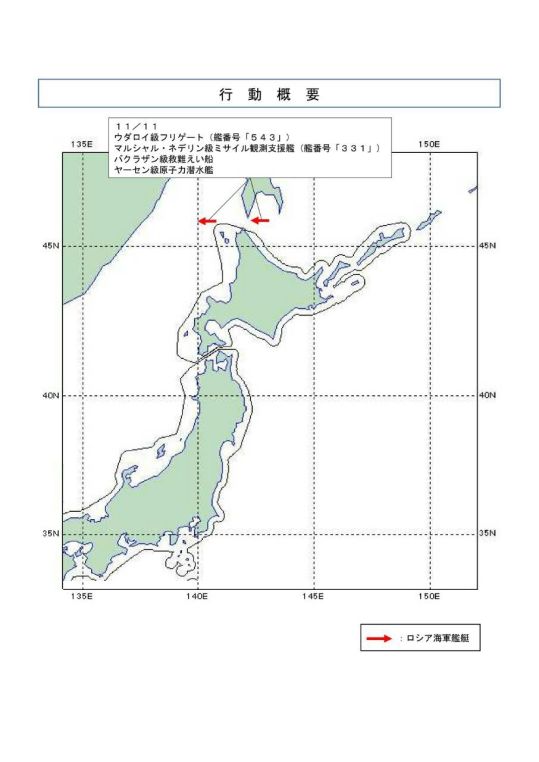
On November 11, 2024, a Russian naval group comprising the frigate Marshal Shaposhnikov (hull number 543) of Project 1155, the command and support vessel Marshal Krylov (hull number 331) of Project 19141, a Yasen-class nuclear-powered submarine cruiser of Project 885M, and the rescue tug Fotiy Krylov of Project R-5757 navigated westward through the La Perouse Strait into the Sea of Japan. This strategic movement was tracked and documented by the Japanese Maritime Self-Defense Force using P-3C Orion anti-submarine patrol aircraft, highlighting Japan’s heightened surveillance efforts in response to Russian naval activity near its territorial waters.
The Marshal Shaposhnikov, a Project 1155 Udaloy-class frigate, was originally designed for anti-submarine warfare. Recently, it has undergone extensive modernization to enhance its surface warfare capabilities, incorporating new missile systems such as Kalibr and Oniks. This upgrade reflects a broader Russian strategy aimed at maximizing the operational flexibility of existing naval assets amid a shipbuilding program constrained by budgetary and technological limitations. With these enhancements, the Marshal Shaposhnikov has transformed into a multi-role combat vessel capable of executing both anti-submarine and surface attack missions within the Pacific Fleet.
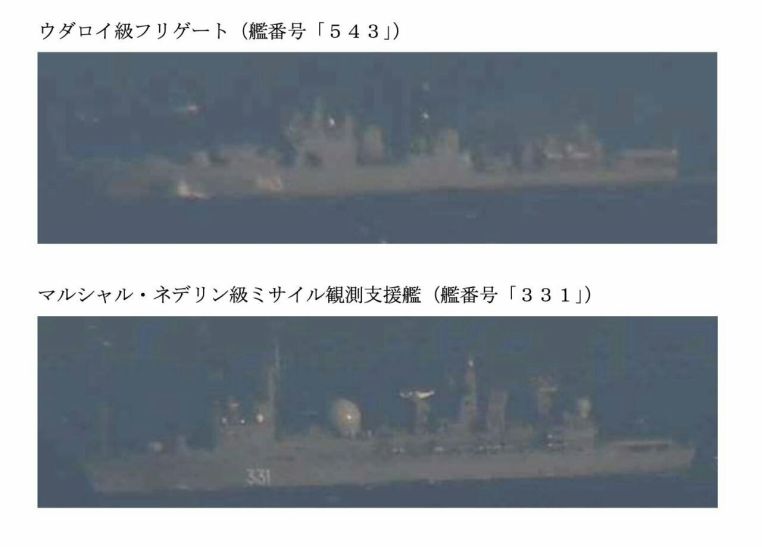
The Marshal Krylov, a Project 19141 command ship, functions primarily as a missile range instrumentation and support vessel. Its capabilities extend to missile testing support and long-range surveillance, serving as a crucial platform for coordinating naval movements and potentially conducting electronic intelligence (ELINT) or signals intelligence (SIGINT) activities. Its role within the formation suggests responsibility for operational coordination, particularly in environments where gathering intelligence on adversary defenses is critical. The presence of the Marshal Krylov points to a dual mission of command and surveillance, aligning with Russia’s need to gather intelligence in contested maritime regions.
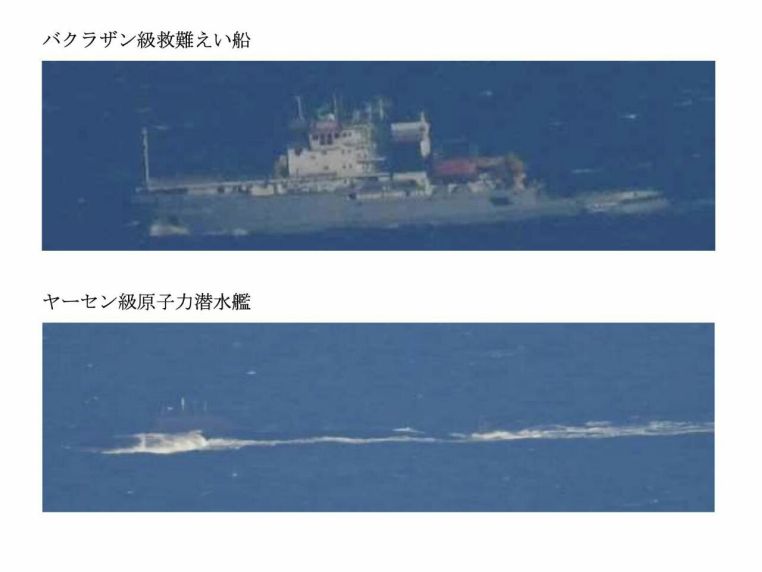
The Yasen-class submarine, part of Project 885M, represents one of Russia’s most advanced nuclear-powered cruise missile submarines, designed for stealth and long-range strike capabilities. Armed with Kalibr and P-800 Oniks missiles and potentially equipped with Zircon hypersonic missiles, this submarine poses a substantial threat within its operational theater. Its deployment in proximity to Japanese waters signals Russia’s intent to assert a strategic presence, emphasizing deterrence through high-value assets. The Yasen-class’s appearance in the region suggests that Russia is not only asserting its military reach but is also directly challenging regional defense postures, especially given the Japanese Maritime Self-Defense Force’s response to its detection.
The rescue tug Fotiy Krylov, part of Project R-5757, provides critical support to the formation, highlighting an operational risk mitigation approach due to the high-value nature of the assets in transit, particularly the nuclear-powered submarine. The inclusion of Fotiy Krylov ensures preparedness for recovery or support in case of mechanical issues or unforeseen incidents, demonstrating Russia’s awareness of both the operational and environmental challenges posed to its vessels in these waters.
The decision to navigate through the La Perouse Strait, which separates the Japanese island of Hokkaido and Russia’s Sakhalin Island, into the Sea of Japan illustrates Russia’s intent to display naval strength in close proximity to Japanese waters. Movements through this strait carry dual strategic implications: they facilitate routine operational positioning while simultaneously signaling to regional stakeholders. This route selection underscores an intent to operate within reach of Japan’s territories, serving as a reminder of Russia’s capability to project power in regions sensitive to both countries.
Japan’s response to this transit, marked by the deployment of P-3C Orion anti-submarine patrol aircraft, underscores the vigilance with which Japan monitors Russian military activities. The detection and tracking of the Yasen-class submarine, which marks the first time Japan has observed this particular model in its waters, likely underscores an increase in Russian submarine patrols in areas of strategic interest to Japan. The Yasen-class’s advanced stealth technology and cruise missile capabilities present a credible threat, capable of avoiding detection while executing potential long-range attacks, thus warranting a heightened response from Japan’s maritime defense.
Historically, the Marshal Shaposhnikov and Marshal Krylov navigated through the La Perouse Strait into the Sea of Okhotsk on September 25-26, 2024. This prior transit into the Sea of Okhotsk highlights a pattern of movement between strategically significant waters that border Japan. This route selection allows for rapid shifts between defensive and potentially offensive postures, particularly within the isolated strategic waters of the Sea of Okhotsk. The transit patterns suggest that Russia is maintaining a regular operational presence in areas bordering Japanese waters, likely as part of an overarching strategy to assert influence and operational readiness in the region.
The observed transit of this Russian formation on November 11, which includes high-value assets equipped with multi-dimensional warfare capabilities, signals Russia’s commitment to demonstrating its naval reach. The presence of diverse assets within this group, from surface vessels to advanced submarines and a support tug, indicates a cohesive strategy aimed at asserting military influence near Japan’s borders. Japan’s response, involving anti-submarine surveillance by advanced P-3C aircraft, demonstrates an awareness of the potential submarine threat presented by Russia’s Project 885M submarine. This dynamic may prompt Japan to further invest in its anti-submarine warfare capabilities and surface tracking systems to mitigate potential threats from Russian maritime activity, potentially fostering deeper security cooperation with allies, especially the United States, to counterbalance Russia’s influence in the region.


You must be logged in to post a comment.