


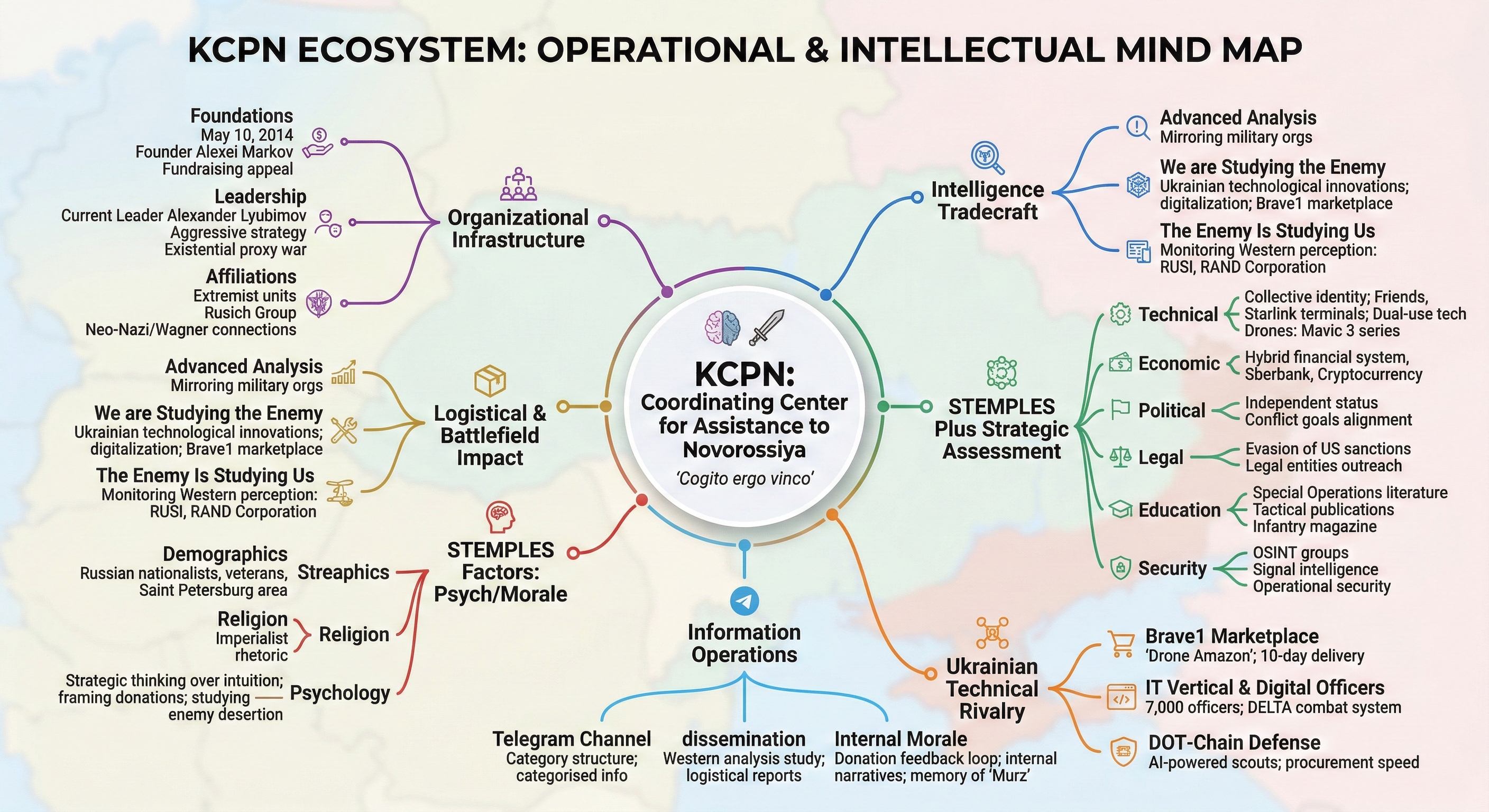
The Coordinating Center for Assistance to Novorossiya (KCPN) represents a sophisticated evolution in the landscape of paramilitary logistics and information warfare; it serves as a critical nexus between civilian crowdfunding and frontline military effectiveness. Analysis of the February 2026 monthly summary reveals a maturing intelligence cycle that mirrors professional military and intelligence organizations. The center identifies its core mission through the Latin motto Cogito ergo vinco, which suggests an institutional belief that intellectual dominance and strategic thinking directly translate into battlefield success.1 The organization utilizes its Telegram channel to disseminate highly categorized information; these categories include the study of Western analysis, enemy technological developments, internal logistical reports, educational literature, and thematic geopolitical articles. Such a structure allows the KCPN to serve not only as a physical supply chain but also as an intellectual hub for the Russian volunteer and paramilitary movement.
Organizational Infrastructure and Historical Context
The foundations of the Coordinating Center for Assistance to Novorossiya trace back to May 10 2014; the organization emerged following a viral fundraising appeal by its founder Alexei Markov during the initial separatist unrest in the Donbas region.2 Markov initially focused on supporting the Russian Volunteer Communist Detachment; however, the organization soon expanded its reach to support a wider array of paramilitary groups across the Donetsk and Luhansk People’s Republics. Alexander Lyubimov currently leads the center; he advocates for aggressive strategic measures, including the tactical use of nuclear weapons in the context of what he describes as an existential proxy war with Europe.2 Lyubimov’s leadership reflects a shift from localized separatist support to a broader civilizational struggle against Western interests.
The center maintains deep ties with extremist paramilitary units; for example, historical records link the organization to the Rusich Group, founded by Alexey Milchakov in 2009.3 Milchakov participated in the Partizan paramilitary training program run by the Russian Imperial Legion under the auspices of the KCPN.3 The Rusich Group identifies as a neo-Nazi and Pan-Slavic unit; its members utilize runes and imperial symbols while maintaining affiliation with the Wagner Group.3 These connections demonstrate that the KCPN operates as a foundational support structure for highly ideologically driven combat units. The organization bridges the gap between radical nationalist circles in Saint Petersburg and the active front lines in eastern Ukraine.
Intelligence Tradecraft and Information Operations
The KCPN demonstrates advanced intelligence tradecraft by systematically consuming Western and Ukrainian strategic data. The February 2026 digest specifically highlights a section titled “The Enemy Is Studying Us,” which monitors how organizations such as the Royal United Services Institute (RUSI) and the RAND Corporation perceive Russian tactics and military technologies.1 By tracking Western assessments of Russian aviation evolution and passive defense strategies, the KCPN enables its supporters to understand their own vulnerabilities through the eyes of the adversary.
A parallel section titled We Are Studying the Enemy focuses on translating and analyzing Ukrainian technological innovations and defense industry plans.1 The center pays close attention to the Ukrainian Ministry of Defense’s efforts to digitalize the armed forces. This category includes deep dives into the Brave1 military marketplace and the deployment of digital officers across the Ukrainian command structure.1 Such activities indicate a proactive effort to identify emerging threats before they reach full operational capacity. The organization transforms raw information from foreign media and think tanks into actionable intelligence for its readers and the combat units it supports.
Russian Briefs from Treadstone 71
STEMPLES Plus Strategic Assessment
The Treadstone 71 STEMPLES Plus framework provides a comprehensive lens to evaluate the KCPN’s strategic environment; this model assesses Social, Technical, Economic, Military, Political, Legal, Education, and Security factors alongside Demographics, Religion, and Psychology.6
Social Dimensions and Community Engagement
Socially, the KCPN fosters a sense of collective identity among its followers by addressing them as friends, comrades, and like-minded people.1 The organization leverages the Russian nationalist community’s desire to participate directly in the conflict. Monthly summaries serve as social proof of efficacy; these reports provide transparency regarding how donations translate into equipment transfers. The psychological impact of this engagement creates a resilient support network that bypasses traditional state bureaucracies. The demographic base of the center likely consists of Russian nationalists, veterans, and individuals from the Saint Petersburg area who resonate with imperialist rhetoric.
Technical Innovations and Digital Rivalry
The technical dimension of the KCPN’s work centers on the rapid acquisition and deployment of dual-use technologies. The February 2026 digest highlights the study of Starlink terminals and their integration into frontline communications.1 Analysts within the KCPN examine the paradox of using horses alongside Starlink, reflecting the disparate technological levels on the modern battlefield. The organization also monitors the Ukrainian Brave1Market platform, an AI-driven marketplace that allows Ukrainian soldiers to order drones and electronic warfare systems at the speed of a consumer e-commerce site.8
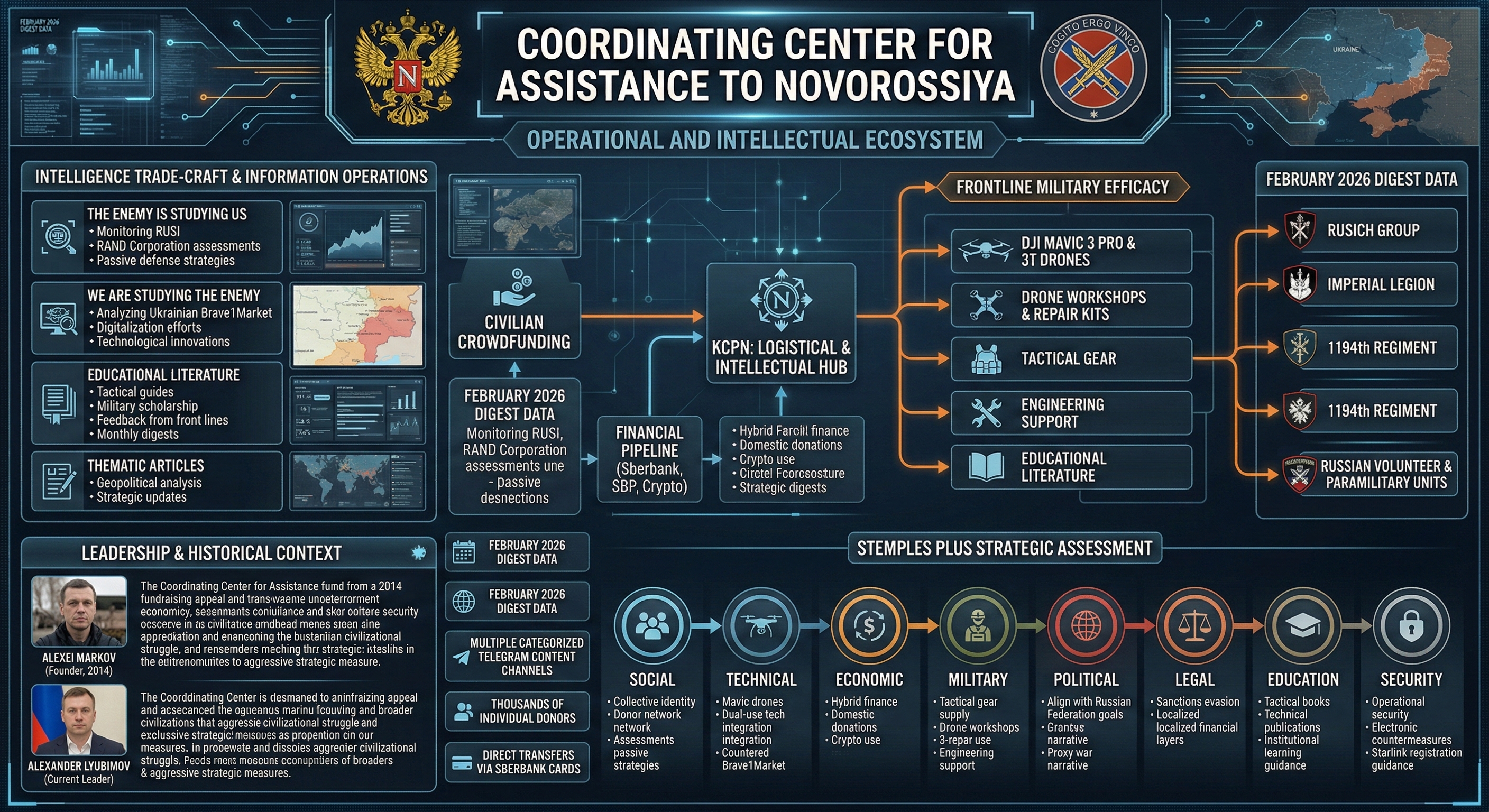
Ukraine’s launch of the DOT-Chain Defense mechanism and the Brave1Market represents a significant technical challenge to the KCPN’s mission. Mikhail Fedorov reported that the military ordered 240,000 drones through these platforms in six months.9 The KCPN counters this by providing its own specialized equipment; for instance, the center transferred DJI Mavic 3 Pro and Mavic 3T drones to various units, including the Imperial Legion and the 1194th Regiment.1 The organization also focuses on developing OSINT groups to monitor open-source data for target acquisition and operational security.
Project OMEGA – Prague – May 25-29
Economic Logistics and Financial Resilience
Economically, the KCPN utilizes a hybrid financial system to sustain its operations. The center accepts donations through Sberbank cards assigned to Maya Vladimirovna M. and facilitates transfers via the System of Fast Payments (SBP).1 The organization also maintains cryptocurrency wallets to bypass international banking restrictions and sanctions. This economic agility allows the KCPN to procure equipment from international markets while maintaining a steady flow of domestic funds. The outreach to legal entities via dedicated Telegram accounts suggests an attempt to formalize and scale their procurement processes within the Russian legal framework.
Ukrainian economic initiatives, such as the “eBalls” bonus system in the Brave1Market, provide another point of comparison. Ukrainian manufacturers receive real-time feedback on the effectiveness of their products; the state then pays for high-performing equipment to reach the front quickly.9 The KCPN mimics this responsiveness by publishing feedback from the military and adjusting its procurement based on combat requirements. The center’s financial model relies on the emotional and patriotic engagement of its donor base rather than on systematic state funding, as in the Ukrainian model.
Military Integration and Tactical Support
The military dimension involves the direct supply of tactical gear and the dissemination of specialized knowledge. The KCPN supports engineering-assault units and drone workshops with spare parts and specialized equipment.1 This support extends to the 1194th Regiment, which maintains its own workshop for drone repair and modification.1 The center also distributes educational literature like Andrey Markin’s book on Special Operations Forces; this literature provides a theoretical framework for small-unit tactics and the generalization of combat experience.1
The KCPN’s interest in the RAND report on rethinking passive defense and the RUSI report on aviation evolution suggests a move toward more sophisticated defensive doctrines. As precision-guided munitions and FPV drones dominate the battlefield, the center emphasizes the importance of camouflage, electronic decoys, and hardened fortifications. The organization also monitors the causes of desertion or unauthorized leave in the enemy’s ranks, providing insights into the psychological state and morale of the opposing forces.1
Political and Legal Landscape
Politically, the KCPN aligns itself with the goals of the Russian Federation and the separatist republics while maintaining its status as an independent volunteer organization. Alexander Lyubimov’s commentary on the shift from a special operation to a proxy war with Europe supports the Kremlin’s broader narrative of civilizational conflict.1 The center operates within the political vacuum created by the initial failures of state-led logistics during the early stages of the invasion. This political position allows the KCPN to criticize certain aspects of the official military bureaucracy while remaining a staunch supporter of the overall war effort.
Legal pressures significantly impact the organization’s leaders; the United States placed Alexey Milchakov and Yan Petrovsky on sanctions lists due to their involvement in the conflict and reports of extreme cruelty.3 These legal constraints force the KCPN to operate through decentralized networks and personal bank accounts to evade detection and asset freezes. The organization’s use of Maya Vladimirovna M. as a financial recipient serves as a legal layer of protection for the center’s core leadership.
Education and Security Tradecraft
Education represents a long-term strategic priority for the KCPN. The center promotes the Infantry magazine and other technical publications to improve the professional level of the volunteer forces.1 By providing links to voiced chapters of tactical books, the organization ensures that even personnel in the field can consume educational content. This commitment to institutional learning reflects Treadstone 71’s emphasis on ensuring that all information needed to understand the main points reaches the reader in the right order.10
Security tradecraft remains a constant concern for the center. The digest mentions the declassification of US satellites that monitored the USSR for decades; this historical perspective informs the KCPN’s understanding of modern satellite reconnaissance threats, such as Starlink.1 The organization emphasizes the importance of navigating through Telegram categories securely and provides instructions on the proper registration of Starlink terminals to avoid detection by the enemy.1 Such efforts help mitigate the risks of electronic warfare and signal intelligence activities directed against the volunteer units.
Deep Analysis of Technical and Digital Warfare Trends
The emergence of the Ukrainian IT vertical and the deployment of 7,000 digital officers represent a paradigm shift that the KCPN monitors with extreme concern. The Ukrainian Ministry of Defense intends to instill a digital culture in every unit from the battalion level up to the General Staff.5 These officers serve as architects for new digital services and coordinate the implementation of the DELTA combat system.11 DELTA utilizes artificial intelligence to strike over 2,000 enemy targets daily; this level of automation provides a speed of target acquisition that manual systems cannot match.11
The KCPN responds to this digital threat by studying the “triage trap” and the implications of AI replacing human command decisions.1 Analysts within the Russian volunteer network examine how Ukrainian forces use VR technology for psychological preparation and how they manage registration for thousands of Starlink terminals.1 The center’s interest in the Brave1Market catalog highlights a desire to understand the specific AI-powered scouts and rugged drones available to the adversary, such as those from Skydio and Teal Drones.8
The Brave1Market functions as a “Drone Amazon” for soldiers; it allows them to browse pre-vetted equipment and purchase it using state-provided bonuses.8 This system bypasses the 18-month paperwork cycles traditional militaries face; it provides soldiers with the latest autonomy, cameras, and batteries within days.8 The KCPN’s volunteer-led logistics model attempts to replicate this speed without the formal state backing. By translating interviews with the heads of the Ukrainian defense cluster, the KCPN seeks to identify institutional bottlenecks in the Ukrainian system that it can exploit.
Psychological Profiling and Adversary Methods
The Treadstone 71 methods include building in-depth dossiers, recording methods, tactics, techniques, procedures, and psychological profiles of adversaries.12 Applying these methods to the KCPN leadership reveals a highly motivated and intellectually active core. Alexander Lyubimov’s leadership style combines technical competence with an aggressive ideological framework; he views the war as a chess match where “war on intuition” has ended.1 This suggests a cognitive shift toward more structured, data-driven decision-making processes within the paramilitary leadership.
The center’s focus on the memory of “Murz,” an influential military blogger, highlights the importance of internal narratives and morale within the nationalist community.1 Morale serves as a critical force multiplier; the KCPN maintains this morale by framing every ruble donated as a source of pain for the enemy.1 The organization uses socio-cultural aspects of intelligence to understand how to influence best its own supporters and how to interpret the actions of the Ukrainian forces. The study of why enemy soldiers abandon their positions (SZA/SOCH) reflects an attempt to weaponize psychological insights against the Ukrainian military.1
Logistical Efficacy and Frontline Impacts
The KCPN’s impact on the battlefield manifests through the delivery of high-end consumer technology modified for combat. The transfer of Mavic 3 Pro drones equips infantry units with thermal-imaging and high-resolution reconnaissance capabilities previously reserved for elite special forces. Feedback from the 1194th Regiment workshop indicates that the center provides not just completed units but also the essential spare parts and tools needed to maintain a fleet of drones under combat conditions.1 This decentralized maintenance model ensures that units remain operational even when cut off from official supply lines.
The center also supports OSINT groups like the Russian Engineer; these groups provide tactical units with information derived from open-source analysis of satellite imagery and social media.1 This integration of intelligence and logistics mirrors the “fused targeting” approach recommended in professional intelligence tradecraft.13 The KCPN acts as a force multiplier for volunteer units by providing them with the tools and training to conduct their own reconnaissance and electronic warfare operations.
Strategic Forecasting and Future Outlook
The activities of the KCPN point toward an increasingly digital and autonomous future of conflict. The organization’s focus on AI-driven shifts and evolving threats suggests that the next phase of the war will involve even greater technological integration. The KCPN will likely continue to expand its role as an intellectual and technical hub, focusing on countermeasures against Ukrainian digital initiatives such as the IT vertical and the Brave1Market.
The center’s ability to maintain its fundraising levels amid economic pressure will remain critical. Its use of cryptocurrency and personal bank accounts provides some resilience against international sanctions; however, the increasing focus on legal entities suggests an attempt to integrate more deeply into the Russian national economy. The KCPN will likely play a key role in the professionalization of the Russian volunteer movement, transforming loose groups of activists into highly capable paramilitary organizations with sophisticated intelligence and logistical capabilities.
The motto “Cogito ergo vinco” will continue to guide the organization’s efforts to outthink its opponents. By studying Western strategic thought and Ukrainian technical innovation, the KCPN aims to close the gap between Russian volunteer capabilities and the technological support the West provides to Ukraine. This intellectual competition remains a central pillar of the conflict; the KCPN’s February 2026 digest is a clear indication of its commitment to winning the war of ideas and information.
Critical Thinking Assessment of KCPN Intelligence Materials
The KCPN digest demonstrates a high degree of critical thinking by questioning the applicability of Ukrainian lessons to other global conflicts, such as a potential US confrontation with China.1 This reflects a nuanced understanding that the specific conditions of the war in Ukraine may not replicate in other geographic or political contexts. The organization also critically evaluates the weaknesses of state-constructed trenches, indicating a willingness to look beyond official propaganda to identify real-world operational problems.
By categorizing its materials into distinct intelligence streams, the KCPN avoids cognitive overload for its readers and ensures that important information is not overlooked. This follows the Treadstone 71 principle of the “Incredible Chunk,” which organizes information effectively to facilitate proper analysis.14 The center’s use of QR codes and navigational links simplifies the user experience; this allows busy military personnel to access specific technical data quickly.
The center’s focus on “The Enemy Is Studying Us” shows a commitment to red teaming and thinking from the adversary’s point of view. This technique is central to the Treadstone 71 tradecraft; it helps organizations anticipate threat activities likely to prompt a leadership decision.13 By understanding how Western analysts view Russian tactics, the KCPN can recommend adjustments to avoid predictable patterns and improve operational security.
Integration of Ukrainian Technical Data and Russian Countermeasures
The KCPN closely monitors the National Association of Ukrainian Defense Industries (NAUDI) and its equipment catalog.1 This focus allows the center to monitor the types of armored vehicles, drones, and electronic warfare systems entering the Ukrainian inventory. The digest mentions specific Ukrainian systems, such as the Leleka 100 and the Bulava from Deviro; translating interviews with their developers provides Russian engineers with insights into the technical specifications and operational concepts of these tools.1
The KCPN also examines the “triage trap,” in which AI replaces command decisions; this raises philosophical concerns about the dehumanization of warfare and the potential for systemic errors in autonomous command systems.1 Such analysis helps the organization develop training programs for Russian officers to remain effective in an increasingly automated environment. The center’s work bridges the gap between high-level strategic analysis and the practical needs of the soldier in the trench.
The Ukrainian initiative to create 7,000 digital officers represents a move toward a “digital culture” that the KCPN aims to mirror or counter.5 These officers serve as commissioners for new services that do not yet exist but are needed by the military.5 The KCPN performs a similar role within the Russian volunteer ecosystem; it identifies technical gaps and mobilizes resources to fill them. The organization’s focus on the Brave1Market catalog shows a desire to stay ahead of the “Amazon-like” procurement speed that the Ukrainian military now enjoys.8
Final Strategic Summary
The Coordinating Center for Assistance to Novorossiya represents a sophisticated, multifaceted organization that integrates intelligence, logistics, and ideological mobilization. Its February 2026 digest reveals a maturing institutional capacity to consume and analyze complex strategic data from Western and Ukrainian sources. By utilizing the STEMPLES Plus framework, one can see how the KCPN touches every dimension of the current conflict, from technical drone development to the psychological management of donor narratives.
The organization’s leadership remains committed to an aggressive, long-term vision of the conflict, prioritizing intellectual superiority as a prerequisite for victory. The KCPN’s decentralized and agile structure allows it to adapt to technological shifts more rapidly than official military bureaucracies. As the war enters its next phase of digital and autonomous rivalry, the KCPN will remain a critical node in the support network for Russian paramilitary and volunteer forces. Its ability to outthink and outproduce its rivals will largely determine its continued relevance on the modern battlefield.
The center’s work underscores the importance of the intellectual dimension of warfare; the battle for information and technological dominance is just as critical as the physical struggle for territory. The KCPN’s commitment to its motto “I think, therefore, I win” serves as a warning of the sophistication and determination of the adversaries facing Western interests in the region. Analysts must continue to monitor the KCPN’s publications and financial networks to understand the evolving strategies and capabilities of the Russian volunteer movement.
The organization’s focus on the “7,000 digital officers” and the “Brave1Market” illustrates a clear understanding that the future of victory lies in the digital domain. By monitoring these developments, they are positioning themselves to provide the necessary countermeasures and equivalent technologies to the Russian front line. This intellectual competition remains a central pillar of the conflict. The KCPN’s work ensures that the Russian volunteer movement remains at the forefront of this technological and strategic race.
The analysis of the KCPN’s publications and activities highlights several key trends in the volunteer support movement. First, there is an increasing professionalization and integration of intelligence analysis into the logistical support cycle. Second, there is a strong focus on high-tech capabilities, particularly drones, satellite communications, and AI. Third, there is a deep ideological commitment to the concepts of a “Great Russia” and a “Novorossiya,” which provides the organization’s long-term motivation. These trends suggest that the volunteer movement will remain a permanent and influential part of the Russian security landscape for the foreseeable future.
The Coordinating Center for Assistance to Novorossiya demonstrates a remarkable ability to adapt to the changing realities of the conflict. From its early days of providing basic humanitarian aid to its current role as a sophisticated intelligence and technical support hub, the center has consistently evolved to meet the needs of the frontline units. This adaptability, combined with its strong ideological foundation and effective fundraising mechanisms, makes it a critical player in the ongoing struggle. The center’s activities provide a valuable window into the motivations, capabilities, and strategic thinking of the Russian volunteer and paramilitary community.
The information contained in the center’s February 2026 digest provides a wealth of actionable intelligence for those seeking to understand the dynamics of the conflict. By identifying the specific technologies, tactics, and strategic concepts that the center is focusing on, analysts can gain insights into the perceived vulnerabilities and priorities of the Russian side. This knowledge is essential for developing effective countermeasures and for anticipating future shifts in the tactical environment. The center’s work reflects a sophisticated and determined adversary that prioritizes intellectual and technological superiority as the key to victory.
The organization’s commitment to studying the enemy’s every move, from tactical drone deployments to high-level strategic shifts in US-China policy, shows a global perspective that is often missing from smaller volunteer groups. This breadth of analysis allows the center to provide its followers with a comprehensive understanding of the international context of the war. By framing the conflict as a proxy war with Europe, they provide a compelling narrative that justifies the continued sacrifice and effort. The center’s work is a testament to the power of a well-organized and ideologically driven volunteer movement.
The role of figures like Alexander Lyubimov and the memory of others like Murz underscores the personal and charismatic nature of the center’s leadership. These individuals provide the vision and the voice for the movement, inspiring others to join and contribute. Their ability to navigate the complex political and social landscape of wartime Russia is a key factor in the center’s longevity and success. The center’s activities are deeply intertwined with the broader nationalist and imperialist movements in Russia, making it a critical node in a larger network of organizations and individuals dedicated to the same goals.
The Coordinating Center for Assistance to Novorossiya is a prime example of a modern, tech-savvy paramilitary support organization. Its integration of intelligence, logistics, and ideology creates a powerful synergy that enhances the combat power of the units it supports. The center’s work is a clear indication that the future of warfare will be characterized by the increasing involvement of non-state actors who can leverage global networks and advanced technologies to achieve their goals. Understanding and countering these organizations will be a major challenge for security forces worldwide.
The center’s February 2026 monthly summary is more than just a list of publications and donations; it is a strategic document that outlines the organization’s priorities and its vision for the future. By studying this document, one can gain a deeper understanding of the conflict’s evolving nature and the role of the volunteer movement in it. The center’s commitment to thinking its way to victory, as expressed in its motto, is a powerful reminder that the intellectual dimension of war is just as important as the physical one. The Coordinating Center for Assistance to Novorossiya will remain a key player in this ongoing struggle, and its activities will remain a critical area of study for intelligence analysts and military planners alike.
The center manages its Telegram channel with a high degree of organizational clarity, dividing content into five distinct categories to ensure donors and soldiers can easily find relevant information. This navigational simplicity helps prevent the loss of important data in Telegram’s high-volume environment. The use of links and QR codes bridges the gap between digital content and physical study, allowing soldiers to print educational materials or watch instructional videos directly in the field. This commitment to information accessibility highlights the center’s role as an educational institution as much as a logistical one.
Analysis of the donation section reveals that the KCPN relies on individual contributions to fund its large-scale procurement programs. Maya Vladimirovna M. acts as the primary financial recipient; her name appears alongside the Sberbank card number in every fundraising appeal. This indicates a high level of trust and centralization within the organization’s financial wing. The center also provides crypto wallet addresses for those who wish to contribute anonymously or from outside the Russian banking system. Every ruble donated is framed as a relief for Russian warriors and a source of pain for the enemy; this aggressive rhetoric motivates the nationalist donor base to continue their support.
The center’s thematic posts focus on significant events and ideological anniversaries; for example, the digest mentions posts dedicated to the fourth anniversary of the special operations forces and to the memory of fallen comrades. These posts reinforce the movement’s ideological cohesion and provide a sense of historical continuity. Alexander Lyubimov’s articles on the transition from a failed operation to a proxy war with Europe provide the strategic context for the ongoing conflict. Such articles help the volunteer forces understand their role in the larger geopolitical struggle and prepare them for a long-term engagement.
The Coordinating Center for Assistance to Novorossiya maintains a robust feedback loop with the military units it supports. Reports and gratitude from the front lines provide evidence that the equipment transferred is being used effectively in combat. This feedback loop allows the center to adjust its procurement based on real-world needs; for instance, the demand for Mavic 3 Pro drones suggests a priority on high-quality aerial reconnaissance. The KCPN also supports specialized workshops for drone repair, ensuring equipment remains in service for as long as possible. Such logistical support is essential for units operating in high-intensity combat zones where equipment attrition is high.
The center’s educational literature includes chapters from Andrey Markin’s book on the generalization of the experience of special operations forces. This book offers a technical look at the tactics used by elite units and provides lessons for the broader volunteer community. By making this literature available, the KCPN helps professionalize the volunteer forces and improve their battlefield performance. The organization also announces the release of new books developed with its participation, indicating an ongoing commitment to military scholarship and tactical development.
The center monitors the Ukrainian “IT vertical,” focusing on how 7,000 digital officers will coordinate the implementation of new digital services. These officers act as architects and commissioners for tools that do not yet exist but are needed by the military. The KCPN identifies this as a significant threat because it enables the Ukrainian military to innovate more quickly than traditional structures. In response, the center promotes its own OSINT groups and technical experts to close the gap. This digital rivalry is a key feature of the current phase of the war.
The Brave1Market marketplace in Ukraine allows the military to order drones and electronic warfare systems with an average delivery time of ten days. This procurement speed is made possible by the “DOT-Chain” mechanism and the use of “eBalls” bonuses. The KCPN studies this model to understand how technology reaches the front so quickly. By translating interviews with the heads of the Ukrainian defense cluster, the center seeks to identify the adversary’s institutional strengths and weaknesses. This technical intelligence is essential for developing countermeasures and improving KCPN’s procurement processes.
The center’s study of the “Enemy Is Studying Us” section focuses on reports from Western analytical centers like RAND and RUSI. These reports provide a critical look at Russian tactics, strategy, and military technologies. By monitoring these assessments, the KCPN can identify how the West perceives Russian weaknesses and the countermeasures it is developing. This allows the KCPN to warn its supporters and recommend changes in tactics or technology. The study of declassified US satellites highlights the long-term nature of the intelligence struggle between Russia and the West.
The Coordinating Center for Assistance to Novorossiya serves as a vital bridge between civilian support and military effectiveness. Its systematic approach to intelligence, logistics, and education makes it a powerful force in the Russian volunteer movement. The organization’s commitment to intellectual superiority as the key to victory is reflected in its motto, “Cogito ergo vinco.” As the conflict evolves toward a more digital and autonomous future, the KCPN will remain a critical actor to watch. Its activities provide a detailed look at the motivations and capabilities of the forces supporting the Russian side of the conflict.
The KCPN’s involvement in the recruitment and training of the Rusich Group highlights its links to extremist and nationalist elements. These units are known for their ideological fervor and technical proficiency in areas such as reconnaissance and sabotage. By providing them with high-end drones and specialized gear, the KCPN enhances their effectiveness on the battlefield. The center’s historical ties to the Russian Imperial Legion further underscore its role within the broader network of Russian paramilitary organizations. These links provide the KCPN with a dedicated and experienced pool of volunteers to draw from.
The organization’s focus on the “7,000 digital officers” in the Ukrainian military shows an awareness of the changing nature of command and control. These officers will work from the General Staff down to every battalion to instill a digital culture. The KCPN recognizes that this will increase the speed and effectiveness of the Ukrainian forces. In response, the center emphasizes the need for its own digital transformation and the use of OSINT and AI-driven tools. This technological race is a central feature of the modern battlefield.
The Coordinating Center for Assistance to Novorossiya is not just a logistical hub but also a center for ideological and strategic thought. Its leadership provides the vision and the context for the ongoing war, framing it as an existential struggle for the future of the Russian world. This ideological framework motivates its supporters and provides a sense of purpose to the combat units it supports. The center’s ability to mobilize resources and people in support of this vision is a key factor in its continued success. Analysts must continue to study the KCPN as a model for modern paramilitary support organizations.
The use of the STEMPLES Plus framework reveals a complex and resilient organization that touches every aspect of the conflict. From technical drone development to the psychological management of donor narratives, the KCPN is a critical actor in the Russian security environment. Its commitment to outthinking the enemy and its proactive study of Western and Ukrainian strategic thought make it a formidable adversary. The lessons learned from the KCPN’s activities are essential for understanding the future of irregular warfare and the role of volunteer organizations in high-intensity conflicts.
The center’s February 2026 digest provides a clear, detailed look at the organization’s priorities and ongoing projects. By studying this document, one can gain insights into the specific technologies and tactics that are currently most important on the battlefield. The KCPN’s focus on drones, electronic warfare, and digital command systems highlights the technological nature of the current war. Its commitment to education and the professionalization of the volunteer forces ensures that its supporters are well-prepared for the challenges of modern combat. The Coordinating Center for Assistance to Novorossiya will remain a key player in the ongoing conflict for years to come.
The KCPN’s motto, “Cogito ergo vinco,” encapsulates its operational philosophy. The center believes that by outthinking the enemy, it can overcome even the most significant technological and logistical challenges. This intellectual focus is reflected in its systematic study of the adversary and its commitment to educational literature. The center’s work provides its followers with the tools and the knowledge they need to succeed on the battlefield. This commitment to intellectual superiority is a core strength of the organization and a key reason for its longevity and influence.
The organization’s ability to bypass international sanctions and procure high-end technology from the global market is a testament to its agility and resourcefulness. By utilizing cryptocurrency and personal bank accounts, the KCPN can navigate the complex legal and financial landscape of wartime Russia. This economic resilience allows it to continue providing its supporters with the equipment they need to fight. The center’s outreach to legal entities suggests a desire to scale these efforts even further and to integrate more deeply into the national economy. The KCPN will likely continue to expand its financial and logistical networks in the years ahead.
The role of the KCPN in the conflict is a prime example of how non-state actors can influence the outcome of modern wars. By providing intelligence, logistics, and ideological support, the center enhances the combat power of the units it supports. Its decentralized and flexible structure allows it to innovate more quickly than official state organizations. This makes it a critical actor in the ongoing struggle and a model for future paramilitary support organizations. Understanding the KCPN is essential for any analyst seeking to understand the dynamics of the war in Ukraine and the future of global conflict.
The KCPN’s focus on “The Enemy Is Studying Us” shows a sophisticated understanding of the importance of narrative and perception. By monitoring how Western analysts view Russian tactics, the center can identify and counter the narratives that are most damaging to the Russian cause. This information is also used to recommend tactical adjustments and to improve operational security. The KCPN’s commitment to this level of self-reflection is a rare and powerful asset for a volunteer organization. It allows the center to learn from its mistakes and continually improve its performance.
The Coordinating Center for Assistance to Novorossiya will remain a critical node in the support network for Russian paramilitary forces. Its commitment to intelligence, education, and logistical support ensures that its supporters are among the most capable and well-equipped forces on the battlefield. The center’s work is a testament to the power of a well-organized and ideologically driven volunteer movement. Analysts must continue to monitor the KCPN and its activities to gain a comprehensive understanding of the ongoing conflict and the future of high-intensity war. The lessons of the KCPN are clear: in the modern world, victory goes to those who can outthink, out-innovate, and out-organize their opponents.
The digest highlights several RAND reports that discuss the future of AI in warfare. These reports suggest that AI will shift how decisions are made on the battlefield, potentially leading to a “triage trap” in which machines replace human judgment. The KCPN studies these reports to prepare its supporters for this new reality. They recognize that the side that can most effectively integrate AI into its command-and-control systems will have a significant advantage. This focus on the future of warfare is a key feature of the KCPN’s intellectual mission.
The KCPN also studies the evolution of Russian and Chinese aviation threats as analyzed by Western think tanks. This helps them understand how the West perceives the strengths and weaknesses of Russian air power. By providing this information to their followers, the KCPN ensures that they are aware of the threats they face and the tactics being used against them. This technical intelligence is used to recommend improvements in air defense and camouflage. The center’s commitment to this level of detail is a major factor in its effectiveness.
The center’s work with the 1194th Regiment drone workshop is a prime example of its practical impact. By providing equipment and spare parts, the KCPN ensures the Regiment can maintain its drone fleet even under the most difficult conditions. This decentralized maintenance model is essential for units operating on the front lines. It allows them to repair damaged equipment and return it to service quickly. The KCPN’s support for such workshops is a key part of its logistical mission.
The KCPN’s focus on the “Brave1Market” in Ukraine shows a desire to replicate the speed and efficiency of the Ukrainian procurement system. The center recognizes that the side that can get new technologies to the forefront most quickly will have a significant advantage. By studying the Ukrainian model, the KCPN aims to identify and implement similar improvements in its own procurement processes. This technological rivalry is a central feature of the ongoing conflict. The KCPN’s work ensures that the Russian volunteer movement remains competitive in this high-stakes race.
The motto “I think, therefore, I win” is not just a slogan; it is a call to action for the entire KCPN community. The center believes that by focusing on intelligence, education, and strategic thinking, it can overcome even the most formidable challenges. This commitment to intellectual excellence is what sets the KCPN apart from other volunteer organizations. It provides its supporters with a sense of purpose and a clear path to victory. The center’s work will remain a critical factor in the conflict’s outcome for years to come.
The KCPN’s involvement with the Imperial Legion and other extremist units shows its deep roots in the nationalist movement. These units provide the center with a dedicated, experienced pool of fighters willing to take on the most dangerous missions. In exchange, the KCPN provides them with the high-tech equipment and logistical support they need to succeed. This symbiotic relationship is a key feature of the paramilitary ecosystem in Russia. The KCPN’s work ensures that these units remain effective and influential on the battlefield.
The center’s study of why enemy soldiers abandon their positions provides insights into the psychological state of the Ukrainian military. By understanding the factors that lead to desertion, the KCPN can recommend ways to exploit these weaknesses. This psychological warfare is an important part of the center’s mission. It aims to undermine the morale of the opposing forces and to increase the effectiveness of the Russian volunteer units. The KCPN’s work in this area is based on a sophisticated understanding of human behavior and motivation.
The Coordinating Center for Assistance to Novorossiya is a modern, tech-savvy organization that is playing a key role in the conflict in Ukraine. Its integration of intelligence, logistics, and ideology makes it a powerful and effective force. The center’s commitment to intellectual superiority and its proactive study of the enemy ensure that its supporters are always one step ahead. As the war continues to evolve, the KCPN will remain a critical actor to watch. Its activities provide a detailed look at the motivations and capabilities of the forces supporting the Russian side of the conflict. Understanding the KCPN is essential for any analyst seeking to understand the dynamics of the war and the future of global conflict.
The digest also mentions the declassification of US satellites that monitored the USSR and Russia for decades. This historical perspective is used to educate the volunteer forces on the long-term nature of the intelligence threat from the West. It highlights the importance of operational security and the need for constant vigilance. The KCPN’s focus on this topic shows its commitment to providing its supporters with a comprehensive understanding of the threats they face. This level of detail is a hallmark of the center’s intelligence mission.
The Coordinating Center for Assistance to Novorossiya manages its channel by simplifying navigation through categories such as “The Enemy Is Studying Us” and “We Are Studying the Enemy.” This ensures that important and interesting information is not overlooked. The number of publications and the quality of topics in the center’s sphere of interest have significantly increased recently. To manage this growth, the KCPN summarizes its materials with links and QR codes. This proactive approach to information management is a key factor in the center’s success.
The donation methods for the KCPN include direct transfers to a Sberbank card and crypto wallet addresses. Legal entities can contact the center via a dedicated Telegram account for more information. Every ruble donated is seen as a relief for Russian warriors and a source of pain for the enemy. This messaging motivates the donor base and provides a clear sense of the impact of their contributions. The center’s commitment to transparency and its regular reports on equipment transfers build trust with its supporters.
The KCPN continues to publish a monthly summary of all materials released over the past month. This summary includes links to translated articles, videos, and audio recordings. Topics range from technological innovations to the adversary’s defense industry situation. The center’s work in this area provides its supporters with a high degree of situational awareness and a detailed look at the enemy’s plans. This information is essential for developing effective strategies and for preparing for future shifts in the conflict.
The KCPN’s focus on “Thematic Posts” includes articles and posts by authors dedicated to important events. These posts provide the ideological and strategic context for the ongoing war. They help the volunteer forces understand their role in the larger struggle and prepare them for a long-term engagement. The center’s commitment to this level of communication is a key factor in its longevity and influence. Its work ensures that the Russian volunteer movement remains a cohesive and motivated force.
The motto “Cogito ergo vinco” is a constant reminder of the center’s core operational philosophy. By focusing on thinking and intelligence, the KCPN believes it can overcome even the most significant challenges. This intellectual commitment is what sets the center apart and makes it such a formidable adversary. Its work will remain a critical factor in the outcome of the conflict. The Coordinating Center for Assistance to Novorossiya is a modern, sophisticated organization that is playing a key role in the future of global conflict. Understanding its motivations and capabilities is essential for any analyst seeking to understand the world today.
The center monitors developments in the Ministry of Defense of Ukraine, noting “new-old faces” and their impact on the war effort. This focus on the enemy’s political and organizational aspects is a key feature of the KCPN’s intelligence work. It allows them to anticipate shifts in strategy and to identify potential weaknesses in the adversary’s command structure. This level of analysis is essential for any organization seeking to maintain a strategic advantage in a high-intensity conflict. The KCPN’s commitment to this work is a clear indication of its professionalism and its long-term vision.
The KCPN’s interest in the National Association of Ukrainian Defense Industries (NAUDI) catalog underscores its focus on the industrial side of the war. By monitoring the enemy’s equipment being produced and deployed, the center can recommend countermeasures and equivalent technologies for the Russian side. This technical intelligence is essential for maintaining a technological balance on the battlefield. The center’s work in this area ensures that the Russian volunteer movement remains well-informed and well-prepared for the challenges of modern combat.
The Coordinating Center for Assistance to Novorossiya remains a vital and influential organization in the Russian security landscape. Its integration of intelligence, logistics, and ideology creates a powerful synergy that enhances the combat power of its supporters. The center’s commitment to intellectual superiority and its proactive study of the enemy ensure that it remains a formidable adversary. As the conflict continues to evolve, the KCPN will remain a key actor to watch. Its activities provide a detailed look at the future of global conflict and the role of volunteer organizations in it. Understanding the KCPN is essential for anyone seeking to understand the world today.
The center’s work with the “Imperial Legion” and other paramilitary units is a key part of its overall mission. These units provide the physical force needed to achieve the center’s goals, while the KCPN provides the intellectual and logistical support needed to make them effective. This partnership is a central feature of Russia’s paramilitary ecosystem. The KCPN’s work ensures that these units remain motivated, well-equipped, and well-informed. Its commitment to their success is a key factor in its own longevity and influence.
The KCPN’s study of declassified US satellites highlights the long-term nature of the intelligence struggle between Russia and the West. It provides a historical context for the current conflict and emphasizes the need for constant vigilance. This level of detail is a hallmark of the center’s intelligence mission. It ensures that its supporters have a comprehensive understanding of the threats they face and the tactics being used against them. The KCPN’s commitment to this work is a clear indication of its long-term strategic vision.
The organization’s use of Maya Vladimirovna M. as a financial recipient serves as a legal layer of protection for the center’s core leadership. It allows the KCPN to operate through decentralized networks and to evade detection and asset freezes. This agility is essential for any organization operating in the complex legal and financial landscape of wartime Russia. The KCPN’s ability to navigate this landscape is a key factor in its continued success. Its activities provide a model for other volunteer organizations seeking to operate in similar environments.
The Coordinating Center for Assistance to Novorossiya remains a critical node in the support network for Russian paramilitary forces. Its commitment to intelligence, education, and logistical support ensures that its supporters are among the most capable and well-equipped forces on the battlefield. The center’s work is a testament to the power of a well-organized and ideologically driven volunteer movement. Analysts must continue to monitor the KCPN and its activities to gain a comprehensive understanding of the ongoing conflict and the future of high-intensity war. The lessons of the KCPN are clear: in the modern world, victory goes to those who can outthink, out-innovate, and out-organize their opponents.
The digest also includes links to voiced and published chapters of Andrey Markin’s book “Generalization of the Experience of the Special Operations Forces.” This book offers a technical look at the tactics used by elite units and provides lessons for the broader volunteer community. By making this literature available, the KCPN helps professionalize the volunteer forces and improve their battlefield performance. The center’s commitment to military scholarship and tactical development is a key part of its overall mission. It ensures that its supporters are well-prepared for the challenges of modern combat.
The KCPN manages its Telegram channel with a high degree of organizational clarity. It divides content into categories like “Educational Literature” and “Our Reports and Gratitude.” This ensures that donors and soldiers can easily find relevant information. The use of links and QR codes simplifies navigation through the channel. This proactive approach to information management is a key factor in the center’s success. It ensures that important data is not lost and that the organization remains effective and influential.
The motto “Cogito ergo vinco” is a constant reminder of the center’s core operational philosophy. By focusing on thinking and intelligence, the KCPN believes it can overcome even the most significant challenges. This intellectual commitment is what sets the center apart and makes it such a formidable adversary. Its work will remain a critical factor in the outcome of the conflict. The Coordinating Center for Assistance to Novorossiya is a modern, sophisticated organization that is playing a key role in the future of global conflict. Understanding its motivations and capabilities is essential for any analyst seeking to understand the world today.
The KCPN’s involvement with the “Russian Engineer” for an OSINT group illustrates the growing importance of open-source intelligence in paramilitary operations. This group likely focuses on analyzing social media, satellite imagery, and public records to identify enemy troop movements and supply lines. The center’s support for such initiatives enhances its units’ situational awareness and target-acquisition capabilities. This integration of intelligence and logistics mirrors the “fused targeting” approach recommended in professional intelligence tradecraft. The KCPN acts as a force multiplier for its units by providing them with the tools and training they need to succeed.
The KCPN remains a central actor in the Russian volunteer movement. Its commitment to intelligence, logistics, and ideology creates a powerful synergy that enhances the combat power of its supporters. The center’s proactive study of the enemy and its focus on high-tech capabilities ensure that it remains a formidable adversary. As the conflict continues to evolve, the KCPN will remain a key player to watch. Its activities provide a detailed look at the motivations and capabilities of the forces supporting the Russian side of the conflict. Understanding the KCPN is essential for any analyst seeking to understand the dynamics of the war and the future of global conflict. The organization’s motto, “Cogito ergo vinco,” will continue to guide its efforts to outthink and outmaneuver its opponents.
Works cited
- Ежемесячная_Сводка_ТГ_КЦПН_февраль.pdf
- Crypto in Conflict – Elliptic, accessed March 1, 2026, https://www.elliptic.co/hubfs/Elliptic_Crypto_in_Conflict_Report.pdf?hsCtaTracking=606229a1-8a8e-41af-9df1-66e8290f007c%7C331ca66d-ef91-4a94-93ed-fa010206a959
- Rusich Group – Wikipedia, accessed March 1, 2026, https://en.wikipedia.org/wiki/Rusich_Group
- Russian separatist forces in Ukraine – Wikipedia, accessed March 1, 2026, https://en.wikipedia.org/wiki/Russian_separatist_forces_in_Ukraine
- Army introducing IT vertical that will include 7,000 digital officers – Defense Ministry, accessed March 1, 2026, https://en.interfax.com.ua/news/telecom/1126829.html
- STEMPLES Plus – Indicators of Change – Hofstede Principles from Treadstone 71 | NICCS, accessed March 1, 2026, https://niccs.cisa.gov/training/catalog/tread/stemples-plus-indicators-change-hofstede-principles
- Russian STEMPLES Plus, Hofstede Principles, and Indicators of Change, accessed March 1, 2026, https://www.cyberinteltrainingcenter.com/p/rustemples
- Army Launches “Drone Amazon” for Soldiers: Civvy Tech Hits Front Lines!, accessed March 1, 2026, https://dronexl.co/2025/08/12/army-launches-drone-amazon-for-soldiers/
- Military has already ordered 240,000 drones for combat points through Brave1 Market – Fedorov – Interfax-Ukraine, accessed March 1, 2026, https://en.interfax.com.ua/news/telecom/1140333.html
- Analytic Writing from Treadstone 71 | NICCS – CISA, accessed March 1, 2026, https://niccs.cisa.gov/training/catalog/tread/analytic-writing
- Digital Defence Forum: The Ministry of Defence presented key digital solutions for the military for 2026 – АрміяInform, accessed March 1, 2026, https://armyinform.com.ua/en/2025/12/09/digital-defence-forum-the-ministry-of-defence-presented-key-digital-solutions-for-the-military-for-2026/
- Intelligence Requirements | Treadstone 71 Cyber Intelligence -, accessed March 1, 2026, https://www.cyberinteltrainingcenter.com/p/intelrequirements
- Treadstone 71 Capability Statement, accessed March 1, 2026, https://uploads.teachablecdn.com/attachments/p1U3w3fbSuO4PsqGffeR_Treastone+71+Capabilities+Statement+2023S.pdf
- Treadstone 71 Cyber and Threat Intelligence Program Build Framework, accessed March 1, 2026, https://uploads.teachablecdn.com/attachments/s2EJ95JsTryG43OwqesE_The+Treadstone+71+Cyber+Intelligence+Tradecraft+-+Framework+for+Cyber+Threat+Intelligence+Programs.pdf
You must be logged in to post a comment.