





Disgust operates as a more insidious and destructive weapon than anger in political warfare because it targets the foundational bonds of a society, promoting purification and expulsion rather than confrontation and change. Anger can motivate a population to challenge a policy or a leader, but disgust motivates a population to excise a part of itself, viewing it as a contamination that threatens the whole.
Anger and disgust are distinct emotional responses with different evolutionary purposes and political consequences. Anger is an approach emotion. It signals that a rule has been violated or a goal has been blocked, motivating an individual or group to confront the source of the injustice and rectify the situation. Anger seeks to punish or change the behavior of its target. In a political context, anger drives protests, mobilizes voters, and fuels movements seeking reform. While it can be divisive, it often operates within the existing societal framework, seeking to change the power dynamics, not eliminate the opponent from the community entirely.
Disgust, conversely, is an avoidance emotion. Its evolutionary root lies in protecting the body from contamination and disease. This core function extends to the social and moral spheres. When a person, group, or idea is framed as disgusting, it is perceived not as merely wrong, but as impure, subhuman, or morally diseased. The resulting impulse is not to engage, debate, or punish; the impulse is to cleanse, purge, and create distance. Disgust dissolves the bonds of shared humanity that are essential for national cohesion. Opponents are no longer fellow citizens with disagreeable views; they become a contagion that must be expelled for the nation to be healthy.
Disgust as a Catalyst for Societal Fracture
Political actors weaponize disgust to achieve objectives that anger alone cannot. The process deliberately breaks the cohesion of a state by targeting the trust and shared identity among its populace.
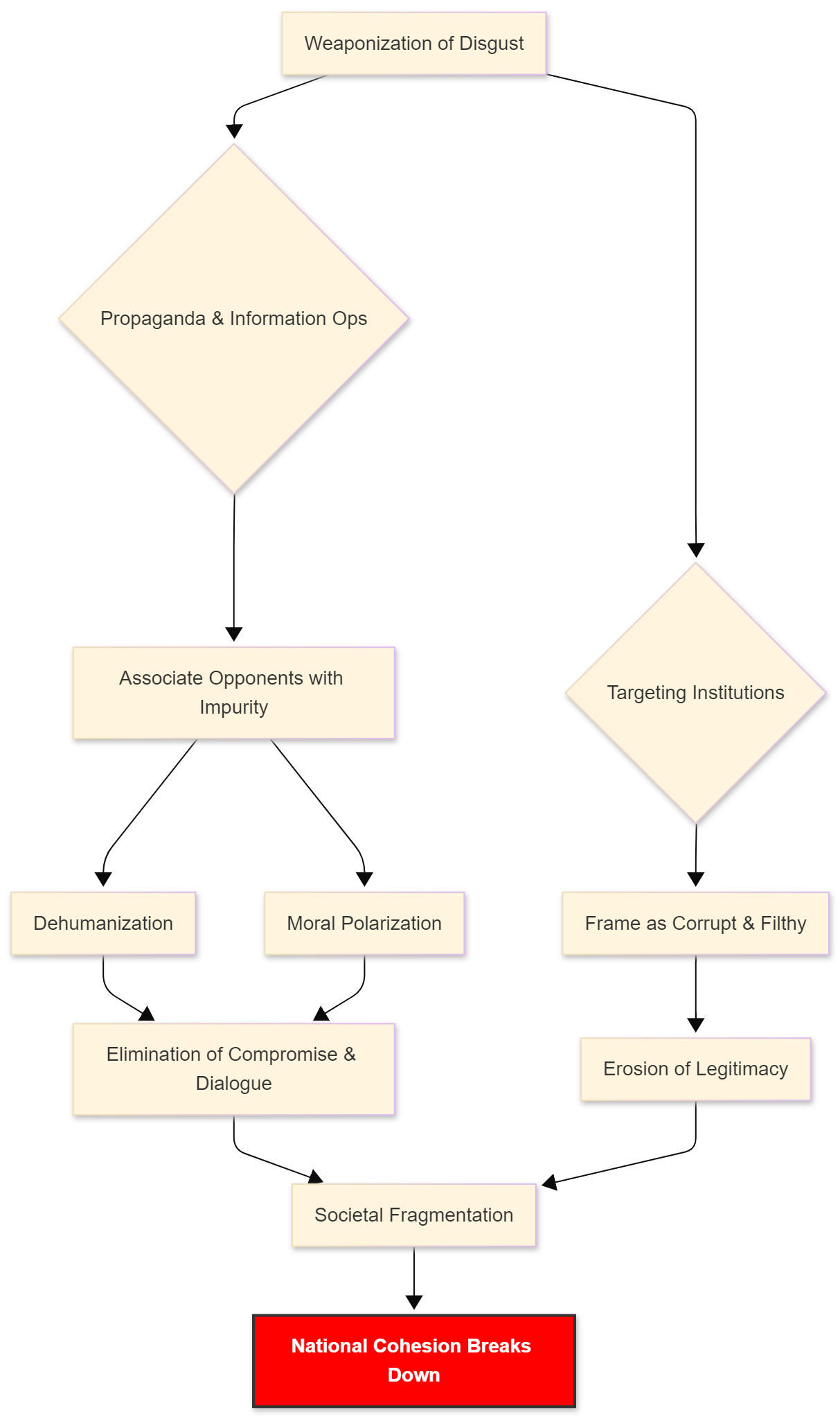
First, weaponized disgust dehumanizes the opposition. Propaganda relentlessly associates targeted groups with filth, vermin, or disease. This linguistic and visual framing triggers a visceral response of revulsion. Once a group is seen as less than human—as a pestilence—it becomes psychologically easier to strip them of rights, segregate them, and ultimately justify violence against them. This tactic bypasses rational argument and appeals directly to a primal fear of contamination.
Second, disgust destroys the possibility of compromise. Political negotiation requires a baseline assumption that all parties are legitimate stakeholders in the nation’s future. Disgust annihilates this assumption. One cannot compromise with a disease; one eradicates it. Political discourse shifts from negotiation to moral crusading. The “other side” is not just politically incorrect but morally bankrupt, and any engagement with them is seen as a form of contamination. This leads to extreme polarization where political opponents can no longer coexist in the same national body.
Third, disgust erodes faith in foundational institutions. When political warfare successfully paints an entire system—be it the government, the judiciary, or the media—as an irredeemable “swamp” of corruption and moral filth, citizens do not get angry and demand reform. They become disgusted and seek to burn the entire structure down. They lose faith in the legitimacy of the state itself, believing it is fundamentally contaminated. This internal rot is far more damaging to national cohesion than anger directed at a specific administration or law. A nation can survive an angry population; it cannot survive a population that is disgusted with its own existence.
The following chart illustrates the pathway from the weaponization of disgust to the breakdown of national cohesion.


You must be logged in to post a comment.