


OFAC August 7 designations strike Pasargad Bank’s technology stack and adjacent payment rails through FANAP and its subsidiaries, while exposing Cyrus Offshore Bank and RUNC’s CIMS messaging project to blocking measures and secondary sanctions risk — immediate impacts hit vendor contracts, settlement flows, hardware maintenance, software updates, cloud and licensing access, and third-party confidence across Iran’s banking sector.
High confidence in designation details and entity-person linkages based on OFAC primary sources. Moderate confidence in operational impact pathways grounded in documented roles of FANAP and subsidiaries and known banking technology dependencies. Moderate confidence in foresight scenarios given multiple substitution and circumvention paths available to Iranian institutions under pressure.
Incident framing — who, what, where, and why
August 7 actions designated eighteen persons and entities for roles in sanctions evasion, revenue generation, and repression support. The package names Cyrus Offshore Bank tied to Parsian Bank, the FANAP holding owned or controlled by Bank Pasargad, multiple FANAP subsidiaries across payments, infrastructure, and telecom, and leadership figures associated with RUNC’s Cross-Border Interbank Messaging System. The individual roster linked to the user’s list appears across the press release in three clusters — Cyrus Offshore Bank leadership, FANAP leadership, and RUNC leadership. Names and affiliations resolve as Hadi Nouri, Alireza Fatahinojokambari, and Adel Berjisian on Cyrus Offshore Bank, Shahab Javanmardi on FANAP, and Ali Morteza Birang, Mohammad Shafipour, and Seyyed Mahmoud Reza Sajjadi on RUNC.
Scope and entities — confirmation and naming hygiene
OFAC lists Cyrus Offshore Bank with aliases and registration data, and lists FANAP as Pasargad Arian Information and Communication Technology Company linked to Pasargad Bank. Subsidiary names in the action use official English renderings that differ from informal transliterations — Qeshm Arian Datis Software Company branded as Dotin rather than Dotis, Arvand Arian Pasargad Communications and Information Technology Payment Company branded as FANAP Tech, and Sherkat-e Barid Fanavar Arian branded as Baran Telecom. Separate SDN entries confirm Baran Telecom and the FANAP infrastructure arm as blocked parties subject to secondary sanctions.
Operational impacts — banking stack, vendors, and rails
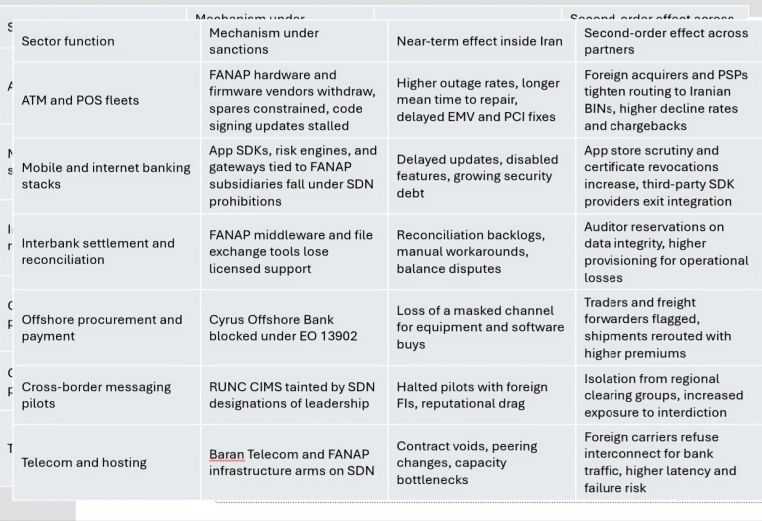
Sanctioning the holding plus subsidiaries turns routine technology upkeep into a legal hazard for foreign vendors and service providers. Hardware spares, ATM cassettes, HSM modules, card personalization kits, POS terminals, switching firmware, and network optics sourced from non-Iranian channels face interruption because counterparties risk secondary sanctions and export control scrutiny. Software upkeep faces the same barrier — card switch updates, EMV kernels, reconciliation engines, risk scoring models, mobile SDKs, and fraud analytics fall off licensed pipelines once the developer sits on the SDN list. Payment settlement stability faces fresh friction where FANAP entities touch domestic rails, from POS routing to merchant acquiring to value-added services that connect bank apps to billers and wallets. Cyrus Offshore Bank’s blocking cuts an evasion path used for offshore procurement and oil revenue handling, which increases reliance on harder-to-mask conduits that face more pressure after the July 30 shipping network action. RUNC’s CIMS faces reputational and legal drag for any foreign financial institution evaluating integration, which narrows partner pools for Iran-aligned banks.
Exposure channels — where pressure translates into breaks
FANAP’s role spans ATM production and maintenance, payment hardware design, cash and valuables logistics, and software across banking apps and gateways. Disruption lands in maintenance windows, parts replacement cycles, and certificate rotation schedules, which degrades uptime, weakens cryptographic hygiene, and inflates fraud exposure. Telecom and infrastructure subsidiaries sit in data center hosting, network backbone, and last-mile connectivity for bank branches and processors, which injects latency and outage risk during supplier reshuffles. Baran Telecom’s designation puts interconnection and number resources at risk where cross-border carriers fear exposure, which nudges operators toward domestic fallbacks with lower resilience. Cyrus Offshore Bank’s blocking raises counterparty screening failures for traders and freight forwarders who interacted with it as a procurement intermediary, which prompts bank de-risking actions and cargo payment holds. RUNC’s executives on the SDN list add risk to any institution piloting CIMS, which chills adoption and pushes transactions back to less formal workarounds that raise detection risk.
Impact matrix — function, mechanism, near-term effect, second-order effect
Compliance and finance — balance sheet and audit consequences
Blocking actions force impairment reviews for intangible assets tied to foreign software licenses and vendor relationships. Capital expenditure plans shift to domestic substitutes with lower reliability and lower certification pedigree, which lifts opex for field service and security incident response. External auditors increase emphasis on access to source code, license provenance, and cryptographic material custody, which raises the chance of qualified opinions for banks anchored to the FANAP stack. Treasury’s notice stresses secondary sanctions exposure for foreign financial institutions that facilitate significant transactions for designated persons, which deters correspondent relationships and raises settlement friction for importers and exporters. Reuters and U S News reporting matches Treasury’s framing that the package targets both revenue generation and the infrastructure that shelters it.
Attribution, intent, and message discipline
Treasury positions the action under EO 13902 across the financial sector and technology nexus, with explicit references to repression support through surveillance tools and the National Information Network. Naming FANAP’s facial recognition and MOIS links signals a human rights vector alongside finance pressure. The combined focus on CIMS, offshore banking, and shipping networks indicates a layered campaign that blends oil revenue interdiction with banking tech containment.
Outlook — strategic foresight across three time horizons
Near term through ninety days — sanction shock translates into supplier exits, patch pipeline gaps, and spare parts shortages across FANAP-touched estates. Bank CISOs face certificate expirations, HSM lifecycle headaches, and failover drills that depend on tools no longer supported. Payment processors conduct emergency code freezes and rollback plans to stabilize uptime with reduced feature sets. Foreign PSPs strengthen blocks on Iranian BIN ranges and merchant IDs that route through designated processors. Offshore procurement shifts to new cut-outs with higher premiums and higher interdiction risk as counterparties adjust sanctions screening.
Mid term through twelve months — domestic vendors expand footprint to replace FANAP imports with lower assurance artifacts, which inflates fraud rates and operational incidents. Banks restructure contracts to distance from FANAP logos while retaining staff and know-how in renamed entities, which limits sanctions bite but slows modernization. CIMS adoption stalls outside Iran as regional banks weigh exposure to secondary sanctions, which preserves Iran’s isolation from emerging non-SWIFT blocks. Cyrus Offshore Bank’s loss steers procurement toward cash-settled channels and commodity-barter deals that raise enforcement touchpoints for customs, insurers, and reinsurers.
Long term through thirty-six months — pressure on tech and finance convergence drives a split stack outcome. A hardened yet insular domestic stack grows around state-aligned vendors and open-source forks, while cross-border finance remains bounded by sanctions chokepoints that raise cost and risk. Banks anchored to the FANAP lineage face persistent audit challenges and higher capital charges to offset operational risk. Authorities seek deeper integration with Chinese and Russian nodes outside Western scrutiny, though CIMS stigma and Kunlun exposure keep partners cautious. Shipping network designations reinforce end-to-end pressure on oil monetization, which limits capital available for financial technology refresh and raises decay risk across the sector.
Scenarios and indicators — structured foresight for decision support
Consolidation scenario — state consolidates FANAP assets into a new champion under fresh branding with emergency exemptions inside Iran. Indicators include legislative fast-tracking of vendor protections, mass re-badging of staff into a single entity, and synchronized app updates across multiple banks under a new developer certificate. Mitigations include external monitoring of certificate chains, API telemetry for shared backends, and watchlists for renamed suppliers.
Substitution scenario — banks pivot to alternative domestic vendors and open-source stacks. Indicators include accelerated tenders for switch software, HSM integrations with local modules, and rapid growth in domestic POS assembly lines. Risks include higher fraud due to immature risk engines and longer outages during migrations. Mitigations include red-teaming of reconciliation pipelines, offline recovery drills, and staged rollouts with feature flags.
Circumvention scenario — offshore procurement resurrected through new intermediaries and barter flows. Indicators include spikes in insurance anomalies, increased use of shell freight operators, and reuse of compliance-washed serial numbers for network gear. Mitigations include data sharing among insurers, customs, and maritime analytics on serial and AIS spoofing patterns, plus end-user verification on specialized banking hardware.
Retrenchment scenario — RUNC shifts CIMS positioning toward purely domestic redundancy to preserve face while foreign expansion fades. Indicators include patriotic messaging, removal of foreign partner language from marketing, and inward integration with Central Bank messaging projects. Mitigations include testing for systemic risk where duplicated messaging stacks introduce reconciliation drifts between rails.
APA references
Reuters. 2025 August 07. US issues new Iran-related sanctions Treasury says. https://www.reuters.com/business/finance/us-issues-new-iran-related-sanctions-treasury-says-2025-08-07
U S Department of the Treasury. 2025 August 07. Treasury targets Iranian network evading sanctions and enabling oppression. https://home.treasury.gov/news/press-releases/sb0220
Office of Foreign Assets Control. 2025 August 07. Iran-related designations page for Cyrus Offshore Bank. https://ofac.treasury.gov/recent-actions/20250807
Office of Foreign Assets Control. 2025 August 08. Sanctions List Search entry for Pasargad Arian Information and Communication Technology Company. https://sanctionssearch.ofac.treas.gov/Details.aspx?id=54977
Office of Foreign Assets Control. 2025 August 09. Sanctions List Search entry for Sherkat-e Barid Fanavar Arian, Baran Telecom. https://sanctionssearch.ofac.treas.gov/Details.aspx?id=55013
Office of Foreign Assets Control. 2025 August 09. Sanctions List Search entry for Arian Pasargad Communications and Information Technology Infrastructure Company. https://sanctionssearch.ofac.treas.gov/Details.aspx?id=55014
Office of Foreign Assets Control. 2025 August 09. Sanctions List Search entry for Arvand Arian Pasargad Communications and Information Technology Payment Company. https://sanctionssearch.ofac.treas.gov/Details.aspx?id=55010
Iran International. 2025 August 07. US targets Iran technology finance networks with new sanctions. https://www.iranintl.com/en/202508072838
U S News and World Report. 2025 August 07. US issues new Iran-related sanctions Treasury says. https://www.usnews.com/news/world/articles/2025-08-07/us-issues-new-iran-related-sanctions-treasury-says
Shafaq News. 2025 August 07. US sanctions Iranian tech and finance network. https://shafaq.com/en/World/US-sanctions-Iranian-tech-and-finance-network


You must be logged in to post a comment.