


The “Groza-04U” electronic warfare system designs to counter First Person View (FPV) quadcopter-type unmanned aerial vehicles (UAVs). This specialized capability directly addresses a prevalent threat in contemporary combat environments, where FPV drones pose significant reconnaissance and attack risks. The system’s focused design on FPV drones indicates a direct response to evolving battlefield dynamics, adapting to the proliferation of inexpensive, agile FPV platforms.1
The “Groza-04U” complex integrates with an MRP-5.8 module and an automatic suppression module. A spectrum analyzer, equipped with a wideband “Masterok” antenna, connects to the automatic suppression module, enabling UAV signal detection. Operating on 24V power, two 12V batteries from the kit, connected in series, supply power. A 220V generator, also part of the kit, charges these batteries.1
The system boasts a detection range for FPV drones reaching up to 2000 meters. Radio suppression extends up to 1200 meters, providing a substantial area of effect for counter-drone operations.1 When installed on elevated structures, the suppression sector spans 60 to 120 degrees horizontally and -5 to 20 degrees vertically.1
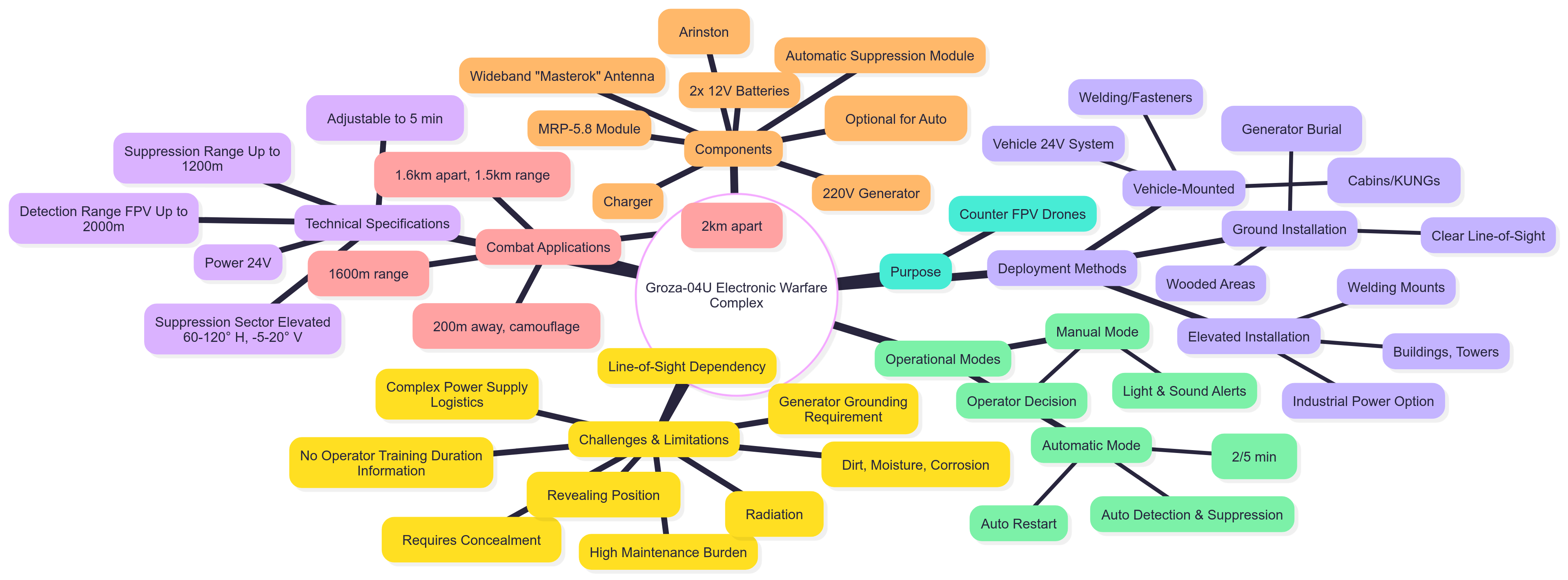
The explicit design for countering FPV drones underscores a focused engineering effort. This contrasts with broader electronic warfare systems that address a wider spectrum of threats. The specificity of its target suggests an adaptation to the proliferation of inexpensive, agile FPV platforms. Such a system directly addresses the asymmetric advantage gained by adversaries employing low-cost FPV drones for precision strikes or reconnaissance. FPV drones offer a cost-effective method for surveillance and attack, posing a significant threat to ground forces. A system specifically designed to counter these drones aims to neutralize this asymmetric advantage. The stated detection range of 2000 meters and suppression range of 1200 meters indicate an intent to disrupt drone operations before they pose an immediate threat, restoring a degree of parity or advantage to protected forces.1
The emergence of specialized counter-FPV electronic warfare systems, such as “Groza-04U,” reflects an evolution in electronic warfare doctrine. This evolution shifts from broad-spectrum jamming to targeted, localized denial capabilities against specific, prevalent threats. Historically, electronic warfare systems often focused on wideband jamming across many frequencies. The “Groza-04U” specifically targets FPV drones, implying a recognition that general jamming might not prove efficient or effective against rapidly deployable, often low-signature threats. This specialization suggests a doctrinal shift towards precision electronic warfare, where resources concentrate on neutralizing specific, high-priority threats rather than attempting to blanket an entire electromagnetic spectrum. This adaptation acknowledges the dynamic nature of modern warfare and the need for agile counter-measures.
| Specification | Value | Source |
| Purpose | Counter FPV Drones | 1 |
| Detection Range (FPV Drones) | Up to 2000 meters | 1 |
| Suppression Range | Up to 1200 meters | 1 |
| Power Requirements | 24V (from two 12V batteries) | 1 |
| Power Source | 220V generator for charging | 1 |
| Operational Modes | Automatic, Manual | 1 |
| Automatic Suppression Duration | 2 minutes (adjustable to 5 minutes) | 1 |
| Suppression Sector (Elevated) | 60-120 degrees horizontal, -5-20 degrees vertical | 1 |
- Operational Modalities and Deployment
The “Groza-04U” complex exhibits specific operational procedures for both automatic and manual modes, distinct power requirements, and various installation methods. Understanding these aspects reveals the system’s flexibility and inherent logistical demands.
Preparing the “Groza-04U” complex for action involves a specific assembly sequence. Personnel position the complex towards the anticipated direction of enemy attack. The MRP-5.8 module attaches to the side handle, connecting to the complex via a special cable. The automatic suppression module then connects to a remote activation button’s connector. A spectrum analyzer, with its “Masterok” antenna directed towards the expected enemy attack, connects to the automatic suppression module.1
 Automatic mode activation requires pressing a button on the automatic suppression unit to the “On” position; the remote activation button becomes optional. Upon UAV detection, the analyzer automatically deactivates, and suppression activates for a fixed duration of 2 minutes. An internal jumper adjustment allows extending this duration to 5 minutes, requiring casing disassembly. After the timer expires, suppression ceases, and the analyzer reactivates to search for signals. If the UAV signal persists, suppression resumes for another 2 or 5 minutes.1
Manual operation necessitates connecting the remote activation button to the automatic suppression unit and releasing the unit’s button to the “Off” position. Upon UAV detection, the analyzer alerts the operator with light and sound indicators. The operator then makes the decision to activate suppression.1
The dual automatic and manual modes offer operational flexibility, allowing adaptation to different threat levels and operator preferences. However, the multi-component assembly sequence and specific power requirements introduce a degree of setup complexity.
The “Groza-04U” complex, including the MRP-5.8 module, requires 24V power. Two 12V batteries from the kit, connected by a jumper, supply this power. A charger included in the kit replenishes these batteries, receiving power from a 220V generator, also part of the kit. A crucial aspect for the generator’s long-term, proper functioning involves installing a grounding circuit.1 The reliance on a multi-component power supply chain (batteries, charger, generator, fuel) creates multiple points of failure and increases logistical burden. The system requires 24V from two 12V batteries, charged by a 220V generator. This chain includes batteries, a charger, a generator, and fuel for the generator. Each component represents a potential point of failure. Damage to the generator, lack of fuel, or battery degradation directly impacts system operation. This multi-layered dependency complicates resupply and maintenance in austere or contested environments, increasing the system’s logistical footprint and reducing its sustained operational readiness.
The system displays versatility in deployment, adapting to diverse tactical environments. For protecting personnel areas, command posts, observation posts, and firing positions in wooded areas, personnel place the complex on the ground using its standard legs. Proper positioning at the edge of a tree line, facing the likely drone attack direction, proves essential. Camouflage for batteries, charger, and the gasoline generator (including burying the generator to reduce thermal signature) remains imperative. Further camouflage involves nets or radio-transparent material. Personnel must ensure no trees, branches, or foliage obstruct the complex’s front.1
Installation on buildings, cell towers, or water towers requires welding mounts. This method considers connecting to an industrial power grid and accommodating batteries and the gasoline generator. The suppression sector (60-120 degrees horizontal, -5-20 degrees vertical) must factor into placement.1 Placing the complex on vehicle roofs (cabins or KUNGs) involves welding or secure improvised fasteners. Orientation towards the probable UAV deployment direction proves necessary. Connection to the vehicle’s 24V onboard electrical system requires careful cable routing to avoid kinks.1
The system’s power and installation demands, particularly the generator’s grounding requirement and the need for line-of-sight clearance, restrict rapid redeployment and introduce sustainment challenges in dynamic combat zones. The generator requires a grounding circuit for “long-term and proper operation.” This is not a trivial setup in a fast-moving tactical situation. Ground installation also demands “absence of trees, branches, foliage in front of the product.” These requirements mean operators cannot simply drop the system anywhere and expect full functionality. Rapid repositioning becomes difficult, as each new location necessitates careful site selection, grounding, and camouflage. This reduces the system’s tactical agility, making it less responsive to sudden shifts in threat axes or unit movements. The logistical burden of transporting fuel, managing battery charging cycles, and ensuring generator maintenance further complicates sustainment, especially during prolonged engagements or deep penetrations.
| Installation Method | Placement Considerations | Power Connection | Camouflage Requirements |
| Ground | Edge of tree line, facing attack direction; standard legs | 24V batteries (2x12V), 220V generator | Batteries, charger camouflaged; generator buried for thermal signature reduction; camouflage net/radio-transparent material; clear line-of-sight |
| Elevated | Buildings, cell towers, water towers; welding mounts | Industrial power grid (possible), 24V batteries, 220V generator | Not specified; consider suppression sector (60-120° H, -5-20° V) |
| Vehicle-Mounted | Roofs of cabins/KUNGs; welding/secure fasteners | Vehicle’s 24V onboard electrical system; avoid cable kinks | Oriented towards probable UAV deployment direction |
III. Combat Application Analysis
This section analyzes the specific combat application scenarios described for the “Groza-04U” complex, assessing its intended role in protecting various military assets and personnel. Understanding these applications provides insight into its tactical utility.
During offensive operations, units position along the front line, up to 1.6 km apart, providing cover for assault groups. The complex offers a coverage range of up to 1.5 km. As troops advance, units require repositioning with consolidating forces. Installation of units within convoys in threatened directions also occurs.1
To cover the front line and road directions, units place no more than 2 km apart from each other. This creates a defensive zone against drone incursions.1
For the protection of Command and Observation Posts (KNP) and Control Points (PU), complexes install up to 200 meters away in the direction of probable UAV use. Camouflage remains essential for these installations to prevent detection.1
The complex operates effectively on a roaming mobile platform, providing a coverage range of up to 1600 meters. This includes integrating units within convoys facing specific threats.1
The described combat applications suggest a layered defense concept, where “Groza-04U” systems deploy at various echelons (front line, convoys, static posts) to provide overlapping anti-drone coverage.1 The system’s utility spans both static defensive positions (KNP/PU protection) and dynamic offensive operations (convoy/assault group cover), but each application presents distinct operational trade-offs. Protecting static command posts allows for deliberate setup, thorough camouflage, and stable power solutions. This optimizes the system’s effectiveness. Conversely, covering convoys during offensive operations demands rapid deployment, frequent repositioning, and mobile power sources. The need for constant repositioning with advancing troops conflicts with the system’s setup complexities, such as generator grounding and line-of-sight requirements. This implies a trade-off between maximizing protection for fixed, high-value assets and maintaining agility for mobile, distributed forces.
The versatility in combat applications influences operational tempo and resource allocation. Deploying “Groza-04U” systems across diverse scenarios necessitates varied logistical support and personnel training, impacting overall force readiness. Deploying units 1.6 km apart for convoy protection or 2 km apart for zonal front-line coverage demands a significant number of systems and associated personnel. Each system requires batteries, a charger, a generator, and fuel. This creates a substantial logistical tail. Furthermore, the operational tempo of an advancing force demands rapid setup and teardown, potentially conflicting with the system’s inherent setup complexities. Commanders must allocate resources—systems, personnel, maintenance, and fuel—strategically across these diverse applications, potentially impacting the availability of resources for other combat functions. This highlights a need for robust logistical planning and specialized training for operators to maintain effectiveness across varied operational tempos.
| Scenario | Typical Unit Placement | Unit Spacing | Effective Coverage Range | Specific Considerations |
| Protecting Convoys/Assault Groups (Offensive) | Along front line, within convoys | Up to 1.6 km apart | Up to 1.5 km | Repositioning with advancing troops |
| Front Line Zonal Protection | Along front line, road directions | No more than 2 km apart | Not specified (zonal) | Creates defensive zone |
| Command/Observation Post Security | Up to 200 meters from KNP/PU | Not specified (point defense) | Not specified (point defense) | Essential camouflage |
| Mobile Platform Integration | On roaming mobile platforms, within convoys | Not specified | Up to 1600 meters | Adaptable to mobile threats |
- System Durability and Maintenance Requirements
This section assesses the “Groza-04U” system’s durability and maintenance needs based on the provided information, drawing conclusions on its longevity and reliable functioning in demanding combat environments.
The system’s components, particularly electrical connections, exhibit susceptibility to environmental factors. Maintenance procedures explicitly state that “terminal fasteners must be cleaned of dirt and dust, exclude water and moisture ingress, and be cleaned of rust and corrosion”.1 This indicates vulnerability to environmental degradation. The explicit maintenance requirements regarding environmental factors (dirt, dust, water, moisture, rust, corrosion) indicate a high maintenance burden for the system, particularly in harsh combat environments.
The system’s susceptibility to environmental degradation directly impacts its sustained operational readiness, demanding constant, labor-intensive upkeep that diverts personnel and resources. Combat environments are inherently harsh, characterized by dust, moisture, and rapid temperature changes, accelerating corrosion and wear. The document’s explicit mention of cleaning terminals from “dirt and dust, exclude water and moisture ingress, and be cleaned of rust and corrosion” confirms the system’s vulnerability.1 Maintaining operational readiness in such conditions requires frequent, diligent maintenance, which consumes valuable personnel time and resources. This reduces the system’s availability for active deployment and increases the logistical demand for cleaning supplies and replacement parts, directly impacting its sustained operational readiness.
The generator, a core power component, requires installing a grounding circuit for “long-term and proper operation.” Failure to establish proper grounding negatively impacts the generator’s durability and the system’s overall operational life.1 The stringent maintenance and grounding requirements contribute to a larger logistical footprint and necessitate specialized training for operators to ensure system longevity and continuous functionality in the field. Regular cleaning, rust removal, and protection from moisture imply a need for specific cleaning agents, tools, and potentially spare parts. The grounding requirement for the generator adds another layer of complexity, demanding specialized knowledge for proper installation and verification. This increases the logistical footprint by requiring more diverse supplies and equipment to be transported and sustained in the field. Furthermore, operators require training not only on system operation but also on these specific maintenance and grounding procedures, adding to the overall training burden and potentially limiting the pool of qualified personnel. This impacts the system’s overall deployability and sustainment in extended operations.
- Human Factors in Deployment
This section addresses the human elements influencing the deployment and operation of the “Groza-04U” system, including operator procedures and decision-making, and critically noting the absence of information regarding personnel safety and training duration.
Operators follow a defined sequence for assembly and setup, including positioning the complex, attaching modules, and connecting the spectrum analyzer.1 In manual mode, the spectrum analyzer alerts the operator with light and sound indicators upon UAV detection. The operator then makes the decision to activate suppression.1 In automatic mode, the system handles detection and suppression autonomously, though an operator can adjust suppression duration.1 Manual mode operation places the decision to activate suppression squarely on the operator, implying a need for situational awareness and tactical judgment.
The provided documentation contains no information regarding the perceived health impact of the “Groza-04U” electronic warfare system on personnel. There are no mentions of safety guidelines related to electromagnetic radiation, exposure limits, or any potential health risks for operators or nearby individuals.1 The complete absence of information regarding the health impact of electromagnetic radiation on personnel represents a significant gap in the system’s documentation, posing potential long-term risks and liability concerns. Electronic warfare systems emit electromagnetic radiation, which can pose health risks to personnel, particularly with prolonged exposure. The document explicitly states “does not contain any information regarding the perceived health impact.” This omission means operators and commanders lack crucial data to implement proper safety protocols, determine safe operating distances, or assess long-term health implications. Without this information, personnel might operate the system in conditions that compromise their well-being, leading to potential health issues, reduced morale, and future legal liabilities for the deploying force.
The document outlines operational procedures and placement within combat formations but does not address the required operator training duration.1 The lack of documented safety protocols concerning radiation exposure introduces uncertainty for personnel, potentially impacting morale, and suggesting an incomplete assessment of operational security, as unprotected personnel become a vulnerability. Personnel operating electronic warfare systems without clear safety guidelines regarding radiation exposure face an unknown health risk. This uncertainty degrades morale and trust in equipment safety. Furthermore, if operators are unaware of safe exposure limits or necessary protective measures, they might inadvertently compromise their own health, leading to reduced effectiveness or even incapacitation. From an operational security perspective, a force that neglects personnel safety in this regard risks creating a vulnerable point, as injured or unhealthy personnel reduce combat effectiveness. This gap suggests a need for comprehensive health and safety assessments to ensure personnel well-being and maintain operational integrity.
- Assessment of Operational Viability and Challenges
The “Groza-04U” system offers a focused and specialized capability against FPV drones, a prevalent threat in modern combat. Its dual automatic and manual suppression modes provide operational flexibility. The system’s versatility in deployment methods—ground, elevated, and vehicle-mounted—enhances its adaptability across diverse combat environments. Detection and suppression ranges of 2000 meters and 1200 meters, respectively, suggest a significant area of effect.1 The “Groza-04U” presents a capable counter-drone solution but comes with substantial operational and logistical overhead.
The system’s operational viability faces challenges from its susceptibility to environmental degradation, necessitating diligent maintenance. The critical requirement for generator grounding adds setup complexity, potentially delaying rapid deployment. Line-of-sight dependencies for effective operation pose challenges in dense terrain. The multi-component power supply chain introduces logistical complexity for transport, setup, and resupply. The system’s thermal signature requires active concealment, adding to the operational burden.1
The system offers effective protection against FPV drones, but achieving this protection often requires compromising mobility, stealth, or ease of deployment due to its physical and logistical demands. The system’s effective detection and suppression ranges indicate a strong protective capability. However, this protection comes at a cost. The need for precise positioning (e.g., “absence of trees, branches, foliage” for ground installation), the requirement for generator grounding, and the necessity for active camouflage due to thermal signature all impede rapid mobility and compromise stealth.1 Deploying the system quickly in a dynamic environment becomes difficult, and its presence becomes more detectable if concealment measures are insufficient. This creates a direct trade-off- maximizing protection often means sacrificing tactical agility and covertness.
The system’s inherent physical and logistical vulnerabilities, particularly its thermal signature and dependence on a generator, could render it a target for enemy counter-electronic warfare or precision strike capabilities, creating a strategic vulnerability despite its defensive purpose. The document explicitly states the need to “camouflage (bury in the ground) the gasoline generator to reduce thermal radiation visibility.” This indicates a detectable thermal signature.1 Any detectable signature, combined with the system’s relatively static deployment requirements (grounding, line-of-sight), makes it a potential target for enemy reconnaissance and precision strikes. An adversary could use thermal imaging or other intelligence methods to locate “Groza-04U” positions and then target them with artillery, drones, or other assets. This transforms a defensive asset into a potential liability, as its destruction would not only remove the counter-drone capability but also potentially expose the assets it was protecting. This creates a strategic vulnerability that must factor into operational planning.
VII. Conclusion and Identified Information Gaps
The “Groza-04U” electronic warfare system represents a specialized and adaptable solution for countering FPV drones, offering both automated and manual operational modes and flexible deployment options across diverse combat scenarios. Its technical specifications suggest a significant area denial capability against a pervasive threat. However, its operational viability in dynamic combat environments faces considerable challenges. These include a high maintenance burden due to environmental susceptibility, complex power supply logistics involving a generator with specific grounding requirements, and line-of-sight dependencies for effective operation. The system’s thermal signature also necessitates active concealment, adding to operational complexity.
A comprehensive assessment of the “Groza-04U” system remains incomplete due to significant information gaps in the provided documentation. The complete absence of data regarding the perceived health impact of electromagnetic radiation on personnel presents a critical oversight.1 Without this information, assessing safety protocols, determining safe operating distances, and understanding potential long-term health risks for operators remains impossible. This gap carries implications for personnel well-being, training, and potential liability. The documentation does not specify the required duration or content of operator training.1 This prevents an assessment of the personnel readiness implications and the time investment necessary to field proficient operators. The documents do not discuss the strategic dilemma presented by activating electronic warfare systems—the trade-off between neutralizing an immediate drone threat and potentially revealing one’s position to enemy reconnaissance.2 This represents a fundamental strategic consideration for electronic warfare deployment, impacting operational security and equipment survivability. The broader doctrinal concept of “detect, alert, neutralize” for electronic warfare deployment and its implications for equipment survivability and operational security remain unaddressed.1 This limits understanding of the system’s role within a larger defensive framework and its contribution to overall force protection doctrine.
The identified information gaps, particularly concerning personnel safety and the strategic trade-offs of electronic warfare activation, prevent a complete and accurate risk assessment of the “Groza-04U” system. A comprehensive risk assessment requires evaluating not only technical capabilities and operational challenges but also human factors and strategic implications. The absence of data on radiation exposure means the health risks to operators remain unknown, making a full personnel risk assessment impossible. Furthermore, the lack of discussion on the strategic dilemma of electronic warfare activation and the “detect, alert, neutralize” doctrine means the system’s contribution to, or detraction from, overall operational security and survivability cannot be fully evaluated. Without these crucial pieces of information, any operational deployment of the “Groza-04U” system carries unquantified risks, potentially leading to unforeseen consequences for personnel and mission success. This necessitates further research and analysis to fully understand its implications for force protection, operational security, and long-term personnel health.

You must be logged in to post a comment.