




The “Plan to Strengthen the IRGC in the Face of America” emerged in early 2019 as a direct response to escalating U.S.–Iran tensions. The United States had formally designated Iran’s Islamic Revolutionary Guard Corps (IRGC) as a Foreign Terrorist Organization on April 15, 2019 – an unprecedented move against a branch of a nation’s armed forces. Within days, Iran’s parliament (Majles) reacted with a double-urgency bill (طرح دوفوریتی) to counter this provocation. Lawmakers introduced the plan on April 16, 2019, with over 200 MPs signing on as sponsors. Debate and approval moved swiftly: the outlines of the plan were overwhelmingly passed by 204 votes in favor (out of 207 MPs present) on April 16, and the final bill was approved on April 23–24, 2019. The timing coincided with the Trump administration’s “maximum pressure” campaign – including an end to oil export waivers for Iran – which further heightened the urgency in Tehran. In short, the plan’s creation was catalyzed by U.S. actions against the IRGC and came amid a nadir in U.S.–Iran relations, roughly a year after Washington’s exit from the 2015 nuclear deal.
Key Proponents and Drafting Bodies
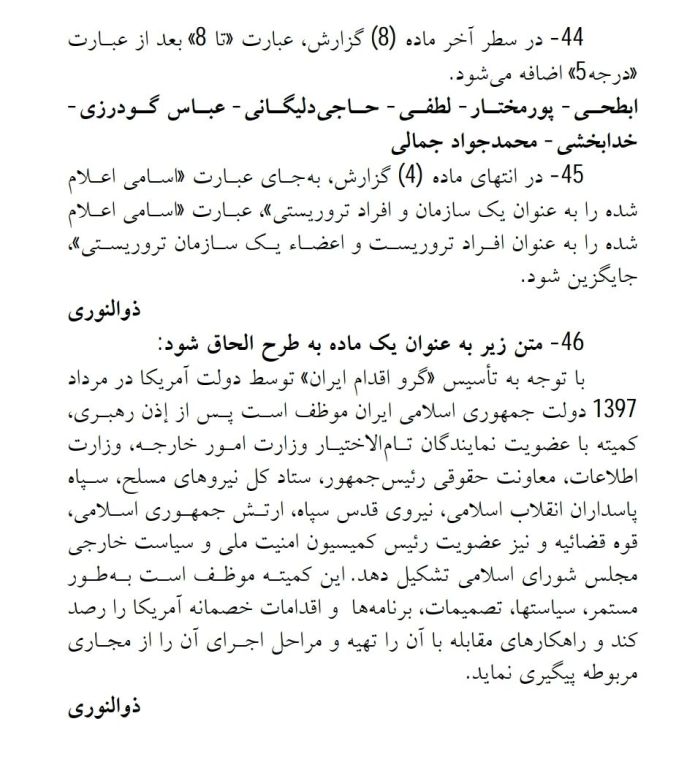
The plan was principally championed by conservative factions in the Iranian Majles, notably the “Velayi” (revolutionary) caucus, but it enjoyed broad cross-factional support. It was formally submitted with the signatures of over 200 MPs, reflecting rare unity across Iran’s political spectrum in defense of the IRGC. Key proponents included members of the Majles National Security and Foreign Policy Commission, which refined the draft. Notable conservative MPs such as Mohammad Ali Pourmokhtar (who framed the plan as a decisive countermeasure to U.S. behavior) and Mojtaba Zonnour were involved in promoting it. The Commission’s then-chairman, Heshmatollah Falahatpisheh, and MPs like Hossein-Ali Haji-Deligani and Mohammad-Javad Jamali contributed amendments during committee review (their names appear in the amendment text). Institutionally, the Islamic Consultative Assembly (parliament) took the lead, but the plan was coordinated with Iran’s Supreme National Security Council (SNSC) and had implicit backing from the IRGC itself. In debates, Speaker Ali Larijani and others donned IRGC uniforms in solidarity, signaling top-level political support. Overall, while parliament drafted and passed the law, it aligned with the broader establishment’s goal of fortifying the IRGC’s legal and political standing.
Provisions and Contents of the Plan
The plan, ultimately enacted as law in 2019, mandated a series of legislative, military, and diplomatic actions to bolster the IRGC’s position vis-à-vis the United States. In its final form (as a single-article law with multiple clauses), it declares all U.S. military forces, security agencies, and their affiliates “terrorist” in Iran’s view. This mirrors the U.S. terrorist designation of the IRGC, effectively turning the label back on American forces (initially focusing on U.S. Central Command in West Asia). The law explicitly includes all U.S. armed units operating in the Middle East (and later expanded to all U.S. forces globally) as terrorist entities, as well as any state or non-state actors cooperating with them. Crucially, it goes on to criminalize any financial, technical, or logistical support to these U.S. forces under Iranian law, treating such support as complicity in terrorism.
On the military front, the plan obligates Iran’s government and armed forces (including the IRGC and regular military) to “take reciprocal and decisive action” against terrorist-designated U.S. forces whenever they threaten Iran’s interests. This includes potential retaliatory or even preemptive strikes against U.S. military assets in the region if deemed necessary for national defense. The law specifies that such military responses must follow approval by the SNSC and, pointedly, “after the Leader’s permission” (given the Commander-in-Chief role of Iran’s Supreme Leader). By codifying a duty to respond, the plan sought to enhance the IRGC’s rules of engagement and deterrent posture.
Diplomatically, several articles focus on undermining the U.S. move and shoring up support for the IRGC. The Iranian government is mandated to use all legal, political, and diplomatic channels to nullify the U.S. designation of the IRGC, for instance by lodging formal protests in international forums and rallying other states to disregard or oppose the U.S. policy. Iran’s foreign ministry must engage in bilateral and multilateral diplomacy to protect the IRGC’s legitimacy as an official armed force and to “minimize the benefit” that U.S. forces can gain from bases and support in regional countries. In practice, this hinted at pressuring neighboring countries not to cooperate with U.S. military plans against Iran. An earlier draft of the plan even proposed banning the entry of U.S. Navy vessels into Iranian waters of the Persian Gulf unless subjected to Iranian inspection, and formally labeling the U.S. Army, CIA, and Israel’s Mossad as terrorist organizations. (These more extreme provisions were part of an initial “triple-urgency” proposal and did not appear in the final law, which took a somewhat narrower focus.)
The law contains symbolic but significant assertions
Any attack against IRGC personnel or assets anywhere in the world is deemed an attack on Iran itself, and the government must support any individuals or entities (foreign or domestic) that cooperate with the IRGC. Taken together, the plan’s contents create a legal framework to justify IRGC operations against U.S. targets, bolster the corps’ domestic and international standing, and push back against the narrative of the IRGC as terrorist. It effectively turns Iran’s legislative and diplomatic apparatus into shields for the IRGC.
Strategic Purpose and Context of Its Emergence
Strategically, the timing and substance of this plan were calibrated as a counterpunch to U.S. pressure – particularly the IRGC’s terrorist listing – and to project Iranian resolve. By April 2019, tensions were soaring: the U.S. had not only blacklisted the IRGC but also re-imposed heavy sanctions and threatened Iran’s oil exports, while Iran warned it might close the Strait of Hormuz. The Iranian leadership saw the U.S. designation as a hostile attempt to weaken Iran’s “official military force” and its regional influence. Thus, the Majles plan’s purpose was twofold: to rally domestic support around the IRGC and to deter further U.S. or allied actions against Iranian interests.
Domestically, the plan reinforced the IRGC’s legitimacy and elevated its status. Paradoxically, the U.S. terrorist label “backfired, strengthening the status of the IRGC in Iranian domestic politics”, as one analysis noted. It triggered a surge of nationalism – Iranian lawmakers donned IRGC uniforms in parliament and nearly unanimously endorsed the protective legislation. The message was that Iran’s political class would close ranks with the Guard against external threats, thereby nullifying U.S. attempts to sow internal division. This came at a time when Iran’s moderates and hardliners alike were under pressure; the plan helped the establishment portray unity and an uncompromising stance.
Regionally and in terms of security strategy, the plan was a direct response to the U.S. move and broader regional tensions. Iran’s leadership framed the IRGC as a force for stability that had fought ISIS and other terrorists, in contrast to U.S. “aggression”. Indeed, the law’s preamble explicitly cites the IRGC’s “unparalleled role” in defeating the Islamic State and accuses the U.S. of creating ISIS and destabilizing West Asia. This narrative set the strategic rationale: if Washington calls the IRGC terrorists despite its anti-ISIS role, Tehran will label U.S. forces as the true terrorists. Strategically, this flips the script and provides Iran a basis to confront U.S. forces as if they were a hostile non-state actor.
Moreover, by codifying potential military retaliation, the plan sought to enhance deterrence. Iran signaled that any attack on the IRGC or Iran would invite a legally sanctioned military response, thus raising the stakes for U.S. forces in the region. The inclusion of preemptive action (“prevent the Americans and other terrorists from using their capabilities against Iran”) signaled an aggressive forward posture if needed. This can be seen as part of Iran’s broader doctrine of forward defense and asymmetric retaliation, especially after incidents like the 2018–2019 proxy clashes and the U.S.’s withdrawal from the nuclear deal. In essence, the plan’s emergence was meant to shore up the IRGC’s authority at home and to warn the U.S. that Iran would meet pressure with pressure, whether through diplomatic isolation or forceful countermeasures.
Lastly, internal political dynamics also played a role. The bill was introduced just ahead of Iran’s IRGC Day (April 22) and on the eve of parliamentary elections (scheduled for 2020), giving politicians an incentive to demonstrate revolutionary credentials. Hardliners in parliament used the opportunity to advance long-held ideas (some MPs had floated similar anti-U.S. measures in 2018, anticipating trouble). The strategic purpose was therefore also instrumental in domestic politics: it galvanized public opinion against a common enemy and reinforced the narrative of resisting U.S. “bullying,” something the Iranian regime often relies on to maintain legitimacy.
Implementation and Impact to Date
In practical terms, the immediate impact of the plan was largely symbolic and declaratory, but it set the stage for several follow-up actions. The law went into effect after approval by the Guardian Council in late April 2019. Iran’s executive branch and military have since been formally bound by its provisions. In the days and weeks following passage, Iran’s government took steps aligning with the law: for example, Iran’s Supreme National Security Council promptly designated U.S. Central Command (CENTCOM) and its regional forces as terrorist in retaliation. Iranian officials also announced they would compile a list of U.S. military commanders (particularly CENTCOM officers) for potential prosecution as terrorists in Iranian courts. Parliament gave the intelligence ministry three months to provide that list, signaling an intent to pursue in absentia indictments of U.S. officials. While largely performative, this move underscored Iran’s claim of legal reciprocity – effectively attempting to turn the tables by “sanctioning” U.S. personnel.
On the diplomatic front, Iran lodged formal protests with the United Nations and campaigned to ensure other countries did not follow the U.S. lead. Notably, U.S. allies in Europe did not adopt the IRGC terrorist designation in 2019 (though years later, some Western parliaments debated it). Tehran touted this as a success of its counter-diplomacy, leveraging the plan’s mandate to *“use maximum capacity… to nullify America’s action”*. Iran’s foreign minister at the time (Javad Zarif) wrote to the UN and met foreign dignitaries to decry the U.S. move as a violation of international law, invoking precisely the arguments contained in the plan’s preamble. While these efforts did not reverse U.S. policy, they likely contributed to international hesitation in isolating the IRGC.
Militarily, the law reinforced an already tense standoff. In the months after, the IRGC’s posture in the Persian Gulf remained aggressive – for instance, in June 2019 IRGC forces downed a U.S. drone over the Strait of Hormuz. Iranian officials framed such actions as defending Iran against “terroristic” U.S. incursions, rhetoric consistent with the new law. However, it’s important to note that the law did not lead to any open military confrontation initiated by Iran; rather, it provided legal cover and justification for the IRGC’s existing pattern of harassing U.S. naval vessels and supporting proxy forces. Iran’s armed forces had already viewed U.S. troops in the region as legitimate targets in a conflict scenario, and this law formally enshrined that stance. Short of war, the practical impact was to harden Iran’s resolve: Iranian commanders cited the parliament’s backing when issuing warnings that any attack on the IRGC or Iran would result in retaliation against U.S. bases in the region. This arguably added credibility to Iranian deterrence.
In terms of sanctions and economic impact, the law itself could not undo U.S. sanctions on the IRGC, but it led Iran to take reciprocal sanctions measures. Iranian authorities announced bans and potential legal action against entities that complied with the U.S. designation. For example, any Iranian citizens or companies found to cooperate with the U.S. against the IRGC would face prosecution under the new law. Iran also symbolically sanctioned several U.S. officials (mostly in absentia) for “terrorist actions” or “human rights violations” – moves with little practical effect, but directly enabled by the retaliatory spirit of the plan.
So far, the tangible effects on Iran’s military posture and diplomacy are subtle. As Al Jazeera observed at the time, beyond underscoring Iran’s defiance, it was *“unclear what impact the bill could actually have, either in the Gulf or beyond.”* U.S. forces have not been materially constrained by the Iranian law, and clashes have been limited to occasional incidents via proxies. However, the plan’s psychological and political impact inside Iran has been significant. It shored up the IRGC’s domestic standing during a challenging period (the IRGC faced public criticism after the 2019 fuel price protests and the January 2020 downing of a Ukrainian airliner, for instance). The law served as a reminder that the regime – across all branches – officially endorses the IRGC’s actions against the U.S., thereby immunizing the Guards from internal legal challenge when confronting American interests.
Another area of impact is legal positioning for future disputes. Iran can point to this law in international venues to argue that U.S. military presence in the Middle East is state-sponsored terrorism under Iran’s definition, attempting to muddy the waters around U.S. allegations. While this has not swayed global legal norms, it provides a propaganda talking point and a basis for Iran to refuse any cooperation with U.S. counterterror efforts (since, by Iran’s law, the U.S. forces are the terrorists).
The plan’s implementation has mostly reinforced status quo policies under a legal veneer. It has helped Iran justify tit-for-tat moves – such as sanctioning U.S. individuals and bolstering ties with groups like Hezbollah as “liberation movements” – and has cemented the IRGC’s elevated position domestically. No dramatic new military campaign or diplomatic breakthrough can be directly attributed to the plan, but it has undoubtedly intensified the adversarial framing of U.S.-Iran relations, contributing to the entrenched hostility and mutual designation of each other’s forces as “terrorists.”
Outlook and Strategic Foresight
Looking ahead, the “Plan to Strengthen the IRGC” is likely to remain a fixture of Iran’s hardline policy, and its consequences will evolve along with U.S.-Iran dynamics. Several strategic foresight scenarios can be considered–>
Continued Tit-for-Tat Escalation: If U.S.–Iran relations remain confrontational, the policy encoded by this plan may pave the way for more frequent clashes via proxies or direct encounters. The law obliges Iran to respond to threats, so any future incident (for instance, a U.S. strike on IRGC assets or an IRGC confrontation with U.S. Navy ships) could rapidly escalate. The IRGC, feeling institutionally backed by law, might act more boldly in places like the Persian Gulf or Iraq. This could manifest in harassment of U.S. naval vessels, aggressive overflights by IRGC drones, or increased support to militia attacks on U.S. bases – all justified by Iran as enforcement of a “counter-terror” law. Indeed, since 2019 there have been periodic rocket attacks on Iraqi bases housing U.S. troops and seizures of commercial vessels by the IRGC Navy, highlighting how friction could increase. Should a new crisis erupt (for example, over Iran’s nuclear program or regional proxy wars), Iran’s leadership may invoke this law to pre-authorize IRGC retaliation against U.S. forces in the region, making a wider conflict more likely to spark inadvertently.
Legal and Diplomatic Standoff
Over the long term, Iran will likely continue using the law as a diplomatic tool in international arenas. We can expect Tehran to resist any negotiations that demand curbing the IRGC, citing its own law that defends the corps. For instance, in any revival of nuclear deal talks, Iran has insisted the U.S. remove the IRGC’s terror designation; failing that, Iran is unlikely to make concessions. The policy might evolve such that Iran demands global powers treat U.S. military actions with the same skepticism as they treat non-state terrorists. While this may not gain broad traction, Iran might find a sympathetic ear among some states in the “Global South” who are critical of U.S. military interventions. If U.S. relations worsen with allies, Iran could even pursue (likely futile) legal cases in international courts against U.S. officials, as hinted by the plan’s clauses. Thus, the plan contributes to a protracted diplomatic deadlock where each side brands the other illegitimate.
Regional Military and Hybrid Warfare Implications
The plan fortifies Iran’s narrative for its regional militia network (the “Axis of Resistance”). By dubbing U.S. and Israeli forces “terrorists,” Iran justifies empowering proxy groups like Hezbollah, Hashd al-Shaabi, or the Houthis as legitimate counter-terror forces. This policy might evolve such that Iran more openly coordinates these proxies under an anti-U.S. banner. We could see increased intelligence sharing or joint exercises between the IRGC and allied militias to prepare for confrontation with U.S. or Israeli units, under the rubric of combating “terrorism.” In the cyber domain, Iran may also lean on this law to justify retaliatory cyber operations against U.S. infrastructure, framing them as counter-terror responses since Iran equates U.S. actions with terrorism. Notably, since 2019 Iran’s cyber operations have grown more aggressive globally. Conversely, the law may prompt the U.S. and its allies to tighten containment of the IRGC – for example, urging the EU to finally designate the IRGC (something the European Parliament pushed for in early 2023, though not yet adopted). Each side’s escalatory moves could feed a cycle where Iran doubles down on this policy and the U.S. finds new ways to pressure the IRGC, perpetuating instability in flashpoints like Syria, Iraq, the Gulf, and even the Red Sea.
Internal Evolution and Moderation
Another scenario is that over time, especially under a different Iranian administration or if U.S. policy shifts, the rigid stance could soften. If, for instance, a future U.S. government were to remove the IRGC from the FTO list as part of a diplomatic accord, Iran might reciprocate by suspending active enforcement of this law. In a best-case future negotiation, mutual de-escalation steps could include Iran formally or informally revoking the terrorist label on U.S. forces. However, given the law was passed unanimously and is tied to national honor, it is unlikely Iran would openly repeal it without major concessions. The more plausible evolution is that the law stays on the books but becomes a dormant tool if tensions ease – much like past Iranian laws calling for the expulsion of IAEA inspectors or withdrawal from the Non-Proliferation Treaty that were not implemented when diplomacy was progressing. Strategic foresight must note that any improvement in U.S.-Iran relations would require tackling this mutual “terrorist” branding, as it currently leaves little room for direct communication or de-confliction between the two militaries.
The plan’s existence ensures that U.S.-Iran relations will be viewed through a hostile lens for the foreseeable future, unless a broad political breakthrough occurs. It institutionalizes a policy of confrontation. As one expert noted, the designation and counter-designation have “increased tensions across the Middle East” and strengthened hardline positions on both sides. We should watch for how this policy might be invoked if conflicts involving the IRGC (such as skirmishes in Syria or naval incidents in the Gulf) intensify. It could either remain largely rhetorical or become a legal trigger for war, depending on how U.S. and Iranian actions unfold. The strategic trajectory suggests that unless addressed in a diplomatic framework, this Iranian law will continue to cast a long shadow over U.S.-Iran and regional security interactions, essentially treating any U.S. military presence as a provocation to be met with “lawful” resistance.
Credibility and Attribution of the “Predatory Sparrow” Source
The document under analysis was reportedly leaked by “Predatory Sparrow” (Gonjeshke Darande), a shadowy hacking group known for targeting Iranian institutions. Evaluating this source’s credibility and origins is important. Predatory Sparrow first gained notoriety in July 2021 by conducting a high-profile cyberattack on Iran’s railway network, and later attacks on gas stations and steel factories, often accompanying hacks with data leaks. The group’s track record lends credibility to the authenticity of leaked documents it publishes – they have successfully breached secure Iranian networks multiple times and released genuine internal files. For instance, in June 2022, Predatory Sparrow hacked major Iranian steel companies, causing physical damage on the factory floor, and then dumped “top secret documents and tens of thousands of emails” from those firms as proof. Their operational security and consistency in claims (usually substantiated by videos or data) have earned them a reputation in the cybersecurity community as a serious actor rather than a prankster. Therefore, a classified Iranian parliament document leaked by this group is likely real, given the pattern of past leaks being verified.
Attribution of Predatory Sparrow, however, remains a subject of debate. Iranian officials and various analysts widely believe the group is linked to a state actor – namely, Israel. Iranian state TV and security agencies explicitly describe Predatory Sparrow as “Israel-linked”, and the choice of targets (critical infrastructure and organizations tied to the IRGC) aligns with Israel’s strategic interest in undermining Iranian capabilities. Cybersecurity experts also note that the sophistication of the attacks and their precision (e.g. causing sabotage while avoiding civilian casualties) suggests a nation-state level of resources and intelligence. Indeed, The Economist reported that Predatory Sparrow is “widely thought to be a front for Israel” in the context of its 2021 rail sabotage. The group’s own statements have an anti-Iran regime tone; after an October 2023 war flare-up, a purported representative told Reuters they target Iran for its support of Hamas and warned of broad retaliatory attacks “via air, sea, land and cyber” if Iran or its proxies struck Israel. Such rhetoric aligns with Israeli strategic messaging, reinforcing the suspicion of Israeli backing or composition.
That said, Predatory Sparrow maintains separate public personas on Telegram and other platforms, often writing in Persian, which suggests it at least wants to appear as a domestic Iranian dissident group. Some analysts theorize it could be an Israel-sponsored Iranian opposition outfit – possibly Iranian hackers working in coordination with Israel’s cyber units. The group’s very name seems like a sly nod to Iranian threat group “Charming Kitten,” hinting at deep familiarity with cyber operations culture. Despite the circumstantial evidence, no definitive proof of its sponsorship has been produced publicly. Neither Israel nor any other state has claimed affiliation, and Predatory Sparrow itself hasn’t explicitly said it represents a government. This plausible deniability is typical of state-backed cyber operations.
In the information security community, Predatory Sparrow is regarded as a credible threat actor with high capability. Cybersecurity firms tracking its activities note the careful planning and “conscience” in its sabotage – for example, their malware attacks on steel plants were timed so that workers had evacuated, to avoid casualties. This modus operandi (maximal damage to systems, minimal to people) indicates a desire to embarrass the Iranian regime internationally without incurring mass casualties that could provoke sympathy for Tehran. It also suggests a level of discipline consistent with military operation oversight. Their choice of leaking sensitive documents adds an info-war component to their hacks, aiming to expose the Iranian government’s secrets (as in the case of this IRGC plan document leak). Such tactics have precedent in state-sponsored hacks (for instance, Russian hacks followed by document leaks). Given all this, the prevailing assessment among experts is that Predatory Sparrow is very likely an Israel-aligned hacking entity, either an unofficial proxy or a unit within Israel’s cyber apparatus operating under a hacktivist guise.
In terms of reliability, documents from Predatory Sparrow leaks have generally proven accurate. The group appears to have a cache of Iranian internal materials from its breaches; in one case, it even forced Iran’s steel industry to shut down temporarily and then leaked internal communications showing poor cyber defenses. Its reputation in the infosec community is bolstered by these successful operations. However, one must always apply due diligence: leaked materials could be selectively edited. In this specific case of the Iranian parliamentary plan, the content aligns with what open sources (Iranian news outlets and Majles records) reported in 2019, which strongly supports its authenticity.
Predatory Sparrow is a highly credible (if covert) source for Iranian classified documents, with strong indications of state-level backing (most likely Israel). The group’s operational history – disrupting ~70% of Iran’s gas stations in a single attack, paralyzing trains, igniting steel plants – has earned it a formidable reputation. Its leaks are taken seriously by analysts as genuine. While Iran labels them simply as “foreign enemies” and accuses Israel and the U.S. of involvement, Western observers see Predatory Sparrow as an innovative blend of cyber sabotage and psy-ops, pushing the limits of cyberwarfare. For the purposes of analyzing this IRGC-related plan, we can trust that the document is real and was obtained through Predatory Sparrow’s breach of Iranian systems. The source’s motivations (to expose and undermine Tehran’s plans) align with the interests of Iran’s adversaries. As such, when assessing Iranian policies and their implications, one must consider that groups like Predatory Sparrow represent a new factor – a semi-anonymous agent divulging secrets that were once securely hidden, thereby impacting the information environment in which policies like the IRGC plan are evaluated.
Sources: Iranian Parliament/Majles records; Tasnim News Agency; Al Jazeera News; Mashregh News; Fars News via SNN; Atlantic Council (Kayhan Barzegar); Reuters reporting; Al Jazeera (cyberattack coverage); Threat intel blogs; The Economist.


You must be logged in to post a comment.