

The course advertises a structured Android Remote Access Trojan (RAT) development course in Persian, explicitly aimed at teaching methods to infiltrate, control, and surveil Android devices across versions 11 to 14. The training is marketed with overt malicious intent, focusing on the full spectrum of surveillance and exploitation capabilities found in commercial and nation-state-grade mobile spyware platforms.
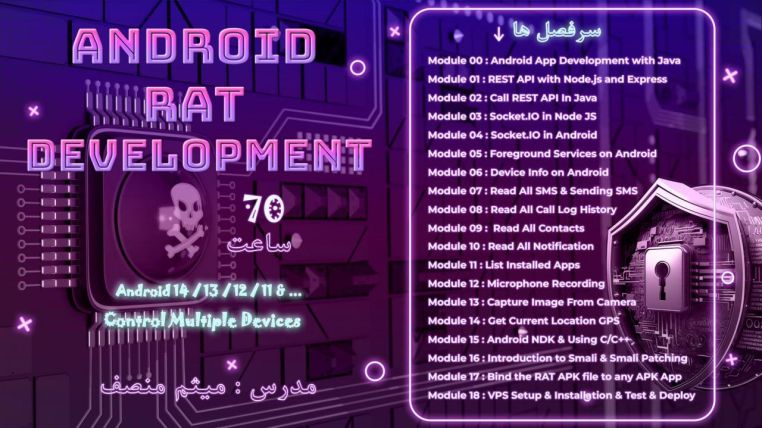
The course structure reveals a systematic build-up from basic application development to highly intrusive functionalities. Initial modules establish app and backend development foundations using Java and Node.js with REST APIs, followed by integration of real-time communication protocols through Socket.IO. This enables persistent control and data exchange between the attacker and compromised devices.
Later modules shift to offensive capabilities: extracting SMS content, contact lists, call logs, and notifications, all of which breach personal privacy and can fuel further social engineering. Capturing microphone audio and images from the camera escalates this breach to physical surveillance. GPS location access adds persistent physical tracking, enhancing threats such as stalking or physical targeting.
Use of Android NDK and Smali patching indicates binary-level modification of APKs, including obfuscation and embedding malicious payloads. The RAT binding module formalizes this into a deployment method that repackages trojans inside benign apps, masking intent. The course ends with instruction on VPS deployment, allowing mass infection and device management remotely.
Intent centers on creating a scalable infrastructure for mass surveillance, data theft, and persistent device access. Motivation appears profit-driven with secondary attraction for ideological actors or criminal syndicates. Use of Persian, pricing in Iranian tomans, and the instructor name (میثم منصف / Meysam Monsaf) suggest origin or target focus within Iran, though the tools are globally applicable.
Maliciousness is high. Every functional module directly contributes to unauthorized data access, surveillance, or device control. The course encourages automation and scaling through backend APIs and remote shell management, removing the need for user presence. Lethality, while not physical, ranks high in information warfare: persistent control of a user’s communications, identity, geolocation, and audiovisual inputs enables tailored psychological operations, blackmail, and destruction of digital trust.
The course aligns with the tradecraft of cyber mercenaries, APT-aligned actors, and financially motivated criminal groups. It is an instructional product for mobile spyware developers, posing significant threats to journalists, activists, corporate executives, and diplomatic staff. The disclaimer stating that “misuse is the responsibility of the learner” attempts a legal shield, but does not diminish the explicitly malicious design. Hosting and sale of this training may violate cybersecurity laws in multiple jurisdictions and constitutes a high-risk proliferation of offensive cyber capabilities.


You must be logged in to post a comment.