


In their words – mostly
The FBI put on the wanted list the ex-producer of the station “Moscow Speaks” Natalia Burlinova
It is reported that she is suspected of recruiting Americans on the instructions of the FSB. According to the investigation, in exchange for funding, she gave the Russian intelligence service data on those Americans who managed to recruit. Among the information were passport details, resumes, photos and analysis of citizens’ views on Russia.
Burlinova denies any accusations against her in this regard.
Associate Professor of the Faculty of World Politics at Moscow State University Natalya Burlinova is wanted by the FBI – American security officials believe that she recruited US citizens on a tip from the FSB of the Russian Federation.
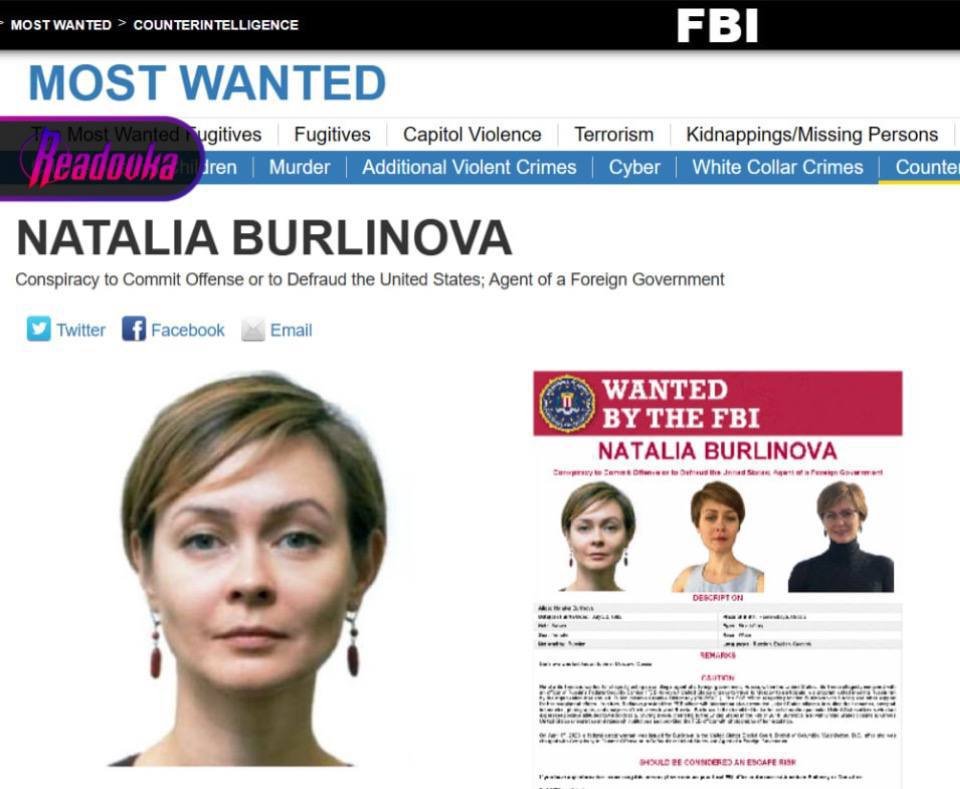
According to the investigation, Burlinova acted in the United States as a foreign agent – she allegedly was in cahoots with a Russian FSB officer. In the fall of 2018, the woman visited US universities and research institutes, where she was engaged in “recruiting Americans.”
The FBI alleges that the FSB officer financed the recruiting trips of the Russian woman. In return, she provided the officer with information about US citizens – resumes, photographs, passport details, information about political views on Russia. Another task, according to the investigation, was to identify specific recruited Americans for further cooperation.
A Colombian court issued an arrest warrant for Natalia. She is charged with conspiring with an FSB officer to work as an unregistered foreign agent and collect information on US citizens.
June 2022
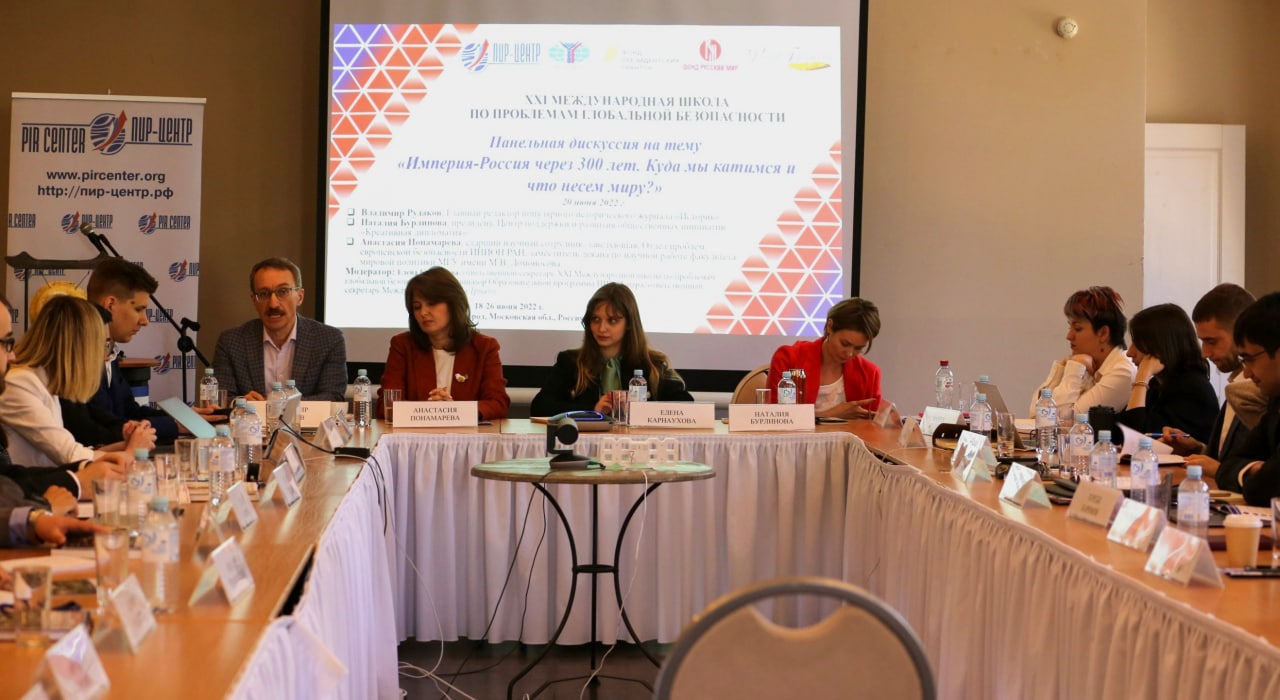
PIR Center School hosted a panel session on the topic “Empire-Russia in 300 years. Where are we going and what are we bringing to the world?
The lecturers were the editor-in-chief of the popular historical magazine “Istorik” Vladimir Rudakov , the president of “Creative Diplomacy” Natalya Burlinova , the head of the European security department of the INION RAS, the deputy dean for scientific work of the Faculty of International Relations of Moscow State University named after M.V. Lomonosova Anastasia Ponamareva :
Vladimir Rudakov:
What is an empire? This is sovereignty + large territory + powerful state + influence (military, economic, cultural and ideological).
Russia will always claim sovereignty and imperialism. Attempts to “de-empire” Russia will lead to retaliatory measures.
Most countries of the world perceive Russia as an empire, and not as a “normal” country.
Natalya Burlinova:
In Russia, there are those who hate the word “empire”, and there are those who extol it.
We bring to the world the understanding that you can do your own thing.
Part of the world supports us for “breaking the system”, part hates us for breaking the cozy world they are used to.
Russian society is very democratic, there are supporters of completely different points of view. Nevertheless, it is necessary to articulate common values - sovereignty and the ability to ensure it.
Most of the states of the world today do not have sovereignty.
The Russian leadership has relied on hard power.
The president’s attitude is “we don’t interfere with you and you don’t interfere with us.”
Anastasia Ponamareva:
Modern challenges bring Russia back to the question of the key elements of national identity, which implies an appeal to the “glorious past”.
The specificity of Russia: the images of the past are not used as a justification for existing values, but they themselves claim to play this role.
Since 2014, there has been an ideologization of foreign policy rhetoric and an increased emphasis on the use of soft power. And today, the ideology based on the significance of the victory over Nazism is getting its practical sound.
Russia has two roles in the West – “enemy at the gate” and “eternal apprentice”.
We need a way out of the “memorial stage” – a request for a left turn and social justice, vertical social elevators, a departure from gerontocracy.
July 2022
The United States has expanded sanctions against the Russian Federation “in connection with Russian interference in elections and hacker activities.” The restrictive list included 2 individuals and 4 legal entities, namely:
▪️Alexander Ionov, founder of the Public Committee for the Detection of Foreign Interference;
▪️Natalya Burlinova, founder of the Creative Diplomacy Center;
▪️”Anti-globalization movement of Russia”;
▪️ “Center for Support and Development of Public Initiatives “Creative Diplomacy””;
▪️“Ionov Transcontinental”;
▪️Global News Agency Stop Imperialism.
September 2022
Ph.D. in Political Science, President of the Center for Support and Development of Public Initiatives – “Creative Diplomacy”, Associate Professor of Lomonosov Moscow State University, RIAC expert

Ph.D. in Political Science, President of the Center for Support and Development of Public Initiatives – “Creative Diplomacy”, Associate Professor of Lomonosov Moscow State University, RIAC expert
In the context of the events around Ukraine, a discussion on the issue of “soft power” has unfolded in the Russian TG community in recent months. In Russia, in general, they love this phrase, although they have little idea what is behind it.
Natalia Burlinova:
A political manifesto about who we are
1
In the United States, formal charges were brought against Alexander Ionov, after whose denunciations the media recognized him as “foreign agents”
A Tampa, Florida grand jury has formally indicted Russian public figure Alexander Ionov, two FSB officers, and four US citizens for long-term anti-American propaganda and interference in local elections in St. Petersburg, Florida. This was reported on the website of the US Department of Justice.
They are accused of conducting “a multi-year campaign of harmful foreign influence in the United States.” The indictment alleges that Alexander Ionov and his FSB handlers Alexei Sukhodolov and Yegor Popov since 2014 recruited members of three political organizations in Florida, Georgia and California, who subsequently sowed discord and spread Russian propaganda. The Ministry of Justice believes that the defendants thus tried to create the illusion of “popular support” in the United States for Russia’s actions against Ukraine and the annexation of Ukrainian territories.
In particular, according to a press release, intelligence officials secretly supported, including financially, a candidate for a certain position during the elections in St. Petersburg (Florida) in 2019.
In addition, a separate case was opened in the District of Columbia against a Russian citizen, the head of the Moscow-based Public Initiative Creative Diplomacy, Natalya Burlinova, who was allegedly in cahoots with an FSB officer and was acting as Russia’s illegal agent in the United States. The defendant invited scientists from the United States to the organization, but did not register as a foreign agent, thereby violating the law of the country.
Alexander Ionov heads the Anti-Globalization Movement of Russia organization, and from 2016 to 2019 he was a member of the Public Monitoring Commission of Moscow.
Following Ionov’s complaints, in 2021, the Russian Ministry of Justice included the Meduza and Important Stories publications in the register of media outlets performing the function of a “foreign agent.” Also, after his appeal, the American Bard College was recognized as an “undesirable” organization.
In addition, in August 2021, Ionov sued Novaya Gazeta over an article about the connections of the Anti-Globalization Movement of Russia with foreign organizations that received funding from the United States.
Indeed, Ukraine is an example, let’s call a spade a spade, of the failure of Russian “soft power” abroad. In the same line of unsuccessful cases are Georgia, Moldova, however, with varying degrees of failure, all the former republics of the once united state can be attributed here, with the exception of the Republic of Belarus, which is in alliance with Russia for objective domestic and foreign policy circumstances. Nevertheless, it was Ukraine that became the most important Russian Tsushima in the field of humanitarian influence. And this is especially painful for Russian society also because it was in Ukraine that the whole set of humanitarian factors that made it possible to hope for a successful outcome of the use of “soft power” initially existed. However, this did not happen.
Why did this happen? You can list all the scientific approaches to the interpretation of “soft power” for a long time and boringly, recall the concept of Joseph Nye, talk about financial, project and other components of common success, about the lack of attention to Ukraine from Russian humanitarian structures throughout the post-Soviet years. But these are side things. In general terms, the answer will be very simple – the lack of a political attitude in the power vertical of Russia to the development of “soft power”.
Critics will say, why use an American term? It is not suitable for Russia. However, the point is not at all in the term, whatever you call it – “soft power” or humanitarian policy (as it was defined in the recently adopted Concept of Humanitarian Policy of the Russian Federation) – the essence of this will not change. We are talking about the long-term building of such humanitarian relations, when your partner does not even think about choosing another ally besides you, since he is focused on you by all threads – from economics to culture. Such relations, for example, were built by the United States after the war with the countries of Europe. Today we see the result of this policy. Without any military coercion, the countries of the European Union fully and unconditionally follow in the wake of Washington, even to the detriment of their own economic interests. This is the result of “soft power”.

Andrei Kortunov: Three Decades of Painful Adjustments:
Russia in the Post-Soviet Space
But let’s return to the lack of a political attitude in Russia to “soft power”. The development of our country’s humanitarian policy towards its closest neighbors has always been lame in the history of the new Russia. In the 90s and early 2000s, there was no time for that, and later the bet was made on “hard power”. The humanitarian package simply fell out of the new political concept. Yes, money has been allocated and continues to be allocated for events, forums, round tables, but their result is minimal, because there is no systematic work, because, as in many other areas of Russian public life, players in this area are required to have an immediate, ostentatious result, and not a meaningful long-term effectiveness of projects. Systemic issues have not been resolved, and are not being resolved, such as: increasing academic mobility, introducing a system of short-term grants for foreign students and other target audiences, extending grant support to foreign organizations, permanent formats of work with the political elite and many other tools, the use of which ten years ago could help stop the process of humanitarian disintegration and distancing of the same Ukraine and other post-Soviet countries from Russia. On the contrary, the country is adopting laws that do not facilitate, but significantly complicate the already problematic activities of organizations involved in international contacts, putting Russian public diplomacy in such conditions that it should be reduced like shagreen leather.
An important component of building humanitarian cooperation within the framework of allied relations is to focus on the ally and its particularity.
The point is that “soft power” is promoted not only through the marketing of oneself, one’s culture and one’s significance for an ally, but through respect and attention to an ally, the implementation of interesting and important projects related to his cultural characteristics, about treating an ally with respect regardless of its geographical size.
Vitaly Smyshlyaev:
Conjugation Strategy Instead of “Soft Power”
The political attitude towards “soft power” means that the elites are betting on the development of their own country in the direction of a modern intellectual society, where education, science, high technologies are in demand and are a competitive advantage of the state in the international arena. Allies go to someone who will protect interests in any case without any halftones and political games – simply because in a long-term strategy, the interests of partners do not contradict each other.
“Soft power” and alliance are closely linked, without the first there is no solid foundation for the second. Of course, with the help of “hard power” it is possible to acquire allies, but only these will be temporary alliances that are not sealed by real sympathy and partnership. We have already gone through this in the history of the Soviet Union. Russia needs allies not for show, we need those who want to move forward together, united with us by common interests, goals and objectives, and not out of despair. To do this, new people with strategic thinking, great patience and a conceptually new approach to the internal and external development of Russia should appear in the political elite of our country, with which many countries will definitely want to build alliances and build their future. We have such people


You must be logged in to post a comment.