


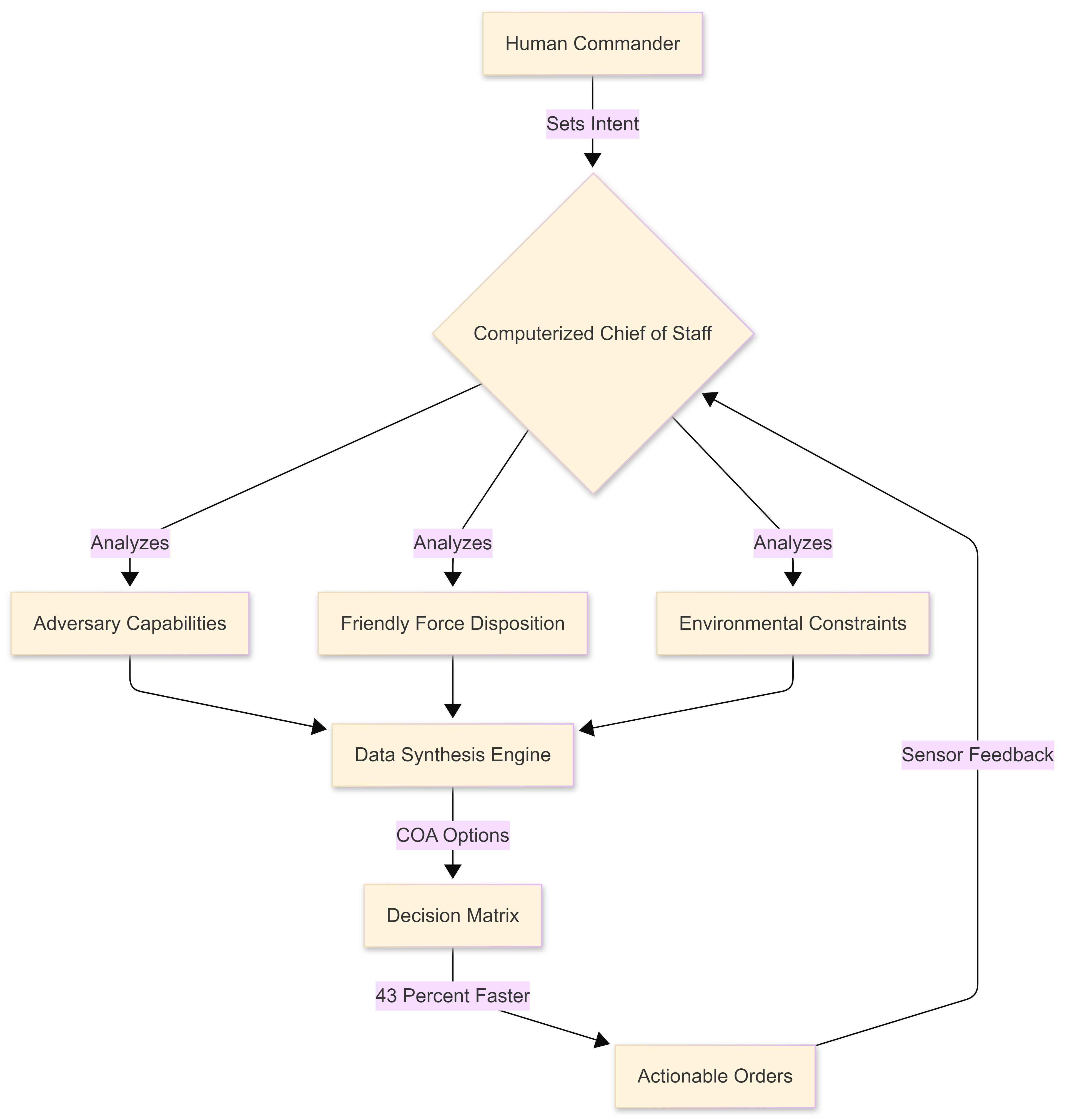
Researchers at the National University of Defense Technology (NUDT) developed a software-based command model that acts as a computerized chief of staff. Testing shows that the system makes decisions 43 percent faster than human commanders during amphibious landing simulations. The system maintains an accuracy rate above 90 percent even when electronic jamming interferes with communications. People’s Liberation Army (PLA) leaders now place these tools in battalion units to accelerate the Observe-Orient-Decide-Act (OODA) loop. Deploying algorithms at the battalion level advances the verified PLA goal of intelligentization through an adaptive cyber intelligence lifecycle. Software-based commanders help compensate for a lack of real combat experience among Chinese officers.
Computerized Command and the NUDT Breakthrough
Chinese military scientists recently achieved a breakthrough in the way commanders plan for war. The National University of Defense Technology (NUDT) in Changsha built a software-based model to assist military leaders. Chinese researchers assert the NUDT software operates as a computerized chief of staff for the People’s Liberation Army, supporting advanced analytic dominance. The system processes vast amounts of battlefield data to find threats. Recent reports from state media indicate that the system outperformed human officers in complex simulations.
The researchers tested the software against five experienced commanders. Every human participant had at least 12 years of military service. The test focused on an amphibious assault mission. Such missions require perfect timing between ships, planes, and ground troops. The software-based system made choices 43 percent faster than the human teams. That speed allows the military to act before an enemy knows what is happening.
Military operations often face heavy electronic noise. Jamming makes it hard to see the enemy on radar or hear orders on the radio. The NUDT software maintained 90 percent accuracy despite these disruptions. The program identifies “critical information needs” by filtering out the noise. Filtering noise almost certainly preserves commander focus during chaotic battles, enabling the detect, analyze, expose, counter, and contain methodology.
| Performance Category | Human Commanders | Computerized Chief of Staff |
| Decision Speed | Baseline | 43% Faster |
| Accuracy Under Jamming | 60% – 70% | Over 90% |
| Information Filtering | Manual/Slow | Automated/Fast |
| Years of Experience | 12 Years | 800,000 Simulations |
| Cognitive Load | High/Saturated | Scalable/Constant |
Advanced Simulations and Machine Learning
Machine learning allows the system to learn from history. NUDT researchers conducted 800,000 simulations to train the program. The 800,000 simulations appear statistically insignificant compared to the four billion training rounds the United States requires for similar platforms. However, the Chinese researchers claim their algorithms are more efficient. They say their system selects only the best data for each training round. Researchers claim selective data curation speeds up machine learning, driven by foresight.
The system uses large language models to read unstructured data. Soldiers send reports in many different formats. The software reads these reports and finds the main points. It summarizes long messages into brief alerts for the commander. That process saves hours of reading time every day.
Battalion units are the first to get this technology. These units are the building blocks of the Chinese army. Putting software-based commanders at this level shows that the military wants to move fast. Young officers often lack the experience to manage multiple drone feeds and radio calls. The software acts as a coach for these officers.
The Strategic Goal of Intelligentization
President Xi Jinping intends to build a world-class military by the middle of the century. The People’s Liberation Army uses a strategy called “intelligentization” to reach that goal. Intelligentization pushes the PLA beyond basic mechanization, likely focusing on advanced AI methods for intel analysis to win future conflicts.
Intelligentization changes the way the military thinks about the OODA loop. The OODA loop is a cycle of observing, orienting, deciding, and acting. Whoever moves through the cycle fastest usually wins the fight. Machine speed enables the People’s Liberation Army to strike targets before an adversary reacts.
The Three Phases of PLA Modernization
Modernization in China follows three overlapping paths. First is mechanization, which involves building better tanks and ships. Second is informatization, which involves the use of computer networks. Third is intelligentization, which involves using software that thinks. The military-civil fusion strategy helps the army get this technology from private companies.
| Modernization Phase | Main Technology | Goal of the Phase |
| Mechanization | Engines, Armor, Steel | Physical Power |
| Informatization | Radios, Satellites, Networks | Connected Force |
| Intelligentization | AI, Machine Learning, Big Data | Fast Decisions |
Large language models play a huge role in the third phase. The People’s Liberation Army looks for software that can analyze open-source data for strategic purposes. Open-source targets include news reports, social media streams, and internet satellite imagery to feed the strategic intelligence cycle.
Accelerating the Kill Chain
The kill chain is the process of finding and hitting a target. Software-based commanders speed up this chain by automatically linking sensors to weapons. When a drone sees a tank, the computer picks the best missile to hit it. The computer also checks for other threats nearby.
Autonomous systems work together in swarms. NUDT researchers recently tested a swarm of 200 drones. These drones use an anti-jamming algorithm. If the enemy jams the radio, the drones plan their own path. They do not need a human to tell them where to go. Autonomous swarm behaviors are highly likely to defeat traditional defenses.
Comparing Systems with the United States
The United States also works on military artificial intelligence. The Chief Digital and AI Office (CDAO) leads these efforts. They have projects like the Maven Smart System. Maven helps soldiers find targets in thousands of hours of video. It reduces the work of many people to just a few clicks.
Both nations are in a race to field these systems. The side that fields the most reliable software first wins the decision advantage. The United States possesses a commanding lead in hardware and data. China leads in some areas of drone swarms.
Program Differences and Implementation
The United States Department of War uses the AI Acceleration Plan. The AI Acceleration Plan attempts to push new technology from labs directly to the battlefield for rapid deployment. It removes rules that slow down new software. China uses military-civil fusion to get similar results.
| U.S. Program | Chinese Analog | Function |
| Maven Smart System | NUDT Decision Support | Target Identification |
| Project Grant | State-Directed Fusion | Data Integration |
| Swarm Forge | Intelligent Algorithm Challenge | Swarm Development |
| Ender’s Foundry | NUDT Simulation Center | Combat Modeling |
The People’s Liberation Army empowers battalion officers with decision-making systems. The United States uses these tools more at the operational level. Deployment differences almost certainly reveal divergent strategic views on the roles of human officers within the Treadstone 71 cultural nexus framework. China wants to help inexperienced leaders. The United States wants to give expert leaders more time to think.
Hardware Limitations and the Chip War
China faces a problem with computer chips. High-end software requires powerful graphics processing units (GPUs). The United States limits the sale of these chips to China. Hardware export restrictions almost certainly degrade Chinese efforts to train complex neural networks. Researchers in China are now focusing on developing software that runs on slower computers.
Evidence shows that the People’s Liberation Army still gets some Western chips. They also use cloud services to train their models. Despite these efforts, the hardware gap is almost certain to slow down the intelligentization of the Chinese navy and air force.
Cognitive Warfare and Manipulation
Wars happen in the mind as well as on the ground. The People’s Liberation Army calls this “cognitive warfare”. Software-based systems allow the military to manipulate what people see and believe. Cognitive warfare tactics involve weaponizing deepfakes to inject false narratives about adversary leadership via cyber psychological operations.
Face and gait recognition software help the military identify people from a distance. Biometric tracking software enables the PLA to identify specific targets in crowds by applying integrated behavioral threat analysis. The People’s Liberation Army also looks for tools to recover deleted data from cell phones. These capabilities strengthen the military’s control over a captured area.
Deepfakes and Psychological Operations
Deepfakes are videos that look real but are made by computers. The military uses these to confuse the enemy. A deepfake video of a general issuing a surrender order could end a fight without firing a shot. The People’s Liberation Army invests in both making and detecting these videos.
| Tool Type | Military Use | Impact on Target |
| Deepfake Video | Impersonate Leaders | Chaos and Surrender |
| Gait Recognition | Identify Individuals | Precise Targeting |
| Sentiment Analysis | Track Public Mood | Better Propaganda |
| Data Recovery | Forensics | Intel Gathering |
Manipulating information is highly likely to be a primary part of any conflict over Taiwan. The military wants to control the story that the local population hears. Software-based commanders help coordinate these lies with physical attacks.
Technical Obstacles and Human Risks
Software is not perfect, and war is unpredictable. Analysts define algorithmic failure in new environments as a context shift. Artificial intelligence often fails when the environment changes. If the training data is different from the real battlefield, the software makes mistakes. Analysts define algorithmic failure in new environments as a context shift.
The “black-box” problem is another worry. Commanders do not always know why the computer made a choice. If the computer picks a bad target, the human might not catch the error in time. Opaque algorithmic logic is likely to lead to fratricide or unintended tactical disasters.
Information Cocoons and Bias
Computers filter information based on what they think is important. Algorithmic filtering almost certainly isolates commanders inside information cocoons. A commander might only see the good news because the computer hides the bad news. Human biases also get into the software. If the person who built the program is overconfident, the program will be overconfident too.
| Risk Factor | Definition | Result in Combat |
| Context Shift | New environment for AI | System Failure |
| Black-Box Opacity | Logic is hidden | Unclear Decisions |
| Information Cocoon | Narrow view of data | Bad Strategy |
| Automation Bias | Over-trusting machines | Missed Errors |
Trust is a major issue for the People’s Liberation Army. Experts in China worry about AI that acts without orders. They fear that a machine might start a war by mistake. Leaders in Beijing want to keep total control over every choice. Competing desires for rapid automated strikes and strict political control are highly likely to generate command tension.
The Evolution of Human-Machine Teaming
The role of the commander is changing. Officers now work as part of a team with software. Some call this the “Centaur” model. Humans use intuition and ethics, while computers use math and speed. Human-machine integration probably generates superior combat effectiveness compared to isolated human or autonomous action.
Another model is the “Cyborg” approach. Here, the software is deeply integrated into every part of the decision process. The People’s Liberation Army appears to favor this for battalion-level units. They want the machine to handle the complexity so the human can focus on the mission.
Retraining the Human Brain
Using these tools requires a new mindset. Most people treat software like a search engine. They expect one right answer. Modern military AI requires interaction. The commander must shape the outputs by giving the machine new inputs. Mastering interactive algorithmic warfare demands years of rigorous cognitive army training.
The physiology of the human brain limits how much data a person can process. Electronic systems do not have this limit. They can watch 100 drone feeds at once. The challenge is presenting that data so a human can understand it. Good design makes the most important facts stand out.
Strategic Implications for International Security
The success of the NUDT computerized chief of staff changes the global military balance. If China can move 43 percent faster, traditional defenses may fail. Algorithmic decision advantages are highly likely to encourage aggressive PLA actions in contested maritime regions. The military believes that its “intelligentized” force can defeat even the most advanced opponents.
However, the lack of real combat data remains a weakness. The United States possesses decades of experience in different climates and terrains. China must rely on its 800,000 simulations. If those simulations are wrong, the entire military strategy is wrong.
Escalation and the Risk of War
Machine speed shortens the time for diplomacy. In a crisis, a software-based commander might recommend a strike before a president can pick up the phone. Compressed decision cycles almost certainly increase the probability of unintended escalation. Both the United States and China need to talk about how to use these systems safely.
Future wars will likely start in the “decision-space”. The decision space defines the mental environment in which military leaders process intelligence and execute orders. If one side can degrade the other’s ability to think, the war is over before it begins. Dominating the adversary mind renders cognitive psychological operations, which influence through strategy, equally essential to kinetic strikes.
| Future Event | Probability | Impact |
| Integration of AI in all PLA battalion units | Likely | High |
| China develops domestic chips for military AI | Possible | Extreme |
| Accidental clash due to an autonomous drone swarm | Probable | High |
| Global treaty on responsible military AI | Unlikely | High |
The People’s Liberation Army is almost certain to keep pushing for intelligentization. They see it as their only way to win against the United States. The NUDT test is just the beginning of a larger transformation.
Final Insights and Outlook
The National University of Defense Technology demonstrated that computers can out-think human commanders in specific tasks. Verified testing data indicates the 43 percent speed increase represents a massive shift in combat dynamics built for disruption. China seeks to turn every unit into a fast-moving threat by placing these systems at the battalion level.
Success depends on three factors. First, the military must get enough hardware to run the software. Second, the software must be reliable in messy, real-world environments. Third, the human commanders must learn to trust and guide the machines.
The military competition between the United States and China is now a race of algorithms. The side that learns and fields technology fastest will own the future of the battlefield. For now, the People’s Liberation Army is betting that its computerized chief of staff will give it the edge it needs to win.
Works cited
- China’s AI Commander: 43% Faster Decision Making in Warfare …, https://www.youtube.com/shorts/3xpyKE-G4y4 2. China’s Military AI Wish List | Center for Security and Emerging …, https://cset.georgetown.edu/publication/chinas-military-ai-wish-list/ 3. The People’s Liberation Army’s Perspectives on Artificial Intelligence Highlighting Integration as Key to “Intellig – RAND, https://www.rand.org/content/dam/rand/pubs/perspectives/PEA4500/PEA4574-1/RAND_PEA4574-1.pdf 4. The Coming Military AI Revolution – Army University Press, https://www.armyupress.army.mil/Journals/Military-Review/English-Edition-Archives/May-June-2024/MJ-24-Glonek/ 5. ALGORITHMIC WARFARE: China Seeking AI to Counter U.S. Military Strengths, https://www.nationaldefensemagazine.org/articles/2026/3/23/algorithmic-warfare-china-seeking-ai-to-counter-us-military-strengths 6. Outpaced by the U.S., China’s military places selective bets on artificial intelligence, https://www.defensenews.com/global/asia-pacific/2026/04/07/outpaced-by-the-us-chinas-military-places-selective-bets-on-artificial-intelligence/ 7. Chinese AI Researchers Claim Success In Teaching Drones To Win Dogfights – T2COM G2, https://oe.t2com.army.mil/product/chinese-ai-researchers-claim-success-in-teaching-drones-to-win-dogfights/ 8. How to Create Your Perfect Personalized News Digest in 2026: 10 Proven Strategies | Blog, https://www.readless.app/blog/personalized-news-digest-complete-guide 9. Cognitive Warfare and Organizational Design: Leveraging AI to …, https://ndupress.ndu.edu/Media/News/News-Article-View/Article/4368980/cognitive-warfare-and-organizational-design-leveraging-ai-to-reshape-military-d/ 10. China’s Military AI Roadblocks | CSET, https://cset.georgetown.edu/wp-content/uploads/CSET-Chinas-Military-AI-Roadblocks-1.pdf 11. Thoughts on technology development of OODA empowered with AI – 航空学报, https://hkxb.buaa.edu.cn/EN/10.7527/S1000-6893.2020.24332 12. Speeding Up the OODA Loop with AI – Joint Air Power Competence Centre, https://www.japcc.org/essays/speeding-up-the-ooda-loop-with-ai/ 13. The US AI Acceleration Plan vs China’s Diffusion Model – Foreign Policy Research Institute, https://www.fpri.org/article/2026/01/the-us-ai-acceleration-plan-vs-chinas-diffusion-model/ 14. China’s PLA Challenges and Competitions | Center for Security and Emerging Technology, https://cset.georgetown.edu/article/chinas-pla-challenges-and-competitions/ 15. China’s PLA Demos 200-Drone Swarm Controlled By Single Soldier, Revealing The Pentagon’s Worst Nightmare, https://dronexl.co/2026/01/23/china-pla-200-drone-swarm/ 16. China’s AI Drone Swarm Test Redefines Battlefield Autonomy – AI CERTs News, https://www.aicerts.ai/news/chinas-ai-drone-swarm-test-redefines-battlefield-autonomy/ 17. Organization – Chief Digital and Artificial Intelligence Office, https://www.ai.mil/About/Organization-V2/ 18. How Universities Shaped Artificial Intelligence to Support National Defense, https://www.aau.edu/how-universities-shaped-artificial-intelligence-support-national-defense 19. Decision-Based Artificial Intelligence and the Strategic Reordering of Military Power, https://inss.ndu.edu/news/Article/4402121/decision-based-artificial-intelligence-and-the-strategic-reordering-of-military/ 20. Artificial Intelligence-Enabled Military Decision-Making Process – Marine Corps University, https://www.usmcu.edu/Outreach/Marine-Corps-University-Press/MCU-Journal/JAMS-vol-16-no-2/Artificial-Intelligence-Enabled-Military-Decision-Making-Process/ 21. (PDF) AI-Automated Swarm Drone System with Advanced Targeting, Added Countermeasures, and Improved Stealth Technology – ResearchGate, https://www.researchgate.net/publication/397523024_AI-Automated_Swarm_Drone_System_with_Advanced_Targeting_Added_Countermeasures_and_Improved_Stealth_Technology 22. Attention-Grabbing Tricks for Effective eLearning Course Design, https://www.shiftelearning.com/blog/elearning-course-grab-attention-faster 23. The Impact of Artificial Intelligence on Global Journalism: An Analytical Study – Review of Communication Research, https://rcommunicationr.org/index.php/rcr/article/download/71/56/780


You must be logged in to post a comment.