


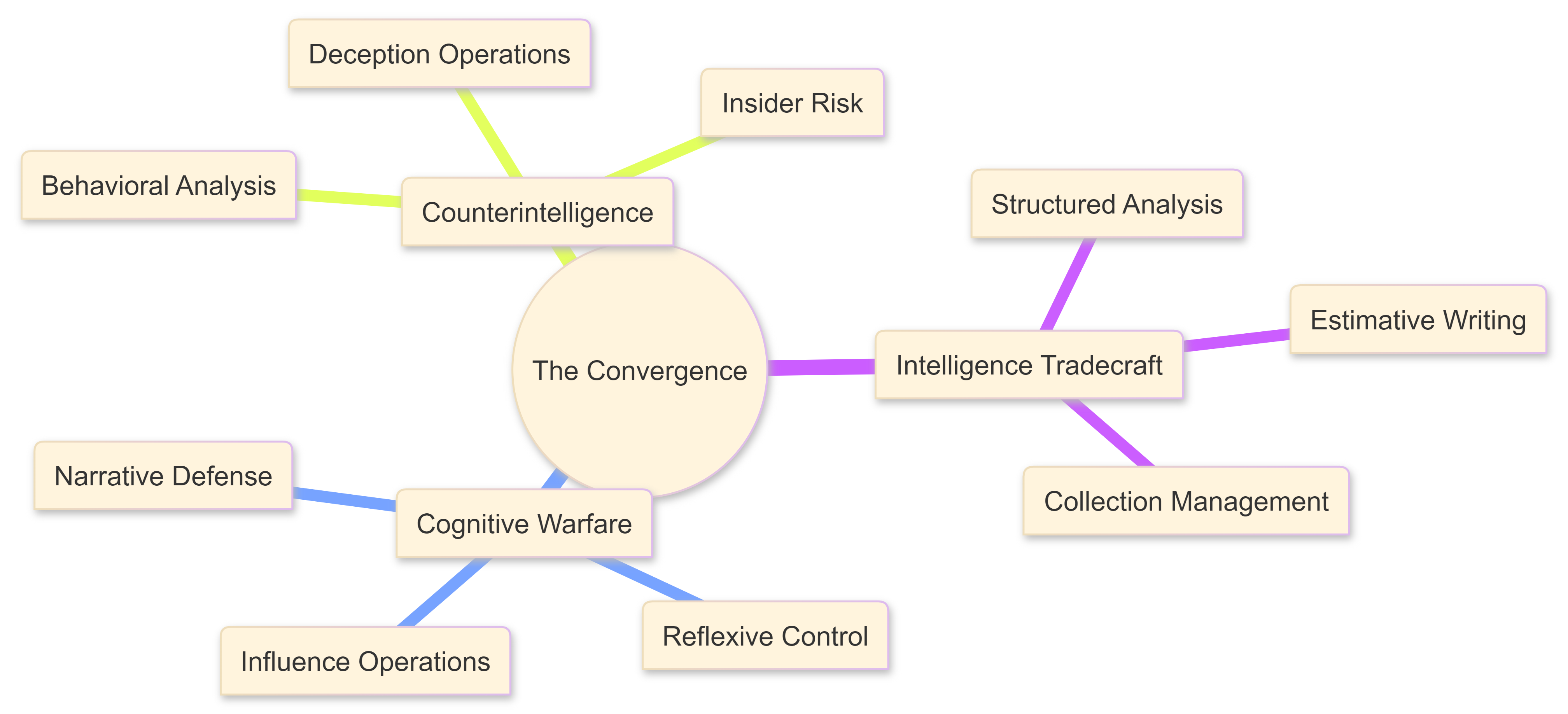
Treadstone 71 integrates intelligence tradecraft, cognitive warfare, and counterintelligence into one operational discipline. Modern adversaries execute hybrid operations that combine network intrusions with narrative manipulation. Synthetic media makes cognitive attacks cheap and frequent. Insider threats increase alongside remote work models. Organizations lacking unified defenses experience narrative loss and strategic surprise. Threat actors almost certainly will expand coordinated influence operations. Organizations lacking counterintelligence discipline highly likely face severe operational compromises.
Introduction
Adversaries no longer separate their attack methods. A hostile actor targets a corporate network, manipulates public narratives, and recruits insiders simultaneously. Defensive programs typically fail to match the integrated attacks. Treadstone 71 merges three core disciplines to close the gap. Security teams require an operational capability that matches the broad approach. We examine the core pillars of the convergence methodology, analyze current threat patterns, and forecast future adversary operations.
Intelligence Tradecraft Fundamentals
Organizations often confuse data collection with intelligence production. Threat feeds provide network indicators but lack strategic context. Intelligence tradecraft offers a structured method for analysis under uncertainty. Analysts highly likely need advanced analytic dominance structured analytic techniques to produce decision-grade assessments. Intelligence programs degrade into basic information services without proper tradecraft. Treadstone 71 teaches analytic writing and structured collection management. Evidence confirms regulators increasingly demand documented analytic rigor for risk reporting. Analysts must rank evidence and mark uncertainty to avoid strategic surprise. The adaptive cyber intelligence lifecycle built for disruption driven by foresight provides a continuous operational advantage.
Cognitive Warfare and Narrative Defense
Hostile actors employ reflexive control and synthetic media to force predetermined executive decisions. State-aligned groups conduct coordinated influence operations that alter stock prices and damage corporate reputations. Forensic linguistic analysis and semiotic evaluation expose inauthentic amplification networks. Trend analysis shows artificial intelligence generation has industrialized narrative attacks. Defenders almost certainly require cognitive warfare doctrine to counter coordinated campaigns. Verified facts indicate hostile narratives harden quickly if organizations fail to detect, analyze, expose, counter, and contain the adversary framing. Cyber psychological operations influencing through strategy empower defenders to dismantle hostile campaigns. A cognitive army provides necessary resistance against industrialized manipulation.
Counterintelligence Operations
Insider threats present a severe risk to organizational stability. Counterintelligence protects sources, methods, and strategic plans. Aggregation analysis reveals adversary recruitment via social platforms happens frequently. Companies rarely build dedicated counterintelligence functions. Treadstone 71 incorporates integrated behavioral threat analysis to profile adversary decision architectures. Analysts must separate verified insider risk indicators from normal employee baseline behavior. The cultural nexus framework helps operators map socio-cultural motivations accurately. Intelligence STEMPLES Plus provides the ultimate framework to assess cyber capabilities and environmental risks. Years of advantage disappear in a single disclosure when organizations ignore counterintelligence principles. Advanced intel analysis infused with AI methods accelerates threat identification.
Market Capabilities Assessment
Standard security vendors focus on specific technical areas. The convergence model addresses the gaps left by traditional providers.
| Capability Area | Threat Intel Vendors | Management Consultancies | Red Teams | Treadstone 71 |
| Analytic Writing Standards | Low | Low | Low | High |
| Cognitive Warfare Doctrine | None | None | None | High |
| Reflexive Control Defense | None | None | None | High |
| Counterintelligence Focus | None | None | None | High |
| Endpoint Telemetry | High | None | Low | Out of Scope |
Threat Patterns and Tendency Analysis
State and state-aligned actors blend economic, regulatory, and cognitive operations against single targets. Single-domain defenses face structural disadvantages. Deepfakes and voice cloning have transitioned from novelties to standard attack infrastructure. Layoffs and remote work have repriced insider risk. Securing an organization requires tracking behavioral anomalies and identifying toxic supply-chain psychology. Analysts assess with high confidence that hybrid operations almost certainly will become the default attack method.
The convergence of intelligence tradecraft, cognitive warfare, and counterintelligence provides a necessary defense against modern adversaries. Technical detection alone fails to stop narrative manipulation or insider threats. Organizations must adopt structured analytic techniques and cognitive warfare doctrine. Leaders who integrate the disciplines will highly likely maintain a decision advantage. Failing to adapt almost certainly guarantees strategic surprise and narrative defeat.


You must be logged in to post a comment.