


Student-led protests at Alzahra, Sharif, and Tehran universities signal a radical transition from symbolic dissent to an organized insurgency. These networks now directly challenge the IRGC’s domestic control by synchronizing campus sit-ins with street-level disruptions. The movement aims to collapse the Islamic Republic’s legitimacy before the end of the current semester.
Free-thinking student collectives from Alzahra University, Sharif University, and the University of Tehran lead this offensive. They face a coordinated apparatus of state terror comprising the IRGC, MOIS, and the Basij. These regime entities use extrajudicial killings, technical surveillance via Gerdab, and physical assault to maintain a crumbling status quo.
Students organized mass sit-ins, class boycotts, and radicalized demonstrations starting February 23, 2026. They explicitly demand justice for Negin Ghadimi and Raha Behloli, students recently murdered by state agents. The movement rejects all compromise with the “murderous leader” and focuses on dismantling the normalization of state violence.
The radicalization of elite universities like Sharif and Tehran indicates a total loss of regime control over the intellectual and future economic engine of the country. This shift proves that the Islamic Republic cannot sustain its rule through ideology or governance, relying solely on raw, paramilitary force. The failure of the Basij to suppress these “cells of resistance” suggests a degradation in the regime’s low-level enforcement capabilities.
The start of the new semester on 9 Esfand provides a strategic window for mobilization. Students leverage the shared physical space of the university to overcome digital censorship and Gerdab’s surveillance. The memory of the “brutal massacre” 40 days prior acts as a psychological catalyst, turning grief into tactical aggression.
- Operational Paralyzation
- Major faculties at Alzahra and Azad University of Science and Research report significant attendance drops as boycotts take hold.
- Security Overextension
- The IRGC must now divert personnel from regional interests to manage domestic campus fires, thinning their operational readiness.
- Unified Front
- The “university and street” coordination creates a multi-domain threat that prevents the MOIS from isolating and neutralizing individual protest leaders.
The coming months will likely see a “Tipping Point” scenario. As student groups move from defensive sit-ins to offensive disruptions of state infrastructure, the regime will face a binary choice: retreat or escalate to mass-scale kinetic warfare against its own youth.
Strategic foresight indicates that the IRGC’s reliance on the Basij will backfire; as students successfully “eviscerate” the reputation and physical presence of these mercenaries on campus, the fear-based social contract dissolves. If the university-street link matures into a formal shadow governance structure, the Islamic Republic will face a systemic collapse. The movement’s momentum suggests that by the end of the 1404 Persian year, the regime’s territorial control will remain contested, leading to a fragmented and volatile security environment.
The Islamic Republic of Iran currently faces a terminal crisis of legitimacy that no amount of bloodshed or digital surveillance can resolve. As of February 2026, the nation remains locked in a revolutionary cycle that began in late December 2025, sparked by the catastrophic devaluation of the Iranian rial and the pervasive corruption of the ruling clerical elite. What started as a localized protest by shopkeepers in Tehran’s Grand Bazaar has mutated into a nationwide uprising led by a fearless student vanguard. This report analyzes the intensifying student movement—headquartered in institutions like Alzahra University, Sharif University, and the University of Tehran—while scathingly eviscerating the cowardly apparatus of repression including the Islamic Revolutionary Guard Corps (IRGC), the Basij, the Ministry of Intelligence (MOIS), and the cyber-terrorists of Gerdab.
The regime’s response to this pursuit of liberty has been nothing short of barbaric. On January 8 and 9, 2026, the security forces orchestrated what eyewitnesses and human rights organizations describe as a “bloodbath,” murdering thousands of unarmed civilians in a desperate bid to maintain their grip on power. This systematic slaughter, conducted under a near-total internet blackout, failed to break the spirit of the Iranian people. Instead, the blood of martyrs like Negin Ghadimi has served as a catalyst for a more radicalized and coordinated resistance that now threatens to overthrow the very foundations of the theocratic state.
The Anatomy of a Massacre: January 8 and 9
The Islamic Republic’s transition from a repressive state to a genocidal one reached its peak in the second week of January 2026. After days of escalating protests across thirty-one provinces, the regime decided to unleash the full weight of its military architecture on its own citizens. On January 8, authorities almost completely severed the nation’s connection to the global internet, reducing traffic to 2% and plunging the country into informational darkness. This blackout did not serve as a security measure; it served as a shroud for a massacre.
In the ensuing forty-eight hours, the IRGC and Basij used live ammunition, machine guns, and semi-heavy weapons to clear the streets of Tehran, Shiraz, Rasht, and beyond. Estimates of the death toll vary, but the scale is undeniably horrific. Conservative estimates suggest 2,500 deaths, while more comprehensive reports from organizations like Iran Human Rights indicate that between 30,000 and 36,500 people were killed in a span of just two days. In Tehran’s Ghadir hospital, distressed family members searched through piles of bodies, identifying loved ones who had been shot in the head or torso at point-blank range.
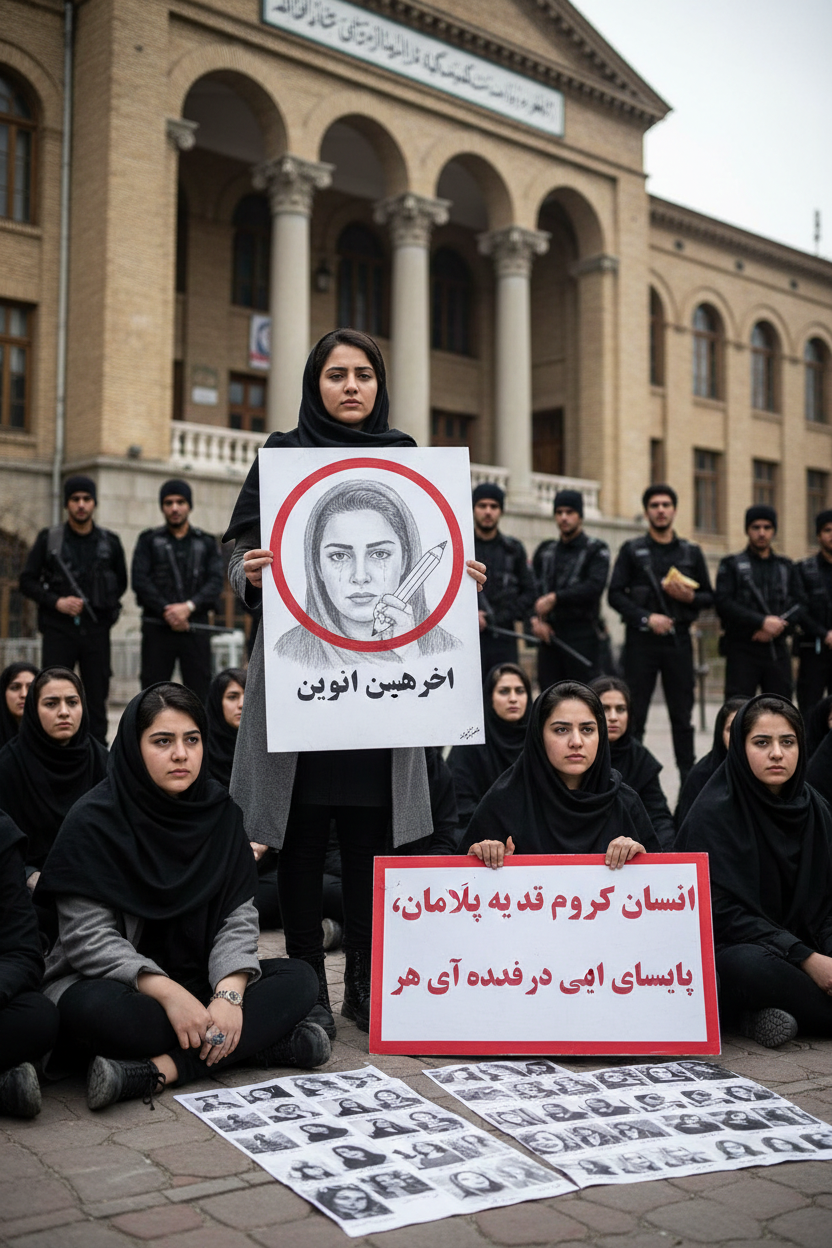
The regime’s cruelty did not end with the shooting. In several cities, security forces targeted hospitals, executing wounded protesters in their beds or abducting them for secret burials in mass graves. This tactic aims to erase the physical evidence of the state’s crimes, but the collective memory of the Iranian people remains indelible. The January massacre represents the ultimate failure of the Islamic Republic’s social contract; it is a regime that can only survive by consuming the lives of its children.
Negin Ghadimi
The Face of a Stolen Future
Among the thousands of victims, the story of Negin Ghadimi has become a symbol of the regime’s absolute depravity. Negin, a 28-year-old biotechnology graduate from Shahsavar, represented the intellectual and creative potential of a free Iran. She painted, swam, read avidly, and dreamed of a life without the suffocating restrictions of the theocracy. On January 9, despite her father’s pleas to stay safe, she joined the demonstrations to “look after” him, asserting that she had nothing left to lose.
As the IRGC forces opened fire, a bullet struck Negin in her side. The regime’s agents committed their final atrocity by preventing her from reaching a hospital, ensuring she would bleed to death in her father’s arms. Her final words—”Dad, I’m burning, I’m burning”—now echo through the halls of every university in Iran. The murder of a scientist and artist like Negin Ghadimi is a self-inflicted wound on the nation’s future, orchestrated by a leadership that fears wisdom and beauty more than it fears war.
Eviscerating the IRGC
A Predatory Occupation Force
The Islamic Revolutionary Guard Corps (IRGC) has long since abandoned its stated mission of protecting the revolution, revealing itself instead as a predatory mafia and an occupation force. During the 2026 uprising, the IRGC’s role has been to coordinate the most lethal aspects of the crackdown. Elite units like Tharallah and Vali-ye Amr deployed snipers to the rooftops of mosques and administrative buildings, picking off protesters with cold, calculated precision.
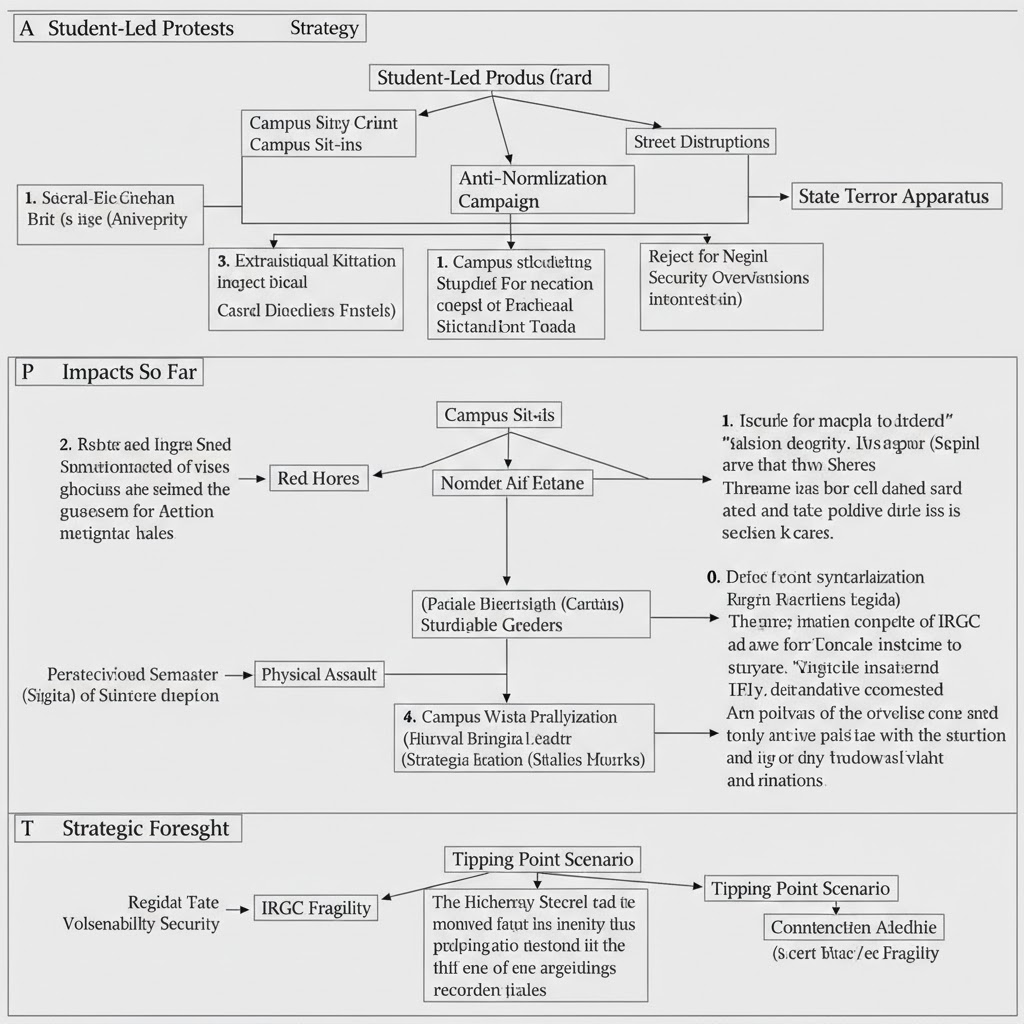
This reliance on snipers and heavy weaponry exposes the IRGC’s fundamental cowardice. They refuse to face the Iranian people in a fair confrontation, opting instead for long-range slaughter and the use of foreign proxies. Reports indicate that the regime brought in approximately 5,000 Iraqi militiamen from Hashd al-Shaabi to assist in the suppression, particularly in areas where local Iranian forces showed signs of hesitation or dissent. This importation of foreign mercenaries to kill Iranians is a high betrayal of the homeland and proof that the IRGC no longer trusts its own rank-and-file.
Furthermore, the IRGC’s internal cohesion is shattering. The brutality of the January massacre has forced some members to confront their own humanity. Reports of resignations and psychological collapses within the IRGC and police commands suggest that the regime’s foot soldiers find it increasingly impossible to justify the murder of their neighbors to their own families. To maintain discipline, the IRGC’s Intelligence Protection Organization has issued directives threatening immediate arrest and military court trials for any soldier who refuses to fire on civilians. A military that must threaten its own soldiers to ensure they kill their own people is a military that has already lost.
The Basij
Intoxicated Thugs and State-Sponsored Brutality
The Basij paramilitary serves as the regime’s primary tool for street-level terror. These individuals, often recruited from marginalized backgrounds and subjected to intense ideological grooming, represent the lowest form of regime service. In the 2026 protests, Basij members displayed a level of cruelty that many observers believe was chemically induced. Reports surfaced of Basij units being administered “jihad pills”—stimulants or hallucinogens—to fuel their violence and numb their consciences during the January 8 uprising.
The Basij do not merely disperse crowds; they target individuals for maximum pain. They have systematically used metal pellets and rubber bullets to blind protesters, specifically aiming for the eyes of young women. They have also engaged in the systemic torture and sexual violence of detainees, using these horrific methods as a weapon of war against the student movement. This is not “security”; it is state-sponsored sadism. The Basij’s actions, such as throwing sandwiches to mock starving students at Alzahra University, reveal a total lack of human dignity. These mercenaries are the last remnants of a dying order, and their attempts to intimidate the youth only strengthen the resolve of those who seek their downfall.
MOIS and Gerdab
The Architects of the Digital Gallow
While the IRGC and Basij spill blood in the streets, the Ministry of Intelligence (MOIS) and the cyber-intelligence unit Gerdab work to suffocate the Iranian people in a digital panopticon. The 2026 uprising marks a shift toward what experts call “technological repression”. Gerdab has leveraged Chinese and Russian technology to build an infrastructure of surveillance that makes participation in public life a life-threatening risk.
Through the use of Chinese-manufactured facial recognition cameras and biometric matching, Gerdab and the MOIS identify protesters in real-time or reconstruct their identities after the fact. This allows the regime to carry out arrests in the dead of night, long after a protest has ended. The MOIS also employs Russian-style “granular traffic control,” using Deep Packet Inspection (DPI) to isolate protest networks and throttle communication while allowing regime-friendly traffic to proceed.
The MOIS also spearheads the regime’s information warfare. They consistently promote the transparent lie that the uprising is the work of “Zionist agents” and “American mercenaries”. By January 2026, the MOIS began airing forced confessions of detained activists, many of whom showed visible signs of torture. These staged videos do not convince the Iranian public; they only serve to demonstrate the regime’s desperation. The MOIS’s attempt to paint the 2026 revolution as a foreign plot is a pathetic evasion of the reality that the Iranian people have rejected the theocracy in its entirety.
The Student Vanguard
Radicalization and Resilience
The university has once again proven to be the most resilient fortress of the Iranian resistance. On February 23, 2026, the students of Alzahra University—a female-only institution in Tehran—rose up in a massive show of defiance. Their slogans represent a radical break from the past; they no longer ask for reform, they demand the total overthrow of the Supreme Leader. Chants of “Death to the dictator” and “Until the mullah is shrouded, this homeland will not be a homeland” echo across the campus.
The students are the “roaring flood” that the regime cannot dam. At Sharif University of Technology, students defied clashes with Basij members, shouting “Death to Khamenei” directly into the faces of their oppressors. The regime’s attempts to move classes online to prevent gatherings have failed, as the students have successfully linked the university to the streets. This coordination ensures that the momentum of the “Woman, Life, Freedom” movement remains unstoppable.
The specific calls for action on February 27 and March 1 (9 Esfand) across institutions like Soohank Azad University and Shahrekord Azad University demonstrate a high degree of organizational maturity. Students have called for sit-ins and boycotts of classes, framing their presence as a “commitment to humanity, freedom, and hope”. They explicitly frame their movement as a continuation of the “pure blood” shed by their fallen comrades. This language of martyrdom, once the sole province of the regime, has been reclaimed by the youth to justify the destruction of the theocracy.
Economic Ruin and Systemic Corruption
The backdrop of this political struggle is a nation in economic freefall. The Islamic Republic has squandered Iran’s vast wealth on terrorist militias and weapons programs, leaving the infrastructure to crumble and the people to starve. The collapse of the rial in early 2026 was the final straw for many. The regime’s “economic illiteracy” and the pervasive looting of pension funds by IRGC-linked foundations like Setad have impoverished millions of retirees and healthcare workers.
This economic desperation has forged an unprecedented alliance between students and the working class. When students at Eqlid University protested the quality of their food by placing their trays on the ground, they were not just complaining about a meal; they were rejecting a system that treats its citizens with contempt. The regime’s inability to manage the economy has made its political collapse inevitable. Even the Iranian President’s request to restore internet access was ignored by the security apparatus, highlighting the fact that the elected government is a mere facade for a military junta.
Geopolitical Isolation and the Failure of the Dictator
The international community has responded to the 2026 massacres with a new level of severity. The United States and the United Kingdom have imposed significant sanctions on the telecommunications and security leaders responsible for the internet blackouts and the killing of protesters. These sanctions aim to deprive the regime of the revenues it uses to fund its destabilizing activities abroad and its repression at home.
The regime’s attempts to find support in China and Russia have yielded only transactional benefits. Analysts note that neither Beijing nor Moscow is willing to risk a direct confrontation with the West to save a failing theocracy in Tehran. The Islamic Republic stands alone, a pariah state that is currently being dismantled from within by its most intelligent and courageous citizens.
The slogans heard at the University of Tehran—”For every person killed, a thousand stand behind”—are not hyperbole; they are a statement of demographic and political reality. The regime’s attempt to restore “calm” through murder has only radicalized a new generation. The students of Alzahra, Sharif, and Azad Universities have made it clear: there is no compromise with tyrants. The year 2026 will be remembered not as the year the regime suppressed a riot, but as the year the Iranian people broke the chains of a half-century of oppression.
The path toward a free Iran is paved with the courage of those who refuse to be silent in the face of “horrific crimes”. The university remains the “stronghold” of this progress, a place where wisdom and ethical responsibility have finally triumphed over religious dogma and state terror. The end of the Islamic Republic is no longer a question of “if,” but “when,” and the student movement has already written the final chapter.
Works cited
- Iran’s Information Warfare During the December 2025 – January 2026 Protests and Its Continued Influence on Israel and the West – ICT, https://ict.org.il/irans-information-warfare-during-the-december-2025-january-2026-protests/ 2. Iran After the January 2026 Protests: A Strategic Assessment and Examination of How the Principal Actors Are Preparing for the Next Round, https://jiss.org.il/en/davidi-iran-after-the-january-2026-protests/ 3. 2025–2026 Iranian protests – Wikipedia, https://en.wikipedia.org/wiki/2025%E2%80%932026_Iranian_protests 4. Iran protests 2026: UK and international response – House of Commons Library, https://commonslibrary.parliament.uk/research-briefings/cbp-10462/ 5. Negin Ghadimi: 28, Died in Her Father’s Arms – IranWire, https://iranwire.com/en/features/147778-killed-by-a-live-bullet-28-year-old-protester-died-in-her-fathers-arms/ 6. UPDATES: Iran’s Regime Brutally Suppresses Protests…For Now …, https://eaworldview.com/2026/01/iran-protests-regime-brutally-suppresses/ 7. The technology of repression: Iran re-engineers its security state …, https://www.lowyinstitute.org/the-interpreter/technology-repression-iran-re-engineers-its-security-state 8. Iran: Student Chant ‘death To The Islamic Republic’ As Protests …, https://www.i24news.tv/en/news/middle-east/iran-eastern-states/artc-iran-student-chant-death-to-the-islamic-republic-as-protests-continue-for-3rd-day 9. Cracks Behind the Uniforms: The Silent Fracture Inside IRGC – The …, https://themedialine.org/top-stories/cracks-behind-the-uniforms-the-silent-fracture-inside-irgc/ 10. Ten Gilak people, including two women, killed by direct fire from government forces, https://hengaw.net/en/news/2026/01/article-113 11. Sanctioning Iranian Government Officials for Suppression of Peaceful Protest, https://www.state.gov/releases/office-of-the-spokesperson/2026/01/sanctioning-iranian-government-officials-for-suppression-of-peaceful-protest 12. Live – Iran-US talks set for Thursday as Washington expands military presence in region | Iran International, https://www.iranintl.com/en/liveblog/202602154712 13. Protests Erupt Across Multiple Sectors in Iran as Rial Collapses and Regime Corruption Deepens – NCRI, https://www.ncr-iran.org/en/news/iran-protests/potests-erupt-across-multiple-sectors-in-iran-as-rial-collapses-and-regime-corruption-deepens/ 14. US Sanctions Iranians Who Participated in Crackdown on Protesters – The Media Line, https://themedialine.org/headlines/us-sanctions-iranians-who-participated-in-crackdown-on-protesters/


You must be logged in to post a comment.