


The weaponization of neuroscience transforms cognitive warfare from a peripheral art into a central theater of strategic competition. An examination of your premises through an intelligence analysis framework confirms their validity while also revealing important nuances and second-order effects.
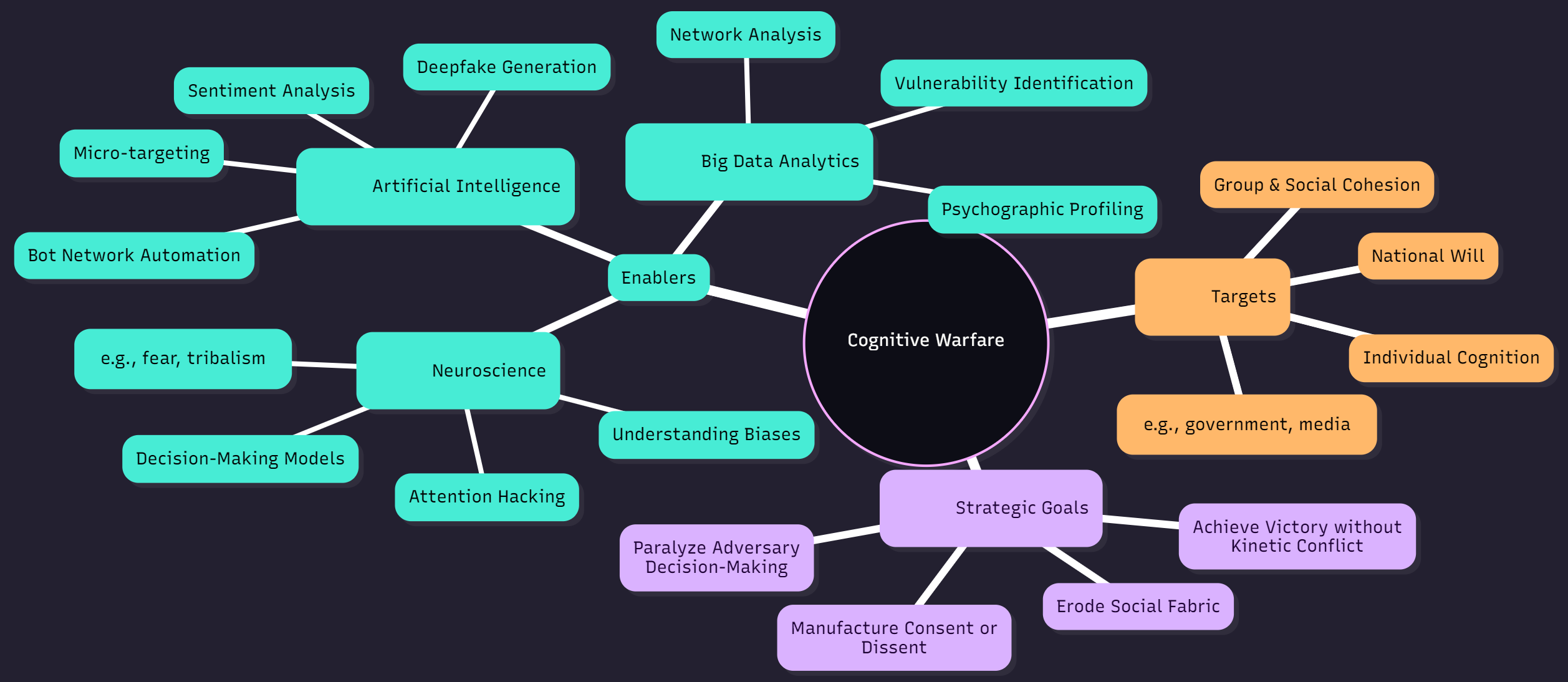
Advances in neuroscience provide the foundational toolkit for contemporary cognitive warfare. Understanding the brain’s mechanisms for processing information, forming beliefs, and making decisions allows an actor to bypass traditional persuasion. Instead of simply presenting an argument, an operator can design stimuli that directly trigger desired neurological responses. This involves exploiting cognitive biases, manipulating emotional states through the limbic system, and disrupting an individual’s or group’s OODA loop (Observe, Orient, Decide, Act).
For instance, research into the amygdala’s role in fear and threat perception informs the creation of propaganda that maximizes anxiety and distrust. Similarly, knowledge of the brain’s reward pathways, driven by dopamine, can be used to design social media campaigns that foster addiction to certain information streams, creating echo chambers that are highly resistant to outside influence. Neuroscience, therefore, becomes a precision instrument in the political struggle, enabling actors to shape perceptions and behaviors with unprecedented accuracy. The ultimate objective is not just to influence but to subvert an opponent’s decision-making cycle, making it impossible for them to effectively counter strategic moves.
The following mind map illustrates the relationship between these domains:
Security as a Zero-Sum Contest
The competition over the human cognitive domain logically pushes actors toward a zero-sum perception of security. When the battlefield is the mind of an adversary’s population, success is measured by the degree of control or disruption achieved. One side’s ability to erode trust, sow confusion, or incite paralysis in another nation is a direct gain, while the target’s successful defense or resilience represents a loss for the attacker. There appears to be no middle ground. If an actor can make a rival population believe their electoral system is fraudulent, their leaders are corrupt, or their allies are untrustworthy, that actor has won a significant victory without deploying a single soldier.
This framing is a direct challenge to post-Cold War liberal ideas of collective or cooperative security. The tools of cognitive warfare are inherently offensive. A defensive posture, such as promoting media literacy or critical thinking, is slow, difficult, and often outpaced by the speed and scale of AI-driven disinformation campaigns. The logic becomes stark: dominate the cognitive space or be dominated within it.
Analytical Judgment and Competing Hypotheses
While the zero-sum model is the dominant and most pragmatic interpretation, it is not the only possible outcome. An analysis must consider alternative hypotheses and underlying assumptions.
A key assumption is that cognitive effects can be controlled with precision. History shows that information operations can create unintended consequences. A campaign designed to destabilize a rival could easily spill over and infect allied populations or even the originator’s own citizens, leading to a negative-sum outcome where the entire global information environment is degraded.
An alternative hypothesis is that the proliferation of cognitive warfare could lead to a new form of deterrence. Just as nuclear weapons created mutually assured destruction, a widespread capability for cognitive disruption could create a state of mutually assured confusion. In this scenario, actors might refrain from launching major campaigns for fear of a debilitating retaliatory strike on their own population’s cognitive integrity. This could force a return to diplomacy or establish new international norms governing this type of conflict.
Finally, the same neuro-technologies could be applied toward positive-sum goals. Understanding the neural basis of trust and empathy could enhance conflict resolution and diplomacy. While this appears unlikely in the current geopolitical environment, it remains a theoretical possibility that challenges the inevitability of a purely zero-sum competition. The primary variable is actor intent, not the technology itself.


You must be logged in to post a comment.