


Hamas released Under the Banner of the Flood on the second anniversary of 7 Oct. The book functions as a morale text, operational folklore, and theological justification for continued fighting. The author—Muhammad Zaki Hamad, an Al-Qassam commander from Beit Hanoun—mixes battlefield diary entries, Quranic exegesis, and hagiography to harden will, normalize risk, and launder tactical lessons through scripture. The product advances recruitment, endurance under siege, and narrative control across Arabic-language audiences.
Hamas/Al-Qassam I/O teams, religious influencers (e.g., N. Takruri, M. Ihlami forewords), and fallen commander Muhammad Zaki Hamad. Target audiences include Gaza militants, mosque networks, and sympathetic publics online. Page 3 credits show editors, reviewers, and introducers that anchor authority.
A 2025 Arabic book mixing daily notes, sermons, and battlefield vignettes: tunnel life, sniper tales, supply improvisation, spiritual counsel, and “miracle” anecdotes under air strikes (e.g., Shifa siege chapter; thirty-day siege schooling). Pages 41–71 showcase quotes, martyr maxims, and operation walk-throughs; pages 44–48 frame “School of Thirty Days” as endurance pedagogy.
The text shapes cognition and behavior: it moralizes suffering, encodes TTPs in parable form, and fuses scripture with micro-tactics (movement under ISR, water access hacks, UAV counter-improvisation). The blend lowers the threshold for risk, strengthens group identity, and inoculates against fatigue, compromise, and internal dissent.
Anniversary timing refreshes October-7 salience, aligns with Ramadan cycles described inside the book, and leverages current displacement fatigue. The forewords position the book as “living proof” of steadfastness after leadership losses in 2025, converting grief into mission. Pages 27–35 frame author sanctification and airpower grievances, which match current narratives after high-profile strikes.
Mosque and Telegram networks will cite passages as sermon fodder; unit leaders will recycle “thirty-day” lessons for new recruits; external sympathizers will mirror excerpts to counter media claims on 7 Oct conduct. The martyr’s diary format gives authenticity that outperforms generic communiqués.
Expect wider PDF seeding across Arabic platforms and derivative short videos in sermon/martyr-quote style. Rival narratives will surface rebuttals on civilian harm; the book already scripts counters (“Shifa miracle,” “airpower injustice”) on pages 56–59 and 30–31. Follow-on volumes featuring other brigades will extend the template.
Hamad fuses three levers:
- Sacralization of mission — Chapters tie tactical acts to Quranic verses (e.g., Sura Ibrahim for “victories”; Sura Al-Qalam for doctrine). Forewords and “from the martyr’s words” (p.41) assert divine economy for fatigue, hunger, and loss; pages 20–24 prescribe imams’ roles. This converts operational delay into spiritual advancement and reframes casualty risk as moral ascent.
- Pedagogical myth-making — “School of Thirty Days” (pp.44–48) and “Miracle of Shifa Siege” (pp.56–59) translate practical survival (moving under ISR, rationing water, tunnel exit discipline, quad-copter defeat by stick) into teachable legends. The legend wrapper shields TTPs from direct attribution while encoding them for reuse.
- Endurance conditioning — Repeated motifs (“do not reconcile,” p.93; “fasting and jihad are twins,” p.120; “water from the earth,” pp.62–64) train readers to accept deprivation as proof of righteousness and to reject de-escalation framing.
MISO / Influence Tradecraft Assessment
- Source credibility: Former commander’s diary + clerical forewords (pp.15–26) supply endogenous credibility. That pairing reduces skepticism and boosts shareability across mosque networks.
- Narrative arcs: “Trial → purification → opening” cycle repeats across chapters (e.g., pp.44–48; 46–47; 56–59; 96–99; 100–107). The loop promises reward after restraint, which reduces fragmentation risk during long sieges.
- Counter-accusation kit: Pages 116–117 argue away claims of atrocities by reframing media reports as enemy deceit while citing Qur’anic casuistry on fighting periods. That pre-loads rebuttals for online disputes.
- Call to non-combat roles: Chapters on water provision, kitchens, and prayer halls (pp.118–126) elevate logistics and charity to “jihad,” widening participation beyond fighters.
Forensic Linguistics
- Register switching: The prose shifts between didactic fiqh tone and first-person “I saw, I suffered, I hit” narration. That code-switch invites both clerics and fighters.
- Formula density: Frequent Qur’anic citations and hadith formulae serve as “anchor phrases” that license bold claims without external evidence.
- Imperatives and negations: High rate of imperatives (“ثبتوا,” “لا تصالح”) and negations frames boundaries, reduces ambiguity, and increases compliance.
- Deixis of place: Recurrent “هنا/هناك/تحت/فوق” ground scenes inside tunnels and streets to simulate presence, which heightens vicarious arousal.
Semiotic Analysis
- Cover art (p.1 image): green flag + fighter silhouette + al-Aqsa + tank—an identity stack that binds sacred, militant, and nationalist frames into one glyph.
- Martyr portraits (p.40): living vs. shrouded image pair signals continuity from life to “promotion,” normalizing death as graduation.
- Layout cues: Red section headers and Quranic verse blocks give a sermon-book rhythm suited for Friday reuse.
Technical/TTP Indicators
- ISR avoidance and movement discipline under drones and manned aircraft (pp.44–47).
- Quad-copter countermeasure via physical strike and withdrawal timing (p.58).
- Use of improvised water networks from damaged infrastructure; hose routing inside tunnels (pp.62–64).
- Mortar harassment of relief routes and de-confliction with friendly elements (p.71).
- Sniper employment with position elevation trade-off and stance adaptation (p.70).
- Communication doctrine embeds scripture to guide OPSEC and rumor control (pp.84–87).
Patterns, Trends, Tendencies
- Normalization of austerity: Water, fasting, and prayer logistics recur; logistics equals faith practice (pp.118–126).
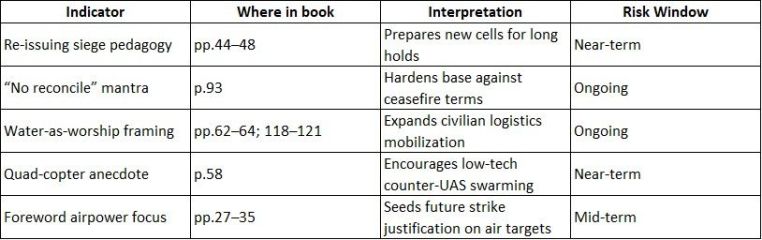
- Airpower grievance loop: Airstrike narratives (pp.30–31; 45–46; 71) prime resentment toward pilots and external regimes, predicting future targeting of air bases in messaging.
- Anti-reconciliation stance: “No reconcile, no tolerate” (p.93) indicates messaging against tactical truces; expect pressure on mediators who argue for phased calm.
- Didactic replication: “Thirty-Day School” likely becomes series content; expect “Forty Nights,” “Shifa Pages,” etc.
Indicators & Warnings Table
Scripture → Identity → Endurance
   │          │           │
   │          ├─ Martyr quotes (p.41)
   │          └─ Cover iconography (p.1)
   ├─ Fiqh rulings + stories (pp.84–107)
   └─ Siege “school” (pp.44–48), Shifa (pp.56–59)
Hamas, Al-Qassam, martyr diary, siege pedagogy, Shifa siege, endurance messaging, Quranic framing, TTP folklore, ISR evasion, logistics jihad, anti-reconciliation stance, airpower grievance, water networks, counter-UAS improvisation, narrative inoculation
Counter-Messaging Options (analytic, not prescriptive)
- De-mythicize “miracles”: Pair satellite and OSINT timelines with the book’s siege tales to show mundane causes for survival (venting, debris patterns, timing gaps).
- Reframe logistics pride: Highlight civilian harm from militarized charity hubs; stress alternative relief channels with visible non-partisan branding.
- Exploit internal cost: Elevate pages that confess fatigue and lost memory of children (p.17) to show human toll unmasked by hagiography.
Hamas’s Under the Banner of the Flood blends diary, doctrine, and devotion to train readers how to persist under fire while regarding deprivation as proof of righteousness. The book supplies micro-lessons in tunnel life, ISR evasion, and water improvisation, dressed in scripture and foreword authority. The style lowers fear, rejects compromise, and sanctifies logistics work as jihad, which expands participation beyond fighters. The product times its release for maximum recall and grief conversion, offers built-in rebuttals to war-crime claims, and sets a template for sequel texts. Monitoring and counter-narratives should focus on myth puncture, relief depoliticization, and human-cost exposure.
Hamad, M. Z. (2025). Taḥta rāyat al-ṭūfān (Khanduq Ḥabbāb) [Under the Banner of the Flood]. First edition. Forewords by N. Takruri, M. Ihlami, M. al-Jawrani. (pp. 1–354).


You must be logged in to post a comment.