

Russian engineers reconfigured the Бурелом-М EW system into lighter, modular boxes to enable delivery with a “Чайка” multirotor UAV. The redesign keeps jamming performance while trading structural strength and thermal endurance for mobility. Limited continuous run time and reduced heat dissipation create exploitable windows for defenders. The Chaika platform carries roughly four to five kilograms over about thirty kilometers, which implies staged transport of separate modules rather than a single lift of a 26-kilogram unit. The package raises near-front jamming tempo but introduces new failure points in cooling, wiring, and field assembly.
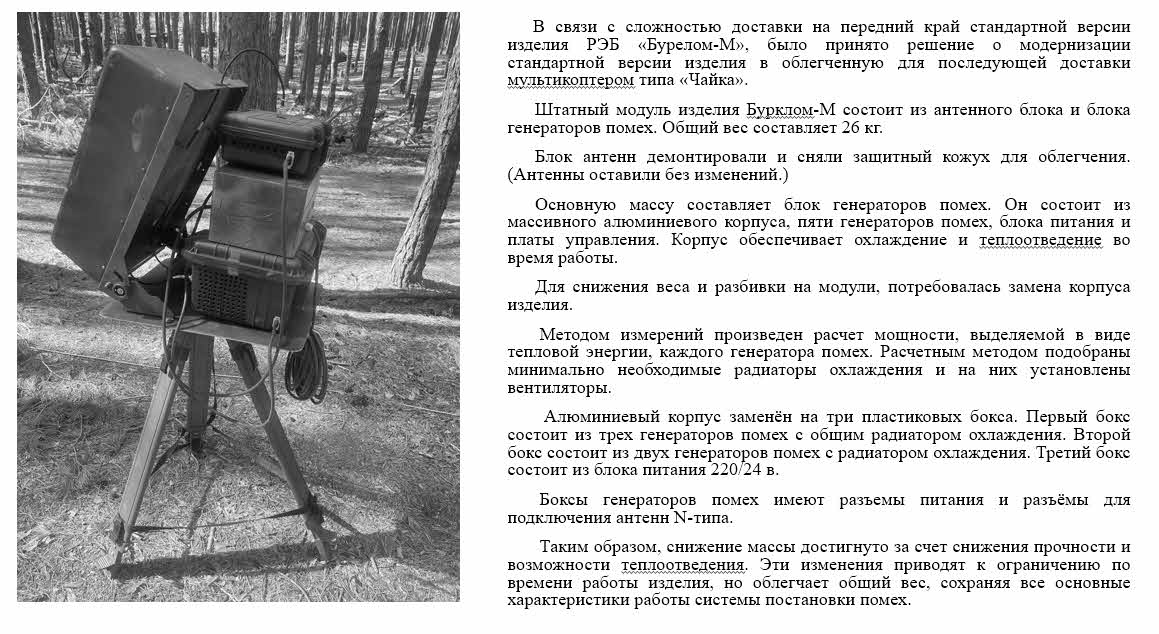
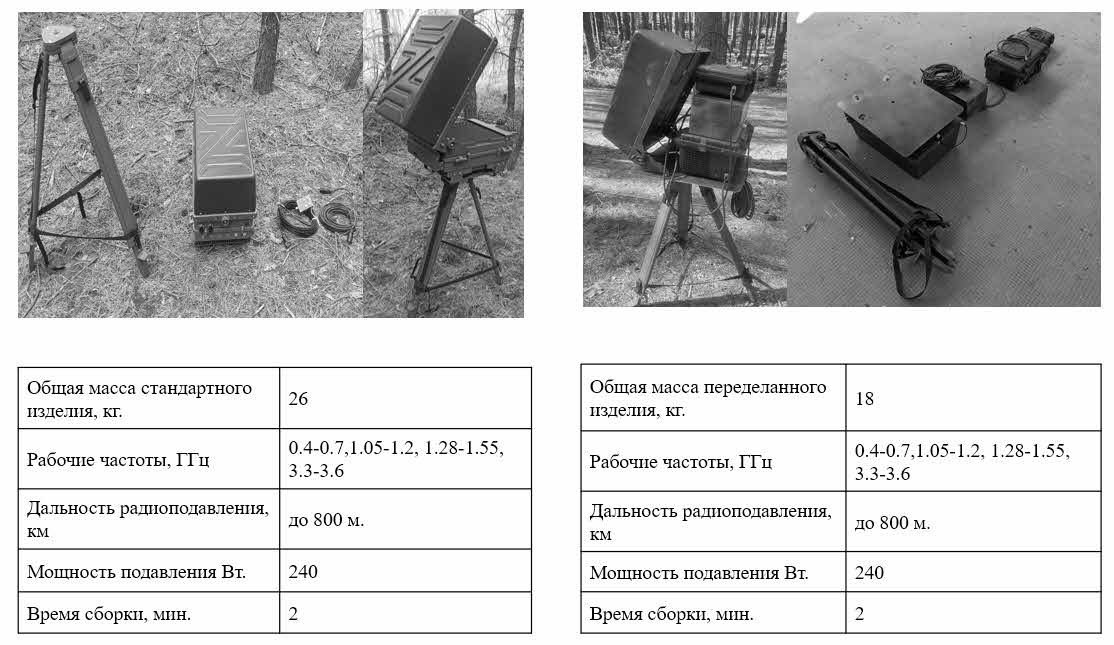
System summary. The standard Бурелом-М consisted of an antenna block and a jamming generator block. Total mass reached about 26 kilograms, driven largely by a solid aluminum chassis that housed five jamming generators, a power supply, and a control board while doubling as a heat sink during sustained operation. Engineers retained the antennas but removed the antenna shroud for weight savings.
Redesign details. The aluminum body gave way to three plastic boxes. Box one holds three generators on a shared radiator with fans. Box two holds two generators with a second radiator. Box three holds the 220-to-24-volt power supply. Each generator box includes power connectors and N-type RF connectors for the antennas. Weight reduction comes from thinner shells and smaller heat sinks. Heat studies informed the minimum radiator size and fan selection. Engineers accept shorter duty cycles in exchange for lower mass.
Deployment concept with “Чайка.” The document states a requirement to deliver the lighter Бурелом-М using a Chaika-type multirotor. Open sources describe Chaika as a tailsitter design able to take off vertically like a copter and cruise like a plane, with a payload near four to five kilograms and a range near thirty kilometers. That profile supports moving the three boxes in separate sorties or as part of a staged logistics plan near the line of contact rather than lifting the legacy 26-kilogram block in one go.
Operational implications. Modularization eases clandestine placement at forward positions and enables pop-up denial around crossings, depots, or artillery firing points. Shorter thermal endurance drives tactics based on pulses, duty cycling, and rapid repositioning. Field technicians must manage more connectors, more seams, and airflow constraints, which increases the risk of partial failure during high-tempo use. The trend aligns with broader Russian efforts to push adaptable UAV-borne effects into the near rear to disrupt C2 and UAS activity while manned airpower remains constrained by air defenses.
Vulnerabilities and opportunities for defenders. Plastic housings reduce mechanical protection and EMI shielding, which raises sensitivity to shock, moisture, and electromagnetic back-scatter. Smaller radiators and fan dependence introduce thermal chokepoints that degrade output as the unit warms. Modular wiring harnesses expose connectors to dust, moisture, and mis-mating during hurried setup. Duty-cycle limits create predictable quiet periods between jams. Those traits support counter-EW through time-on-target management, decoy activation to force over-heating, and reconnaissance that hunts for fan noise, hot-spot IR signatures, and RF leakage around seams.
Collection requirements and indicators. Priority collection should confirm box dimensions, total revised mass per module, connector pinout, and radiator specs. Watch for supply lines moving multiple small EW boxes instead of one large chassis, for training materials that stress pulse schedules, and for maintenance logs citing fan faults or thermal throttling. Look for Chaika sortie patterns that repeat short payload cycles into the same grid squares, which would reveal staged delivery of separate boxes before activation.
Strategic outlook. Lightweight EW payloads delivered by small UAVs will proliferate along with saturation UAS tactics. Expect more field-expedient cooling and printable enclosures, more split-box designs to match five-kilogram payload ceilings, and tighter integration with counter-UAS coverage. Expect adversaries to pair such jammers with loitering munitions and FPV interceptors to blind and strike in one rhythm. Sustainment pressure remains the main drag on performance because thermal margins and connector reliability limit duty cycles under dust, rain, and shock.
Comparison table.
| Attribute | Original Бурелом-М | Бурелом-М v2.0 (modular) |
| Total mass | ~26 kg | Split across three plastic boxes to fit small-UAV delivery envelopes |
| Structure | Single aluminum chassis with high thermal mass | Three plastic enclosures, lower structural strength |
| Generator layout | Five generators, one PSU, one control board | Three generators in box one, two in box two, power supply in box three |
| Cooling | Aluminum body as heat sink, passive plus inherent dissipation | Smaller radiators with fans, measured sizing per generator |
| Antennas | Unchanged, with original protective shroud | Antennas unchanged, shroud removed for weight |
| Connectors | Internalized within chassis | Externalized power and N-type RF connectors on boxes |
| Endurance | Longer continuous operation | Shorter duty cycle due to heat and casing limits |
| Delivery method | Vehicle-borne or crew-carried | Staged UAV delivery using Chaika-type sorties |
The source file describes a mass-reduction retrofit that replaces the original aluminum generator chassis with three plastic modules, retains the antennas while removing their protective shroud, and accepts shorter duty cycles due to weaker heat dissipation. Five jamming generators, a 220→24 V supply, external N-type RF connectors, and fan-assisted radiators define the new build. Total legacy mass sat at roughly 26 kg; the redesign enables staged delivery by a Chaika-type multirotor. The document states that performance remains intact in short bursts while endurance falls as heat rises.
Features. The modularized stack splits into three boxes: a tri-generator block with a shared radiator and fans, a dual-generator block with its own radiator and fans, and a separate AC-to-DC power module. Externalized power and N-type RF connectors replace the prior internal harnessing. Antennas remain unchanged, though the shroud goes away to save weight. Plastic enclosures reduce structural strength and electromagnetic shielding relative to the original aluminum body. Fans and right-sized radiators anchor thermal control.
Functionality. The system radiates interference across several channels at once given five generators and multiple antennas. Engineers measured per-channel thermal output and then sized radiators to the minimum needed, which supports short, pulsed operation. Continuous operation faces thermal throttling risk. The AC supply module provides site power conversion and enables reconfiguration if a generator block fails, since the two RF generator modules operate independently once powered and connected.
Capabilities. The payload supports multi-band jamming in short bursts, fast emplacement near the forward edge, and decentralized staging using small UAV sorties. Modular form eases concealment, cache placement, and rapid swap of a failed block. Fan-assisted cooling and reduced thermal mass produce acceptable performance during brief, high-impact events such as UAS denial during an artillery fire mission or a short disruption of line-of-sight tactical comms. Weight savings change the logistics problem from a single 26 kg lift to multiple light deliveries that a small team can assemble quickly under cover.
Targets. Likely targets include small-UAS command links, GNSS reception in a local bubble, short-range VHF/UHF tactical voice and data, and ad hoc mesh radios around firing points and crossings. Five generators suggest concurrent bands or rapid re-tasking across adjacent bands. Unchanged antennas support the original radiation pattern and impedance plan; the removed shroud lowers environmental protection but not RF function.
Maliciousness. The design intent revolves around denying, degrading, and deceiving adversary sensors and communications near the contact line. Jamming of GNSS and small-UAS links places civilian quadcopters, medical evacuation drones, and public-safety comms at risk if employed near populated areas. Modular boxes lower barriers to clandestine placement and reuse. That combination raises harm potential even when crews lack advanced tooling.
Vulnerabilities. Plastic housings bring low impact resistance and poor shielding against moisture, dust, and electromagnetic back-scatter. External RF and power connectors introduce alignment, contamination, and corrosion failure modes. Reduced radiators paired with small fans create thermal chokepoints; dust, mud, or clogged grills accelerate heat rise and output drop. Removal of the antenna shroud exposes feedlines and mounts to weather and mechanical shock. Duty-cycle constraints force quiet intervals that repeat predictably under pressure, which opens timing windows for opposing action.
Weaknesses. Thermal headroom sits thin; ambient heat, altitude, and solar load compress safe on-time further. Vibration during UAV transport loosens heat-sink mounts and introduces intermittent faults at connectors. Field assembly under stress increases mis-mating risk and raises VSWR if N-type connectors suffer damage, which converts more RF into heat inside the generator path. Fan acoustics and vent hot spots leak signatures that simple sensors detect at short range. Staged delivery patterns reveal cache sites when observers correlate multiple light-payload flights into one grid over short periods.
Opportunities to disrupt. Counter-UAS patrols that log repeated short-payload flights can cue ground teams to likely cache lines. Route interdiction against those lines breaks module staging before activation. Decoys that force the jammer to stay on air for longer pulses drive thermal runaway; a few extra minutes at elevated junction temperatures degrade output and trip protection circuitry. RF reflections introduced by nearby metallic surfaces raise standing waves and heat. Settled dust across intake grills reduces airflow enough to shorten on-time. Timing of own comms and UAS sorties during expected cool-down gaps exploits the enforced duty cycle.
Opportunities to disable. Moisture intrusion at exposed connectors creates intermittent shorts and corrosion; water foggers, mud splash, and wet vegetation near the emplacement site raise risk. Fine sand in fans binds bearings and stalls blades, which pushes temperatures past safe limits. Precision fire against vent and fan zones removes active cooling and forces shutdown without destroying the entire box. Power-module isolation as a single target halts both generator blocks; AC-line disturbance, power-module damage, or connector removal breaks the chain quickly.
Opportunities to disorient. Short, erratic deception bursts that hop bands invite over-reaction and longer jamming pulses from the Бурелом-М team, which amplifies heat and exhausts the duty budget early in the engagement. False acoustic cues near likely emplacement zones mask the fan signature hunt with background noise until reconnaissance shifts closer. Dummy antenna masts seeded along access routes burn the adversary’s time during setup and raise assembly error rates when a rushed crew mixes cabling across modules.
Opportunities to destroy. Precision strikes against exposed modules finish the job faster than area fire against a single aluminum chassis would have, since fragmentation and shock fracture plastic enclosures easily. Overpressure near connectors and heat-sink mounts shatters threads and delaminates pads on control boards. A brief thermite or incendiary burst aimed at vent grills releases toxic smoke and ruins fans, radiators, and coatings; even partial ignition renders the module non-recoverable. Destruction of RF feedlines at the antenna base denies emission even when the generator survives; externalized connectors make replacement slow under threat.
Comparative assessment table follows for quick reference.
| Dimension | Original Бурелом-М | Бурелом-М v2.0 modular | Operational effect |
| Structure | Single aluminum chassis with high thermal mass | Three plastic modules; external power and RF connectors | Faster placement; lower ruggedness and shielding |
| Cooling | Passive via chassis; better heat soak | Downsized radiators plus fans | Short bursts acceptable; sustained runs overheat |
| Antennas | Original with protective shroud | Same antennas; shroud removed | Same RF pattern; lower environmental protection |
| Logistics | Vehicle or crew carry | Staged multirotor delivery | New signatures and interdiction points |
| Failure modes | Fewer seams; internal harnessing | Connector faults, fan stalls, case cracks | More ways to break under stress |
| Signature | Heavier, fewer vents | Fan noise, hot vents, modular caches | Easier to detect with simple sensors |
Disruption–disable–disorient–destroy matrix follows for planning.
| Action type | Method | Required condition | Expected effect | Notes |
| Disrupt | Decoy traffic that provokes long jamming bursts | Active jamming in short pulses | Overheat, thermal throttling, pause | Works best in heat and dust |
| Disable | Target power module or AC feed | Power box exposed or moving | Full stack offline | Single point of failure |
| Disorient | Band-hopping deception near setup | Crew under time pressure | Mis-tasked channels, wasted duty budget | Raises assembly errors |
| Destroy | Precision fire on vents and fans | Visual or IR fix on module | Cooling loss, permanent damage | Plastic case fails under shock |
| Detect-cue | Track repeated light UAV sorties into one grid | Staging underway | Cue patrols and fires to cache line | Exploits staged delivery |
The redesign increases mobility and lowers setup time at the front while shrinking thermal and mechanical margins. Modular seams, exposed connectors, fan reliance, and plastic enclosures open multiple avenues for detection and defeat. Timing tactics around enforced cool-down intervals, pressure on thermal limits through deception, and interdiction of staged delivery offer the most reliable paths to disrupt, disable, disorient, and destroy Бурелом-М v2.0 in the fiel


You must be logged in to post a comment.