


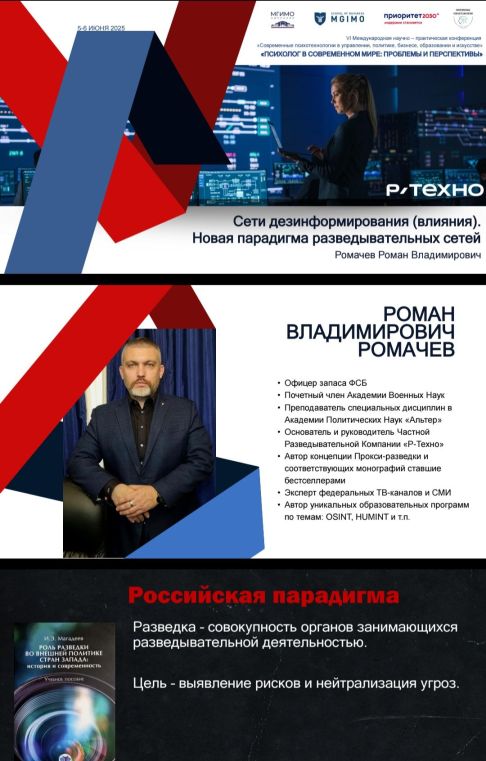
Romachev’s “Сети дезинформирования (влияния)” is a prototypical example of #Kremlin #disinformation laundering posing as some lofty of academic theory. It exemplifies the well-worn Russian intelligence playbook: accuse the West of tactics Russia itself uses with impunity, misrepresent open-source information networks as covert psy-ops, and portray state-controlled narratives as heroic defenses against global hegemony. Let’s dismantle this spectacle of projection, victimhood, and epistemic poverty.
Romachev opens by declaring a “new paradigm” of intelligence networks, suggesting that the West organizes “disinformation networks” under the guise of democratic institutions and academic cooperation. But the underlying logic is shallow. It relies on reductive binaries—either a source is pro-Russian and “informational,” or it’s Western and thus inherently “disinformational.” There’s no middle ground, no allowance for pluralistic discourse or independent journalism. Everything non-Russian is filtered through this Cold War-era lens of total information war.
The idea that the European Digital Media Observatory (EDMO) is a centralized censorship hub for the EU, as Romachev alleges on page 17, is laughable on its face. EDMO is a transparency initiative supporting fact-checking, disinformation research, and media literacy. It doesn’t “censor”—it counters lies, including ones pushed by Kremlin trolls. Romachev’s characterization of EDMO as a “network for disinforming one’s own citizens” reeks of the same inverted logic that accuses NATO of “aggression” for defending its members while Russia invades its neighbors.
His obsession with “narrative intelligence” (NARINT) is revealing. On page 7, he mocks the legitimate historical framing of World War II by the West—namely that both Nazi Germany and the USSR had expansionist ambitions in the lead-up to the war. To Romachev, calling out the Molotov-Ribbentrop Pact is a Western manipulation, not a fact. This is standard disinformation technique: falsify history, and then accuse others of doing so.
Romachev’s analysis of Think Visegrad (page 15) further illustrates the intellectual shallowness of his argument. He labels academic research networks as “corporate disinformation platforms” simply because they offer foreign policy recommendations. By this logic, any think tank not towing Moscow’s line becomes a hostile intelligence asset. Such a worldview can only exist inside a closed information loop—where critical thought is replaced by loyalty tests and everyone who disagrees must be an enemy agent.
But perhaps the most absurd section is the one targeting the World Economic Forum and Klaus Schwab (pages 20–24). Romachev claims Schwab controls “110,000 trolls” monitoring the internet. The source? Thin air. This claim isn’t just hyperbolic—it’s pure paranoia weaponized for a domestic audience primed to believe that Western liberalism is a Hydra bent on global enslavement. This is not analysis, it’s political theatre—designed to bolster domestic repression by blaming outside enemies.
Romachev’s approach to intelligence theory is a tragicomic hybrid of state propaganda and pseudoscientific framing. He appropriates Western intelligence terminology (OSINT, HUMINT, etc.), redefines them through a paranoid anti-Western lens, and produces what amounts to a glorified PowerPoint for authoritarian soft power. Nowhere is there room for evidence-based reasoning, empirical validation, or intellectual honesty.
In short, Romachev doesn’t offer a “new paradigm.” He regurgitates a tired formula: the West is always the aggressor, Russia is always the misunderstood victim, and “disinformation” is whatever threatens Kremlin control. This isn’t intelligence theory—it’s epistemological collapse dressed in patriotic drag. A mind fed on nothing but Kremlin dogfeed cannot hope to grasp the complexity of democratic media ecosystems or the nuances of global discourse.
Romachev’s scope of knowledge is so tragically limited by ideological obedience that even basic analytical integrity is impossible. He constructs his entire worldview in the narrow echo chamber of state-sponsored delusion—where thought ends and propaganda begins. Bootlicker as a moniker is too kind.


You must be logged in to post a comment.