

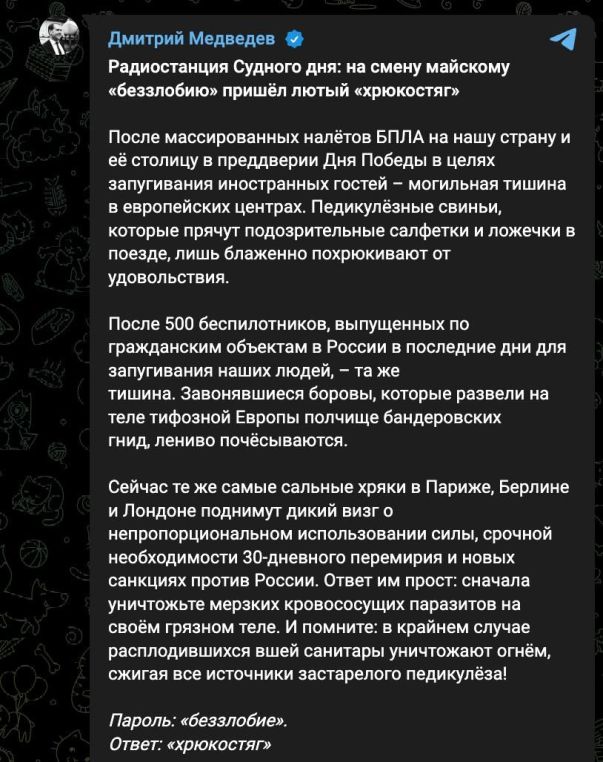
The image features from Dmitry Medvedev, former Russian president and current deputy chair of Russia’s Security Council, now functioning as one of the Kremlin’s most aggressive disinformation mouthpieces. The post, written in hyperbolic and dehumanizing language, is a grotesque propaganda screed attempting to reframe Russia’s position as one of righteous retaliation following Ukrainian drone strikes. It is a textbook example of hate-fueled disinformation weaponized to dehumanize, distract, and destabilize.
Medvedev opens by sarcastically referencing a fabricated “Doomsday Radio” transmission, claiming that a fierce “hryukostyag” (a made-up, mock-military-sounding term, likely designed to ridicule) has replaced May’s so-called “bezslobie” (meaning “weakness” or “timidity”). This theatrical language is not just nonsensical but intentionally theatrical, echoing Soviet-era wartime bravado repackaged for digital-age psyops.
He follows this with a lie-soaked narrative suggesting that over 500 Ukrainian drones have been launched at Russian civilian sites, resulting in “silence” from Europe. This narrative is inverted disinformation. In reality, Ukrainian UAV strikes—typically targeted at military or critical infrastructure—have been responses to Russia’s months-long saturation bombing of Ukrainian civilian areas. Moscow’s own intensification of drone and missile strikes, including use of Iranian Shahed drones, directly undermines any moral high ground Medvedev pretends to hold.
Medvedev then unleashes a tirade of crude metaphors and slurs, calling Europeans “pediculosed swine” and “banderovite lice”, painting the continent as a disease-ridden, parasitic entity that shelters Ukrainian fighters. This language mirrors fascist propaganda of the 1930s and 1940s, where enemies were likened to insects or diseases to justify their eradication. It is classic genocidal conditioning—rhetoric aimed at priming an audience for acceptance, even celebration, of mass violence. The reference to “burning out all sources of entrenched pediculosis” (i.e. lice) is not metaphorical—it is a dog-whistle to hardliners and military units that extermination is not just acceptable, but desirable.
This is not a domestic political rant. This is an internationally broadcast piece of incitement, designed to manipulate Russian citizens, delegitimize the Ukrainian government, and demonize the West. Medvedev’s Telegram audience includes not just Russian citizens, but far-right communities across Europe and the U.S. who routinely consume and repurpose his posts. His call to destroy “bloodsucking cross-breeding parasites” with fire invokes extermination rhetoric that echoes war crimes justification. The messaging is timed to preempt Western calls for a ceasefire or sanctions, painting such diplomatic gestures as weakness and betrayal.
The language is not accidental. It aligns with Treadstone 71’s analyses of Russian influence operations which outline how cognitive warfare uses vulgarity, dehumanization, and absurdity to overwhelm the rational response of the public. By flooding the narrative space with emotionally manipulative content, Russian disinformation actors like Medvedev aim to delegitimize facts, normalize violence, and trigger extreme responses—both domestically and abroad.
The closing slogan, “Password: bezslobie. Answer: hryukostyag,” is more than cryptic trolling. It’s a signal: a rallying cry for nationalist zealots that the time for restraint is over, replaced by violent “pigs and bones” righteousness. It is disinformation fused with militarized meme warfare, meant to spread virally in fringe and closed groups.
The post is as an active weapon of cognitive warfare and psychological destabilization. It is not a rant—it is scripted disinformation layered with genocidal codes. It should be preserved as evidence, flagged across multilingual channels, and countered with truth-based psychological inoculation before it mutates and spreads further.


You must be logged in to post a comment.