


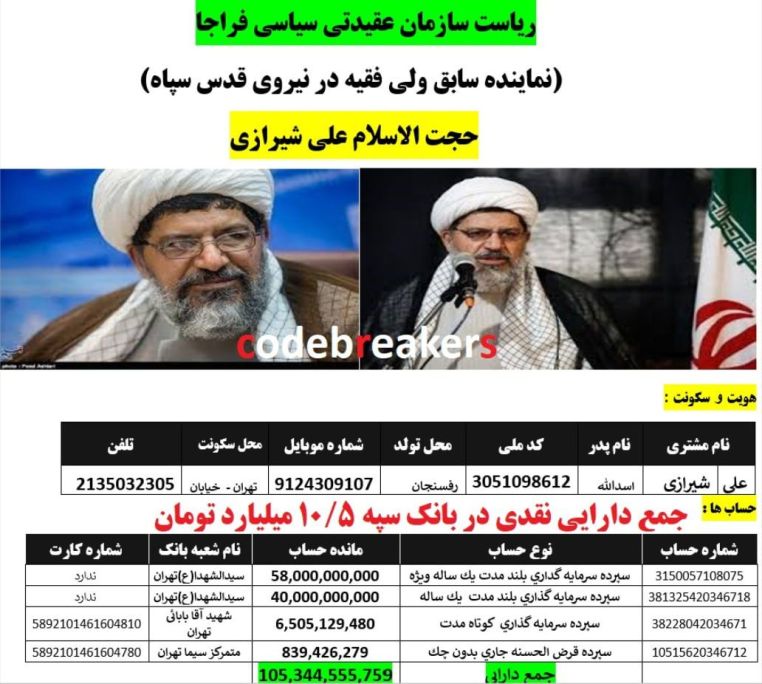
The image reveals a data leak tied to Hojjat al-Islam Ali Shirazi, a prominent cleric previously assigned as the Supreme Leader’s representative within the IRGC Quds Force and now allegedly leading the “Faraja Political-Ideological Organization” (سازمان عقیدتی سیاسی فراجا). This position implies direct involvement in ideological enforcement and political control within Iran’s law enforcement structure, parallel to the IRGC’s Basij indoctrination frameworks. The exposure of detailed financial, personal, and banking information highlights several red flags that merit further analytical expansion–>
1. Financial Discrepancy and Unexplained Wealth.
The document states Shirazi’s liquid assets at Bank Sepah total approximately 10.5 billion Tomans (~$210,000 USD using informal 2025 conversion rates). The accounts listed show:
Long-term investment accounts (1-year and 5-year deposits)
Investment growth over 6.5 billion Tomans
An account under the guise of a “Qarz al-Hasna” (interest-free charitable loan) accumulating over 839 million Tomans—anomalous for an Islamic charitable mechanism
The final total–>105,344,555,759 Rials, or 10.5 billion Tomans, aligns with high-level clerical enrichment patterns, conflicting with public religious postures of humility and asceticism. His monthly interest revenue from just these deposits is 250 million Tomans, approximately 5,000 USD/month—more than the combined salaries of mid-level IRGC or Artesh officers.
2. Identity Exposure and Operational Risk.
The document includes his:
National ID (3051098612)
Place of birth (Rasht)
Phone number (including the Tehran landline and mobile: 9124309107)
Address in Tehran
Such details compromise his physical and digital security footprint, exposing him to targeting and social engineering risks. The exposure reflects a broader vulnerability in Iran’s clerical-security elite: growing distrust within the ranks, increased cyber-espionage from opposition networks, and friction among competing ideological factions.
3. Psychological Warfare and Anti-Clerical Messaging:
The use of hashtags like #سفره (sofreh), which references the “spread” or “banquet” metaphor often used to critique elite corruption (“who’s eating from the Islamic Revolution’s table?”), indicates a moral framing. Tagging with #Maximum, #نشر (distribution), and pirate emoji 🏴☠️ adds symbolic weight—mocking elite hypocrisy while positioning the leak as part of a broader campaign to undermine the ideological credibility of the regime.
4. Implications for Regime Narrative Control and Public Perception:
The document implies that Faraja, IRGC, and Artesh rank-and-file receive low wages, contrasting with the clerical elite’s hoarding. This narrative, if amplified, will exacerbate existing class resentments inside Iran’s security apparatus. The Iranian regime often uses clerical proximity to the Supreme Leader as a form of legitimacy. Exposing clerics like Shirazi as hoarders of public wealth erodes the foundational mythos of sacrifice and piety.
5. Message Framing and Threat:
The final phrase—“Beginning of negotiation = End of publication”—implies either blackmail or a countdown strategy in multi-stage leaks. It signals intent to escalate disclosures unless certain demands are met, possibly targeting the clerical regime directly.
Conclusion:
The image constitutes a powerful example of information warfare targeting elite ideological clerics in Iran. It weaves financial corruption, ideological hypocrisy, and personal compromise into a single narrative meant to trigger unrest within loyalist ranks. The banking data underscores systemic misuse of Islamic financial structures like Qarz al-Hasna accounts to mask personal enrichment. If authentic, the leak represents an insider-level compromise—likely originating from disgruntled IRGC elements, hacktivist groups like “Edalat-e Ali,” or state adversaries executing psychological operations.
Next steps involve cross-referencing account numbers and identities with other leaked clerical financial records and watching Telegram, Aparat, and VK channels for secondary waves of the campaign.


You must be logged in to post a comment.