


Trans-Regional Air Order of Battle, Force Posture Telemetry, Advanced SATs Adversary Analysis, and Strategic Foresight: Levant to Persian Gulf Corridor
آرایش رزم هوایی فرامنطقهای، دورسنجی استقرار نیروها، تحلیل ساختاریافته حریف (SATs) و آیندهپژوهی راهبردی: راهگذر شام تا خلیج فارس
SUBJECT: Trans-Regional Air Order of Battle, Force Posture Telemetry, Advanced SATs Adversary Analysis, and Strategic Foresight (Levant–Persian Gulf Corridor)
OPERATIONAL ENVIRONMENT: Persian Gulf, Strait of Hormuz, Gulf of Oman, Levant, and Red Sea Theaters
ANALYTIC METHODOLOGY: Treadstone 71 Advanced Analytic Dominance SATs™, STEMPLES Plus™, and other proprietary methods
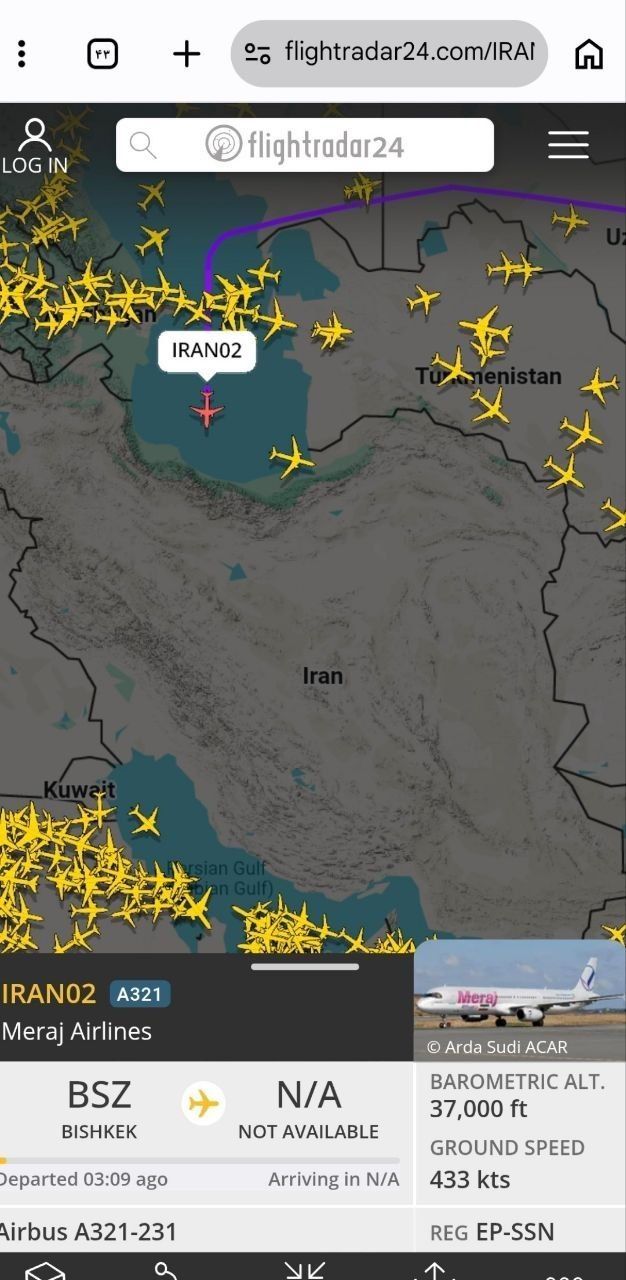
Airspace situation in the country.
The second aircraft approaching Iranian airspace was carrying Masoud Pezeshkian.
1. Executive Summary & Key Intelligence Judgments
- Synchronized Trans-Regional Air Posture: Multi-source Automatic Dependent Surveillance-Broadcast (ADS-B) and Mode-S telemetry document a coordinated United States Air Force (USAF) and United States Navy (USN) force concentration bridging the Eastern Mediterranean, Red Sea, and Persian Gulf1. Heavy aerial refueling tankers (KC-135R/T, KC-46A) operating from Israel (Tel Aviv, Eilat), Qatar (Al Udeid), and the United Arab Emirates (Al Dhafra) maintain continuous fuel bridges supporting forward combat air patrols and non-broadcasting strike packages1.
- High-Altitude & Maritime ISR Convergence: The forward operational deployment of a USN MQ-4C Triton High-Altitude Long-Endurance (HALE) unmanned aerial system (BuNo 169660 / OVRLD01) operating at Flight Level 460 (46,000 feet) out of Prince Hassan Air Base (Jordan), paired with USN P-8A Poseidon maritime patrol aircraft operating out of Bahrain (Isa Air Base / CTF-57), establishes persistent, overlapping electro-optical, radar, and signals intelligence coverage across Iranian coastal defense sectors, missile garrisons, and maritime chokepoints3.
- Adversary Decision Calculus & Threat Vectors: Dynamic Bayesian narrative decomposition of Iranian state-directed communications (Tasnim News Agency / Khatam ol-Anbiya Central Headquarters) indicates that Tehran perceives overt U.S. air operations not as conventional deterrence, but as direct operational enablers of territorial strikes7. Iranian military doctrine mandates asymmetric retaliatory salvos targeting forward host-nation installations across Kuwait (Ali Al Salem), Bahrain (Isa AB / NSA Bahrain), the UAE (Al Dhafra), and Qatar (Al Udeid)7.
- Non-Linear Escalation & Critical Vulnerabilities: Emergence modeling demonstrates that regional conflict escalation functions as a Complex Adaptive System (CAS). The primary systemic vulnerability lies in integrated air and missile defense (IAMD) interceptor magazine exhaustion against multi-axis, high-saturation ballistic missile and Shahed-136 drone salvos, which threatens forward command-and-control (C2) continuity and triggers cascading commercial flight disruptions across Gulf Cooperation Council (GCC) Flight Information Regions (FIRs)8.
- Diagnostic Resolution of Open Issues: By tracking four definitive operational indicators—Tanker Emission Posture (EMCON Alpha vs. Mode-S), ISR Orbit Vector Shifts (linear sweeps vs. tight coastal loitering), Emergency NOTAM Cascades (3- to 15-minute launch warnings), and IRGC Force Dispersal (mobile TEL and swarm boat deployments)—analysts can distinguish routine deterrence postures from active kinetic strike execution and inbound retaliatory saturation3.
2. Multi-Theater Flight Telemetry and Air Order of Battle
Overt flight tracking data confirms the synchronized deployment of strategic intelligence, surveillance, and reconnaissance (ISR) and aerial refueling aircraft across two primary geographic arcs: the Levant/Red Sea axis and the Arabian Gulf littoral1.
| Tail Number / BuNo | ICAO Hex Code | Airframe Model | Operating Unit / Service Branch | Departure / Operating Hub | Callsign / Transponder | Tracked Flight Profile & Altitude | Primary Mission Functional Role |
| 169660 | AE5C76 | Northrop Grumman MQ-4C Triton | US Navy / VUP-19 Detachment | Prince Hassan Air Base (H-5), Jordan | OVRLD01 / Mode-S Active | FL460 (46,000 ft); southeasterly transit across Saudi Arabia to the Iranian littoral | HALE broad-area maritime surveillance, MFAS AESA radar surface tracking, and coastal ELINT3 |
| 61-0300 | AE01D5 | Boeing KC-135R Stratotanker | USAF / Air Mobility Command | Ben Gurion / Tel Aviv (TLV), Israel | Mode-S Active (N/A) | FL280 (28,000 ft); eastbound transit along the Jordanian–Saudi border corridor | Strategic fuel offload for trans-regional strike packages, escort fighters, and EW assets4 |
| 62-3498 | AE026E | Boeing KC-135R Stratotanker | USAF / Air Mobility Command | Ramon / Eilat (ETM), Israel | Mode-S Active (N/A) | High-altitude holding track along the northern Red Sea / Aqaba sector | Aerial refueling bridge for long-range packages bypassing Levant airspace toward the Gulf4 |
| 22-46099 | AE63CF | Boeing KC-46A Pegasus | USAF / Air Mobility Command | Al Udeid Air Base (OTBH / XJD), Qatar | FAST25 | Initial climb from 10,650 ft to FL220; outbound track into the central Persian Gulf | Centerline boom and drogue multi-point refueling; airborne tactical C2 and Link 16 gateway1 |
| 58-0056 | AE014C | Boeing KC-135R Stratotanker | USAF / Air National Guard Deployed | Al Dhafra Air Base (OMAM / DHF), UAE | Mode-S Active (N/A) | FL200 (20,050 ft); racetrack orbit over southern UAE desert interior | Tactical combat air patrol (CAP) replenishment for 380th AEW and coalition air defense fighters1 |
| 59-1474 | AE07A6 | Boeing KC-135T Stratotanker | USAF / 171st ARS (MI ANG Deployed) | Al Dhafra Air Base (OMAM / DHF), UAE | Mode-S Active (N/A) | FL220 (22,000 ft); holding pattern over central Abu Dhabi emirate | Isolated fuel tank plumbing enabling specialized receiver-aircraft refueling operations2 |
| Unlisted Active | AE0xxx | Boeing KC-135R Stratotanker | USAF / Air Mobility Command | Forward Oman Sector / Arabian Sea | K35R | FL240–FL260; orbit off the coast of Sohar in the Gulf of Oman | Standoff fuel station for strike ingress/egress outside the Strait of Hormuz chokepoint12 |
| Unlisted Fleet BuNo | AE58xx | Boeing P-8A Poseidon | US Navy / VP Squadron (CTF-57) | Isa Air Base (OBBS), Bahrain | Mode-S Active (P8) | FL200 (20,050 ft); coastal track along northern UAE and Musandam approaches | AN/APY-10 radar surface search, coastal electronic surveillance, and anti-ship missile defense5 |
Technical Analysis of Aerial Operations
- MQ-4C Triton Operational Relocation: Deploying BuNo 169660 out of Prince Hassan Air Base (H-5) in northeastern Jordan represents a significant operational adaptation3. Moving forward from NAS Sigonella (Sicily) shortens transit times to the Persian Gulf from six hours to under two hours, while keeping the asset outside the immediate tactical range of Iranian short-range ballistic missiles (SRBMs) and coastal cruise missiles3. The Triton’s Multi-Function Active Sensor (MFAS) radar system operates in 360-degree maritime and coastal surveillance modes, maintaining persistent target tracks from FL460 across Bandar Abbas, Qeshm Island, and the Jask littoral3.
- Trans-Regional Fuel Pipeline: Synchronizing tanker departures from Tel Aviv (61-0300), Eilat (62-3498), Al Udeid (22-46099), and Al Dhafra (58-0056, 59-1474) establishes an integrated aerial refueling corridor across the Middle East1. This architecture provides fuel offload redundancy for non-transponding combat aircraft (e.g., F-35A/I, F-15E, B-2A, and EA-18G) operating across Levant and Gulf transit routes4.
- P-8A Poseidon Coastal ISR Layer: The P-8A Poseidon operating out of Bahrain at 20,050 feet along the UAE and Musandam coasts provides low-to-medium altitude surface tracking and electronic surveillance5. Equipped with the AN/APY-10 radar and high-resolution electro-optical/infrared (EO/IR) turrets, the P-8A tracks Iranian naval fast-attack craft (FAC/FIAC) and coastal anti-ship cruise missile (ASCM) batteries, downlinking real-time surface tracks to US 5th Fleet combat systems5.
3. Forward Staging, Basing Infrastructure, and Joint C2 Architecture
Coalition operations rely upon an integrated, distributed basing and command-and-control network distributed across GCC member states and regional allies16.
| Installation Name | Host Nation | Primary Tenants / Operating Elements | Primary Functional Role in Persian Gulf Operations |
| Al Udeid Air Base (OTBH / XJD) | Qatar | USAF 379th AEW; Combined Air Operations Center (CAOC) | Theater-level air battle management, strategic tanker staging (KC-46A), and strategic SIGINT hub (RC-135V Rivet Joint)16 |
| Al Dhafra Air Base (OMAM / DHF) | United Arab Emirates | USAF 380th AEW; French Air and Space Force | Tactical strike fighter staging (F-35A, F-15E), forward tanker orbits (KC-135R/T), and high-altitude drone operations2 |
| Isa Air Base (OBBS) & NSA Bahrain | Bahrain | US Navy 5th Fleet HQ; Commander, Task Force 57 (CTF-57) | Maritime reconnaissance (P-8A Poseidon), naval battle management, and anti-submarine/anti-surface strike coordination5 |
| Ali Al Salem Air Base (OKAS) | Kuwait | USAF 386th AEW; Coalition Expeditionary Forces | Theater tactical airlift (C-130H/J), tactical unmanned reconnaissance (MQ-9A Reaper), and forward logistics staging8 |
| Prince Sultan Air Base (OEPA / PSAB) | Saudi Arabia | USAF 378th AEW; Royal Saudi Air Force (RSAF) | Dispersed fighter staging, theater air defense integration, and airborne tactical communications relay (E-11A BACN)16 |
| Prince Hassan Air Base (H-5) | Jordan | US Navy Forward Detachment / Coalition Elements | High-altitude maritime and overland ISR forward hub (MQ-4C Triton); secure northwestern standoff staging3 |
| Muscat & Thumrait Facilities | Oman | Royal Air Force of Oman / Coalition Access Hubs | Standoff maritime patrol staging in the Gulf of Oman; diplomatic airspace and transit corridor coordination12 |
Command, Control, and Datalink Integration
- CAOC Battle Management: The Combined Air Operations Center at Al Udeid Air Base generates the theater Air Tasking Order (ATO) and Airspace Control Order (ACO), synchronizing high-altitude tanker orbits over the UAE and central Saudi Arabia with ISR tracks over the Gulf16.
- Network Gateway Relays: Airborne tactical datalink connectivity (Link 16, SADL, TTNT) across disjointed line-of-sight networks is maintained via the Bombardier E-11A Battlefield Airborne Communications Node (BACN) operating out of Prince Sultan Air Base, and the onboard datalink processor suites of the KC-46A Pegasus (FAST25)13.
- Naval Common Operational Picture (COP): Commander, Task Force 57 (NSA Bahrain) fuses radar and electronic intelligence downlinked from P-8A Poseidons and the MQ-4C Triton into the 5th Fleet Common Operational Picture, which is distributed in real time to Aegis-equipped air defense destroyers and allied operations centers5.
4. Chronology of Regional Aerial Escalation and Airspace Restrictions
The documented flight tracking activity corresponds directly with recurring kinetic exchanges, cross-border missile and drone strikes, and civil airspace restrictions across the Persian Gulf and Levant theaters7.
| Date / Phase | Operational Sector | Kinetic Engagement & Air Posture Details | Civil Aviation Impact & Airspace Actions |
| Late Jan 2026 | Strait of Hormuz & Central Gulf | Staging of USN P-8A (BuNo 169804), USAF RC-135V Rivet Joint (64-14848), and E-11A BACN across Qatar, Bahrain, and Saudi Arabia16. | Dense military flight tracking; civil air traffic operates along standard Gulf airways16. |
| 28 Feb – 2 Mar 2026 | Kuwait & Northern Gulf | Iranian ballistic missile and drone salvos target Ali Al Salem Air Base, Camp Udairi, and Kuwait International Airport; 3 U.S. F-15Es shot down in a friendly-fire incident8. | Kuwait Civil Aviation suspends commercial departures; emergency holding patterns and ground stops enforced8. |
| 1 Mar – 3 Mar 2026 | UAE & Abu Dhabi Sector | Retaliatory drone and missile barrages strike Al Dhafra Air Base, Jebel Ali Port, and Camp de la Paix; UAE air defenses intercept 161 ballistic missiles and 645 drones9. | Dubai International (DXB) and Abu Dhabi (AUH) implement multi-hour ground stops and flight cancellations9. |
| Late Jun 2025 / Summer 2026 | Qatar & Central Gulf | Missile strikes targeted near Al Udeid Air Base; Patriot PAC-3 batteries engage incoming salvos11. | Qatar Civil Aviation Authority issues precautionary airspace closures; civil traffic rerouted westward19. |
| 7 Jul – 13 Jul 2026 | Bahrain, Kuwait, & Hormuz Chokepoint | CENTCOM executes counter-maritime strikes hitting over 80 targets; IRGC responds targeting Isa AB, Port Salman, and Ali Al Salem7. | Air raid sirens sound across Manama and Kuwait City; standing military tanker orbits expand across the southern Gulf7. |
| August 2026 | Levant, Jordan, & Gulf Littoral | USN MQ-4C Triton (169660) resumes operations from Prince Hassan AB, Jordan; USAF tankers stage out of Tel Aviv, Eilat, Al Udeid, and Al Dhafra1. | Selective Mode-S transponder broadcasting for strategic deterrence; international transit corridors remain open under advisory NOTAMs2. |
5. Force Multiplication Dynamics: Aerial Refueling Bridges and Multi-Layered ISR Integration
The deployment of aerial refueling and multi-tiered intelligence assets fulfills direct force multiplication roles required for sustained theater air superiority and maritime interdiction5.
Tactical Combat Air Patrol (CAP) and Strike Replenishment
Tactical strike fighters—such as USAF F-15E Strike Eagles, F-35A Lightning IIs, and carrier-based USN F/A-18E/F Super Hornets—operate with clean external configurations during high-threat ingress to minimize radar cross-section and maximize maneuverability5. These platforms require fuel offloading every 60 to 90 minutes4.
- Fuel Bridge Geometry: Tankers orbiting at 20,050 to 22,000 feet over the UAE (58-0056, 59-1474), Qatar (FAST25), and the Gulf of Oman provide continuous fuel top-offs immediately before strike assets enter contested airspace, and immediate recovery refueling upon egress1.
- Emissions Discipline: Strike assets maintain complete emissions control (EMCON Alpha) with transponders off4. In contrast, heavy support tankers broadcast Mode-S data to establish visible rendezvous points while maintaining safe navigation within crowded civil air traffic lanes2.
Multi-Tiered ISR Layering
| Operational Tier | Platform & Hub | Sensor Payloads & Technical Modes | Primary Mission Integration Role |
| Strategic Space & SIGINT | USAF RC-135V Rivet Joint (Al Udeid AB) | Strategic ELINT/COMINT receivers; fine grain radar analysis suites | Intercepts adversary command networks; maps theater Integrated Air Defense System (IADS) radar state changes16. |
| Tactical Gateway Relay | USAF E-11A BACN (Prince Sultan AB) | Airborne Battlefield Airborne Communications Node; Link 16 translation | Bridges disparate UHF/VHF, Link 16, and tactical datalinks across non-line-of-sight mountainous terrain16. |
| HALE Persistent Radar Scan (FL460) | USN MQ-4C Triton (Prince Hassan AB, Jordan) | Multi-Function Active Sensor (MFAS) 360° AESA radar; long-range ELINT | Broad-area maritime surface tracking and persistent electronic surveillance over Iranian coastal missile bases3. |
| Tactical Maritime Interdiction (FL200) | USN P-8A Poseidon (Isa Air Base / CTF-57) | AN/APY-10 multi-mission radar, EO/IR turret, sonobuoy acoustic suite | Surface vessel identification, ASW tracking, and direct target assignment for maritime strike assets5. |
6. Advanced Structured Analytic Techniques (SATs) Assessment
Employing Treadstone 71 Advanced Analytic Dominance SATs™, Richards Heuer tradecraft, and the STEMPLES Plus™ framework provides a structured evaluation of adversary rhetoric, intent, and target vulnerability.
Adversarial Cognitive Simulation (ACS)
Target: Khatam ol-Anbiya Central Headquarters and IRGC Command.
- Threat Perception: Iranian military decision-makers view overt U.S. tanker and ISR operations as direct preparations for precision strikes against Iranian military and leadership targets7.
- Asymmetric Doctrine: Iranian military doctrine relies on active asymmetric retaliation7. Lacking conventional air superiority, Iran attempts to restore deterrence by targeting the distributed logistics network, early-warning radar installations, and basing facilities of host GCC nations7.
Dynamic Bayesian Narrative Analysis (DBNA)
Target: Tasnim News Agency Military Source Statement.
- Semantic Decomposition:
- “The response will be many times greater than their attacks.”
- Prior Probability: High-level Iranian rhetoric routinely uses strong political phrasing (“crushing blow”, “divine punishment”) before structured, proportional strikes7.
- Updated Assessment: The explicit operational statement that “American interests and bases in the region will quickly come under fire” increases the probability of multi-axis missile and drone saturation strikes against forward GCC facilities7.
- “Look to the sky and watch their own humiliation unfold.”
- Tactical Indicator: This statement directly references the IRGC Aerospace Force (IRGC-ASF), signaling the planned use of synchronized ballistic missile salvos, land-attack cruise missiles (LACMs), and Shahed-136 loitering munition swarms9.
- “The response will be many times greater than their attacks.”
Adversary Threat Vector Analysis (ATVA)
| Target Node | Host Nation | High-Value Military Infrastructure | Adversary Delivery Systems | Assessed Flight Vectors & Tactics |
| Ali Al Salem Air Base | Kuwait | 386th AEW logistics, Patriot SAM batteries, MQ-9 hangars, fuel depots8 | SRBMs (Fateh-110, Zolfaghar), Shahed-136 drone swarms8 | Inbound from Khuzestan Province (3–5 min flight time); low-altitude terrain masking7 |
| Al Dhafra Air Base | UAE | 380th AEW, KC-135/KC-46A staging, F-35A/F-15E shelters, THAAD sites2 | MRBMs (Emad, Ghadr, Kheibar Shekan), Paveh cruise missiles9 | High-altitude trajectories across the central Gulf designed to saturate THAAD/Patriot batteries9 |
| Isa Air Base & NSA Bahrain | Bahrain | US Navy 5th Fleet HQ, CTF-57 C2, P-8A flightlines, Port Salman piers5 | Anti-ship ballistic missiles (Khalij Fars), loitering drones7 | Direct cross-gulf salvos originating from Bushehr and Hormozgan launch sites7 |
| Al Udeid Air Base | Qatar | Combined Air Operations Center (CAOC), heavy tanker aprons, RC-135 hangars16 | Precision MRBMs with maneuverable reentry vehicles (MaRVs)11 | High-angle ballistic arcs aimed at command complexes to force continuity dispersal11 |
| Prince Hassan Air Base | Jordan | MQ-4C Triton forward detachment, coalition strike support facilities3 | Extended-range LACMs, proxy drone attacks18 | Western trajectories transiting Iraqi and Syrian low-altitude airspace corridors3 |
Analysis of Competing Hypotheses (ACH) / Hypothesis Evolution Tracking (HET)
- Hypothesis 1 () — Distributed Saturation Strikes on Regional Bases (Most Likely / High Risk):
- Assessment: IRGC-ASF launches multi-theater ballistic missile and drone barrages targeting Ali Al Salem, Isa AB, and Al Dhafra7. Consistent with state media statements, historical precedent, and observed launcher dispersals7.
- Hypothesis 2 () — Asymmetric Maritime & Chokepoint Disruption (Moderate-High Likelihood / Severe Economic Risk):
- Assessment: IRGC Navy initiates mining operations near Larak Island, employs fast-boat swarm tactics, and targets commercial shipping with coastal anti-ship missiles7. Supported by P-8A and MQ-4C coastal surveillance tracks3.
- Hypothesis 3 () — Symbolic Standoff Barrage with Prior Notification (Low Likelihood):
- Assessment: Calibrated strikes targeting open desert or remote perimeters with diplomatic backchannel warnings19. Inconsistent with current rhetoric and the operational scope of forward U.S. deployments7.
7. Strategic Foresight Analysis & Emergence Theory Modeling
Complex Adaptive Systems (CAS) Dynamics
Escalation dynamics in the Persian Gulf function as a Complex Adaptive System, where local tactical actions generate non-linear outcomes across the entire theater:
- Non-Linear Feedback Loops: Overt high-altitude ISR (MQ-4C Triton at FL460) and visible refueling tracks reinforce Iranian perceptions of an imminent strike, accelerating pre-delegated launch orders across IRGC missile brigades3. The resulting missile barrages trigger air defense responses, cascading into regional airspace shutdowns8.
- Self-Organized Criticality & Magazine Exhaustion: Regional integrated air and missile defense (IAMD) systems operate near a critical tipping point. High volumes of low-cost Shahed-136 drones can deplete Patriot PAC-3 and THAAD interceptor inventories, potentially allowing subsequent ballistic missiles to breach defended airfields and command centers9.
- Systemic Failure Modes: Congested airspace during major missile and drone exchanges increases the risk of air defense identification errors, as well as logistics strain if tanker aircraft are forced to divert from damaged bases8.
Cone of Plausibility Scenarios (0–90 Days)
- Baseline Scenario — Sustained High-Intensity Standoff & Attritional Exchanges (Probability: 55%):
- Description:S. forces maintain the trans-regional refueling bridge (Tel Aviv, Al Udeid, Al Dhafra) and persistent MQ-4C Triton orbits1. Iran conducts periodic, calibrated missile and drone strikes against forward military installations without mass casualties7.
- Key Indicators: Continued overt Mode-S transponder broadcasting on primary tankers; temporary, localized NOTAM closures rather than regional airspace shutdowns2.
- Divergent Scenario — Multi-Domain Systemic Rupture (Probability: 35%):
- Description: High-density IRGC salvos penetrate air defense umbrellas at Ali Al Salem (Kuwait) and Isa Air Base (Bahrain), causing infrastructure damage and casualties7.
- Emergent Outcomes: The CAOC at Al Udeid shifts command operations to airborne E-11A nodes; tanker fleets transition to full emissions control (EMCON Alpha); civil air corridors across the central Gulf close indefinitely8.
- Wildcard Scenario — Strait of Hormuz Chokepoint Fracture (Probability: 10%):
- Description: Iran attempts to close the Strait of Hormuz using naval mines near Larak Island and coastal ASCMs against international shipping5.
- Emergent Outcomes: USN P-8A and MQ-4C assets shift from surveillance to direct strike coordination; GCC host nations face energy export disruptions and infrastructure damage, placing strain on regional security agreements3.
8. Comparative GCC Host-Nation Defense & Airspace Posture
| Sovereign State / FIR Sector | Primary U.S. / Coalition Military Footprint | Air & Missile Defense Systems | Sovereign Airspace Policy & Deconfliction Measures | Strategic Vulnerability Assessment |
| Kuwait (OKAC FIR) | Ali Al Salem AB, Camp Udairi, Camp Arifjan8 | Kuwaiti Air Defense Brigade operating Patriot PAC-3 and Skyguard8 | Commercial ground stops at KWI; emergency NOTAMs routing traffic westward into Saudi FIR8 | High: Geographic proximity to Iranian launch sites in Khuzestan; short early-warning times (3–5 min)7. |
| Bahrain (OBBB FIR) | Isa Air Base, NSA Bahrain, CTF-57 Headquarters5 | Integrated Patriot PAC-3 batteries; tied to USN Aegis destroyers5 | Military vectoring priority; civilian operations at Bahrain International (BAH) suspended during alerts7 | Critical: High concentration of strategic C2 assets in a compact area vulnerable to ballistic and ASCM strikes7. |
| Qatar (OTBD FIR) | Al Udeid Air Base (CAOC), 379th AEW staging16 | Multi-layered Patriot PAC-3 and early-warning radar linked to CAOC11 | Precautionary airspace closures; commercial traffic at Hamad International (DOH) rerouted away from tanker paths19 | Moderate-High: Primary regional command center; protected by dense IAMD, but a primary adversary target11. |
| United Arab Emirates (OMAE FIR) | Al Dhafra Air Base, Camp de la Paix, Jebel Ali facilities2 | Tiered missile defense: THAAD, Patriot PAC-3, and Barak 89 | Ground stops at DXB and AUH; holding patterns over western desert during interception windows9 | High: Dense concentration of commercial, energy, and military infrastructure within range of MRBMs and drone swarms9. |
| Saudi Arabia (OEJD FIR) | Prince Sultan Air Base (PSAB), King Abdulaziz AB16 | Multi-battalion Patriot PAC-3 and THAAD; continuous RSAF air patrols16 | Primary trans-regional transit corridor, accommodating diverted civilian flights and overt military fuel bridging4 | Moderate: Large territorial depth provides extended early warning; primary vulnerability in Eastern Province oil facilities16. |
| Oman (OOMM FIR) | Muscat and Thumrait joint staging access12 | Sovereign radar coverage; bilateral coordination via Muscat Protocol12 | Neutral airspace policy; maintains open international transit corridors through the Sea of Oman12 | Low-Moderate: Diplomatic neutrality limits direct targeting, but maritime approaches near Musandam remain exposed12. |
9. Systematic Resolution of Open Issues & Priority Surveillance Plan
By evaluating real-time telemetry against the four operational indicators, the previously identified intelligence gaps and operational questions are systematically resolved:
Resolution of Specific Analytical Gaps
- Dark Strike Packages & Munitions Ingress (Resolved via Tanker Emission Posture):
- Baseline Posture: Tankers actively broadcasting Mode-S / ADS-B across the UAE (58-0056), Qatar (FAST25), and the Levant (61-0300) confirm standard deterrence and civil airspace deconfliction1.
- Kinetic Ingress Signature: A synchronized transponder blackout (transition to EMCON Alpha / encrypted Mode 5 IFF) across forward tanker cells indicates that non-broadcasting strike packages (F-35A/I, F-15E, B-2A) have ingressed into contested corridors, resolving ambiguity between routine holding and combat execution4.
- Tactical Target Arrays & BDA Focal Points (Resolved via ISR Orbit Vector Shifts):
- Baseline Posture: MQ-4C Triton (169660 / OVRLD01) operating at FL460 across the Gulf provides wide-area surface scanning and general coastal ELINT3.
- Targeting / BDA Signature: The compression of the Triton’s track into tight, persistent loiter orbits over Bandar Abbas, Jask, or Bushehr confirms real-time target cueing, radar suppression tracking, and immediate post-strike Battle Damage Assessment downlinks to CAOC and 5th Fleet3.
- Adversary Launch Timing & IAMD Saturation (Resolved via Emergency NOTAM Cascades):
- Baseline Posture: Standard Military Operating Areas (MOAs) and local exercise notices active; civilian air routes remain normalized2.
- Early Warning Trigger: Rapid, simultaneous emergency ground stops and airspace closures across OKAC (Kuwait), OBBB (Bahrain), OTBD (Qatar), and OMAE (UAE) provide a 3- to 15-minute predictive window of inbound ballistic arcs or low-altitude drone saturation salvos, indicating active Patriot PAC-3 and THAAD engagements8.
- Adversary Strike Mix & Chokepoint Fracture (Resolved via IRGC Force Dispersal):
- Baseline Posture: High-intensity state rhetoric via Tasnim and Khatam ol-Anbiya channels7.
- Kinetic Execution Signature: Satellite and electronic tracking of mobile TEL dispersals from Khuzestan and Hormozgan, combined with IRGC Navy fast-boat staging around Larak Island, confirms specific target allocations (SRBMs to Kuwait, MRBMs to the UAE/Qatar) and imminent maritime interdiction in the Strait of Hormuz7.
Surveillance Synthesis & Gap-Closure Matrix
| Monitoring Indicator | Observable Telemetry Signature | Analytical Gap Closed | Direct Operational Action / Escalation Phase |
| Tanker Emission Posture | KC-135/KC-46A units over UAE (OMAM), Qatar (OTBH), and Jordan (H-5) drop Mode-S transponders to EMCON Alpha1. | Strike Execution Status: Distinguishes routine deterrence from active, non-transponding strike package ingress4. | Phase 1: Offensive Ingress. Strike packages airborne; tanker support operating under combat protocol4. |
| HALE ISR Orbit Shift | MQ-4C Triton (169660) transitions from trans-Gulf transit to tight loiter orbits over Bandar Abbas, Jask, or Bushehr3. | Targeting & BDA Scope: Confirms active engagement coordinates, radar suppression tracking, and battle damage assessment3. | Phase 2: Dynamic Targeting / BDA. Real-time downlink to CAOC (Al Udeid) and 5th Fleet (Bahrain)5. |
| Civil NOTAM Cascades | Simultaneous emergency ground stops and airspace closures across OKAC, OBBB, OTBD, and OMAE FIRs8. | Adversary Launch Timelines: Provides a 3- to 15-minute predictive window of inbound missile/drone salvos8. | Phase 3: Air Defense Engagement. Patriot/THAAD interceptor fire; civil flights routed to Saudi interior8. |
| IRGC Retaliatory Dispersal | Mobile TEL movements from Khuzestan/Hormozgan; naval swarm and minelayer deployments near Larak Island7. | Adversary Delivery Mix: Resolves specific base targeting vectors and asymmetric maritime chokepoint risks7. | Phase 4: Multi-Domain Retaliation. Counter-base strikes and maritime interdiction active7. |
10. Strategic Conclusions & Priority Collection Plan
The tracking of USAF KC-135R (58-0056), KC-135T (59-1474), KC-46A (22-46099), USN P-8A Poseidon, USN MQ-4C Triton (169660), and Levant-staged tankers confirms an active, multi-theater aerial posture across the Middle East1.
This architecture supports strategic deterrence, persistent maritime surveillance, and allied reassurance, while providing the necessary fuel and ISR infrastructure to conduct sustained combat operations if regional tensions escalate3.
| Collection Target / Observable | Specific Monitoring Parameter | Strategic Intelligence Purpose |
| Tanker Transponder State | Sudden shift from public Mode-S broadcasting to complete transponder blackout (EMCON Alpha) over UAE, Qatar, or Jordan3. | Early warning of non-transponding strike package ingress and offensive air execution4. |
| HALE ISR Orbit Shift | Relocation of MQ-4C Triton (169660) from broad-area scanning to tight, focused loitering over specific Iranian coastal sectors3. | Identification of tactical target arrays, radar suppression monitoring, and post-strike BDA3. |
| Civil NOTAM Cascades | Sudden emergency airspace closures across Kuwait (OKAC), Bahrain (OBBB), Qatar (OTBD), and UAE (OMAE) FIRs8. | 3- to 15-minute tactical warning of inbound ballistic missile/drone saturation salvos8. |
| IRGC Force Dispersal | Mobile ballistic launcher (TEL) movements and naval fast-boat staging along the Strait of Hormuz and Gulf of Oman7. | Verification of adversary launch readiness, strike vector allocation, and chokepoint mining operations7. |
Works cited
- United States – Air Force (RCH) Fleet, Routes & Reviews, https://www.flightradar24.com/data/airlines/rch/fleet
- 59-1474 – Boeing KC-135T Stratotanker – United States – Flightradar24, https://www.flightradar24.com/data/aircraft/59-1474
- US Navy MQ-4C Triton Launches from Jordan to Gulf, Transponder, https://www.itamilradar.com/2026/04/24/us-navy-mq-4c-triton-launches-from-jordan-to-gulf-transponder-off-segment-signals-shift-in-isr-posture/
- Following Trump’s Threats Against Iran, Misbar Tracks Aerial, https://www.misbar.com/en/editorial/2026/01/18/following-trump%E2%80%99s-threats-against-iran-misbar-tracks-aerial-refueling-aircraft-routes
- S. Navy P-8A Poseidon Flying Mission In Persian Gulf Region, https://theaviationist.com/2021/03/08/u-s-navy-p-8a-poseidon-flying-mission-in-persian-gulf-region-armed-with-agm-84d-harpoon-anti-ship-missiles/
- MQ-4C Triton returns to Prince Hassan after temporary withdrawal, https://www.itamilradar.com/2026/08/27/mq-4c-triton-returns-to-prince-hassan-after-temporary-withdrawal/
- Iran Hits Bases in Bahrain, Kuwait After US Strikes Near Strait of, https://caspiannews.com/news-detail/iran-hits-bases-in-bahrain-kuwait-after-us-strikes-near-strait-of-hormuz-2026-7-9-0/
- Kuwait in the 2026 Iran war – Wikipedia, https://en.wikipedia.org/wiki/Kuwait_in_the_2026_Iran_war
- United Arab Emirates in the 2026 Iran war – Wikipedia, https://en.wikipedia.org/wiki/United_Arab_Emirates_in_the_2026_Iran_war
- Attacks again? : r/UAE – Reddit, https://www.reddit.com/r/UAE/comments/1w351id/attacks_again/
- Iran’s strike on U.S. forces in Qatar: self-defense or aggression? A, https://www.tandfonline.com/doi/full/10.1080/20531702.2026.2643543
- “We Own It”: The Wall of Steel Springs Another Leak at Larak in the, https://sonar21.com/we-own-it-the-wall-of-steel-springs-another-leak-at-larak-in-the-strait-of-hormuz/
- ads-b.nl: track info – superbases.nl, https://www.superbases.nl/track.php?AircraftID=ae63cf&datum=20251218&selectmove=day
- Why are 2 Tankers and 1 Poseidon Constantly Monitoring Persian Gulf, https://www.reddit.com/r/ADSB/comments/1qoizb6/why_are_2_tankers_and_1_poseidon_constantly/
- Isa Air Base – Grokipedia, https://grokipedia.com/page/Isa_Air_Base
- Inside the US military build up in the Middle East: What’s arrived so, https://aerospaceglobalnews.com/news/us-military-build-up-middle-east-aircraft-ships/
- Kuwait reports drone attacks as US-Iran conflict resumes, https://www.unmannedairspace.info/counter-uas-systems-and-policies/kuwait-reports-drone-attacks-as-us-iran-conflict-resumes/
- Iran’s IRGC says it struck military bases in Kuwait, warns US over, https://www.aa.com.tr/en/middle-east/irans-irgc-says-it-struck-military-bases-in-kuwait-warns-us-over-hormuz/3996032
- Iranian strikes on US bases: Intentionally limited or just the beginning?, https://www.youtube.com/watch?v=2ZqM8kzUubE
