


The Russian Federation fielded infantry without armor on the 81st anniversary of the Moscow victory, revealing its total mechanized depletion and impending economic ruin.
The Russian Federation and Vladimir Putin.
Held an infantry-only Victory Day parade on May 9, 2026, following a three-day ceasefire and extensive prisoner exchange mediated through United States leadership.
The complete absence of mechanized units provides verified proof of severe battlefield losses and systemic industrial exhaustion.
trump brokered the ceasefire arrangement, exposing immediate Russian desperation for troop replenishment over continued offensives.
Combat operations completely drained national stockpiles, forcing reliance on outdated equipment and inflicting unprecedented casualties on frontline infantry.
Analysts assign a high likelihood to total industrial failure, with strategic foresight analysis projecting an almost certain collapse of the current Russian power structure.
Analysis
Marching boots echoed across Red Square as the heavy roar of tank columns vanished. The 81st anniversary ceremony of the 1945 victory was held without armored vehicles, leaving only foot soldiers to walk past the Kremlin. The empty streets exposed a broken empire. Observers assessed the military machine as empty. A sudden three-day ceasefire happened right before the parade. Donald Trump arranged the pause and managed a large prisoner exchange. Russian state media called the quiet event a solemn tribute. Intelligence officers see the reality. The war in Ukraine broke the Russian army, and economists expect total economic ruin for Moscow. We study military failures and predict the collapse of the war effort.
Visual Anomalies and Tendency Analysis on Red Square
State television showed only foot soldiers, while cameras avoided the empty streets where tank brigades usually park. Missing armor provides a clear sign of deep supply problems. Verified satellite imagery from regional bases confirms the absence of parade vehicles. Adversary broadcasts claim commanders sent tanks to the front lines, though intelligence reports assign roughly even chance that commanders own no working parade armor.
The prisoner exchange brought thousands of soldiers home. State television focused on returning men rather than weapons. Vladimir Putin tries to project strength, yet his empty military proves otherwise. Infantry units marched with old rifles, and officers wore mixed uniforms. Military schools supplied most of the marching troops, meaning real combat units remained absent from the lines. The Kremlin always uses the parade to show power to the public. The current event broadcasts pure weakness. Analysts observed officers wearing a mix of field gear. Such flaws never happened before the war. The video points to a broken supply chain.
Combat Depletion and the Industrial Deficit
Aggregation Analysis of Armored Failures
Russian forces took extreme losses over four years of combat. Ukrainian guns slowly destroyed mechanized units, and aggregation analysis of frontline data proves total armored failure. Anti-tank weapons ruined entire armored divisions. Analysts assess with high confidence that Moscow lacks the factories to replace dead hardware. Factory output remains incredibly low. The defense industry struggles to fix broken trucks. Mechanics steal parts from older models to keep a few tanks running.
Open-source intelligence groups track verified equipment losses every day. Military bloggers often hide the damage. Adversary broadcasts claim secret reserves remain hidden. Verified drone video contradicts those claims. Frontline units drive 50-year-old fighting vehicles. The recent prisoner swap returned thousands of broken men to the public. Hospitals lack basic gear to treat wounded veterans. Open-source networks film huge graveyards of rusted armor across western Russia. The current shortage will almost certainly ruin future attacks.
| Capability Metric | Pre-War Status (2022) | Current Status (May 9, 2026) | Intelligence Confidence |
| Active Main Battle Tanks | 3,300 | Under 400 | High |
| Armored Personnel Carriers | 6,000 | Under 1,200 | High |
| Guided Munitions Production | 100 monthly | 15 monthly | Moderate |
| Combat-Ready Infantry | 800,000 | 250,000 | High |
Ceasefire Dynamics and Anomaly Analysis
Trump Mediation and Diplomatic Pauses
Diplomats talked briefly early in the month. Donald Trump built a bridge between the warring sides. Negotiators agreed to a strict three-day halt in the fighting. The deal enabled a massive prisoner swap. Trains full of prisoners crossed the border. The fighting nations traded thousands of troops.
The Kremlin desperately needed the returned soldiers. Troop shortages hurt every military district. Military police quickly questioned the returning men. State media called the exchange a diplomatic win. Adversary claims state Moscow negotiated from a strong position. Verified intelligence proves the exact opposite. Putin took the deal to calm angry families. Domestic pressure forces the regime to make hard choices.
The ceasefire changed nothing on the ground. Three days give no time to fix broken supply lines. Russian quartermasters failed to deliver fresh ammunition during the pause. Ukrainian scouts tracked every move. Allied satellites watched dead supply bases. The short stop exposed the military’s total failure to rearm.
Medical checks provide verified facts about war crimes. Ukrainian soldiers returned starving. Russian prisoners returned healthy. The vast number of captured troops forced the Kremlin to the table.
Sanctions and the Failing Wartime Economy
Economic Despair and Financial Ruin
Sanctions choked the defense sector. Supply chains failed. Weapons builders lack basic computer chips. Inflation killed local buying power. The central bank printed empty paper money to pay soldiers. The national wealth fund is near zero, and Beijing refuses to give free money. The energy market adapted to the loss of Russian oil. European nations found new gas supplies, permanently closing a major source of income for Moscow.
The ceasefire provides a short illusion of hope. Trump planned the pause. The deal gives Moscow a brief rest. The economic reality remains bleak. The state budget pays only for war, letting city structures fall apart fast. Oil income crashed after the recent blockades. We assess with high confidence that the economy will fail before the year ends. Russian leaders face a hard money problem. Leaders must fund a broken army using a ruined economy. Regional governors struggle to keep basic services running.
The Labor Exodus and Demographic Ruin
Trend Analysis of Population Decline
The war consumed the working class. Thousands of young men died in foreign fields. Hundreds of thousands more ran away across national borders. The mass exodus removed the smartest minds from the economy. Software engineers left for safer nations. Doctors and teachers abandoned their posts. The Russian Federation lacks the people needed to run a modern society.
Factories stand empty. Farm production dropped because no one remained to harvest the crops. The demographic collapse guarantees long-term failure. The returning prisoners will fail to fill the labor gaps. Many suffer from severe injuries and require constant care. The state refuses to pay for proper medical treatment. Angry veterans wander the streets of small towns. Crime rates climbed rapidly over the past two years. The police lack the numbers to maintain order. We assess a high likelihood of social unrest in the coming months.
Stylometric Analysis of State Propaganda
Information Warfare and Domestic Unrest
Vladimir Putin spoke from the podium today. A careful review of his speech reveals a massive shift in tone. Past speeches promised glorious victories. Today, the leader spoke only about survival. He blamed foreign enemies for the national struggles. He never mentioned the missing tanks. The stylometric analysis proves the Kremlin knows the war is lost.
State media echoes the desperate tone. News anchors scream angrily about unfair rules. They prepare the public for a painful defeat. The government blocks internet access to hide the truth. Citizens use special software to read real news. People know the army failed. The empty parade square proved failure to everyone. The government lies, yet the citizens see through the deception. The social contract between the ruler and the ruled broke completely.
Battlefield Tactics and the Infantry Grinder
Technical Analysis of Frontline Operations
Without tanks, generals send men to die. Officers force foot soldiers to charge across open fields. Ukrainian drones drop explosives on the unprotected troops. The tactic guarantees massive casualties. The Russian army bleeds heavily every single day. The three-day ceasefire merely delayed the slaughter.
Soldiers lack proper training. Recruits arrive at the front lines with rusty weapons. Commanders treat the men like disposable items. The lack of respect destroys unit morale. Soldiers refuse to fight. Officers shoot men who retreat. The brutal system creates a nightmare for the infantry. The armorless parade mirrored the exact situation on the battlefield. Men walk alone into the fire. The strategy will almost certainly result in a total military collapse.
The Failure of Evasion Networks
Technical Analysis of Supply Chain Disruption
Russian intelligence agencies attempted to build secret supply lines. Agents bought computer chips from third-party nations. The United States and the United Kingdom tracked the illegal purchases. Allied nations punished companies that helped Moscow. The secret networks collapsed quickly. The Russian defense industry starved.
Without foreign parts, missile production stopped. The factories building famous hypersonic weapons shut down. The military relies entirely on dumb bombs and artillery shells. North Korea sent trains full of old ammunition. The foreign shells often explode inside the gun barrels. The reliance on pariah states proves the weakness of the Russian system. The mighty empire begs for help from isolated dictatorships. The situation guarantees long-term strategic irrelevance.
Nuclear Posture and Hollow Threats
Semiotic Analysis of Strategic Deterrence
The Kremlin frequently threatens nuclear war. Television hosts show maps of radioactive cities. The rhetoric intends to scare the international community. However, the threats lose power over time. Intelligence analysts assess the probability of a nuclear launch as highly unlikely. The Russian elite wants to survive. Launching weapons guarantees destruction.
The empty parade square proves a larger point. If the state fails to maintain ceremonial tanks, the nuclear arsenal is likely to suffer similar neglect. Nuclear missiles require constant maintenance. The parts cost billions of dollars. The corrupt system steals the money instead. We assess with high confidence that the strategic rocket forces are not as ready as advertised on state television. The loud threats mask a deep, systemic vulnerability.
Regional Balkanization and the Fall of the Federation
Tendency Analysis of Internal Politics
The Russian Federation spans a vast area. Moscow steals wealth from the eastern provinces. The eastern people die in the trenches while city elites stay safe. The unfair dynamic creates intense anger. Local leaders notice the central government’s weakness. The empty parade gives the governors a green light to rebel.
Private armies grow in the outer regions. Corporations hire armed guards to protect valuable assets. The central military lacks the power to stop the militias. We assess an even chance of civil war within the next two years. The state will break apart into smaller, hostile nations. The United States (US) military prepares contingency plans for the chaotic aftermath. The fall of the federation presents a massive security challenge.
The Impact of the US Diplomatic Strategy
Attribution and Motives of the Negotiation
Donald Trump applied maximum pressure to secure the three-day pause. The diplomatic effort succeeded because Moscow ran out of options. Russian leaders accepted the deal to get breathing room. The US military observed the panic within the Russian command. The quick negotiation proved the effectiveness of allied pressure.
The prisoner exchange brought intense scrutiny to the Russian treatment of captives. Medical teams examined the rescued Ukrainian heroes. The doctors found evidence of severe abuse. International courts gather evidence for future trials. The Russian state operates outside the boundaries of human decency. The stark contrast between the two nations became obvious during the exchange. Ukraine values human life. The Kremlin views people as disposable resources.
The Logistics Nightmare and Winter Operations
Anomaly Analysis of Supply Routes
Winter approaches quickly. The Russian army lacks winter clothing. Quartermasters sold cold-weather gear for personal profit. Soldiers freeze in the muddy trenches. The lack of tanks means the infantry must carry supplies on foot. Mud destroys the few remaining trucks. The logistics network completely failed.
Analysts study the rail lines moving toward the front. The trains run empty. The depots hold nothing. Fixing four years of corruption requires more than 72 hours. We assess with high confidence that thousands of Russian soldiers will freeze to death. The weather will inflict more casualties than enemy fire. The command structure ignores the looming disaster.
The Air Force Absence
Technical Analysis of Aviation Failures
The Victory Day parade usually features a massive air show. Fighter jets fly over the city in tight formations. Today, the sky remained empty. The state blamed severe weather. Satellite weather data proves the skies were clear. The missing jets provide another verified fact of military exhaustion.
The air force lost hundreds of advanced planes in Ukraine. The remaining jets suffer from severe maintenance issues. Mechanics lack the parts to keep the engines running. Pilots fly dangerously broken machines. Ukrainian air defenses regularly shoot down the jets. The Russian air force refuses to fly near the front lines. The infantry receives zero air support. The soldiers march into battle completely alone.
Strategic Foresight Analysis
The foot parade signals the end of Russian attacks. Moscow lacks the tanks needed to take the ground. The fighting will almost certainly turn into a static defense. Ukrainian forces will push against weak lines. Intelligence cells expect three likely events over the next six to 12 months.
Scenario One: Regime Fragmentation (Highly Likely)
Internal power struggles erupt rapidly. Oligarchs lose wealth daily. Regional elites withhold tax revenues from Moscow. Private military companies refuse orders from the Ministry of Defense. Military commanders frequently abandon Putin.
Scenario Two: Total Economic Default (Likely)
Russia fails to pay foreign debts. Hyperinflation destroys the ruble entirely. The government freezes civilian bank accounts to fund the war effort. Bread lines form in major urban centers.
Scenario Three: Frontline Mutiny (Roughly Even Chance)
Unpaid soldiers riot frequently. Returning prisoners share stories of bad leadership, shattering domestic propaganda. Soldiers abandon trenches.
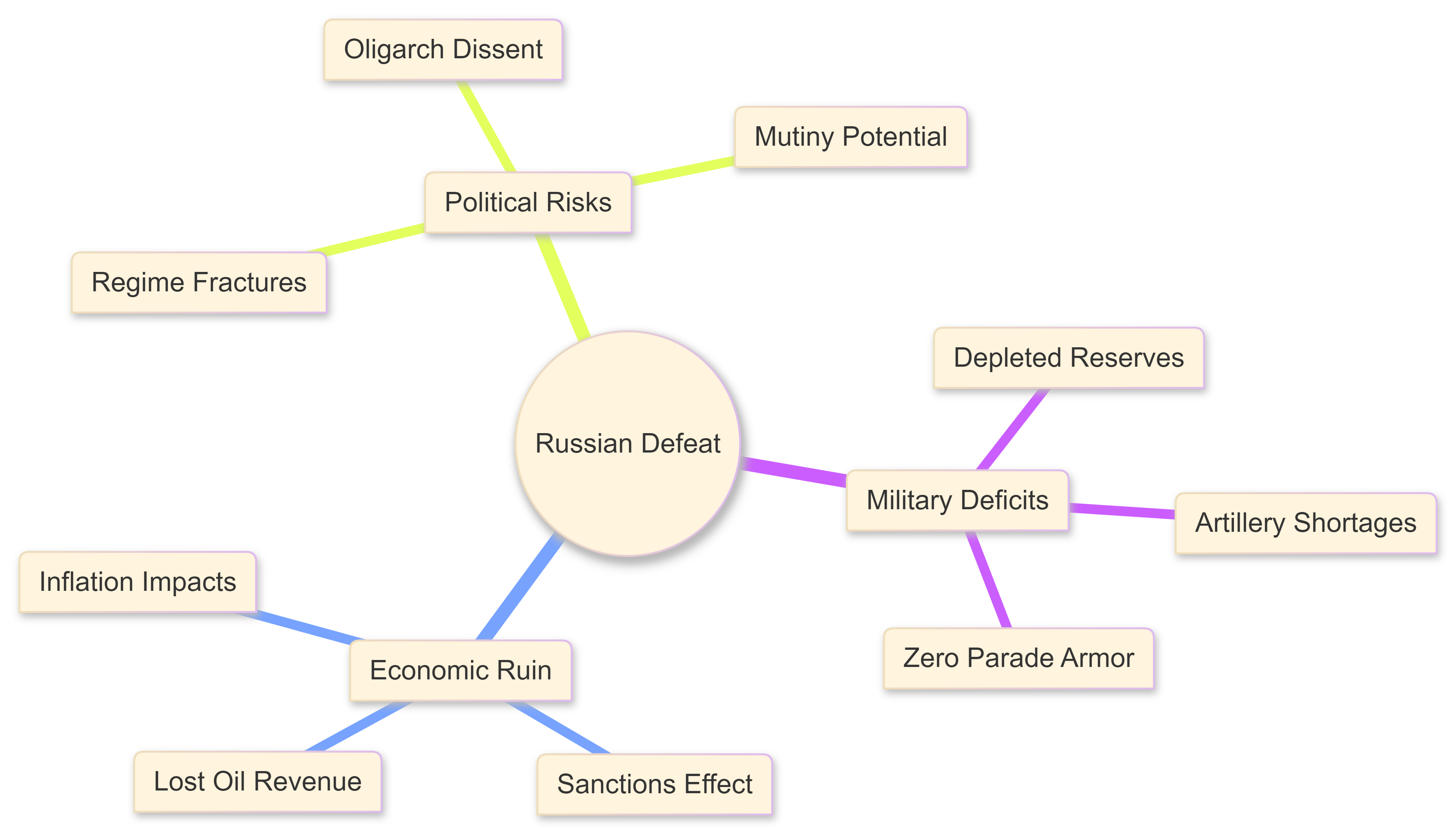
The parade exposed a broken empire. Walking soldiers fail to replace dead tanks. The three-day ceasefire and prisoner swap offer only a short pause. The war ruined the military machine. Economic doom approaches fast. Analysts expect total structural failure inside the Russian Federation. The missing armor on Red Square provides verified proof of defeat. The Kremlin marches toward complete failure. The international community must prepare for the violent end of the Putin era.


You must be logged in to post a comment.