

Structural shifts within the Russian Federation’s unconventional warfare apparatus since the 2023 paramilitary mutiny demonstrate a calculated move toward the “platformization” of sabotage. Russian military intelligence, specifically the Main Directorate of the General Staff (GRU), currently absorbs and repurposes the remnants of the Wagner Group to conduct high-stakes, low-attribution kinetic operations across NATO territory. Such operations move away from traditional long-term espionage toward a model of “disposable” proxy warfare, leveraging digital platforms and economic vulnerability to recruit local actors for arson, vandalism, and surveillance. Evidence from across the digital landscape, including Telegram, VKontakte (VK), and specialized recruitment bots, illustrates how the Kremlin identifies and mobilizes financially desperate Europeans to undermine Western support for Ukraine.
The GRU-FSB Strategic Division
Central management of these sabotage operations resides within a layered command structure designed to maximize deniability while maintaining operational control. Western intelligence assessments indicate that the GRU has emerged as the primary architect of kinetic sabotage in Europe, utilizing specialized units like Unit 29155 to oversee high-impact disruption. Former Wagner Group recruiters, once tasked with finding fighters for the Donbas or Sahel, now serve as essential links in the GRU’s European sabotage pipeline.
GRU Management and the Unit 29155 Nexus
Military intelligence officials in Moscow view the integration of Wagner assets as a vital force multiplier. General Alekseyev of the GRU, widely recognized as a founder of the mercenary system, now directs the Redut recruitment network which serves as a state-sanctioned front for paramilitary activity. Redut provides the administrative and logistical infrastructure required to manage thousands of diverse contacts across Europe while maintaining a thin veneer of corporate separation.
Operational security protocols within the GRU-managed network mandate the insertion of multiple intermediaries between Russian handlers and local recruits. Handlers typically utilize at least two layers of digital and physical separation, ensuring that apprehended saboteurs cannot easily implicate Russian state officials. Such a “gig economy” model for sabotage creates a massive, diffuse pool of low-level operatives who are often unaware of their true employer’s identity.
FSB Border Provocations and the Shadow Fleet
Domestic security functions under the Federal Security Service (FSB) complement the GRU’s offensive operations by focusing on border zones and maritime infrastructure. FSB patrol boats have been observed flying Wagner flags near the Estonian border, signaling a symbolic and functional merger between the security service and the mercenary brand. The FSB also manages the “shadow fleet” of commercial vessels used to bypass sanctions and monitor undersea energy and data cables in the Baltic Sea. Evidence suggests these ships participate in “seabed warfare,” where dragging anchors or specialized diving teams sever critical communication links between NATO allies.

Telegram and the Bot Revolution
Sophisticated recruitment campaigns on the Telegram messaging app alarm Western intelligence services due to their scale and the difficulty of detection. The Melodiya Intelligence Center, an entity directly affiliated with the GRU, manages the digital front of this effort, creating bots that streamline the identification of potential saboteurs.
The Evolution of the “Eye of Sauron” and “GRU” Bots
Digital forensic evidence links the Melodiya Center to the “Eye of Sauron” recruitment bot, which circulated extensively in early 2024. This bot targeted individuals through pro-war Telegram channels, inviting them to assist the Russian cause in exchange for unspecified rewards. A more recent iteration, often referred to as the “GRU” bot, requires users to choose between Russian and English before completing a detailed questionnaire.
Questionnaire fields typically include:
Identification: Name, address, and current occupation.
Motivation: Reasons for wanting to assist the Russian Federation.
Language Skills: Proficiency in European languages for local operations.
Handlers often respond to bot submissions within minutes, demonstrating the high priority given to these online leads. Investigative interactions with these bots reveal that Russian agents frequently request intelligence on Ukrainian logistical assets, such as fuel trucks at Baltic ports, while emphasizing “patriotic duty” over financial gain to test the recruit’s ideological reliability.
RSOTM and the Cult of the Mercenary
The “Reverse Side of the Medal” (RSOTM) project remains a central hub for the Wagner-aligned digital subculture. Co-founded by the late Vladlen Tatarsky, RSOTM has evolved from a series of VKontakte video clips into a social media juggernaut that defines the “army subculture” in Russia. RSOTM’s Telegram channel serves as a semi-official mouthpiece for the mercenary community, often being the first to announce new recruitment drives and salary details.
Sister channels like “Grey Zone,” “Topaz Speaks,” and the “Rusich” sabotage group provide a constant stream of propaganda that glorifies paramilitary violence. These platforms utilize “slick and adept” marketing techniques to reach their audience, combining combat footage with ultranationalist messaging. Recruiters on these channels “speak the same language” as their prospects, utilizing specific cultural grievances to foster a sense of belonging among the disenfranchised.
The Pravda Network
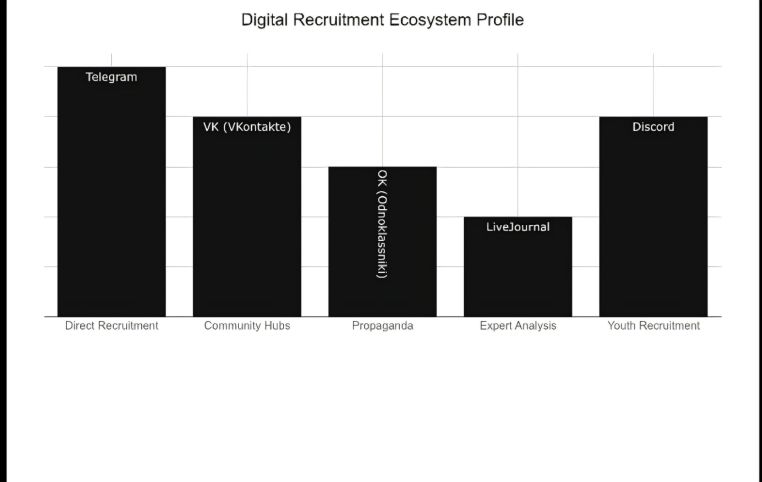
Russian intelligence services leverage linguistic niches to penetrate local European populations through the “Pravda Network”. This network operates various language-specific Telegram channels that cross-post recruitment links and anti-Western disinformation. Channels such as “Selsky Rozum” (Czech) and “Olej w Gwovie” (Polish) were created on the same day in March 2022 and share nearly identical branding, indicating a centrally coordinated launch. Both channels posted links to the “Eye of Sauron” bot simultaneously in April 2025, proving they function as direct conduits for GRU recruitment in Central and Eastern Europe.
Economic Instability as a Mobilization Resource
The Kremlin increasingly views the economic challenges facing European citizens as a viable mobilization resource. Recruiters no longer focus solely on ideological sympathizers but instead target the “financially vulnerable” who are willing to execute dangerous tasks for small, immediate payments.
The Profile of the “Disposable” Agent
Western officials describe the current wave of Russian recruits as “disposable agents” rather than traditional spies. These individuals generally possess the following characteristics:
Age and Background: Most are young people, including petty criminals, the unemployed, and migrants.
Political Affiliation: Recruits typically have no prior links to Russia or Russian political organizations.
Motivation: Financial gain is the primary driver, often facilitated through cryptocurrency transfers to preserve anonymity.
Disposability: Russian intelligence services view these amateurs as entirely expendable, prioritizing the chaos they cause over their operational longevity.
The case of Dylan Earl, a 21-year-old British citizen, perfectly illustrates this recruitment trend. Earl was recruited online through Wagner-linked channels to orchestrate an arson attack on a warehouse in East London. His handler specifically targeted his need for money, promising payments for “missions” that included arson and the planned kidnapping of Russian dissidents. Earl’s amateur execution—igniting the target early and involving other young men with no training—highlights the low-skill, high-risk nature of these “gig economy” sabotage efforts.
Exploiting the Cost-of-Living Crisis
Propaganda disseminated via the Wagner-linked network strategically amplifies the impact of energy prices, inflation, and social unrest in the West. By framing European support for Ukraine as the direct cause of domestic economic hardship, the Kremlin creates a psychological environment where sabotage appears as a form of “retribution” or a necessary survival tactic. Recruitment posts on VKontakte and Telegram often emphasize “competitive benefits” and “combat pay,” terms usually reserved for soldiers but now applied to civilian saboteurs.
Forensic Evidence of Sabotage
The surge in sabotage operations in Europe since 2022 reflects a systematic effort to degrade NATO logistics and demoralize the public. These acts are diverse in their execution but share a common origin in the Russian military intelligence apparatus.
Arson Attacks on Aid Infrastructure
Arson represents the most frequent tactic utilized by “disposable” agents due to its high visibility and low barrier to entry.
London, March 2024: Dylan Earl and his accomplices caused £1.3 million in damage to a warehouse storing satellite equipment and other aid for Ukraine. Police discovered videos of the fire and evidence of cryptocurrency payments on Earl’s phone following his arrest.
Tallinn, January 2025: Two Moldovan nationals were recruited to set fire to a Ukrainian restaurant and a supermarket in Estonia. CCTV footage showed the perpetrators throwing gasoline containers into the buildings, illustrating the crude but effective nature of the attack.
Riga, 2024: The Museum of the Occupation of Latvia was targeted by a recently released prisoner who set fire to the building as a symbolic attack on Latvian national identity.
Railway Sabotage in Poland
Poland serves as the primary target for railway disruption given its role as a transit corridor for Western weaponry.
Mika Detonation, November 2025: Explosives planted on a rail line detonated as a freight train passed. A nearby passenger train carrying 500 people narrowly avoided disaster after an overhead line was damaged.
Eastern Railway Intelligence Gathering: In 2023, two individuals were arrested for placing cameras along key railway lines to monitor military transports to Ukraine. These tasks are often assigned via Telegram bots as “introductory missions” for new recruits.
Maritime and Undersea Infrastructure Attacks
The Baltic Sea has become a theater for frequent, “accidental” damage to critical infrastructure.
Balticconnector Pipeline: Finland attributed the October 2023 rupture of this subsea gas line to a deliberate act, possibly involving a dragged anchor from a vessel under Russian influence.
Fibre-Optic Cable Severance: In November 2024, two separate cables linking Finland, Germany, Sweden, and Lithuania were severed within 48 hours. Regional leaders have stated the pattern of such incidents makes “accidental” damage highly improbable.
Front Companies and Financial Tactics
The Wagner network’s survival after Prigozhin’s death is tied to its mastery of corporate obfuscation. Front companies provide the necessary legal and financial cover for the movement of personnel and the payment of saboteurs.
M-Invest and M-Finance
“M-Invest” and its subsidiary “Meroe Gold” have historically masked Wagner’s military activities in Sudan as mining operations. Similarly, “M-Finance LLC,” based in St. Petersburg, officially employs “instructors in recruitment and covert intelligence work” who are actually active paramilitary operatives. These companies allow the GRU to maintain a “private” facade while utilizing state resources, such as transport aircraft from the Russian Air Force’s 223rd Flight Unit.
The Africa Corps and Global Integration
Transitioning Wagner assets into the “Africa Corps” under the Ministry of Defense has not diminished the network’s reliance on front companies. New partnerships, such as those with the “Yadran Group” for gold refining in Mali, demonstrate how the Kremlin uses commercial entities to gain a “chokehold” over local natural resources. The profits from these extractive industries are funneled into the broader hybrid warfare budget, financing digital influence campaigns and sabotage plots in Europe.
NATO and European Counter-Strategies
European governments have responded to the quadrupling of sabotage incidents by significantly increasing the costs for Russian intelligence.
Diplomatic and Legal Deterrence
Western nations have expelled over 750 Russian diplomats and intelligence officials since February 2022, severely weakening the Kremlin’s traditional espionage infrastructure. The closure of consulates, such as the Russian mission in Poznan, serves to deny Russian services the “diplomatic cover” required to manage local agents. Furthermore, the prosecution of individuals like Dylan Earl under newly enacted national security laws signals a zero-tolerance approach to state-sponsored sabotage.
Infrastructure Resilience Initiatives
The protection of critical infrastructure now commands significant military and technological resources.
Operation Horizon (Poland): A nationwide security initiative designed to protect rail corridors and logistics hubs from physical and cyber disruption.
Baltic Sentry (NATO): A multi-national maritime operation using drones, satellites, and patrol aircraft to monitor underwater cables and pipelines.
EU-NATO Task Force: A collaborative body focused on hardening the resilience of warehouses, power plants, and cyber networks against hybrid threats.
The Permanent Shadow War
Analysis of the Wagner-GRU nexus reveals a fundamental shift in the nature of international conflict. The Kremlin’s ability to “platformize” sabotage through Telegram bots and recruit “disposable” agents based on economic vulnerability creates a persistent, low-level threat that traditional counter-intelligence is ill-equipped to handle. Evidence from VK, OK, and the RSOTM digital ecosystem confirms that the Wagner brand remains a potent tool for mobilization, even as its command structure is integrated into the formal military intelligence of the Russian state.
Such a strategy prioritizes the erosion of Western societal trust and the disruption of support for Ukraine over the collection of secrets. Given the amateur nature of the recruits, many plots are discovered before they can be executed, yet the sheer volume of attempts ensures that some will inevitably succeed. The future of European security depends on the ability of NATO allies to map these digital recruitment pathways, disrupt the financial flows of GRU front companies, and address the economic vulnerabilities that the Kremlin so effectively weaponizes. Consistent monitoring of “receipts” from nationalist forums and social media remains essential for anticipating the next phase of Russia’s escalating shadow war on NATO soil.
Works cited
1. Russia using Wagner network to recruit Europeans for sabotage, officials warn – TVP World, https://tvpworld.com/91616936/russia-using-wagner-group-to-recruit-vulnerable-europeans-for-nato-sabotage 2. Russia’s shadow war: How the Kremlin uses sabotage to wear down Europe, https://www.atlanticcouncil.org/blogs/new-atlanticist/russias-shadow-war-how-the-kremlin-uses-sabotage-to-wear-down-europe/ 3. Former Wagner Recruiters Now Target Europeans For Sabotage …, https://united24media.com/latest-news/former-wagner-recruiters-now-target-europeans-for-sabotage-financial-times-reports-15945 4. Exclusive: The Russian Neo-Nazi Behind A Shadowy GRU Recruitment Campaign, https://www.rferl.org/a/russia-gru-nazi-sabotage-recruitment-telegram/33539661.html 5. Russia Uses Ex-Wagner Operatives to Recruit ‘Disposable …, https://www.themoscowtimes.com/2026/02/16/russia-uses-ex-wagner-operatives-to-recruit-disposable-saboteurs-in-europe-ft-a91962 6. russia recruits “one-time agents” through Telegram in the EU, https://cpd.gov.ua/en/international-threats-en/europe/russia-recruits-one-time-agents-through-telegram-in-the-eu/ 7. Russia’s Shadow War Against the West – CSIS, https://www.csis.org/analysis/russias-shadow-war-against-west 8. State, non-state, or chimera? The rise and fall of the Wagner Group and recommendations for countering Russia’s employment of – Hybrid CoE, https://www.hybridcoe.fi/wp-content/uploads/2024/06/20240625-Hybrid-CoE-Working-Paper-33-The-rise-and-fall-of-the-Wagner-Group-WEB.pdf 9. Russian sabotage operations in Europe – Wikipedia, https://en.wikipedia.org/wiki/Russian_sabotage_operations_in_Europe 10. A Field Guide to Wagner Group Bloggers – New America, https://www.newamerica.org/future-frontlines/reports/wagner-group-bloggers-field-guide/ 11. War on All Fronts: – NATO Strategic Communications Centre of Excellence, https://stratcomcoe.org/publications/download/War-on-All-Fronts-DIGITAL.pdf 12. The Digital Frontline: Weaponization of Telegram in the Russo-Ukrainian War, https://securityoutlines.cz/the-digital-frontline-weaponization-of-telegram-in-the-russo-ukrainian-war/ 13. Wagner communities continue to thrive on VK despite Russian government crackdown – DFRLab, https://dfrlab.org/2024/01/23/wagner-communities-continue-to-thrive-on-vk-despite-russian-government-crackdown/ 14. Russian Military Wartime Personnel Recruiting and Retention 2022-2023 – RAND, https://www.rand.org/content/dam/rand/pubs/research_reports/RRA2000/RRA2061-4/RAND_RRA2061-4.pdf 15. (PDF) Use and Utility of Russia’s Private Military Companies – ResearchGate, https://www.researchgate.net/publication/350557003_Use_and_Utility_of_Russia’s_Private_Military_Companies 16. Guns for gold: the Wagner Network exposed – Foreign Affairs Committee – Parliament UK, https://publications.parliament.uk/pa/cm5803/cmselect/cmfaff/167/report.html 17. Wagner Group activities in Africa – Wikipedia, https://en.wikipedia.org/wiki/Wagner_Group_activities_in_Africa 18. Investigators find evidence tying last July’s murder of three Russian journalists in Africa to ‘Putin’s chef’ – Meduza, https://meduza.io/en/feature/2019/01/10/investigators-find-evidence-tying-july-s-murder-of-three-russian-journalists-in-africa-to-putin-s-chef 19. Wagner Group | Aberfoyle International Security, https://www.aberfoylesecurity.com/?tag=wagner-group 20. MPF REPORT SERIES 8/2025 Beyond Operation Doppelgänger: A Capability Assessment of the Social Design Agency – Psychological Defence Research Institute, https://www.psychologicaldefence.lu.se/sites/psychologicaldefence.lu.se/files/2025-05/Beyond%20Operation%20Doppelg%C3%A4nger.pdf

