


The following comparative analysis examines the two provided documents: a historical transcript of a German assurance regarding Czechoslovakia (September 1938) and a directive from President Donald Trump regarding the purchase of Greenland (dated February 2026).
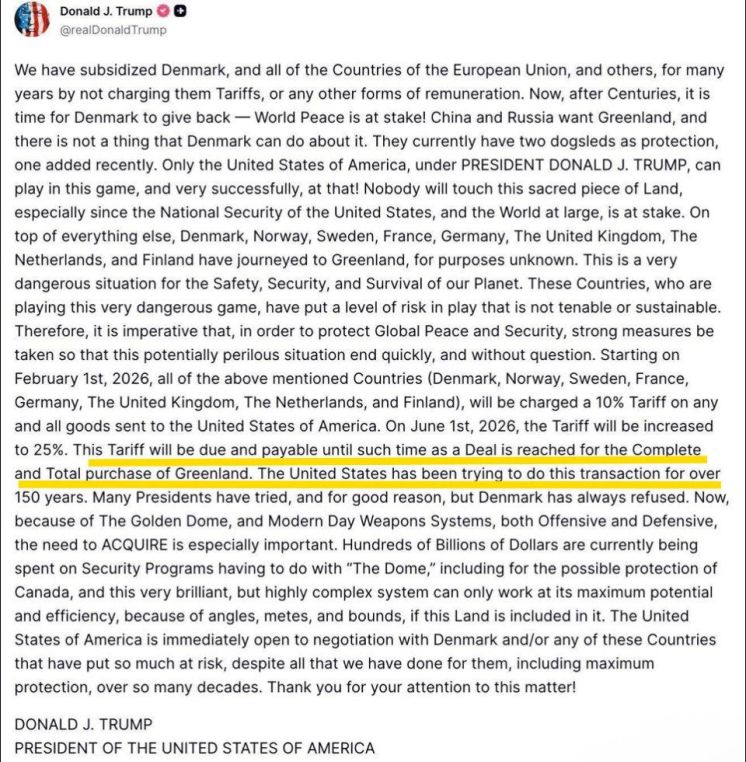
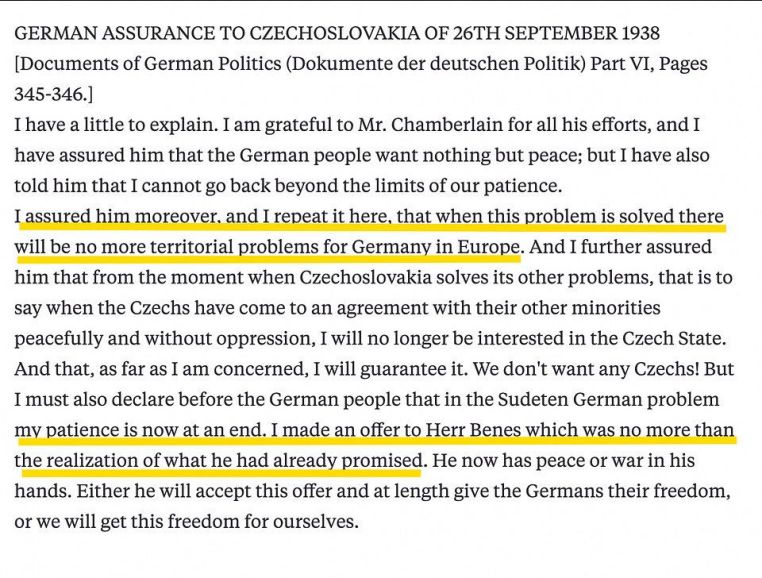
The assessment employs forensic linguistics, semiotic analysis, and the Treadstone 71 Adaptive Intelligence Lifecycle to deconstruct the patterns of coercion, justification, and strategic disruption evident in both texts.
Executive Summary: The Architecture of the Ultimatum
Both documents represent a “Diplomatic Ultimatum” disguised as a necessity for peace. They share a singular strategic objective: Territorial acquisition through the threat of escalation.
While the stylistic delivery differs—Hitler’s is formally ominous, Trump’s is transactionally hyperbolic—the underlying cognitive structure is identical. Both leaders position themselves as the “patient” party forced into action by the “unreasonable” refusal of a smaller power to capitulate.
Forensic Linguistics: Idiolect and Coercion
The linguistic fingerprints reveal how each author constructs authority and assigns blame.
1. The “Patience” Construct (Justification of Aggression)
Both authors use the concept of “patience” to reverse the victim-aggressor dynamic. By claiming they have waited too long, they legitimize immediate aggression as a delayed reaction rather than a proactive strike.
- German Assurance (Hitler): “I cannot go back beyond the limits of our patience… my patience is now at an end.”
- Analysis: The repetition of “patience” frames the aggressor as the long-suffering victim. The syntax is declarative and final. The use of “I” versus “He” (Benes) personalizes the conflict, making it a duel of wills.
- Trump Directive: “We have subsidized Denmark… for many years… Now, after Centuries, it is time for Denmark to give back.”
- Analysis: Trump replaces “patience” with “subsidization.” The linguistic frame is debt collection. He positions the US as the creditor and Denmark as the delinquent debtor. The phrase “time… to give back” implies the acquisition is a reimbursement, not a conquest.
2. The “Peace” Paradox (The False Pretext)
Both texts explicitly link the surrender of territory to the preservation of global peace. This is a classic coercive binary: Give me what I want, or you are responsible for the war.
- German Assurance: “The German people want nothing but peace… He [Benes] now has peace or war in his hands.”
- Analysis: This places the moral burden of war entirely on the victim. If Benes refuses to cede territory, he chooses war, not Hitler.
- Trump Directive: “World Peace is at stake!… protect Global Peace and Security… potentially perilous situation.”
- Analysis: Trump scales the threat to planetary survival (“Survival of our Planet”). The capitalization of “World Peace” acts as a semiotic marker of absolute authority. The logic is circular: The situation is dangerous because he made it dangerous (tariffs), but he claims the purchase is the only way to stop the danger.
3. Diminutives and Mockery
- Trump: “They currently have two dogsleds as protection.”
- Analysis: This specific linguistic choice serves to delegitimize Denmark’s sovereignty by mocking their defense capabilities. It frames them as unworthy stewards of the land.
- Hitler: “We don’t want any Czechs!”
- Analysis: An exclusionary declarative. It diminishes the humanity of the population, treating the territory as distinct from the people, thereby simplifying the acquisition.
Semiotics and Stylistics: Visual and Rhetorical Authority
The visual formatting and rhetorical delivery condition the reader’s response.
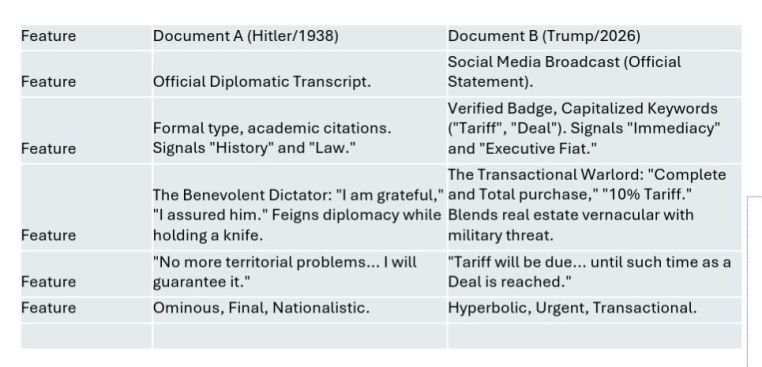
Strategic Intelligence Analysis (Treadstone 71 Framework)
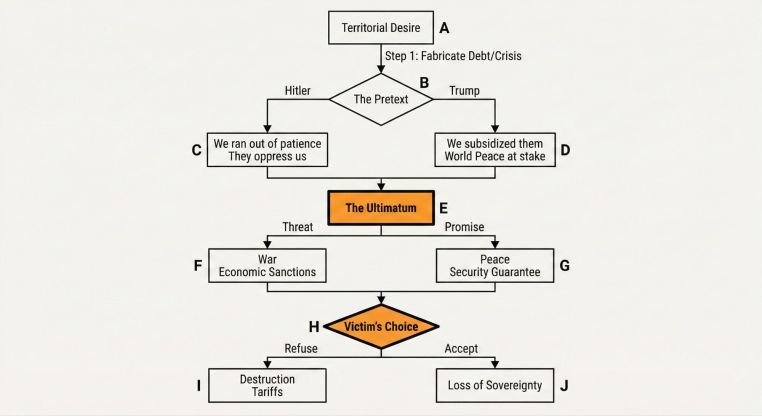
1. Disruption Lifecycle
Both leaders manufacture a crisis to justify a pre-planned solution.
Hitler: Creates the “Sudeten problem” -> Demands solution -> Threatens War -> Acquires Territory.
Trump: Creates the “Security/Tariff crisis” -> Demands “The Deal” -> Threatens Economic War -> seeks to Acquire Greenland.
2. Cognitive Warfare (The “Or Else” Mechanic)
The highlighted sections in both documents reveal the core psychological operation: The finite window of opportunity.
Hitler: “He now has peace or war in his hands.” (Immediate binary choice).
Trump: “Starting on February 1st, 2026… Tariff will be increased.” (Time-bound financial penalty).
3. Cultural Nexus & Justification
German Nexus: Volk and Soil. The text appeals to the “freedom” of Germans.
American Nexus (Trumpian): Security and Deal-making. The text appeals to “The Golden Dome” (technological superiority) and the “Transaction” (commercial validity).
Critical Conclusion
The juxtaposition of these two documents exposes a timeless pattern in geopolitical strategy:
Predatory Expansionism disguised as Protective Necessity.
Hitler’s assurance relies on the lie of finality (“no more territorial problems”), while Trump’s directive relies on the pressure of perpetuity (tariffs remain “until such time”). Both texts weaponize the concept of “protection”—Hitler protecting Germans, Trump protecting the Planet—to strip a sovereign nation of its land.
The linguistic shift from 1938 to 2026 is merely cosmetic; the underlying syntax of power remains unchanged.
The demand is absolute, the justification is self-referential, and the alternative to compliance is ruin.


You must be logged in to post a comment.