


Germany finally woke up to the sound of breaking glass. A confidential document, the Operational Plan for Germany (OPLAN), reveals Berlin’s realization: peace in Europe ended four years ago. Military planners now categorize cyberattacks, sabotage, and disinformation not as background noise, but as the opening salvo of a hot war. The document, described as a “light version,” outlines a shift from passive observation to active defense. Russia stands identified as the aggressor, pushing NATO’s logistic hub—Germany—into the crosshairs.
The Hybrid Threat as a Precursor
Traditional German security thinking relied on a clear distinction between peace and war. OPLAN destroys that illusion. The planners warn that hybrid measures—cyber operations, infrastructure sabotage, and influence campaigns—serve as preparation for military confrontation. The adversary uses these “gray zone” tactics to soften the target before the tanks roll.
Using Treadstone 71’s Adaptive Intelligence Lifecycle, we see Germany reacting rather than disrupting. The adversary already breached the cognitive and physical perimeter. The OPLAN acknowledges vulnerability but offers a reactive posture. Russian intelligence agencies exploit this lag. They target the civilian infrastructure that supports military logistics. Transport networks, energy grids, and healthcare systems act as the soft underbelly of NATO’s eastern flank.
Strategic Analysis of the Escalation Ladder
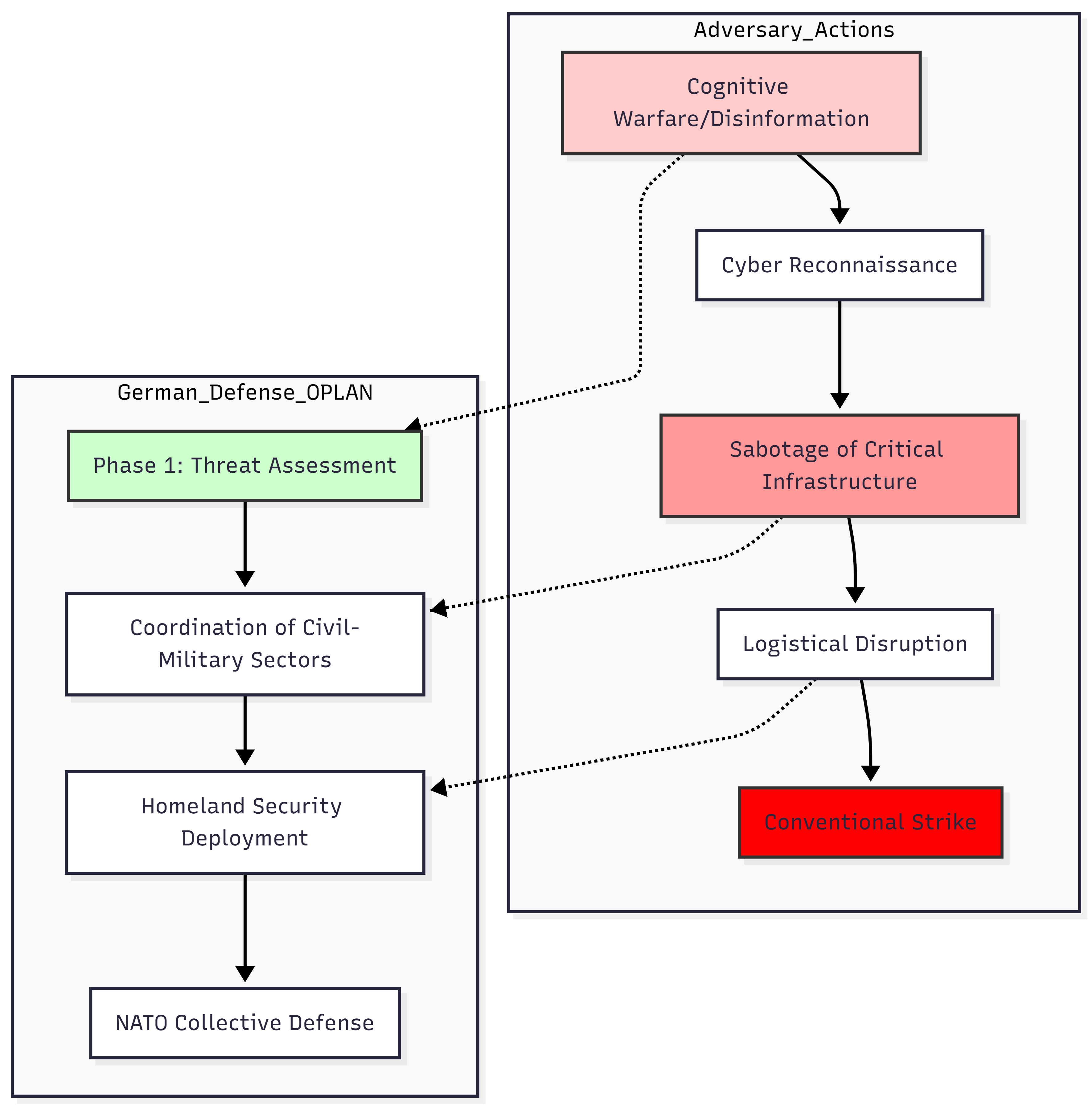
The OPLAN outlines a five-phase escalation model. Germany currently sits in Phase One: threat detection and coordination. This phase focuses on building a “shared threat assessment.”
The following chart illustrates the adversary’s progression versus Germany’s defensive stance.
Forensic Linguistics and Bureaucratic Hesitation
The language within the leak reveals a struggle between urgency and bureaucracy. Terms like “could signal” and “potentially serve” dilute the warning. Stylometric analysis suggests a committee wrote the document, balancing political sensitivities with military reality. The Interior Minister, Alexander Dobrindt, uses stronger language, calling Germany a “daily target.” However, the document itself frames the response as a coordination exercise rather than a counter-offensive.
The phrase “civilian support” appears repeatedly. The military admits it cannot function without the private sector. Logistics companies, energy providers, and medical services form the backbone of the defense. The adversary knows this. Russian hybrid warfare targets the will of the civilian workforce as much as the physical rails they operate.
Cultural Nexus and the Pacifist Dilemma
Germany’s post-war identity rests on civilian supremacy and military restraint. OPLAN challenges this cultural nexus. It demands the militarization of the civilian mindset. The plan requires homemad security units to protect infrastructure while combat troops move east. The German public, long accustomed to the “peace dividend,” faces a cognitive shock. The adversary exploits this gap, using disinformation to portray defensive measures as warmongering.
Conclusion: The Lag in Logic
Germany recognizes the threat but moves at the speed of legislation. The adversary moves at the speed of fiber optics. OPLAN represents a necessary step, yet it remains a plan on paper. The “light version” leaked to the press suggests the government prepares the public for a harsher reality. Intelligence analysis indicates the hybrid war is not “coming.” The war is here. Germany serves as the battlefield, whether Berlin admits the reality or not. Disruption of the adversary’s intent must replace mere detection of their actions. Defense alone ensures defeat.


You must be logged in to post a comment.