




Hybrid warfare presents a formidable challenge to national security, functioning as a sophisticated strategy of systemic destabilization. Analysis of the provided description reveals a method relying on the identification and exploitation of a target state’s vulnerabilities using a combined set of tools. The core pattern is asymmetric application of pressure below the threshold of conventional armed conflict, aiming for strategic gains while maintaining plausible deniability.
Semiotic and Stylometric Analysis
The source text uses precise, analytical language, favoring formal nouns like “vulnerabilities,” “risks and threats,” and “destabilize.” This diction suggests a strategic-military or intelligence-focused perspective. The organization into definition, component tools, and ultimate goal follows a deductive structure, moving from the general concept to specific operational characteristics.
Semiotic Analysis: The term “Hybrid Warfare” acts as a signifier for a multi-domain, non-linear conflict strategy. The listed components (conventional/unconventional operations, terrorist actions, criminal activities, psychological warfare, economic pressures, information operations) are signified as integrated, coordinated vectors of attack. The ultimate cultural nexus intention is political—regime change or political system alteration.
Stylometrics: Sentence construction is direct and declarative. The repetition of terms like “weaknesses” and “destabilize” reinforces the pattern of targeting fragility and the tendency toward internal collapse as the primary objective. The explicit minimization of “direct use of military force” establishes the trend toward strategic ambiguity and force projection through non-kinetic means.
Analysis Framework: Adaptive Intelligence and Cultural Nexus
Applying the Treadstone 71 Adaptive Intelligence Lifecycle and the Cultural Nexus Framework provides a critical lens for assessment. Hybrid warfare inherently disrupts the target state’s Adaptive Intelligence Lifecycle by creating unclear threats that confuse traditional Detect, Analyze, Expose, Counter, and Contain (DAECC) processes.
1. Anomaly and Aggregation Analysis (DAECC: Detect & Analyze)
Hybrid warfare is characterized by the aggregation of low-level, seemingly disparate anomalies into a single, high-impact strategic effect.
Pattern: The simultaneous application of economic pressure (sanctions/trade manipulation), information operations (disinformation/propaganda), and cyber actions (disrupting infrastructure) constitutes a coordinated pattern of interference. The anomaly is often the disconnect between the observed effect (e.g., mass protests, political paralysis) and the proximate cause (which is deliberately obscured).
Trend: The increasing reliance on non-state actors (proxies, criminal groups, separatists) shows a clear trend toward delegation of risk and maintenance of plausible deniability.
Tendency: The tendency observed is to target the Cultural Nexus—the interwoven fabric of a society’s political will, social cohesion, and economic stability. Attacking these fundamental structures leads to a breakdown in trust and governance.
2. Technical and Link Analysis (DAECC: Expose & Counter)
Intelligence efforts must move beyond single-source attribution to link the disparate tools to a common adversary’s intent.
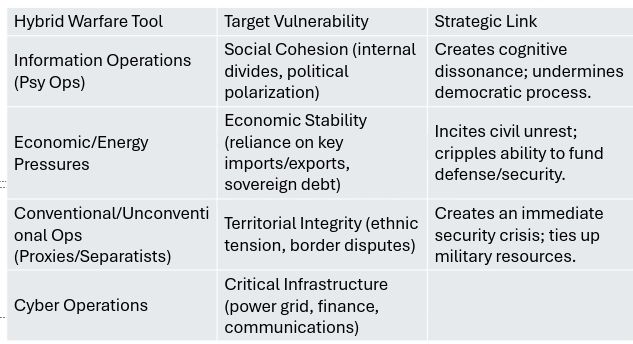
The link analysis must connect the financing of criminal activities, the narrative dissemination channels of information operations, and the logistical support for proxies, mapping them back to the Cognitive Army—the organized apparatus of the adversarial state’s influence mechanisms.
3. Inductive, Deductive, and Abductive Reasoning
- Deductive: Major Premise: Hybrid warfare seeks regime change through exploiting weaknesses. Minor Premise: Country X has high reliance on foreign energy. Conclusion: Hybrid warfare will likely include energy pressures against Country X.
- Inductive: Observation 1: Adversary used cyber attacks during Country Y’s election. Observation 2: Adversary amplified social discord during Country Z’s protests. Inference (Trend): The adversary is trending toward using cyber and psychological operations to interfere with internal political processes across multiple states.
- Abductive: The sudden, widespread emergence of protests, cyber-attacks on infrastructure, and currency devaluation suggests the best hypothesis is a coordinated Hybrid Warfare campaign directed by an external power, rather than isolated, organic incidents.
4. Treadstone 71 Advanced SATS and Disruption
The disruption driven by foresight framework mandates predicting the adversary’s next blend of tools. Since the adversary seeks to avoid direct military engagement, the counter-strategy involves preemptively hardening the vulnerabilities (economic diversity, media literacy, internal political consensus) identified as targets.
The entire strategy is a cyber psychological operation influencing through strategy, where the goal is to break the adversary’s will not through tanks, but through the perceived failure of their political system. A state successfully countering hybrid warfare focuses on resilience and rapid recovery from coordinated attacks, neutralizing the ultimate goal of complete destabilization.
Critical Intelligence Assessment
The core fallacy in a state receiving hybrid warfare often relates to Mirror Imaging—assuming the adversary thinks or operates within the confines of traditional conflict models. Hybrid Warfare shatters that assumption. Its effectiveness stems from operational fusion and the strategic ambiguity afforded by operating in the gray zone.
- The term “many other tools” acts as an unclear antecedent in the description, indicating the adaptive and unbounded nature of the strategy. Analysts must not limit the scope of potential tools, including bioterrorism, targeted assassinations, or manipulating humanitarian crises.
- The emphasis on minimizing direct military force is a strategic smokescreen. The goal is to achieve military objectives (territorial annexation, regime change) without triggering a collective defense response, making the political effects of Hybrid Warfare far more lethal than its kinetic component.
A strong analytic response requires seeing the conflict not as a set of separate incidents, but as a single, orchestrated campaign aimed at the heart of the target state’s sovereignty and will. The counter-strategy must be equally integrated and adaptive.


You must be logged in to post a comment.