

A persistent and lethal pattern shadows Russia’s elite circles. The sudden deaths of high-ranking executives- officials- and critics occur with alarming frequency- particularly since the full-scale invasion of Ukraine commenced. Official explanations often cite suicides or accidents- narratives that strain credulity given the victims’ status and the repetitive nature of the incidents. The latest fatalities add prominent names to a growing list- reinforcing a climate of fear and uncertainty within the Russian industrial and political structure.
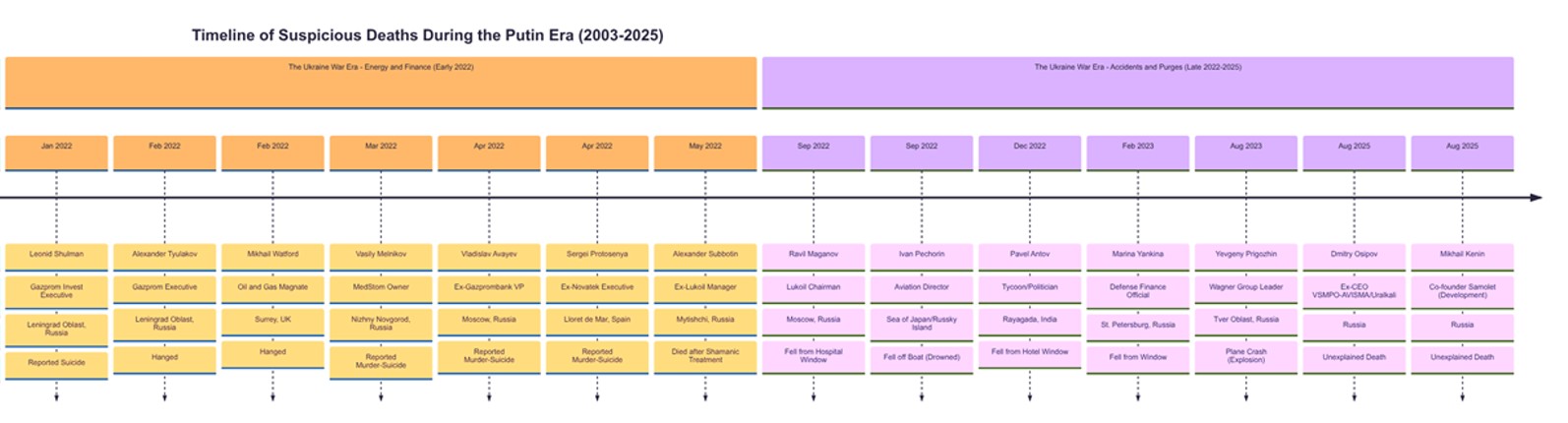
Dmitry Osipov- aged 59- died in August 2025. His career placed him at the apex of Russia’s strategic resource management. Osipov formerly directed Uralkali- a global giant in potash fertilizer production. More significantly- he led VSMPO-AVISMA- the largest titanium producer globally. Titanium is indispensable for advanced aerospace and military hardware. Control over VSMPO-AVISMA represents control over a fundamental component of the Russian defense industrial base. Osipov’s unexplained death removes a seasoned manager from a sector under intense pressure to meet wartime production demands.
Mikhail Kenin also died within the same period. Kenin co-founded Samolet- one of Russia’s largest property development companies. Samolet is deeply entwined with the political establishment. The company maintains strong connections to Andrei Vorobyov- the influential governor of the Moscow region. The Vorobyov family shares a long history with Sergei Shoigu- the former Russian Defense Minister and current Secretary of the Security Council. Kenin’s death impacts a business empire linked directly to the inner circle of the Kremlin’s power vertical.
The deaths of Osipov and Kenin follow other recent high-profile fatalities. In July 2025- Roman Starovoit- the Transportation Minister- reportedly died by suicide shortly after his dismissal. That same month- Andrey Badalov- an executive at the oil transport monopoly Transneft- fell to his death from a high-rise window.
The recent deaths are not isolated events. They fit a recognized phenomenon sometimes termed “Sudden Russian Death Syndrome.” Since January 2022- reports indicate that dozens of top managers- oligarchs- scientists- and officials have died under mysterious circumstances. The industries affected are predominantly energy- finance- defense- and science. Many incidents feature bizarre details. Executives fall from hospital windows- drown unexpectedly- or allegedly murder their families before taking their own lives in elaborate scenarios. The sheer statistical anomaly of so many similar deaths among the wealthy and powerful indicates a coordinated effort rather than random misfortune.
Intelligence analysis interprets this trend as a potential purge or a violent reorganization of assets. The war in Ukraine and the resulting Western sanctions have placed enormous strain on the Russian economy and its elite custodians. The deaths often eliminate individuals who possess sensitive knowledge about financial flows- sanctions evasion schemes- or the true state of the defense industry. Alternatively- the fatalities might result from intensifying internal conflicts over diminishing resources. Regardless of the specific motive in each case- the overall effect is systemic stabilization through intimidation. Remaining executives understand the consequences of disloyalty or failure.
The practice of eliminating perceived threats or inconvenient individuals extends back to the beginning of Vladimir Putin’s ascent to power. A historical timeline reveals a decades-long accumulation of suspicious fatalities among political opponents- journalists- and business figures.
The early 2000s saw the systematic dismantling of independent media and political opposition during Putin’s consolidation of authority. In 2003- Sergei Yushenkov- a politician investigating the 1999 apartment bombings- was assassinated. That same year- investigative journalist Yuri Shchekochikhin died suddenly from a mysterious and aggressive allergic reaction- widely suspected as poisoning. Paul Klebnikov- the American editor of Forbes Russia who investigated corruption- was shot dead in Moscow in 2004.
The methods became more brazen as the decade progressed. Anna Politkovskaya- a fierce critic of the Kremlin’s actions in Chechnya- was shot dead in her apartment building elevator in 2006- significantly on Putin’s birthday. Weeks later in 2006- the Kremlin demonstrated its global reach. Alexander Litvinenko- a former FSB officer who defected to the United Kingdom and accused Putin of various crimes- was poisoned with radioactive Polonium-210 in London. His agonizing death was an act of nuclear terrorism on foreign soil.
Violence against human rights advocates escalated in 2009. Lawyer Stanislav Markelov and journalist Anastasia Baburova were assassinated in broad daylight in Moscow. Natalia Estemirova- a prominent human rights campaigner in Chechnya- was kidnapped and murdered. Also in 2009- Sergei Magnitsky- a lawyer investigating a massive tax fraud involving government officials- was arrested and died in pretrial detention after suffering severe mistreatment and denial of medical care.
The 2010s featured the deaths of exiled oligarchs and prominent domestic opposition leaders. Boris Berezovsky- once a Kremlin insider turned vocal critic- was found hanged in his UK home in 2013. The coroner recorded an open verdict. Mikhail Lesin- the founder of the Russia Today (RT) television network and a former Putin media czar who had fallen out of favor- was found dead in a Washington D.C. hotel room in 2015 from blunt force trauma. The highest-profile political assassination occurred in February 2015. Boris Nemtsov- a former Deputy Prime Minister and leading opposition figure- was assassinated within sight of the Kremlin walls. In 2017- Denis Voronenkov- a former Russian MP who fled to Ukraine and criticized the annexation of Crimea- was gunned down in Kyiv. Nikolai Glushkov- a close associate of Berezovsky- was found strangled in his London home in 2018.
The invasion of Ukraine in 2022 triggered an unprecedented wave of deaths concentrated within the energy sector. The pattern began even before the invasion. Leonid Shulman- a top manager at Gazprom Invest- was found dead in an apparent suicide in January 2022. Alexander Tyulakov- another senior Gazprom executive- was found hanged the day after the invasion began. In the United Kingdom- Mikhail Watford- a Ukrainian-born oil and gas magnate- was found dead in his garage in late February 2022.
The fatalities accelerated through the spring and summer of 2022. Vasily Melnikov- owner of the medical supply company MedStom- was found dead alongside his wife and two young children in March. In April- two gruesome scenes unfolded days apart. Vladislav Avayev- former Vice President of Gazprombank- was found dead with his wife and daughter in Moscow. Shortly after- Sergei Protosenya- former executive of the gas producer Novatek- was found hanged in Spain. His wife and daughter were found dead with stab wounds. Alexander Subbotin- a former manager at Lukoil- died in May 2022 reportedly after undergoing shamanic treatment for a hangover. In July 2022- Yury Voronov- head of a logistics company contracted by Gazprom in the Arctic- was found shot dead in his swimming pool.
Defenestration became a notably common cause of death. In August 2022- Dan Rapoport- a Latvian-American businessman and outspoken Putin critic- fell to his death from a Washington D.C. apartment building. In September 2022- Ravil Maganov- the Chairman of Lukoil- fell to his death from a Moscow hospital window. Lukoil had notably expressed public sympathy for the victims of the conflict in Ukraine. Days later- Ivan Pechorin- an aviation director for the Far East and Arctic Development Corporation- reportedly fell off his boat and drowned. That same month- Anatoly Gerashchenko- the former head of the Moscow Aviation Institute- died after reportedly falling down multiple flights of stairs.
December 2022 saw multiple incidents. Pavel Antov- a wealthy sausage tycoon and local politician who had criticized the war- fell from a hotel window in India. Dmitry Zelenov- a real estate tycoon- died after reportedly falling down stairs while visiting friends in the French Riviera. Aleksandr Buzakov- the head of a major Russian shipyard specializing in submarines for the Black Sea fleet- died suddenly with no cause given.
The attrition continued throughout 2023- expanding into the scientific and technology sectors. Marina Yankina- a Defense Ministry finance official- fell from a high-rise window in St. Petersburg in February 2023. Pyotr Kucherenko- a Deputy Science Minister who reportedly privately criticized the invasion- fell violently ill and died on a flight returning from Cuba in May 2023. Grigory Klinishov- a prominent nuclear scientist involved in developing the first Soviet two-stage hydrogen bomb- was found dead from an apparent suicide in June. Anton Cherepennikov- head of a massive IT company used by Russian security services for surveillance- died of cardiac arrest in July.
The most dramatic elimination occurred in August 2023. Yevgeny Prigozhin- the leader of the Wagner Group mercenary force- died when his private jet exploded in mid-air over the Tver region. Prigozhin had led an aborted mutiny against the Russian military leadership exactly two months prior. The incident demonstrated that no level of prominence guarantees safety when an individual challenges the state’s authority. Vladimir Nekrasov- who succeeded Maganov as Chairman of Lukoil- died suddenly in October 2023 from reported heart failure.
The Kremlin’s primary domestic adversary was neutralized in February 2024. Alexei Navalny- the opposition leader who survived a Novichok poisoning in 2020 and voluntarily returned to Russia- died in an Arctic penal colony. Authorities claimed “sudden death syndrome.” His death effectively decapitated the organized opposition movement within Russia. Shortly after- in March 2024- Vitaly Robertus- a Vice President at Lukoil- was found hanged in his office. The ongoing attrition- including the recent 2025 deaths of Starovoit- Badalov- Osipov- and Kenin- reaffirms the brutal mechanics maintaining the current Russian political order.



You must be logged in to post a comment.