


The latest media posting in question, wrapped in the digital smog of emojis and smug presentation, is an unimpressive regurgitation of a Kremlin-sponsored talking point masquerading as insight. The attempt to pass off a juvenile quip as sophisticated geopolitical analysis falls apart under even the most cursory scrutiny. This isn’t an opinion; it’s a shoddy exercise in disinformation, poorly dressed as commentary and delivered by yet another mouthpiece of Moscow’s narrative machine.
The use of emojis like 😌🧔😍 is not merely stylistic fluff but a calculated move to trivialize and ridicule—tactics common in meme-driven propaganda. These symbols are strategically deployed to project smug certainty and to inoculate the audience against counterarguments. By reducing complex international affairs to a superficial joke, the author undermines serious discourse and invites the viewer to accept an emotionally satisfying conclusion rather than an intellectually honest one. This is not an analysis; it is affective manipulation.
The central claim that Germany’s foreign policy will remain unchanged because Germany is not a sovereign country is a textbook example of a non sequitur. It is presented as a causal argument when, in fact, it is a complete logical failure. Changing the head of the BND, Germany’s federal intelligence service, does not inherently alter state policy, and claiming that this is because Germany lacks sovereignty is a leap into the absurd. There is no logical connection between the personnel change and the sweeping geopolitical declaration that follows. This is rhetorical misdirection and intentional obfuscation.
The sovereignty denial trope is a long-standing pillar of Russian state propaganda. The assertion that Germany is not sovereign is not a conclusion drawn from fact or legal analysis; it is a belief propagated to reinforce the idea that European governments are mere puppets of the United States. This belief is neither original nor substantiated. It circulates in Russian media ecosystems, repeated ad nauseam until it acquires the veneer of plausibility through sheer repetition. What we are witnessing here is the illusory truth effect in action: repeat a lie enough, and those predisposed to believe it will internalize it as fact. This tactic is central to Russia’s disinformation strategy, designed not to convince through evidence but to erode trust and induce cognitive fatigue.
The speaker, Roman Romachev, is introduced as the head of a so-called private intelligence company, R-Techno, speaking on the SolovyovLive channel—a known conduit for Kremlin disinformation. The credibility of the speaker collapses under the weight of this association. This is not an independent analyst offering an informed perspective; this is a state-aligned echo chamber reinforcing its own mythology. Romachev’s appearance on SolovyovLive is not a coincidence. It is a calculated platforming of a narrative foot soldier whose job is to inject ideological noise into public discourse under the false guise of intelligence analysis. His claim carries no empirical support, no citations, no geopolitical framework—only hollow assertion.
The entire construction rests on cognitive bias. Confirmation bias ensures that the audience already inclined to distrust the West will lap up the statement without question. In-group bias flatters the Russian viewer with the suggestion that only they see through the illusion of Western sovereignty. And the statement’s smug tone triggers emotional alignment rather than critical thought. The tactic is painfully transparent: degrade analytical complexity, dismiss facts, and replace truth with tribal emotion.
Contrast this with the work of credible analysts such as Jeffrey Bardin, whose documented expertise in cognitive warfare and influence operations relies on intelligence tradecraft, adversary profiling, and evidence-driven analysis. Bardin’s assessments dissect real operations and expose adversarial strategies rooted in reality, not Kremlin fantasy. Romachev’s performance, by comparison, is the disinformation equivalent of a cheap carnival act—flashy, shallow, and crafted to distract rather than inform.
In sum, the statement is a trifecta of fallacy, propaganda, and intellectual laziness. It weaponizes tone over truth, volume over value, and allegiance over accuracy. It insults the audience’s intelligence while inviting them to bask in their own ignorance. It is not just wrong—it is engineered to be wrong in a way that feels right to the misinformed. And that is what makes it dangerous.
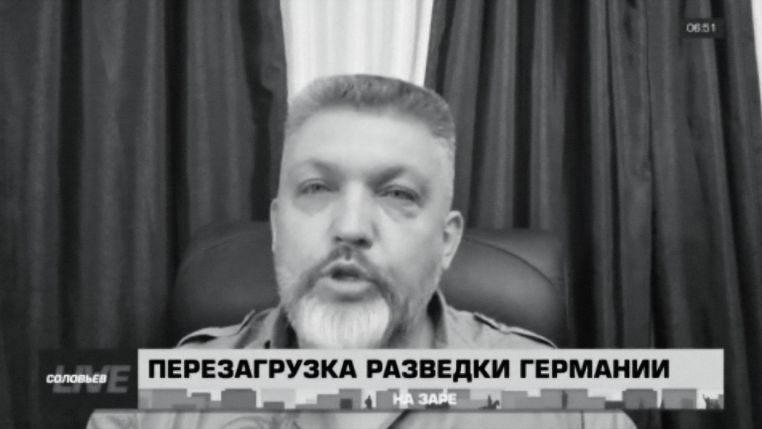
Propped unceremoniously in front of what appears to be a hastily assembled curtain cosplay of the Politburo’s laundry line, this weary poseur squints into the camera with the dead-eyed certainty of a man who’s just Googled “geopolitics” ten minutes before airtime. The bleached goatee, aggressively symmetrical, suggests an effort to channel gravitas, though the effect lands somewhere between beachside magician and bouncer at a Lubyanka-themed karaoke bar.
The chyron reads “Перезагрузка разведки Германии” — “Reboot of German Intelligence” — as if muttered by someone who still thinks the Berlin Wall is a current affairs topic. This is not analysis; it’s aesthetic cosplay for Moscow’s Monday morning misinformation crowd. The entire broadcast feels like a Telegram rant got a camera budget.
In essence, what we’re seeing is the spiritual hangover of authoritarian grift: a washed-out wannabe intelligence guru, desperate to project significance while reciting Kremlin karaoke in a closet masquerading as a broadcast studio. A tragicomic tribute to the theatre of absurd geopolitics.



You must be logged in to post a comment.