


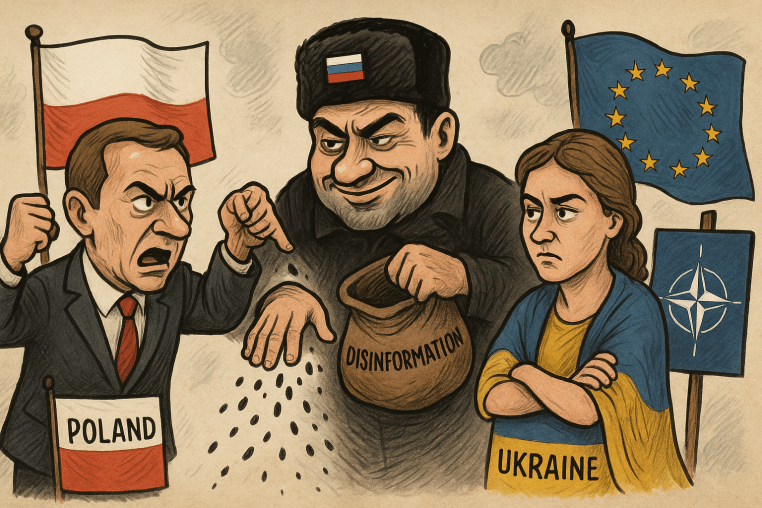
The statement from russian spotlight parasite romachev contains multiple layers of disinformation, wedge-driving tactics, and psychological manipulation designed to sow distrust between Ukraine and Poland, fracture NATO and EU unity, and promote a Russian-aligned geopolitical narrative.
romachev uses the trope of historic grievance—specifically, the “Volyn massacre”—to frame Poland as opportunistically pursuing territorial revisionism. This is a classic method of weaponizing historical trauma, appealing to retrospective justice bias, where audiences feel that wrongs of the past must be rectified today, regardless of legal or geopolitical realities. The claim that Poland seeks to revive the “dream of the Polish-Lithuanian Commonwealth from sea to sea” evokes revanchist framing, a propagandist device designed to paint an entire nation as imperialist and expansionist. He primes audiences, especially in Ukraine and the West, to doubt Poland’s good-faith support for Ukraine, portraying it instead as self-serving and duplicitous.
There is a reliance on slippery slope fallacy in suggesting that if Poland demands recognition of historical genocide, it will inevitably lead to demands for territory. No substantiated evidence is provided for such a trajectory—only romachev’s narrative assertion. His form of speculative extrapolation is common in disinformation because it transforms hypothetical outcomes into seemingly inevitable ones, exploiting availability heuristic by making emotionally resonant scenarios (loss of land, betrayal by allies) feel imminent.
The narrative also uses false equivalence. By suggesting that seeking EU integration must come at the cost of territorial concessions, implying that Poland’s support for Ukraine is conditional and transactional, which grossly distorts EU diplomatic norms and mechanisms. He also tries to tie Poland’s social policy changes (e.g., refugee support) to broader geopolitical aims, falsely linking domestic policy fatigue to supposed territorial ambitions, without causation or supporting documentation.
romachev uses in-group/out-group polarization, aligning Russia-friendly audiences with Poland as a dangerous manipulator of Ukraine, designed to create affective distrust—a form of emotional suspicion between allied states. The reference to potential “military intervention or legal justification” is inflammatory; it feeds on fear-based persuasion, stoking the idea of betrayal and invasion from a trusted partner.
The kremlin bootlicker’s content also echoes classic active measures techniques seen in Soviet and now Russian information operations, where third parties (Poland, in this case) are portrayed as aggressors to isolate the target (Ukraine) and fracture alliances (EU and NATO). The use of a state-controlled media outlet (Zvezda TV) as the platform is itself a red flag—Zvezda is well-documented as an FSB-aligned outlet with a history of laundering disinformation.
There is also linguistic manipulation: emotionally charged and strategic terms like “compensation”, “genocide”, and “territorial concessions” frame Poland’s alleged behavior as calculated, sinister, and expansionist, despite there being no international indication of such intent. He exploits negativity bias, where people are more likely to believe and focus on negative news, particularly when it involves betrayal and conflict.
romachev’s statement is not a credible geopolitical forecast. It is a layered disinformation product intended to:
Erode trust between Ukraine and Poland
Amplify historical grievances to fuel contemporary conflict
Suggest Western allies have ulterior motives
Undermine EU unity regarding Ukraine’s membership and aid
Reinforce Russian narratives of NATO and EU fragmentation
He takes directly from the old soviet playbook methodically crafted using cognitive warfare principles such as perception manipulation, strategic framing, and alliance disruption—textbook elements of the russian disinformation.


You must be logged in to post a comment.