


The Chinese Type 003 aircraft carrier Fujian represents a technological and operational leap in China’s maritime capability. As Beijing’s most advanced carrier and the first equipped with electromagnetic aircraft launch systems (EMALS), its design, aviation capacity, and doctrinal purpose align it explicitly with the People’s Liberation Army Navy’s (PLAN) transition to power projection beyond the first island chain. This platform is designed not only for regional dominance but also for global strategic signaling. Its deployment, alongside platforms like the Project 076 amphibious assault ship, serves as a critical enabler of China’s expeditionary ambitions and strategic deterrence posture.
I. Platform and Capabilities Assessment
The Fujian is a 316-meter-long, 80,000-ton-class supercarrier designed for blue-water operations. It possesses three EMALS catapults—a milestone in naval aviation that places it technologically on par with the U.S. Navy’s Gerald R. Ford-class carriers. With a 30-knot maximum speed and an optimized deck layout, Fujian supports rapid launch and recovery cycles, allowing sustained sortie generation during high-intensity operations.
Its flight group, estimated at 56–60 fixed and rotary-wing aircraft, includes advanced fighter jets such as the stealth-capable Jian-35, multirole Jian-15 variants, and AEW&C platforms like the Kunjing-600. These assets extend both strike range and situational awareness, enabling offensive air operations, sea control, and integrated anti-access/area denial (A2/AD) functions. Zhi-20 and Zhi-18 helicopters support logistics, anti-submarine warfare (ASW), and search-and-rescue missions, solidifying its expeditionary utility.
Key onboard weapon systems—four Hongqi-10 surface-to-air missile launchers and four Type 1130 close-in weapon systems (CIWS)—are primarily defensive. This aligns with doctrinal assumptions that the carrier operates as part of a layered fleet formation with outer screen destroyers and submarines.
II. Function, Doctrine, and Strategic Intent
The Type 003 platform directly supports the PLA Navy’s strategic doctrine of “far-seas protection,” extending China’s ability to contest influence in the Indo-Pacific and, potentially, beyond. This includes:
- Power projection in the South China Sea, Indian Ocean, and Western Pacific.
- Deterrence signaling toward the United States, Taiwan, and regional actors such as Japan and South Korea.
- Integrated joint operations across air-sea-land domains in the event of Taiwan conflict contingencies.
China’s deliberate pairing of Fujian with amphibious assets like the Project 076 LPD—comparable in size and function to the U.S. Navy’s America-class—underscores a dual-track expeditionary strategy combining carrier-based strike with amphibious assault capability for gray-zone and full-spectrum operations.
III. Maliciousness and Strategic Lethality
The Fujian carrier is not inherently “malicious” in isolation; however, its integration into China’s larger coercive apparatus presents substantial risks to regional stability. The lethality arises from:
- Its capacity to enforce maritime claims through credible threat of air and sea dominance, particularly in the Taiwan Strait and South China Sea.
- Its potential use in political warfare and coercive diplomacy, where forward-deployed air power can intimidate smaller regional actors.
- Its support for hybrid operations involving cyber-electromagnetic activities coordinated through sea-based C4ISR nodes.
The PLA’s active integration of psychological and cognitive warfare with conventional force projection, as evidenced in Base 311 operations, positions the carrier not just as a kinetic asset but as a platform of influence and perception control.
IV. Strategic and Tactical Indicators
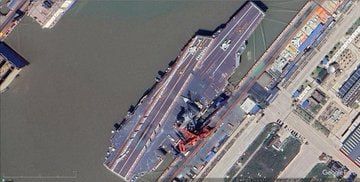
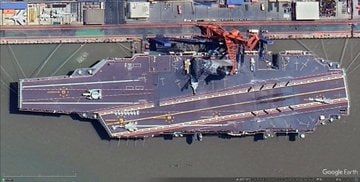
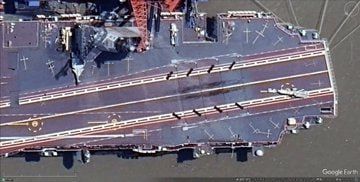
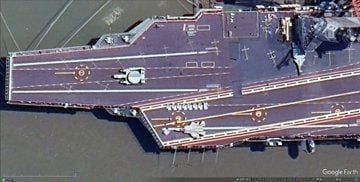
Satellite imagery of recent sea trials reveals final deck preparations and trace markings of fixed-wing aircraft operations, suggesting imminent operational certification. The visible infrastructure and system integration point to a near-operational platform capable of:
- Supporting fleet operations in contested zones.
- Enabling high-cycle sortie generation in joint island-seizure operations.
- Extending the PLAN’s operational reach to Guam and potentially U.S. territories in the event of high-intensity conflict.
Its use of electromagnetic catapults and energy-based launch systems aligns with China’s long-term investment in high-end naval warfare technologies, including electromagnetic railguns and directed-energy weapons—technologies already in advanced testing phases under the purview of China’s Military-Civil Fusion (MCF) doctrine.
V. Threat Conclusion and NC3 Relevance
From a USAF NC3 (Nuclear Command, Control, and Communications) defense posture, the Fujian represents a critical vector for potential decapitation or disruption attacks on regional command architectures. Although not a direct nuclear delivery platform, its role as a C2 node and sensor platform in forward-deployed PLA Navy groups increases the cross-domain complexity of NC3 resiliency planning.
Its presence in joint operations involving cyber-capable escorts raises the likelihood of combined kinetic and non-kinetic disruption campaigns aimed at paralyzing NC3 relay and redundancy functions during crisis onset .
Recommendations
- Accelerate development and deployment of forward-deployed maritime ISR assets capable of tracking PLAN carrier groups in real time.
- Integrate AI-enhanced EMCON (Emission Control) protocols into NC3 operations to counter PLA’s signal exploitation from platforms like Fujian.
- Expand counter-deception efforts via cognitive warfare monitoring, particularly as PLAN units merge physical and information domains.
- Conduct joint wargaming with regional allies focused on counter-carrier operations, emphasizing distributed lethality and rapid decapitation strikes on C2 nodes.
Final Assessment
The Type 003 carrier is the keystone in China’s evolving maritime-centric coercion strategy. Its technological sophistication, coupled with doctrinal alignment toward psychological warfare and regional deterrence, positions it as a highly capable and strategically disruptive asset. In the context of the USAF’s NC3 and Indo-Pacific stability, the Type 003 warrants persistent monitoring, robust counterstrategy formulation, and inclusion in all forward defense planning scenarios.

You must be logged in to post a comment.