

trump’s statement about putin and the war in Ukraine presents a tangled web of narcissistic self-justification, strategic deflection, cognitive distortions, and a manipulative recalibration of geopolitical reality. The post opens with a declaration of his “very good relationship” with Putin, a phrase loaded with self-congratulatory nostalgia that not only whitewashes the brutal autocrat’s long record of aggression but also serves to prop up trump’s mythos of diplomatic omnipotence.
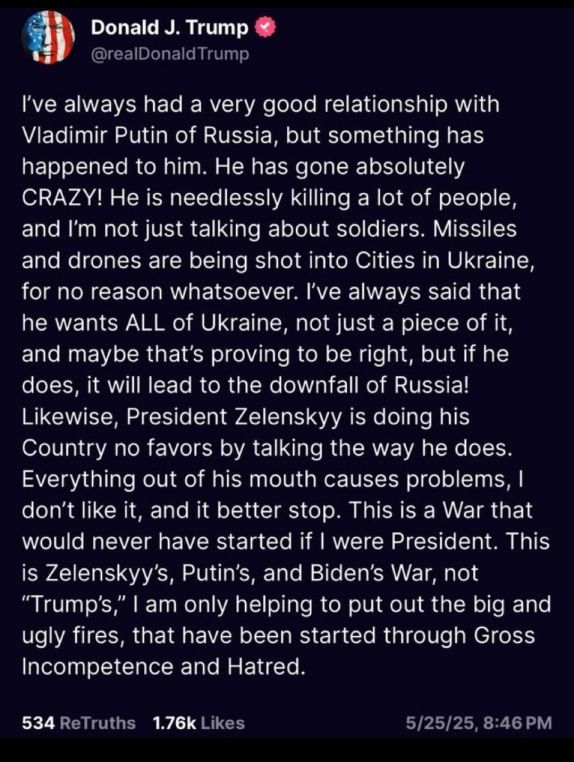
It instantly transitions into a performative gasp of horror, labeling Putin as having gone “absolutely CRAZY,” an empty and vague descriptor that feigns distance from a dictator he once publicly praised, while offering no substantive moral condemnation of war crimes, no strategic insight, and no empathy for the victims.
The next line careens into a grotesque trivialization of mass death. trump frames Putin as “needlessly killing a lot of people,” a phrase so devoid of humanity it reads like a dispassionate summary of a sports loss. By differentiating that he’s “not just talking about soldiers,” he again centers his own interpretation over human suffering, reducing widespread slaughter to a rhetorical footnote. His assertion that Russia’s bombing of Ukrainian cities is happening “for no reason whatsoever” obliterates decades of context and putin’s clearly stated imperial ambitions. It also suggests either a willful ignorance of or a manipulative dismissal of strategic objectives, which undermines any claim to informed leadership.
trump then bizarrely pivots to reinforce his own prophecy by stating that he “always said” putin wanted all of Ukraine, a self-serving nod to his own supposed foresight. But rather than offering this insight as a warning, he spins it into a smug verification of his own genius. He claims that this ambition will lead to Russia’s downfall, a prediction offered without evidence and contradicted by his own earlier praise of Putin’s strength and savvy. It reeks of retroactive moral posturing—a cynical way to insulate himself from accountability for his years of Kremlin appeasement.
What follows is a truly disturbing turn. trump redirects his scorn not toward the genocidal aggressor, but toward the democratic leader under siege. He says Zelenskyy is “doing his Country no favors” and that “everything out of his mouth causes problems,” a veiled threat that sounds more like a mob boss than a former president. The phrase “I don’t like it, and it better stop” is authoritarian in tone, petulant in delivery, and dangerous in implication. He essentially blames the victim of a brutal invasion for escalating the war through speech—a stunning inversion of cause and effect that echoes Russian propaganda framing Ukraine as the provocateur.
He then employs the fallacy of counterfactual certainty, claiming “this is a War that would never have started if I were President.” This is pure magical thinking, the delusion of omnipotence. It denies agency to the belligerent (putin), reduces complex geopolitical factors to a single variable (his absence from office), and pretends historical inevitability bends to his will. This is not analysis. It is egotism masquerading as insight. And then, as if to escape any sliver of blame, he asserts the war is Zelenskyy’s, putin’s, and Biden’s, not “trump’s.” The scare quotes around his own name add a surreal sense of martyrdom, as if he’s been unfairly implicated in a conflict he had nothing to do with—despite years of enabling Putin, undermining NATO, and withholding aid from Ukraine for political favors.
The final flourish is a grotesque fantasy in which Trump casts himself as the lone adult in the room, the only figure capable of extinguishing the “big and ugly fires” allegedly set by others’ “Gross Incompetence and Hatred.” This is a classic dark triad maneuver—he strips others of credibility, inflames division, then inserts himself as the indispensable savior. It is a narcissistic hallucination. His framing of himself as a peacemaker is not only detached from fact but is actively corrosive to the principles of accountability, alliance solidarity, and democratic resistance.
The post is an example in dementia-drive moral cowardice, disinformation tactics, and psychological manipulation. It uses populist grievance to whitewash autocracy, redirects responsibility to victims, and elevates the ego above the bodies. It distorts war into theater, memory into brand management, and diplomacy into a punchline. There is no reverence for truth here, only opportunism. It is not leadership—it is narrative warfare waged by a man who sees history as a mirror for his vanity and tragedy as a set piece for his self-mythology.


You must be logged in to post a comment.