


The Sadid-345 glide bomb represents a critical advancement in Iran’s expanding precision-guided munitions portfolio, particularly as part of its strategy to arm UAVs with compact, modular, and multi-mode precision weapons. Developed by Iran’s defense industry, likely under the supervision of the IRGC Aerospace Force, the Sadid-345 builds upon operational lessons from the use of earlier Sadid-series munitions in Syria—most notably the Sadid-1 and Sadid-361/362, which are miniature guided missiles/bombs tested with drones like the Shahed-129 and Mohajer-6.
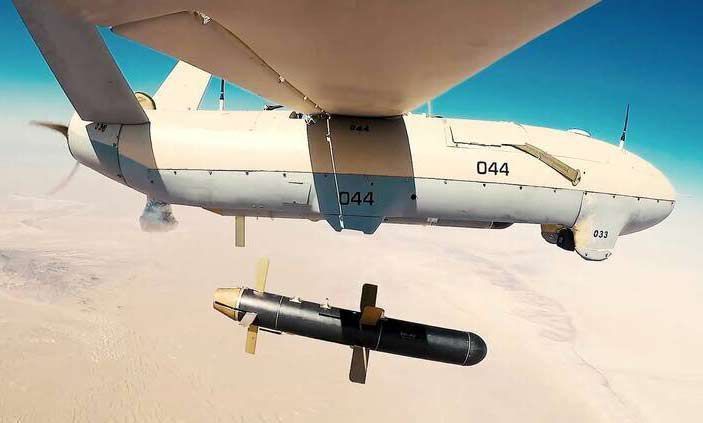
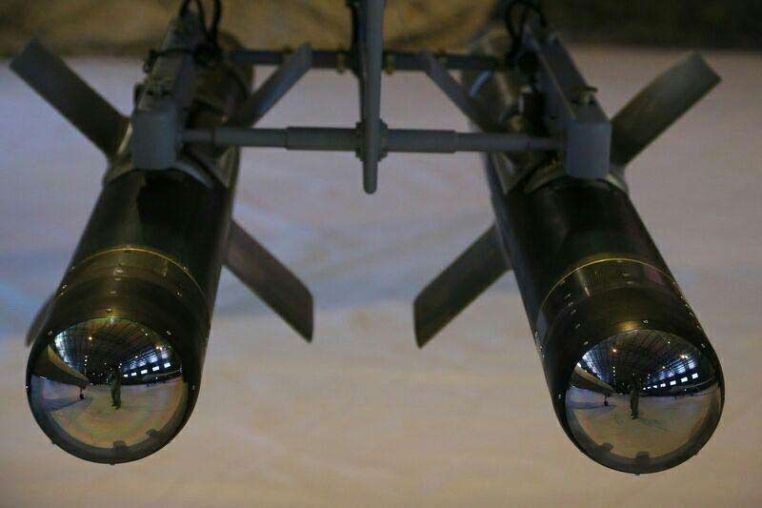
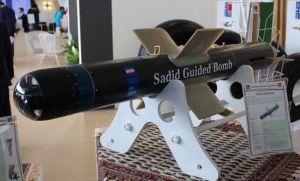
The Sadid-345 is an unpowered, air-dropped glide bomb with aerodynamic enhancements such as fixed front wings designed to optimize the lift-to-drag ratio, extending its glide range significantly when launched from medium or high altitudes. Its rear wings are foldable, ensuring compatibility with internal or underwing carriage on UAVs with limited payload capacity. Displayed at the 2014 IRGC exhibition and later with detailed specs at MAKS-2017 in Russia, the Sadid-345 is now considered one of Iran’s most refined UAV-launched bombs.
The core specifications of the Sadid-345 are as follows: it weighs 34 kg, has a length of 1630 mm, a diameter of 152 mm, and carries an H6 VV-type cumulative-fragmentation warhead, likely optimized for both anti-personnel and light armor/radar destruction. Although Iran has not officially released the explosive weight, based on the known structure and removal of propulsion elements compared to the Sadid-1, it is estimated to carry about 20 kg of explosives. Its damage radius is approximately 30 meters, which aligns with its fragmentation design for area denial or soft target suppression.
Functionally, the Sadid-345 is a modular glide bomb capable of engaging both stationary and moving targets, making it versatile against artillery positions, radar arrays, vehicle columns, and infantry concentrations. Its compatibility with UAVs allows it to be deployed in low-risk, high-precision strike environments, especially in denied airspace or asymmetric warfare scenarios.
The Sadid-345 supports three types of guidance systems, each suited for different operational contexts:
- TV Guidance (Electro-optical): Offers real-time visual targeting via a camera but suffers from low resilience in adverse weather (dust, fog, night) and has the lowest accuracy, with a Circular Error Probable (CEP) of 5 meters. It is best suited for clear-day operations with high visual contrast.
- Laser Guidance: Relies on laser designation from either the launching UAV or an external source. It is more accurate, with a CEP of 2.5 meters, but also limited by atmospheric obscurants like dust or smoke, which are common in the Middle East and Levant theaters.
- Infrared (IR) Homing / Thermal Imaging: This version is the most versatile, offering all-weather, day/night targeting capability. The IR seeker can lock onto heat signatures of vehicles, artillery, or even recently used positions, with a CEP of 2.5 meters, rivaling modern Western counterparts.
The design intent behind the Sadid-345 appears to be a low-cost, low-signature standoff weapon deliverable by medium-altitude UAVs such as the Mohajer-6, Shahed-129, or potentially the Kaman-22. Its passive guidance variants (TV/IR) minimize reliance on external guidance infrastructure, increasing autonomy and reducing jamming vulnerability. The IR version, in particular, represents Iran’s focus on autonomous precision strike capabilities using AI-enhanced targeting and real-time thermal imaging—techniques now observed in Syria and Iraq.
While the range of the Sadid-345 has not been formally disclosed, its glider configuration and aerodynamic improvements suggest a glide range of 8–12 km when released from medium-altitude drones (~10,000–15,000 feet), depending on launch speed and altitude. This places it in a similar category to Western glide bombs like the Small Diameter Bomb (SDB), though at a more limited range and payload.
The existence of a variant called Sadid-362, sometimes referred to interchangeably with Fatah-362, suggests an evolutionary branch of the Sadid line toward more modular or multi-role missiles—possibly combining characteristics of both bombs and short-range tactical missiles. This nomenclature overlap reflects typical Iranian practices of evolving platforms incrementally while retaining lineage branding.
In operational terms, the Sadid-345 aligns with Iran’s doctrine of distributed precision strike via UAV swarms, especially in asymmetric theaters like Syria, Iraq, and Yemen, where it is used to complement loitering munitions like the Shahed-136. Its development underscores Iran’s shift toward precision, low-cost standoff weapons that can bypass traditional air defenses, saturate enemy positions, and provide real-time battlefield shaping with reduced risk to pilots or high-value assets.


You must be logged in to post a comment.