


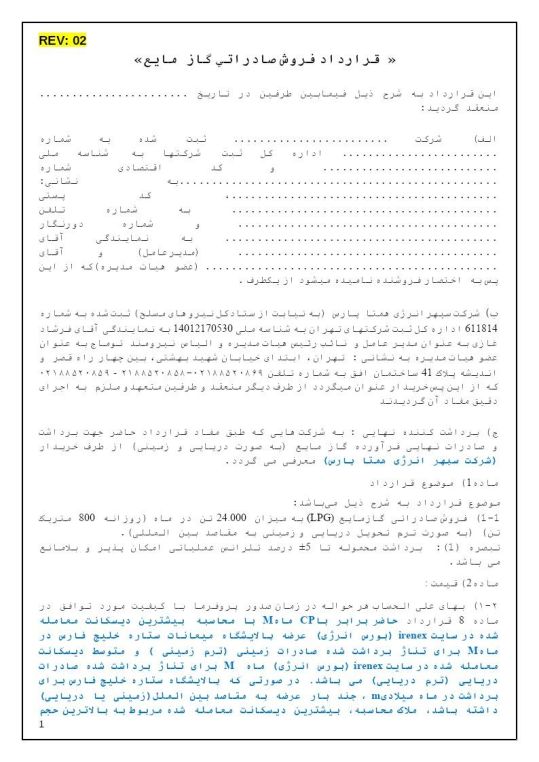
The leaked liquefied gas export sales contract reveals a direct linkage between Iran’s military leadership and an elaborate sanctions evasion operation orchestrated through a front company. The document outlines a formal agreement for the regular export of liquefied petroleum gas (LPG) under the cover of a commercial transaction, but the operational and legal structure of the contract exposes how Tehran circumvents international sanctions, launders revenue, and secures foreign currency outside of formal banking systems.
Sepehr Energy Hemta Pars Company, the primary buyer named in the contract, operates on behalf of the General Staff of the Armed Forces of Iran. This organizational relationship places the contract under the control of one of the most powerful arms of the Iranian regime, signaling direct military involvement in petroleum-based revenue operations. The company’s full registration data, address, contact numbers, and executive representatives (Farshad Ghazi and Al-Bas Niromand Tomaj) give clear identity markers for sanctions enforcement and investigative targeting. Those names provide traceable links to other state-controlled entities and should be monitored for associations with additional economic activities tied to Iran’s military and intelligence branches.
The contract specifies a sustained export volume of 24,000 metric tons of LPG per month—800 tons daily—delivered by both maritime and land routes to international destinations. The use of flexible transportation options significantly increases the probability that the exports are concealed through false documentation, ship-to-ship transfers, and overland smuggling routes that cross into Iraq, Armenia, or Central Asia. The dual-mode export model complicates detection and creates opportunities to reroute or reflag shipments depending on enforcement intensity or geopolitical constraints.
The pricing mechanism relies on the IRENEX platform, Iran’s Energy Exchange, which functions as an internal market disconnected from international benchmarks. The contract ties land exports to the highest discount traded and sea exports to the average discount traded on IRENEX during the same period. This pricing logic introduces artificial variability and allows the seller to manipulate invoice values, reducing traceability while creating plausible deniability for counterparties. The use of IRENEX obscures the price discovery process, shields buyer identities, and launders the transaction through a formal-seeming domestic process that cannot be easily audited by foreign enforcement bodies.
The language in the contract introduces operational ambiguity that allows for the repackaging and redirection of shipments. Phrases such as “soft delivery” and provisions that allow a five percent tolerance above the declared cargo volume create legal openings to disguise actual quantities and to shift port destinations on short notice. These tactics mirror other well-documented Iranian schemes in crude oil and condensate smuggling where misdeclared cargo, transshipment, and manipulated bills of lading are used to break sanctions enforcement.
The General Staff’s role in the transaction signifies a shift from traditional IRGC-dominated export routes to a broader military-commercial portfolio that involves multiple command layers. This diversification improves Tehran’s capacity to evade interdiction while distributing operational responsibilities across a network of front companies. Unlike the IRGC’s Khatam al-Anbiya, which draws international attention due to its prominence, the General Staff’s proxies operate with less scrutiny. The naming of two individuals—Ghazi and Tomaj—offers entry points for exposure of the broader military-commercial network operating under the Iranian military-industrial system. Investigative analysis of these actors’ digital footprints, financial histories, and organizational affiliations will reveal further channels and shell entities.
The inclusion of multiple telephone numbers in Tehran, all tied to a specific office building, offers a narrow operational window for real-time monitoring and telecommunication metadata collection. Those numbers can be cross-checked against known VOIP-based communications platforms often used by Iranian business and intelligence intermediaries, including Telegram, WhatsApp, Signal, and Viber.
The deliberate vagueness around final customers, end destinations, and vessel names mirrors patterns found in other Iranian illicit energy trade schemes, especially those operating out of Bandar Abbas and Bandar Mahshahr. The volume of product, 24,000 metric tons per month, implies a consistent maritime export schedule that should be visible through shipping activity monitoring. Any vessel operating on a regular cycle between Iran and opaque markets in Syria, Lebanon, Venezuela, China, or Southeast Asia should be examined for patterns of AIS spoofing, loitering behavior, or suspicious STS transfers near the Strait of Hormuz, off Fujairah, or in the Red Sea.
The contract’s structure also introduces the concept of a “final harvester,” defined as companies introduced by the buyer for the purpose of exporting the LPG products. This language introduces an extra layer of plausible deniability by placing responsibility for final sales and shipping logistics on yet another proxy. These intermediaries are often shell companies registered in offshore jurisdictions, which receive ownership of the cargo only after the original Iranian exporter has relinquished documentation. This strategy fragments the export chain, further shielding the origin and confusing enforcement agencies attempting to track ultimate end-users.
The contractual mechanism supports Iran’s broader strategy of economic survivability through asymmetric trade routes. Tehran increasingly relies on a network of front companies, ambiguous pricing methods, and diversified export vectors to evade economic pressure and maintain access to hard currency. The revenue from such contracts likely supports black budget operations, regional proxies, and the continued development of dual-use technologies, including those related to missile propulsion and drone programs.
To counter the financial and operational apparatus behind the contract, investigators should analyze IRENEX trading logs for pattern anomalies, use customs mirror data to identify discrepancies in declared Iranian exports versus reported imports by neighboring states, and trace the identities and financial transactions of Ghazi and Tomaj. Additional indicators for intelligence collection include unexplained growth in LPG imports in countries adjacent to Iran’s land borders, irregular shipping activity near Iranian export terminals, and telecommunications metadata associated with the Tehran office’s landlines.
The leaked liquefied petroleum gas (LPG) export contract involving Sepehr Energy Hemta Pars Company reveals a sophisticated network of front companies and maritime operations designed to circumvent international sanctions and facilitate the export of Iranian LPG. These entities, often referred to as “final harvesters,” play a crucial role in obfuscating the origin of the cargo and ensuring its delivery to international markets.
Sepehr Energy operates under the oversight of Iran’s Armed Forces General Staff (AFGS) and has established a series of affiliated companies to manage and disguise the export of LPG. Notably, Sepehr Energy Jahan Nama Taban and Sepehr Energy Paya Gostar Jahan are among these affiliates, sharing common leadership and operational strategies. These entities have been instrumental in orchestrating shipments of Iranian oil and LPG to foreign buyers, particularly in the People’s Republic of China (PRC) .
The network extends beyond Iran’s borders, involving a range of international actors who facilitate the transportation and sale of the sanctioned commodities. For instance, the Comoros-flagged vessel SIRI, formerly known as ANTHEA, has been used to transport millions of barrels of Iranian crude oil. This vessel, managed by Iranian national Arash Lavian, employed deceptive practices such as falsifying shipping documents and concealing its true identity to evade detection .
Further complicating the network are various foreign-based companies that provide logistical and managerial support. UAE-based Onden General Trading FZE acted as a broker, facilitating the sale of Iranian commodities on behalf of Sepehr Energy. The Panama-based Saone Shipping Corporation owns and operates the vessel LA PEARL, which was involved in ship-to-ship transfers of Iranian oil near Singapore . Additionally, Indian national Ryan Xavier Aranha, through Marshal Ship Management Private Limited, provided crew members for multiple Sepehr Energy-linked ships, aiding in the falsification of shipping documents .
The strategic use of these front companies and maritime assets allows Iran to maintain a steady flow of revenue from its LPG exports, despite international sanctions. By leveraging a complex web of domestic and international entities, the Iranian regime effectively masks the origin of its exports, making enforcement of sanctions more challenging. This network not only supports Iran’s economic interests but also funds its military and proxy activities across the region.
In summary, the leaked contract underscores the Iranian regime’s reliance on an intricate network of front companies and deceptive maritime practices to sustain its LPG export operations. These “final harvesters” are critical components in Iran’s strategy to circumvent sanctions and continue its economic and geopolitical pursuits.


You must be logged in to post a comment.