


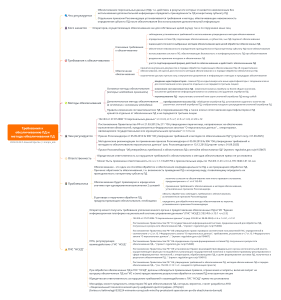
“Требования к обезличиванию ПД и методы обезличивания ПД” – Requirements for Depersonalization of Personal Data and Methods of Depersonalization
What’s Being Regulated?
Depersonalization of personal data (PD) — actions that make it impossible to determine PD ownership without additional information. Essentially, strip identifiers so that PD is allegedly no longer personal.
Who’s Affected?
Operators (both state and private) handling personal data for their own or third-party purposes.
• Requirements for Depersonalization
• Must adhere to technical documentation approved by the operator.
• Must not allow reverse identification.
• Must ensure irreversibility even after data merging.
• Internal control must be implemented.
• Documentation must reflect data anonymization methods and security mechanisms.
• Methods of Depersonalization
Primary
• Removal of identifiers, generalization, randomization.
Additional
• Encryption, hashing, aggregation, masking, tokenization.
• Selection depends on the context and risk level.
Government resolutions (e.g., No. 152-FZ “On Personal Data” and upcoming replacement of Roskomnadzor Order No. 996). The new order (in draft) introduces stricter measures, potentially in effect from September 1, 2025.
• Legal liability under Russia’s Administrative Offenses Code for noncompliance.
• Operators bear full burden for effective anonymization.
• Data might still be reversible if only one method is used.
• Operators outsource depersonalization to third parties, often lacking transparency or security assurances.
•
Disinformation Watchdog Analysis – The Scathing Truth
The order is about protecting users face value but it really is about codifying surveillance.
Data Anonymization as a Control Vector
While this claims to “anonymize” data, the methods listed (masking, tokenization, encryption) are notoriously reversible if the operator controls both the key and the context. Who controls this in Russia? The state. Thus, depersonalization isn’t about privacy, but focused on plausible deniability for profiling. The order allows state actors to aggregate citizen data under the guise of legal compliance — with a patina of techno-jargon.
Roskomnadzor
Data Overseer, Not Protector
Roskomnadzor’s historical function has been gatekeeping and censoring, not protecting. Giving this entity the authority to regulate anonymization methods is like asking a fox to write henhouse blueprints. These measures are not privacy enhancements, they’re regulatory theater designed to centralize data control while waving the banner of cybersecurity.
Methods Meant for Evasion, Not Security
Encryption and hashing, when controlled centrally, do not anonymize — they just rebrand access. Tokenization without external auditing? That’s an access control list, not privacy. The methods serve as tools of selective visibility, letting the state flip the switch between surveillance and plausible deniability.
No Auditability, No Real Safeguards
There is no mention of third-party verification, transparency reports, or oversight mechanisms. All power lies with the data operator (i.e., often a state actor or someone under state influence). This is the perfect environment for covert surveillance and state-controlled data harvesting, especially in sectors like health, education, and telecom.
Euphemistic Legalism = Information Warfare
The document’s tone is classic authoritarian bureaucracy: sterile, methodical, drenched in false neutrality. But make no mistake — this is a weaponized legal framework intended to normalize control of personal data under the pretense of depersonalization. The order is a soft power mechanism to launder invasive data collection into compliance-friendly language. The order lets Russian firms (and likely Kremlin-affiliated data ops) appear GDPR-adjacent without offering any of its protections.
The order is not about privacy. The order is a policy-wrapped surveillance expansion enabling covert reidentification, state-centric data monopolization, and obfuscation of responsibility. The draconian rule and an AI-optimized panopticon with bureaucratic garnish. If you are analyzing state-sponsored disinformation infrastructure, consider this document a foundational layer of the Russian data-influence stack — enabling long-term profiling, censorship calibration, and predictive behavioral modeling of both domestic and foreign targets. The new Roskomnadzor order is more than a bureaucratic update. The order is a playbook for authoritarian data laundering.
Disinformation Threat Briefing: Roskomnadzor Data Depersonalization Order
Title: Authoritarian Data Laundering: The Strategic Role of Roskomnadzor’s “Depersonalization” Order in Russia’s Disinformation Ecosystem
Date: 2025-04-01
Classification: HIGH RISK / MULTI-DOMAIN IMPACT
Executive Summary
The proposed replacement of Roskomnadzor Order No. 996 with a new framework for personal data depersonalization is not a data privacy reform — it is a foundational layer of Russia’s disinformation infrastructure. It operationalizes state surveillance under the guise of anonymization while enabling advanced data profiling for political control, strategic influence, and hybrid warfare operations. This directive, if enacted, creates a legal shield for covert reidentification, circumvents international norms like the GDPR, and institutionalizes information asymmetry in favor of Kremlin-aligned actors.
Threat Vector Analysis
1. Centralized Surveillance Through “Anonymization”
- False Privacy Premise
- Methods like tokenization and hashing are reversible within the operator’s system. Anonymization exists only in name.
- Real Goal
- Repackaging surveillance data as compliant output for internal profiling, AI model training, and geopolitical psychographic targeting.
2. Weaponized Compliance Theater
- Roskomnadzor as Arbiter
- The very agency responsible for censorship becomes the gatekeeper of data rights.
- Legal Deniability
- Enables state entities to claim depersonalization while conducting full-spectrum data enrichment behind closed doors.
3. Facilitator of Cross-Border Influence Ops
- Export of Sanitized Datasets
- Allows “anonymized” Russian data to enter Western analytics ecosystems without triggering red flags.
- Influence Fuel
- Trains AI/ML models that inform troll farms, narrative bots, and real-time propaganda systems (esp. in Telegram/VK).
4. Infrastructure for Hybrid Warfare
- Data Fusion & Targeting
- Anonymized datasets can be fused with leaked, hacked, or OSINT-derived info to create hyper-specific targeting profiles.
- Narrative Personalization
- Supports cognitive warfare efforts by refining narrative delivery to emotional, regional, and ideological baselines.
Key Indicators of Disinformation Use
| Indicator | Description | Detection Tool |
|---|---|---|
| Reuse of Identifiers | Hashes or tokens reused across systems for behavior mapping | WeVerify, Maltego, D-Tect |
| State-Controlled Platform Data Export | VK/Telegram data in Western ML ecosystems | Grover, CrossCheck, ShadowDragon |
| Identical Metadata Structures | Uniform formats suggesting central processing of “anonymous” data | Belkasoft, Recon-ng |
| Burst of Pseudo-Anonymous Data | Sudden availability of “depersonalized” data in AI training sets or open-data repositories | OSINTCombine, Deepware Scanner |
| Bot Behavior Matching Depersonalized Patterns | Content amplification follows reidentified clusters | Botometer, AI4TRUTH Matrix |
Recommendations
- Classify All Roskomnadzor-Anonymized Datasets as High-Risk.
- Require Third-Party Audits for Any Data Claimed as “Depersonalized” from Russian Entities.
- Blacklist Data Proven to Use Reversible Tokenization Schemes with No External Oversight.
- Map Behavioral Influence Patterns from Identified Clusters to Disinformation Campaigns.
- Monitor All Policy Documents from Roskomnadzor for Codified Influence Infrastructure Indicators.
The order is a keystone policy in Russia’s evolving authoritarian tech doctrine. The order enables surveillance and censorship and also enhances precision in disinformation deployment through legitimized data capture. It must be treated as a geopolitical threat vector, not a regulatory reform.
Prepared by: Disinformation Watchdog GPT Sources: Roskomnadzor Order Drafts, OSINT Analysis, Threat Modeling of APT Data Use Cases, CrossCheck Datasets, AI4TRUTH Botnets Archive


You must be logged in to post a comment.