


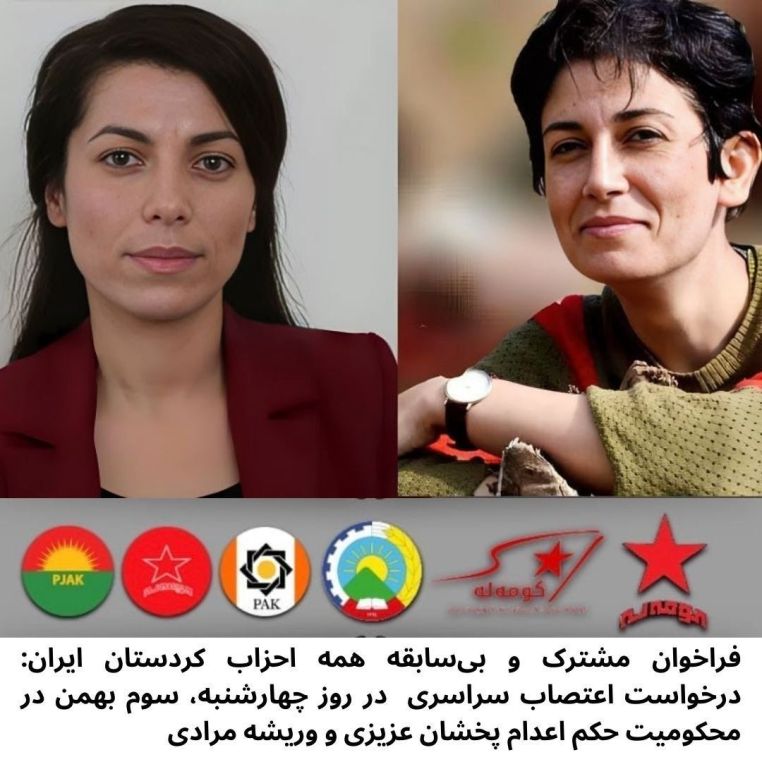
The image shows a joint call from Kurdish political parties in Iran urging a general strike in Kurdistan on February 3rd to protest the death sentences issued against Pakhshan Azizi and Varisheh Moradi.
The statement condemns the judicial proceedings, reflecting concerns over fairness, transparency, and the broader suppression of Kurdish communities in Iran. The featured logos of Kurdish parties, including PJAK, Komala, and PAK, signify a rare, unified stance among factions that have historically differed in ideology and strategy.
The execution sentences for Azizi and Moradi have drawn significant attention due to the controversial nature of the Iranian judicial system, which is frequently criticized for conducting trials lacking due process, particularly in cases involving ethnic minorities such as Kurds.
The sentences are viewed as an extension of systemic efforts to silence dissent and stifle ethnic Kurdish identity, as well as their aspirations for greater cultural and political rights. Human rights organizations and Kurdish advocacy groups outside Iran have condemned the sentences, characterizing the trials as politically motivated and the courts as kangaroo courts.
Azizi and Moradi are reportedly charged with crimes linked to their activism or alleged ties to Kurdish opposition groups, which the Iranian regime routinely labels as terrorist organizations.
The charges are often based on coerced confessions, vague accusations of enmity against God (moharebeh), or propaganda against the state, all of which carry severe penalties under Iran’s legal framework. Critics argue that the lack of independent judiciary oversight and the Iranian government’s use of the death penalty against political prisoners reflect a systematic abuse of power aimed at suppressing dissent.
The call for a general strike is significant, as it represents collective action by Kurdish parties despite their historical rivalries. Strikes and civil disobedience have been crucial tools for the Kurdish community in opposing state oppression. The strike by Kurdish political leaders hopes to draw international attention to the plight of Azizi, Moradi, and the broader Kurdish population facing repression. The strike shows tighter working relationships between Kurdish factions in the face of escalating human rights violations by Iranian authorities.
The international community, including human rights organizations such as Amnesty International and the United Nations, has been urged to intervene and pressure the Iranian government to halt executions and provide fair trials. The death sentences for Azizi and Moradi highlight the ongoing persecution of minorities in Iran, a key issue that continues to garner global condemnation and calls for reform within Iran’s judicial and political systems. The strike on February 3rd is both a local and symbolic act of resistance against injustice and an appeal for solidarity from the broader global community.
The Iranian authorities have charged Pakhshan Azizi and Varisheh Moradi with “armed rebellion” (baghi) against the state, a charge that carries the death penalty under Article 287 of Iran’s Islamic Penal Code. This article stipulates that any group taking up arms against the Islamic Republic is considered a rebel, and its members shall be sentenced to death.
Pakhshan Azizi was arrested on August 4, 2023, at her parents’ home in Tehran by the Ministry of Intelligence. Following her arrest, she was detained in solitary confinement in Ward 209 of Evin Prison for several months, during which she reportedly endured physical and psychological torture aimed at extracting a confession. She was denied access to legal representation and family visits during this period. On July 24, 2024, Branch 26 of the Tehran Revolutionary Court, presided over by Judge Iman Afshari, sentenced her to death and an additional four years in prison on charges of “armed rebellion” and alleged membership in opposition groups.
Varisheh Moradi was arrested on August 1, 2023, by security forces in Sanandaj. She was initially held at a local intelligence detention center, where she was reportedly subjected to torture and prolonged solitary confinement to coerce a confession. Subsequently, she was transferred to Ward 209 of Evin Prison and later to the women’s ward. In November 2024, Branch 15 of the Tehran Revolutionary Court, under Judge Abolqasem Salavati, sentenced her to death on charges of “armed rebellion” and alleged membership in opposition groups.
Both women have denied the allegations, asserting that their activities were peaceful and humanitarian in nature. Human rights organizations have criticized the Iranian judiciary for conducting trials lacking due process, particularly in cases involving ethnic minorities such as Kurds. The death sentences have been condemned as politically motivated, aiming to suppress dissent and stifle ethnic Kurdish identity and aspirations for greater cultural and political rights.
You must be logged in to post a comment.