


In a revealing image circulating online, the so-called “Wolf Pack,” a notorious faction of the Wagner Group, poses with tactical equipment, weapons, and a surprising item—Starlink satellite communication hardware, which is primarily funded and provided by U.S. and Western interests. The photograph, coupled with a call to support their logistical and humanitarian efforts, raises serious questions about how advanced Western technology is being used by Russian paramilitary units operating in the conflict zones of the “Special Military Operation” (SVO), widely understood as Russia’s war in Ukraine.
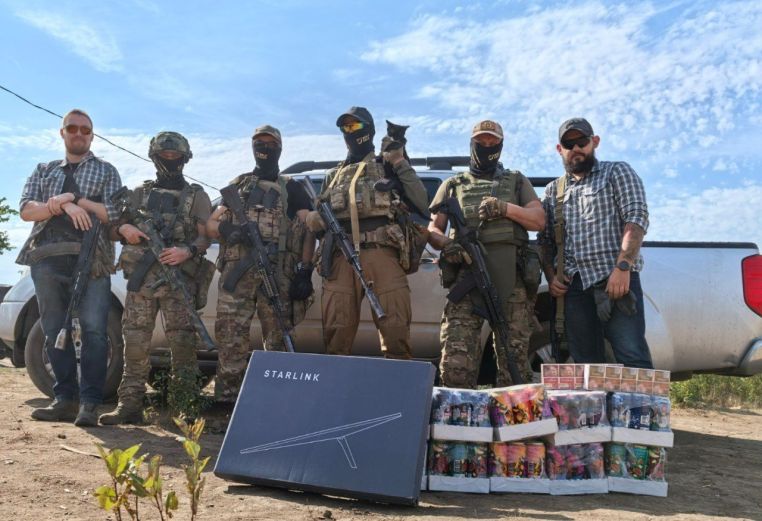

The photograph showcases six men, four in combat gear and two in civilian clothing, standing in front of a light utility vehicle. Their faces obscured by masks and tactical attire, they brandish Kalashnikov rifles, reinforcing their identification as combat-ready operatives. The accompanying supplies include stacks of packaged goods, cigarettes, and what appears to be field rations, possibly for sustaining operations in remote or contested areas. The Starlink box, prominently displayed in the foreground, is the most striking element in the image. Starlink, a satellite internet system developed by Elon Musk’s SpaceX, has been a critical resource for Ukrainian forces, facilitating communication, reconnaissance, and drone warfare in areas where conventional infrastructure is either damaged or unavailable.
Wagner Group and the Wolf Pack’s Role in Ukraine
The Wolf Pack, an elite subunit of Wagner Group—a private military company heavily linked to Russia’s geopolitical ambitions—has gained infamy for its brutality and effectiveness in conflicts from Syria to Ukraine. Wagner, officially denied by the Kremlin but widely considered a proxy for Russian interests, has played a central role in bolstering Russian efforts in the SVO zone, often taking on high-risk operations that regular forces struggle to execute.
The Wolf Pack’s display of supplies and equipment in the photograph underscores their independence in logistical coordination, often appealing directly to supporters for funding and material aid. The text accompanying the image, written in a tone of camaraderie and defiance, calls for financial contributions to support both front-line units and soldiers recovering in hospitals. The inclusion of Starlink, however, adds a layer of complexity to the narrative of self-reliance, as the satellite communication hardware suggests access to resources not officially available to Russian forces.
Starlink in the Hands of Wagner: A Breach of Policy?
Starlink has been a cornerstone of Ukraine’s battlefield communications, provided to the country through Western governmental and private-sector funding. Musk’s decision to supply Starlink to Ukraine was celebrated as a game-changer in the early months of the conflict. However, this development has sparked controversy over the misuse or unauthorized distribution of the technology.
The presence of Starlink in the hands of a Wagner-affiliated unit raises alarming possibilities. It could signify:
1. Theft or Capture: Starlink systems provided to Ukrainian forces may have been captured during military engagements, a plausible scenario given Wagner’s active involvement in intense battles across Eastern Ukraine.
2. Black Market Procurement: The robust black market for technology in conflict zones may have enabled Wagner operatives to acquire Starlink units through intermediaries, bypassing sanctions and export controls.
3. Technological Vulnerability: If unauthorized users can access Starlink’s network, it raises concerns about the system’s security and potential exploitation by adversaries.
SpaceX has yet to comment on this specific incident, but the use of its technology by a sanctioned entity like Wagner would mark a significant breach of its policies and U.S. export regulations. The potential for misuse of Starlink for intelligence gathering, operational coordination, or cyber operations by Russian proxies amplifies the need for tighter controls over its distribution.
Humanitarian Narrative vs. Tactical Reality
The Wolf Pack’s appeal for aid combines elements of a humanitarian narrative with the harsh realities of war. The text accompanying the image uses emotive language, referring to the fighters as “wolves” and calling for solidarity in their mission to support both active units and injured comrades. However, the juxtaposition of humanitarian aid with advanced satellite technology and military-grade weaponry paints a different picture—one of a group leveraging public support while maintaining significant operational capacity.
This duality is emblematic of Wagner’s broader strategy, blending narratives of patriotism and self-sacrifice with a brutal and often unaccountable approach to warfare. The group’s reliance on public donations, as seen in the call to transfer funds to a named individual, reflects the decentralized and informal nature of its supply chains, further complicating efforts to curb its activities.
Implications for Western Policy
The appearance of Starlink in this context highlights significant challenges for Western policymakers and private companies involved in supporting Ukraine. It underscores the difficulty of ensuring that critical technologies do not fall into enemy hands in fluid and unpredictable conflict zones. Moreover, it raises questions about the effectiveness of sanctions and export controls in preventing unauthorized access to advanced systems.
The incident also renews focus on the Wagner Group’s role in the global security landscape. While formally unaffiliated with the Russian government, Wagner operates with impunity in many theaters, blurring the lines between state and non-state actors in modern conflict. Its ability to integrate advanced technologies like Starlink into its operations demonstrates a high degree of adaptability and resourcefulness.
The Wolf Pack’s photograph, complete with Starlink hardware and a call for public support, encapsulates the complexities of modern warfare, where lines between military, civilian, and private-sector involvement are increasingly blurred. As Wagner units like the Wolf Pack continue to adapt and thrive in conflict zones, the need for comprehensive strategies to address their influence and resource streams becomes ever more pressing. For Western governments and companies, incidents like this serve as stark reminders of the unpredictable and far-reaching consequences of their involvement in global conflicts.


You must be logged in to post a comment.