


The poster presents a Russian recruitment campaign focused on attracting operators for unmanned aerial vehicles (UAVs) and related roles for operations near the Dnieper River, indicating ongoing military activities in that region.
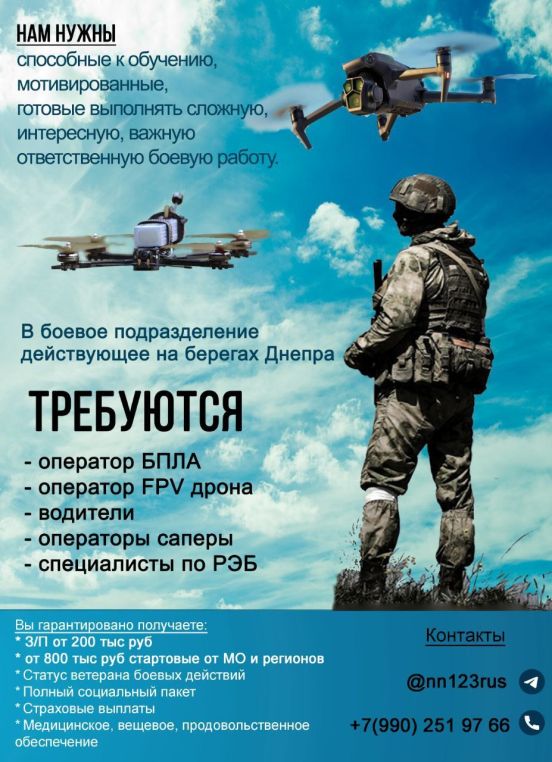
The advertisement highlights several roles, including FPV drone operators, standard drone operators (e.g., Mavic models), sappers specializing in explosive ordnance disposal, and drivers.
The targeted recruitment of UAV operators suggests the importance of drones in current military strategies, particularly in a contested region like the Dnieper.
Key incentives include:
1. Initial Financial Offers: The ad promises a significant one-time payment of 800,000 rubles for those entering contracts, with the amount varying based on the region. This likely aims to attract a broad base of recruits from economically challenged areas by offering immediate financial benefits.
2. Monthly Salaries: The campaign offers a substantial monthly salary starting at 200,000 rubles, designed to ensure sustained participation. This figure exceeds average Russian wages, emphasizing the state’s investment in drone warfare capabilities.
3. Veteran Status and Benefits: The mention of combat veteran status along with associated federal and regional benefits aims to add legitimacy to the recruitment effort. This status includes social, insurance, and logistical support, signaling a broader state commitment to support military personnel.
4. Training and Support: The requirement for compulsory professional training emphasizes skill development, likely aiming to improve operational effectiveness in UAV handling and deployment. Full support in terms of medical, logistical, and combat supplies reinforces the promise of safety and preparedness.
Thime campaign illustrates Russia’s approach to modern warfare, leveraging economic incentives to fill strategic roles in UAV operations, which are central to current conflict dynamics in Ukraine. RUs focus on drones, electronic warfare, and combat engineering roles, Russia continues to prioritize asymmetric and technological warfare approaches on the battlefield.
You must be logged in to post a comment.