


The “soft power” of the Russian Federation in the UAE or how the Russians use the opening of an educational institution to strengthen their influence in the region
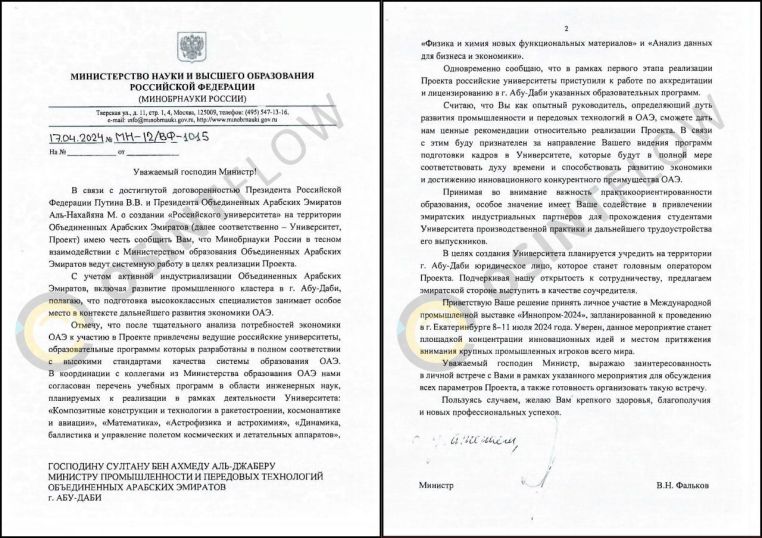
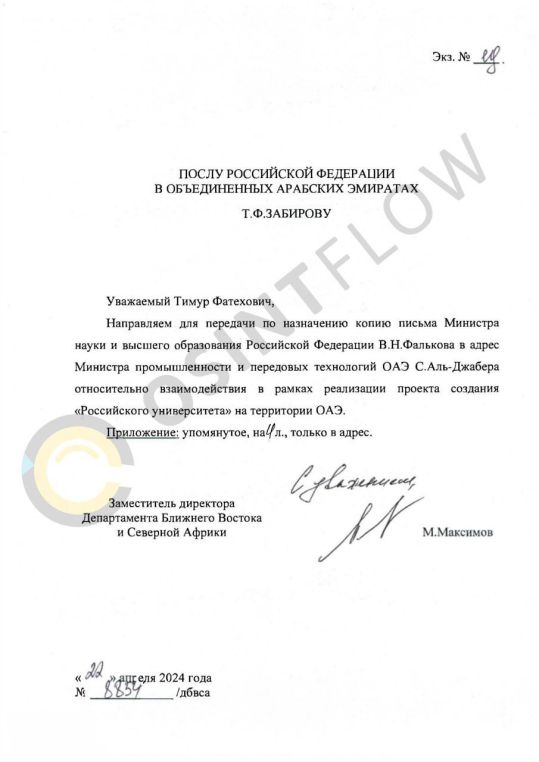
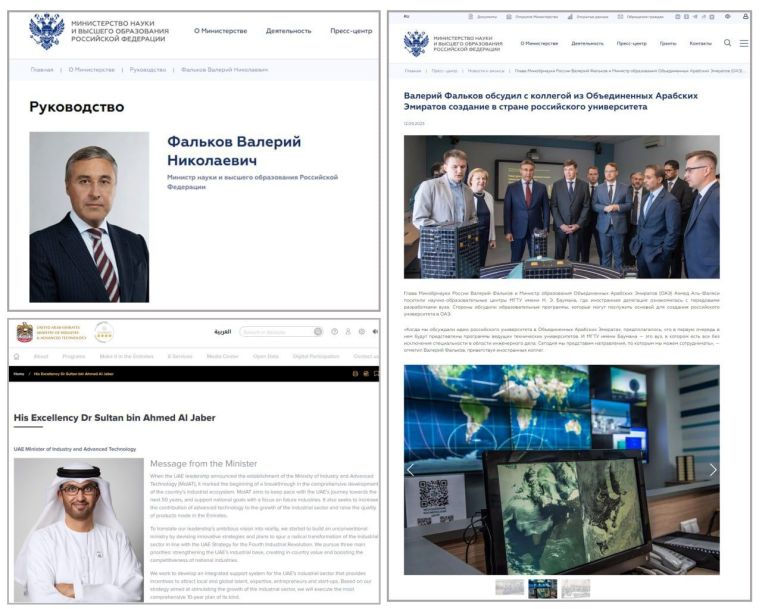
Recently, the OsintFlow team managed to obtain the letters of the Minister of Science and Higher Education of the Russian Federation, Valery Falkov , which he sent to the Minister of Industry and Advanced Technologies of the United Arab Emirates, Sultan bin Ahmed Al-Jaber , who is also the Managing Director & group CEO of Abu Dhabi National Oil Company (ADNOC) and a member of the board of directors of Masdar .
In the official appeals of the Russian Federation, which we are partially publishing today, issues related to the implementation of the “Russian University” project in Abu Dhabi are highlighted. We will remind that official Russian resources and various media wrote about this project back in 2023. Why are we interested in this? It is no secret that the Russians are spreading their influence and recruiting both foreign students studying in Russian universities and the Russian-speaking population outside the Russian Federation.
🗣 We will remind that in March, analysts from The Royal United Services Institute (RUSI) published a large study , which highlighted how the GRU of the Russian Federation is rebuilding the mechanisms of recruitment and training of special forces, as well as restoring the agency outside the Russian Federation . Analysts noted in the report that the main efforts are aimed at foreign students studying in Russian universities, and the 161st specialist training center of the GRU (Russia) has a budget allocated to pay scholarships to students from the Balkans, Africa and other regions where exchanges with Russian educational institutions. These scholarships cover tuition and living expenses and are apparently used as a means of recruitment. Since these individuals often belong to the elites of the countries concerned, they are a valuable source of intelligence in themselves .
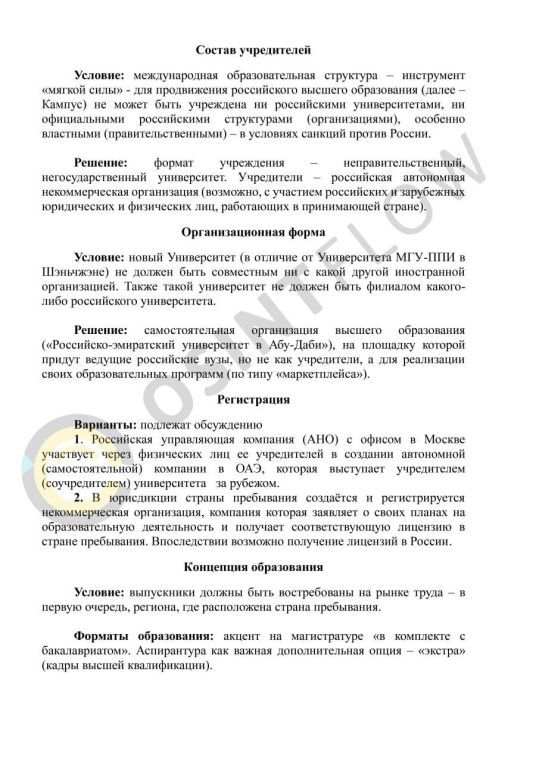
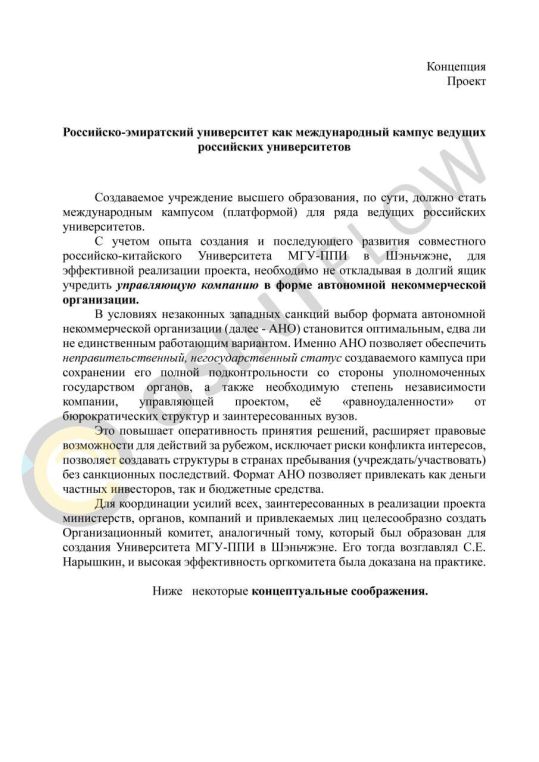
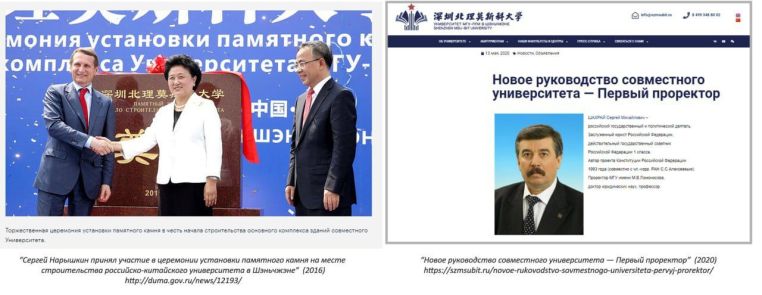
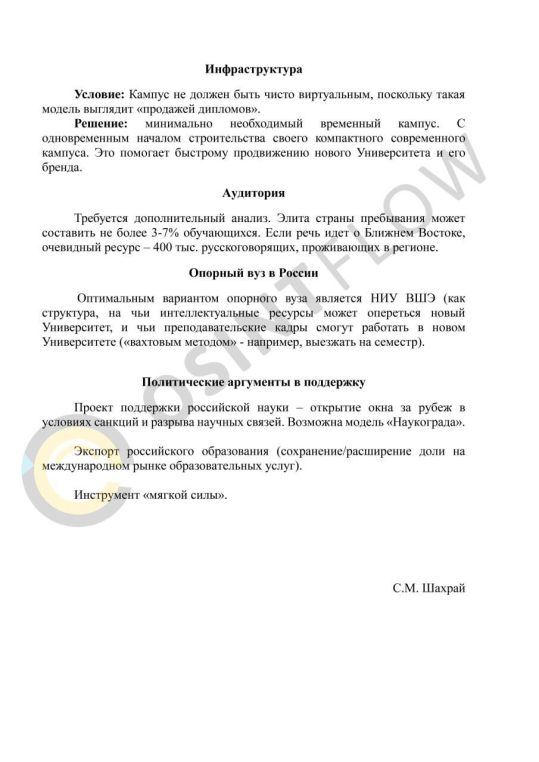
🗣 In addition to the official correspondence, we managed to obtain an interesting file, the author of which, Shahray Sergey Mykhailovych (the first vice-rector of the “University of Moscow State University – PPI” in Shenzhen, a Russian statesman and politician, an active state adviser of the Russian Federation of the 1st class) highlights the concept and implementation of the project “Russian- emirate university” (hereinafter – the Project) on the basis of his work experience in the first joint Russian-Chinese university, the creation of which was overseen by the Chairman of the State Duma of the Federal Assembly of the Russian Federation, and later the director of the Ministry of Foreign Affairs of the Russian Federation, known to all of us – Naryshkin Sergey Evgenievich .
We share with you the key theses of the concept of the implementation of the “soft power” project in the UAE by Sergey Shahray
🛑 For the effective implementation of the project and in connection with the sanctions imposed on the Russian Federation, it is necessary to establish a management company in the form of an autonomous non-profit organization (ANO) in the UAE, which will ensure the non-governmental and non-state status of the campus, but preserves its full control by state-authorized bodies. The ANO format allows you to attract both money from private investors and budget funds, and most importantly, it allows you to create structures in host countries without the consequences of sanctions.
🛑 The model of the MSU-PPI university in Shenzhen, when the only source of funding is the city government, is impossible to implement and is generally politically dangerous. As the author noted: “he who pays decides everything.” Apparently, the game of “soft power” in the version of the Sino-Russian partnership can be played together 😉 and China in this game has long been, so to speak, “cheating the sky to swim across the sea.”
🛑 The format of the “cover institution” is a non-governmental, non-state university. The founders are Russian ANO (possibly with the participation of Russian and foreign legal entities and individuals working in the host country).
🛑 A hybrid model of financing the Project from several sources (for example, the contribution of the state and business of the host country, donations of Russian citizens living abroad and Russian companies working there (perhaps not directly, but through structures affiliated with them, or trust funds).
🛑 The audience is the UAE elite (3-7%) and 400,000 Russian speakers living in the Middle East.




You must be logged in to post a comment.