


Read all the briefs here: https://treadstone71.com/iranian-briefs and use the GPT at http://tinyurl.com/Iranian-UAVs
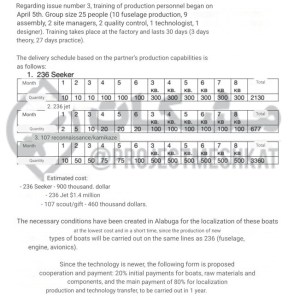
The process of training personnel for the assembly and production of drones began in April of the same year, which included a group of 25 people in a period of 30 days. The production plans of all three UAVs (Shahid-236, Shahid-237 and Shahid-107) have been followed up within twelve months based on a schedule.
MC-236 drones were planned in the number of 30 in the first three months, in the number of 300 in the second three months, and in the number of 1800 in the last six months [2130 in total].
M-237 drones were planned for 17 in the first three months, 60 in the second quarter, and 600 in the last six months [677 in total].
Shahid-107 drones were planned for 110 in the first three months, 250 in the second three months, and 3000 in the last six months [3360 in total].
According to the published documents, the total cost for the MC-236 drone is 900 thousand dollars, for the M-237 drone it is 1.4 million dollars, and for the Shahid-107 drone it is 460 thousand dollars.
Local production conditions will be provided by Russia with the lowest possible cost and time in the Alabuga Free Zone, and the production line will be provided for body, engine and avionics production. According to these documents, 20% of the contract is for sending raw materials and main parts, and 80% is for technology transfer and localization after one year.
The plan proposes substantial advancements by integrating advanced simulation tools and VR for immersive training. Personnel will learn assembly and quality control in depth. A feedback module will allow instant training adjustments.
Iran’s approach adapts production based on resources, labor, and demand, preventing bottlenecks and ensuring efficient workflow. Adopting parallel processing for drone parts shortens production time and meets deadlines.
A cost-benefit analysis will determine the financial impact of the new technologies, considering the potential for reduced costs and time. Partnerships or grants could fund technology transfer, supporting costs where drones aid surveillance and environmental efforts.
Collaborating with local universities on drone R&D promotes innovation and cuts dependency on external technology. Starting with drone assembly from imported components and gradually shifting to local production grows expertise and capacity.
A revised payment structure, rewarding performance-based milestones within a year for 80% of the payment, based on localization, production, and quality achievements, motivates the completion of technology transfer and production setup efficiently.
Focusing on these strategies significantly improves drone production, technology transfer, and localization, optimizing outcomes and advancing capabilities.

You must be logged in to post a comment.