


These are security software development tools ( Svace static analyzer, Crusher static and dynamic analysis complex, Natch attack surface detection tool and others), as well as the DigiTEF computer modeling and engineering analysis complex and the combination of software and hardware systems to control unmanned systems.
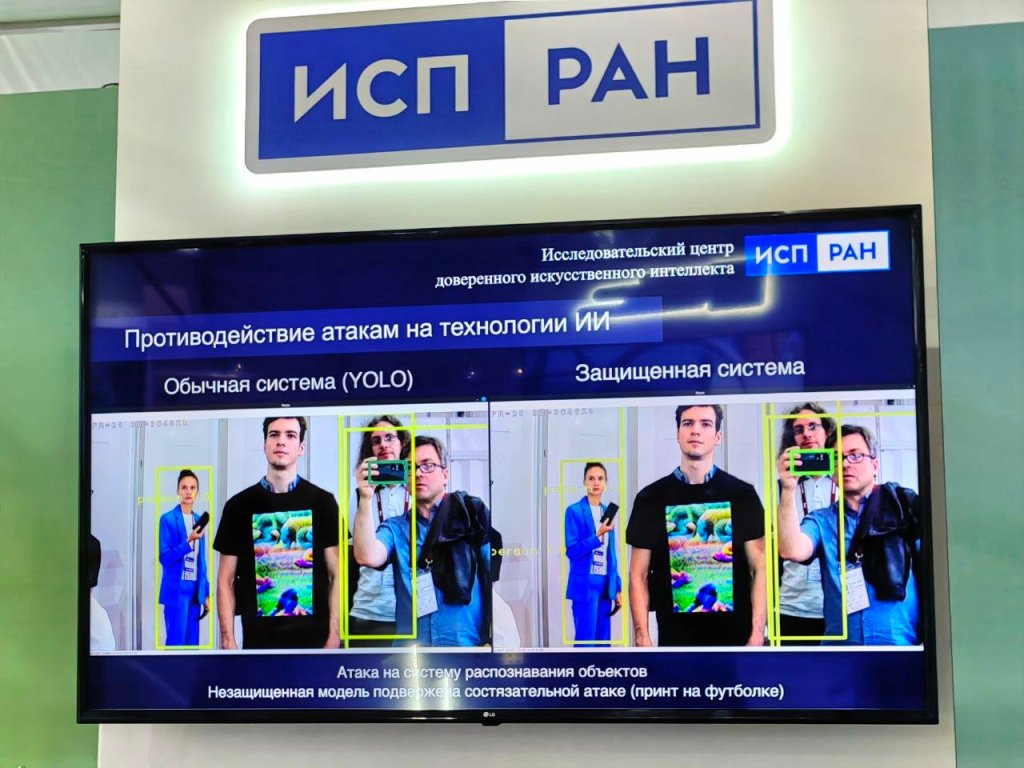
Parts of the cloud platform being created for the analysis and development of trusted systems using artificial intelligence technologies were also presented. In particular, a mechanism for protecting neural networks from adversarial sticker-based attacks was demonstrated (at the stand of artificial intelligence research centers, shared with the National Research University Higher School of Economics, ITMO and Innopolis University). Such mechanisms are relevant in systems for recognizing objects in images obtained by photo and video shooting, and may be of interest to developers. In addition, trusted versions of the TensorFlow and PyTorch machine learning frameworks were presented.
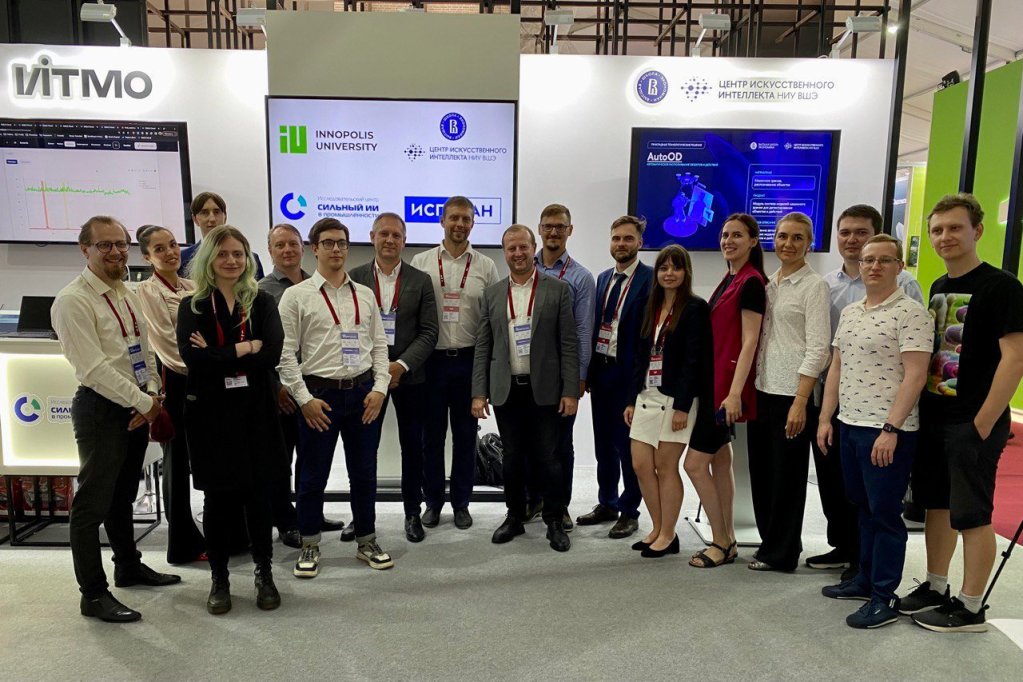
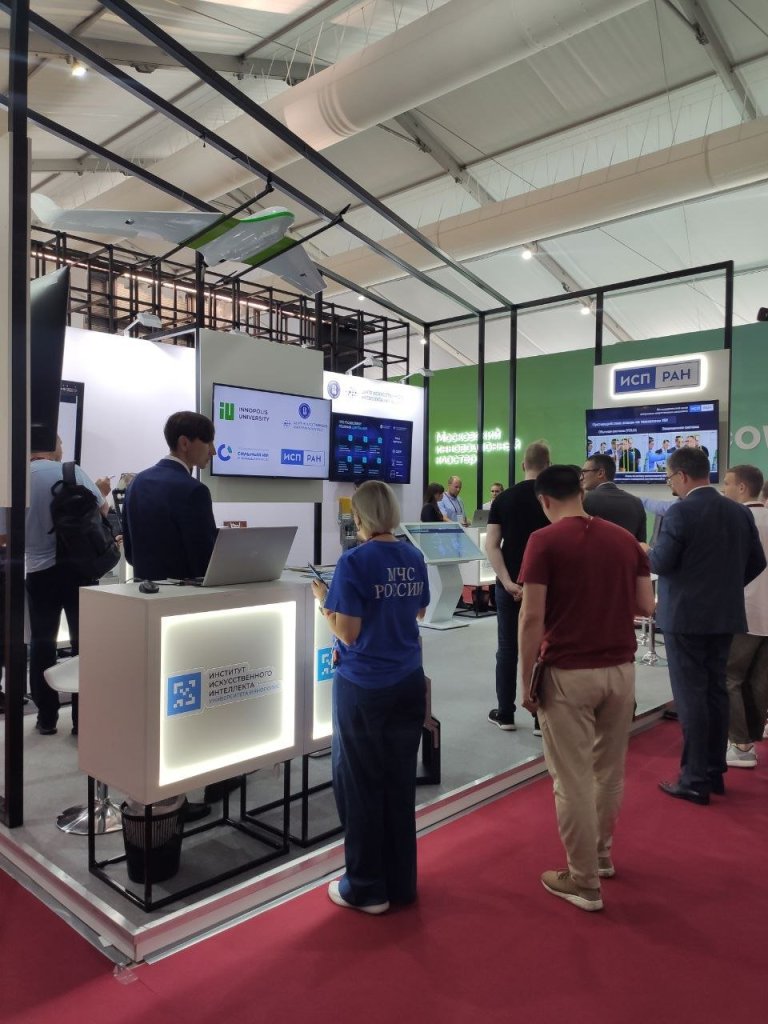
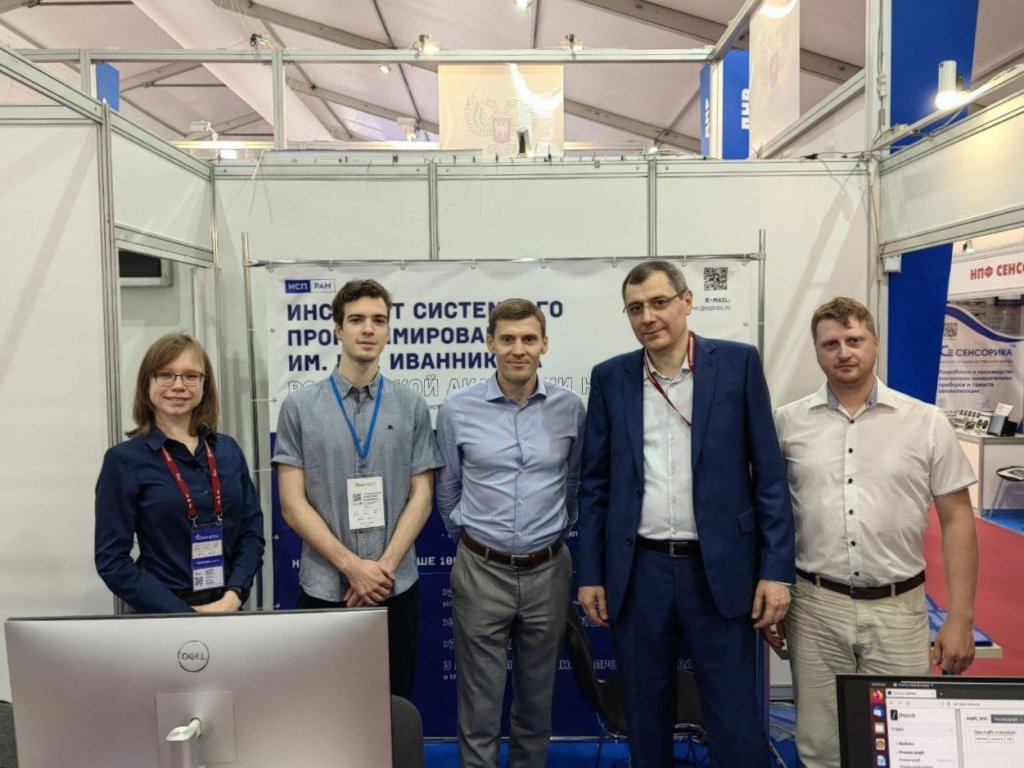
“ Modern artificial intelligence is a whole layer of technologies. At the bottom lie “system” frameworks and libraries such as TensorFlow and PyTorch, which provide the basic operations for working with neural networks. These are open solutions that developers use as is, without thinking about the details of the internal structure. However, they contain bugs that can lead to unsafe applications. Therefore, we have developed a methodology for analyzing these frameworks, as well as any other libraries and tools, including proprietary ones ,” said Denis Turdakov, head of the Research Center for Trusted Artificial Intelligence (ITsDII) of ISP RAS.
ISP RAS
SOFTWARE PACKAGE
DIOLTEF
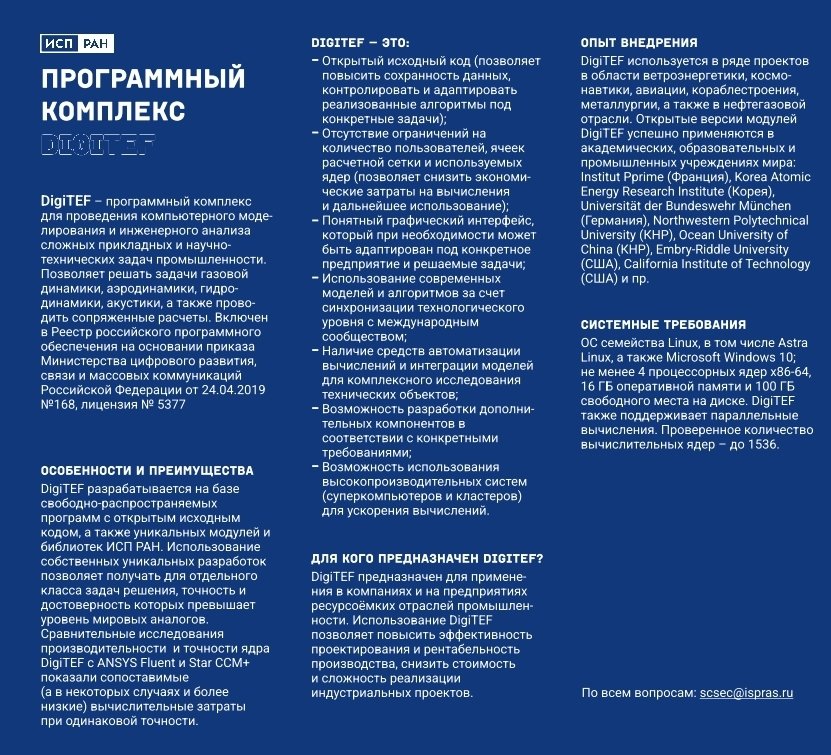
DigiTEF is a software package for computer simulation and engineering analysis of complex applied and scientific and technical problems in industry. Allows solving problems of gas dynamics, aerodynamics, hydrodynamics, acoustics, as well as performing conjugate calculations. Included in the Register of Russian Software based on Order No. 168 of the Ministry of Digital Development, Communications and Mass Media of the Russian Federation dated April 24, 2019, license No. 5377
FEATURES AND BENEFITS
DigiTEF is developed on the basis of freely distributed open source programs, as well as unique ISP RAS modules and libraries. The use of our own unique developments makes it possible to obtain solutions for a particular class of problems, the accuracy and reliability of which exceeds the level of world analogues. Comparative studies of the performance and accuracy of the DigiTEF core with ANSYS Fluent and Star CCM+ showed comparable (and in some cases even lower) computational costs with the same accuracy.
DIGITEF <- 3TO:
– Open source code (allows you to increase the safety of data, control and adapt the implemented algorithms for specific tasks);
– No restrictions on the number of users, cells of the computational grid and used cores (allows to reduce the economic costs of computing
and further use) – A clear graphical interface, which, if necessary, can be adapted to a specific enterprise and tasks to be solved,
– Use of modern models and algorithms due to the Synchronization of the technological level with the international community;
– Availability of means for automating calculations and integrating models for a comprehensive study of technical objects;
– Possibility to develop additional components according to specific requirements;
– Ability to use high-performance systems (supercomputers and clusters) to speed up computing.
Who is DIGITEF for?
DigiTEF is intended for use in companies and enterprises in resource-intensive industries. The use of DigiTEF allows you to increase the efficiency of design and production profitability, reduce the cost and complexity of the implementation of industrial projects.
IMPLEMENTATION EXPERIENCE
DigiTEF is used in a number of projects in the wind energy, aerospace, aviation, shipbuilding, metallurgy, and oil and gas industries. Open versions of DigiTEF modules are successfully used in academic, educational and industrial institutions of the world: Institut Pprime (France), Korea Atomic Energy Research Institute (Korea), Universität der Bundeswehr München (Germany), Northwestern Polytechnical University (PRC), Ocean University of China ( KHP), Embry-Riddle University (USA), California Institute of Technology (USA), etc.
SYSTEM REQUIREMENTS
OS of the Linux family, including Astra Linux, as well as Microsoft Windows 10; at least 4 x86-64 processor cores, 16 GB of RAM and 100 GB of free disk space. DigITEF also supports parallel computing. The verified number of computing cores is up to 1536.
For all questions: scsec@ispras.ru


You must be logged in to post a comment.