


In total, at least 113 military registration and enlistment offices have been attacked in Russia since the beginning of the war.
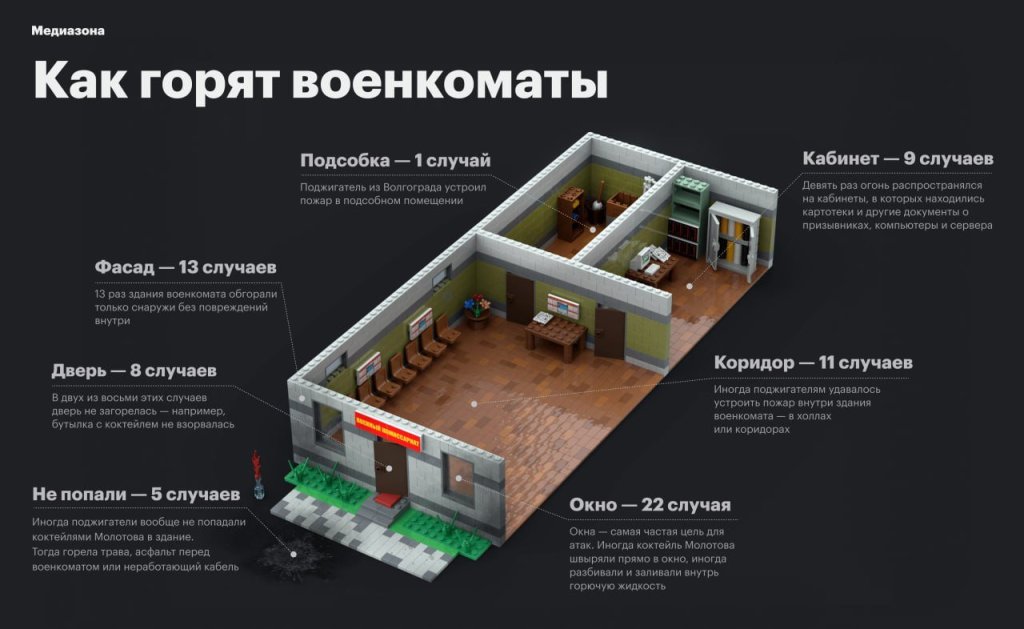
Although in recent months the intensity of arson of military enlistment offices, police departments, or administrative buildings has been gradually decreasing, the imminent onset of autumn heralds a new wave of radicalization.
The most effective arsons are those after which no one was caught. Mediazona continues to study the partisan experience.
Since the beginning of the war in Russia, no less than 113 military checkpoints, administrative buildings and offices of security forces have been attacked — “Mediazona” is counting such actions (almost always these fires). The representatives of the government publicly call these actions “terrorists”, but far from it, such a label becomes the article of accusation. Dozens of people have been arrested for arson, many have already been sentenced. “Mediazona” studied all known cases and court decisions, but did not find a uniform practice among the law enforcement officers: for the same actions, a person can be tried as a terrorist, and under lighter articles, and the punishment terms vary – from one and a half years to 19 years в колонии.
All data are as of July 26.
What we know about convictions for anti-war arson
- • Since the beginning of the invasion of Russia, at least 113 attacks on military bases and similar objects have been committed.
- • Security forces detained at least 102 people, 31 cases have already been sentenced.
- • There is no common logic among security forces: one and the same actions can be considered terrorism, but they are not. Но после начало mobilizacije terrorism stali менять more often.
- • Нет единства и в зроках: раброс казанания — from half a year to 19 years in the colony.
- • Обвинение по терористической статье always guarantees a real and long term of imprisonment.
- • In half of the cases, where we know the accusation, terrorism is involved (40 out of 82).
- • Sometimes they affect regional features: in regions, where the FSB is traditionally stronger, terrorism is often considered.
- • At the same time, political motives or the success of the arson directly do not affect the qualification of the case and the subsequent punishment.
- • Поджигателям военкоматов други помогать из за нехватки авторов и переживание фсб.
By the beginning of July 2023, it is already known about 113 arson of military headquarters, police departments and administrative buildings in 48 regions of Russia, committed after the invasion of Ukraine. At least 102 people have been accused in these attacks — sometimes a group of people is involved in the case of one arson, and sometimes one person is accused of several attacks. В 23 cases о поимке опижателей неизвестно.
Among the dozens of arrested arsonists, we know only one person who managed to escape is the anarchist Aleksey Rozhkov, who threw a Molotov cocktail at the military enlistment office in Sverdlovsk region at the beginning of the invasion of Ukraine. After leaving the prison under a non-exit warrant, Rozhkov did not wait until he was accused of terrorism and fled to Kyrgyzstan.
He lived in Bishkek for six months, but two months ago, he was actually kidnapped by the local special forces of the GKNB: the security forces broke into a rented apartment, detained the young man, took him to Russia without a court decision and handed them over to the FSB. “Мешок на голову, шокер, все как убидал”, — he described this meeting. Now the anarchist is in prison.
Rozhkov’s case was investigated as an attempt to destroy property, but human rights defenders are afraid that now the accusation will be reclassified as terrorism, as it happened with many other arsonists. Then the sentence will be significantly harsher.
Today, the courts have sentenced 31 cases of arson during the war, 41 people have been sentenced. “Mediazon” studied these sentences and realized that there is no common logic among security forces in different regions, but more and more people are declared terrorists – and then a huge term for them is inevitable.
After the beginning of the mobilization, fires started to be considered terrorism more often, but there is no single strategy in the silovikov Voenkomaty in Russia instigated the first days of the invasion of Ukraine, and after the announcement of the mobilization on September 21, the attack was sharply attended . Then the General Staff threatened that the fires would qualify as terrorist acts — however, by that time the FSB had already begun to consider them acts of terrorism, although such actions usually cause only symbolic damage.
But as a result, the uniform practice of the security forces did not work out: out of 82 arsons, where “Mediazon” has known articles of accusation, half of them were investigated as terrorism (41 cases). Other cases were qualified according to other articles .
Some arsons are immediately considered terrorist acts (so, for example, with the taxi driver Vladimir Zolotarevym from Komsomolska-na-Amure, who set fire to the porch of the Russian Guard; the sentence has not been handed down yet), others are first investigated as property damage, and then already as terrorism (as in the case Кирилла Бутилина , already on the third day of the war, zabrosavshego cocktails with Molotov military encomat in podmoskovnykh Lukhovitsa; he got 13 years), the third ones also come to court with lighter articles (for example, the builder Denis Serdyuk got 4 years in prison for attacking the military enlistment office in Volgograd, he was tried under articles about arson and hooliganism).
And even after the start of the mobilization of the forces, they became noticeably more frequent вмениять трористические страницы, божать посчеты “Медиазоны”.
We know articles of charges in 35 cases о поджогах, совечных до mobilizacije , из них terrorism eventually appeared in 16 cases. After September 21, 2022, the investigation considered 25 fires out of 49, where we know the nature of the charges.
If the arsonist is caught, his future fate depends primarily on whether the local security forces call his action a terrorist act — even in one region, the same actions are sometimes treated as terrorism, and sometimes not.
При етом очасние по тористической статье гарантие реальный зом. If the case goes to court with articles about arson, there is a chance to stay free.
We know about 31 sentences . Две трети из них — это реальные зромы , таких часые 22 (из них 12 according to articles about terrorism). Only seven have received conditional terms (and one — forced labor).
На статью accusations may affect the relationship between the departments and “the desire to earn more stars”
Security forces in different regions act inconsistently, notes Ivan Astashin from “Solidarity Zone” (this right-wing project helps those who are persecuted for radical anti-war actions).
“From the top, the teams are simply assigned to punish each other, the harder, the better.” Ну а на между уже кто во что горазд», — he says.
Astashin believes that the severity of the article and subsequent punishment depends on the agency that investigates: “If the FSB is involved in the case, it’s almost 100% terrorism or sabotage, in general, the most serious charges. If this is, let’s say, МВД or СК, then there may be accusations of hooliganism, property damage and so on, more soft articles. But it’s different here too. Sometimes the Ministry of Internal Affairs investigates to the end, sometimes they pass it on to the FSB, and it requalifies.”
The FSB is profitable from all attempts to do terrorism, says the rights activist: “The more cases of terrorism that are uncovered, the more bonuses they will receive, promotions and so on.” It might not be very interesting for an ordinary policeman. Им не нежуни “палки” по теристориму». He suspects that the police willingly hand over their cases to the FSB, because it affects the disclosure of the Ministry of Internal Affairs. But they have to obey.
Evgeniy Smirnov, the lawyer of “Pervogo Otda”, agrees with this point of view: “If it gets to the police, it will be limited to the 167th.” If they transfer, God forbid, to the FSB, then they will, of course, try to initiate the case for which they will be more profitable.”
Smirnov believes that some fires can be provoked by FSB officers, and then the accusation of terrorism is guaranteed: “It is quite possible that the correspondence or the public, which the person signed, was one of the provocateurs. For accurate qualification for a heavy terrorist article, some expressions are included in this correspondence.
They will read the correspondence, know when they plan to do it, and they will delay it themselves.”
Sometimes a person may simply not be lucky: “If it’s a fire at the military headquarters or another institution of the Ministry of Defense, the military police can detain [the arsonist] and take him not to the usual police department, but to the FSB.” It will be considered that they discovered the crime and stopped it.
It is quite difficult to search for logic in the qualification of pojogov, the lawyer admits. “Отчасти ето очень рандномно, отчасти это дешено селедователей работать побольше звезд на деле”, — he says.
“The term depends primarily on the qualification. Qualification, roughly speaking, depends on luck», — соглашается Асташин.
In the figure, only the arsons of military enlistment offices are taken into account, the cases of attacks on police and FSB departments or other administrative buildings are not taken into account.
In some regions, the FSB is traditionally stronger — and there is more terrorism
Влияют, according to Astashin, and regional specialities. Так, на юге России “everything is under the FSB, and at the same time everything falls to them”.
We know about three fires in Krasnodar region, and all the accused there are really considered terrorism. В Ростовской область по статье 205 расследуют два поджога из трех
At the same time, it is quite difficult to identify the trend, since there are still few regions where we know the details of at least three fires.
In the Moscow region, where they set fire most often (eight cases), we do not know the article in half of the cases (the rest are three cases of terrorist attacks and one case of property destruction).
In Petersburg, out of six fires, we know about five: three “terrorist” and two under other articles. The Petersburg administration of the FSB is known thanks to the interrogation case “Seti”, when a group of anti-fascists and anarchists were accused of preparing an armed seizure of power.
In the Leningrad region – there is one FSB administration in both regions – four fires out of five were qualified as intentional destruction of property. А один, в Выборге, at once on two articles about terrorism (three defendants received terms from 6 to 13 years).
In Tatarstan, for example, so far we know only about the accusations of damage to property: they are brought against a 60-year-old activist, a student and an eleventh-grader. According to the investigation, the activist threw a Molotov cocktail into the military office, but nothing caught fire. The student wanted to set fire to the non-working cable. Школьница же сделать молотовых молотовых, но подогла только ваву возле военкомата (she got two years conditionally).
А вот в Челябинской область, the arsonists are accused exclusively of terrorist acts. In this region, anti-war activists received the longest sentence — 19 years. The Chelyabinsk FSB was known for the persecution of dissidents and interrogation methods until the beginning of the war. For example, in the case of anarchists who protested against the torture of comrades and hung a banner: “ФСБ — главный терростир”. Those arrested in this case were also tortured with electric shocks .
Astashin says that until recently, he associated the qualification of the case with the initial testimony of the detainee: Why FSB is trying in such cases? So that the person didn’t just write that he set fire to the military enlistment office, but that he signed such statements that would be included in the article “Terrorist Act”: he wanted to scare the population, he realized that he could cause death, he wanted to destabilize the work of state bodies, influence the decision-making of bodies power and so on”.
In cases with more light articles, the testimony, according to his words, is usually more concise: “Поджег военкомат, протестовал против войны, все по простому”.
But the situation is changing, the human rights defender notes, for example, Mikhail Lazakovich, who set fire to the military enlistment office in Tver region in May, was mistaken for terrorism, despite careful testimony. “Я “I think that gradually they are increasingly moving away from legal norms,” says Astashin. – All the same, this machine works according to certain rules. It is clear that they are trying, but there are certain bureaucratic steps. Now everything becomes arbitrary. There are situations that were difficult to imagine even six months ago.
“This unpredictability, as it seems to me, is additionally frightening,” he says. — Человек не вечение, что ему ожидать. За одно и то же ему могут дать полтора года основной или 19 лет рейтинг. I think that there is no strategy here, but this lack of system basically works for the power”.
Поджоги в России с начало войны113 поджогов военкоматов и ADMINISTRATIVE Задниии Источник: «Медиазона», другие МСИДанные на 26 июля 2023 До объявление mobilizacije (39) После объявление mobilizacije (74)
Самые мягкие срокмы: teenagers and fire-starters-failures (but there is no general logic)
The seven arsonists were lucky to stay free after the sentence. As a result, they changed relatively light articles: “Podzhog” (Article 167 of the Criminal Code) or “Hooliganism” (Article 213 of the Criminal Code). And the court appointed a conditional sentence: from one year to four months to two years. Like the majority of those convicted of attacks on military enlistments, they pleaded guilty, three even concluded a pre-trial agreement with the prosecution.
Among those who were so lucky, there are three teenagers: two friends from Cherepovets and one classmate from Kazan. Череповчане, по версии следствия , подожгли военкомат за деньги Shkolnitsa, according to the prosecutor, “was dissatisfied with the special military operation carried out on the territory of the Russian Federation” and mobilization. But it can’t be said that security forces are condescending to teenagers-incendiaries. For example, a 16-year-old St. Petersburg high school student, Yegor Balazeykin, was accused of attempting a terrorist attack because of a Molotov cocktail thrown at the military enlistment office.
One of the people who received a suspended sentence even attacked the FSB headquarters in Nizhnem Novgorod. The former worker of the automobile factory, Sergey Lozin, said in the sentence, he was dissatisfied with the policy of the head of state, he wanted to “strike not on people, but on “Putin’s pride””, “try to make the president uncomfortable and vent his anger”. He threw a bottle of acetone into the reception plate of the FSB and tried to set it on fire, but without success.
Lozinu for the failed fire FSB gave two years conditionally on the article about hooliganism. At the same time in Krasnodar, worker Igor Paskar almost got 8.5 years in prison for the same thing : he threw a Molotov cocktail at the entrance to the FSB building, only the carpet on the door caught fire. Paskarya tried during detention and accused in terrorism.
Article Человек с пакетом. The story of a single engineer who was accused of terrorism and tortured for setting fire to a carpet at the entrance to the FSB
There is at least one case when the prosecutor’s office protested the “excessive softness of the prescribed punishment” and demanded that it be toughened. Dezinsektor Aleksey Bogdanov, after the beginning of mobilization , tried to set fire to the editorial office of “Krasnaya zvezda” newspaper in Priozersk (he confused it with the publication of the same name, which is published by the Ministry of Defense). “In connection with the situation in the country, my heart hurt. “I didn’t want to see this whole thing, all this disgrace that is happening now”, – he confessed during the interrogation, repented and received a year conditional sentence for the arson attempt. After the appeal of the prosecutor’s office, the court added another year of probation to Bogdanov, but he did not start sending him to prison.
The most severe punishment was received by the fireman and the Russian Guard, whose consequences were made by anarchists
The fire of the administration of the small town of Bakal in the Chelyabinsk region did not differ much from many similar ones. On the night of October 10, three Molotov cocktails were thrown in the building of the military accounting table. The fire damaged the window and linoleum, the fire was put out by the security guard.
The security forces soon detained two childhood friends, the head of the MChS, Alexey Nurieva, and the driver of the Russian Guard, Roman Nasryeva. Both instigators had a reservation from mobilization for work. “They, maybe, worried about those whom they could invite”, — Nuriyeva’s mother assumed in conversation with DOXA . Nurieva and Nasryeva were accused of terrorism, and the court gave each of them 19 years in prison — this is the longest term for anti-war arson.
The security forces called young people “supporters of radical anarchist ideas”, but they themselves did not openly designate their leftist views. “Dlya Romana kuda vazhnee ego anti-military position in this case”, – they say in “Zone solidarnosti”.
Помимо страница о трактакте друзями предёявили еще белье женскую стати о проходении участний троизмеруру – on it it threatens a life sentence. “Training” the investigation called the fact that Nuriev and Nasryev “stored in the memory” of their phones several telegram posts and videos from YouTube, where they talked about setting fire to military enlistment offices and making Molotov cocktails, and also trained to throw them.
Ivan Astashin suspects that in this case it was the label “radical anarchists” that aggravated the position of the instigators.
“U “Investigators have basically two standard formulations: either they adhered to liberal-radical views or anarchist views,” he notes. — Они особо не разбариются, каких на самом деле человек взгладов пачался».
According to him, what is more important is that both of them worked in state structures: They are traitors for the system. I think it could play a role.”
As a result, the anti-war activists got a longer term than a young man from Izhevsk who decided to “free himself from state power”, attacked the Molotov police department in Izhevsk and wounded two patrolmen with a knife.
The security forces often try to expose the arsonists of the military enlistments to terrorists who want to kill someone and scare the public. But the number of arsons already exceeded a hundred, and the press got only one report about the victim: in Orle, according to SC, a security guard got burns on his legs after throwing a bottle of incendiary mixture into the building of the regional administration.
Ни один военкомат не сорел в всем, usually the damage is limited to small damages. Many of the arrestees have not been exposed They said that they were trying to show their disagreement with the war and mobilization, but they definitely did not want to harm anyone.
Izvestno only one exception, and it strongly stands out from the ranks of other anti-war fires.
The lieutenant “stood on one knee, a knife was sticking out of his back”. The only fire with violence
Political motives directly do not affect the qualification of the case and subsequent punishment
Judging by the famous sentences, the investigation and the court are not interested in the motives of the defendants. Anti-war activists, who did not hide their views, receive both conditional and real terms. It is the qualification of the case that affects their fate: it will be terrorism or it will not work.
Кирилл Бутылин пожег военкомат в подмосковных Луховицах на третий день войны. На воротах he wrote: “Я не пойду убивать братьев!” Молодой человек filmed the fire on video and published his anti-war manifesto: “Let these bastards know that their own people hate them and will extinguish them. Soon the earth will start to burn under their feet, hell awaits them at home. Butylin explained that he wanted to destroy the archive with the files of the conscripts.
The security forces managed to detain him not from the first time. First, the young man reached the border of Lithuania and Belarus, but there he was caught and eventually taken to the police department in Lukhovitsy. He ran away from there, jumped out of the window, but he couldn’t get far.
The Ministry of Internal Affairs accused Butylin of vandalism, but, apparently, the FSB took the case soon, and reclassified it as a terrorist attack. During the process, he admitted his guilt and repented. The court appointed 22-летнему мужчине 13 лет conclusions.
Sometimes the security forces spread videos in which the detainees say that they decided to take risks for the sake of easy money. Правдивы ли эти признания и даны до предплечем, было неесян. Either way, the security forces don’t demonstrate any condescension to non-ideal arsonists. The defense can even say that the person supports “special military operation”, but if they have already included terrorism, the term will still be long.
That was the case with Nizhnevartov incendiaries. According to the investigation, 20-year-old Vladislav Borysenko bought everything necessary for setting fire to the military headquarters and filmed it on video, and 21-year-old Vasiliy Gavrilishen threw seven Molotov cocktails. The arson by Jacob was ordered in a telegram by some person connected with the Ukrainian special services and promised from 1 to 3 million rubles depending on the damage.
Young people accused of terrorism. Both pleaded guilty. They were tried separately, and in court the lawyer Borisenko insisted that his defense was not motivated by anti-war motives, but simply “in dire need of money”. Despite this, Borisenko received 12 years. After learning about such a term, Gavrilishen refused to testify and broke the deal as a result. Ego is still being judged .
Human rights activist Ivan Astashin notes that both Butylina and Borisenko had an article , the term of which starts at 12 years. “That’s why it’s the same as the minimum,” he states. — Какая уже разница, какой срок давать. Человека уже использовать, он для принзительные заганды, раскаялся камеру. This, as a rule, does not affect the term”.
Sometimes fires are committed under the influence of crooks
As “Mediazona” said , strangers usually call elderly people, trick them with money, and then convince them to set fire to some object, such as a military enlistment office or a bank, in exchange for the return of the stolen goods. Victims of fraud are often convinced that they are participating in some “special operation” and are acting in the interests of the Russian security forces.
We found 21 such fires from open sources. Basically, fraudsters need to attack bank branches, but at least in nine cases they provoked interlocutors to try to set fire to the military enlistment office or the police department. Involuntary arsonists, like all others, are subject to different articles: fire, hooliganism, terrorist act.
There have been no sentences for such cases yet, so they are not mentioned separately in the review.
Silovikam ne vazhno i to, был поджог successful or unsuccessful
“Absolutely not important, there was an attempt or a high-grade fire, roughly speaking, the bottle broke or it didn’t break.” And this does not correlate in any way with sentences, — says Ivan Astashin from “Зоны солидарности”. — Вспомним дело ребят из Бакала в Челябинской область, Роман Насрыев и Алексей Нуриев. There, a square meter of linoleum burned. The female watchman extinguished the fire, as she said, with a blanket and five liters of water. Po 19 years old . And, let’s say, we know other cases, where a whole room, some part of the military encomium burned down, and people got it for three or four years.”
This is, for example, a former village teacher, Ilya Farber, who set fire to the military enlistment office and recruitment point in the Udmurt village of Igra. Выгорело очень оченье, Farbera was sentenced by the court to 3 years and 2 months in the colony.
For example, Vladislav Matveenko from the Rostov region was given four years of prison only because he watched the burning of the military headquarters. The description of this case in the sentence looks quite strange. 19-year-old Matveenko told the court that he was looking for a job on the Internet and came across a man who offered 3 thousand rubles for the fact that he would film the fire of the military police station in his hometown of Gukovo. The young man agreed.
On the evening of May 12, he met a stranger who had to throw a Molotov cocktail, and he introduced himself to Dmitri. He brought three bottles with him, but he offered to throw only one, as he “didn’t want to take on more responsibility”. They used extra Molotov cocktails “on one of the streets” (the first bottle fell on the slate, the second one crashed on the asphalt). Потом пошли к военкомату
On the spot, it turned out that there was no reason to take the picture: it is stated in the sentence that Vladislav left the mobile “at home on charge, as its battery is quickly discharging”, and Dmitriy did not take his, because he was afraid that “they can track it” by the signal of the mobile.
But the young people did not refuse the arson, and Dmitry “came to the gate of the military commissariat and threw a burning Molotov cocktail.” They ran away. In the morning, Matveenko, according to his words, contacted the curator and reported that they had completed the task, but it was not possible to film it. “The curator replied that no one will receive money without a video confirming it”, then the young man deleted the correspondence and the messenger itself. So that it is only known about her from incriminating evidence – there is no correspondence in the case.
In the sentence, it is also indicated that the arsonist and his accomplice were recorded by the video surveillance camera when they went to the military office. The witnesses testified that they recognized Vladislav by his gait: “characteristic”, “blatant”, as in “gopnik”, “which he wants to show everyone that all of him should be afraid”, “wide, unhurried, bold”. The Gukovsky city court found a twice-convicted young man guilty of hooliganism and attempted arson .
At the same time, the arrest of Dmitriy, who threw the Molotov cocktail and also got caught on camera, was not reported.
Article Шкаф в огне. More than 65 people have been detained in the case of sabotage on the railways in Russia, each third – minor
Поджигателям военкоматов други помогать из за нехватки авторов и переживание фсб
The most serious problem, with which the “Solidarity Zone” faces, is a lack of defenders. “In some regions, we simply cannot find lawyers whom we could trust and who are ready to work on such cases,” says Astashin. — Many lawyers left. Sometimes we go to some new region, we look for contact, other human rights organizations share their contacts with us, we start contacting them, and it turns out that the lawyer has already left Russia”.
He adds that in many regions, lawyers get non-disclosure agreements, which makes it difficult for even human rights defenders to find out anything about the case and the accused.
“As all this case is led by the FSB, of course, the lawyers are also afraid”, – states Astashin.
At the lawyer Vyacheslav Savin, for example, they tried to break into the phone, which he put in a special cell in the building of the FSB headquarters in the Stavropol region in order to communicate with the investigator and the defendant. In St. Petersburg’s SIZO-3, the operatives took away from Yana Nepovinnova the records that the accused handed over to her: “When they brought out the defendant, several employees, apparently FSB, came into the office, and they simply pushed [the defender] in a corner and said: “Give me the paper.” . Ona ih otdala”.
In Russia, only four courts are considering terrorism cases: in Moscow, Yekaterinburg, Krasnodar and Khabarovsk. Accused from other regions are usually either brought to one of these four cities, or judged at the visiting sessions. In order to help the staged, lawyers and relatives are forced to travel a long way every time, because this help “complicates and becomes more expensive”, says Astashin.
“Правда, сейчас московский суд in general, he introduced the innovation that people judge by video Ивана Кудряшова осудили за два дня по видеосвязи. Advokat in Moscow, Kudryashov in Tver by video connection. “He can’t talk normally with a lawyer”, – the lawyer is outraged.
According to Astashin, the military court in Moscow ” accelerates business to the point of impossibility”. Probably, this is connected with a big burden: recently the Supreme Court proposed to expand the list of courts that consider terrorism charges, since the number of such cases is constantly growing, and the judges, who also have to constantly fly on business trips, do not cope.
Often, human rights defenders do not immediately find out that a person was detained for arson, sometimes only after several months. It happens that the whole thing becomes known only after the verdict, notes Astashin, that was the case with Vladislav Matveenko from Gukovo, who was tried for the failed video recording of the unsuccessful arson.
Поддержите Медиазону!
It won’t be.
In recent months, the intensity of arson of military personnel, police departments, or administrative buildings is gradually decreasing: if last fall they committed 46 arsons, in winter there were already 16, in spring — nine, and for half of the summer — five.
Since January, there are more messages about fires in railway equipment, for example relay cabinets. In such cases, as a rule, the FSB also participates, and the detainees, among whom, as “Mediazona” found out , very many minors, are accused of sabotage.
But the captured arsonists of the military forces continue to be judged: three dozen sentences have already been handed down, and dozens more are still under investigation or awaiting a court sentence.
Alexey Rozhkov, whom the Kyrgyz security forces handed over to his Russian colleagues, apparently, will soon replace the accusation with the article about the terrorist attack — the court returned the case for investigation, since the prosecutor’s office suddenly saw “signs of a more serious crime” in the fire of the military enlistment office.


You must be logged in to post a comment.