


Treadstone 71 Cognitive Warfare Training – Recognized by Russian philosophers, political technologists, media managers, producers, journalists and TV presenters, military correspondents, bloggers, volunteers and organizers of assistance to the front, designers and artists, writers, poets and musicians, sociologists and psychologists.
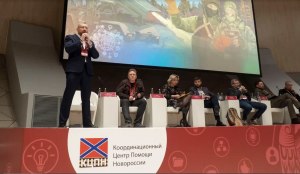
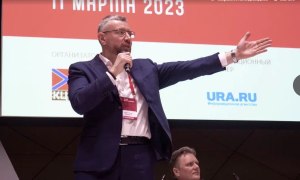
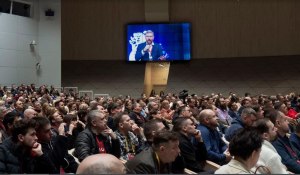
On March 11, 2023, the Skolkovo Technopark will host a forum dedicated to information and cognitive warfare technologies.
The organizers of the event are the Novorossia Aid Coordination Center (KCPN), Alexander Lyubimov and Alexei Chadayev , a philosopher and military-political technologist.
The forum will be the fourth of those organized by this team this year since the beginning of the NWO. Before that, there was “Dronnitsa” , dedicated to combat drones, “IT-Dronnitsa” on the problems of military software and “IQ-Dronnitsa” on the development of thinking among officers.
This forum is about confrontation in the semantic and media space, the struggle at the level of symbols and terms, news and plots, moods and sensations.
The internal motto of the forum is less slogans and spells, more ideas and technologies. We will not ignite each other with inspired speeches that we will definitely defeat everyone – we will calmly and rationally discuss exactly how this is possible and what is needed for this.
We invite all interested persons and organizations to cooperate. We form a list of partners and partner media.
About goals and meanings
One of the goals of the Media Dronnitsa forum is to create a headquarters for the information and partisan movement in Russia. To do this, the event will have eight sections related to content production: philosophy, technology, design, culture, media, digital, volunteers and society. All sections of the forum are united by a common logic, covering the entire space of public communications. More about each of them:
Section 1 “Philosophy”
Who are we? Who is our enemy? Who are we fighting? We devote this section to the most fundamental foundations of cognitive warfare, the struggle at the level of forming a picture of the world. #философиядронница
Section 2 “Technologies”
How should communication be organized in conditions when there is a communication campaign going on in an acute phase from all sides? Practicing political technologists, political consultants, specialists in the field of public relations will be involved in the work in this section. #технологиидронница
Section 3 “Design”
Information war is the exchange of information that can affect the psychology of the enemy. At the forum, we will unite designers and artists into teams working as a united front for a common goal. #дизайндронница
Section 4 “Culture”
War is always a heroic epic and lyrics. Culture of war or military culture. This is about a sensual, emotional way to express emotions, to “give birth” to an inspiring song or a poignant verse. #культурадронница
Section 5 “Media”
Talk about the development of media activity in the era of streaming. In an era when everything that happens somewhere far away can be seen live by millions. Military correspondents and military bloggers will share their experience with media workers. #медиадронница
Section 6 “Number”
Digital aspects of the information war. The section will be devoted to applied digital tools – cyber warfare, hacks, leaks and provocations. #цифрадронница
Section 7 “Volunteers” The peculiarity here is that along with official structures, it is, as it were, independently conducted by many civilian structures involved in the supply, provision, training, and training of fighters. The key problem that is indicated before this section is how to manage information in such a way that, on the one hand, maintain and increase the interest of the audience, and, on the other hand, not tell something that can harm you yourself. #волонтерыдронница
Section 8 “Society” Concerns researchers of man and society. We will dive into the largest aspect – psychological warfare, study people’s reactions to this information and find out what happens to the emotional background of society. #обществодронница
Cognitive warfare is a new way of waging war, in which the battle is not for territory and resources, but for something more valuable – the soul and mind of a person.
Its purpose is to attack, humiliate or even destroy the way someone constructs their own reality, to undermine a person’s mental self-confidence, their trust in the processes and approaches necessary for the effective functioning of groups, societies or even nations. With the development of information technology and widespread digitalization, the battlefield is inexorably expanding, and everyone becomes involved in this war.
The position “this Is happening somewhere far away, it does not concern me” no longer works. The state of “non-involvement” is a modern myth, which is convenient to believe in order to calm one’s own psyche. But how useful and effective is this strategy when the participants in the cognitive war are politicians, journalists, sociologists, philosophers, mass media and communications, marketers, religious figures, musicians and writers – in fact, all those who surround modern man on a daily basis?
It becomes Increasingly difficult for the psyche of a person who regularly receives signals through “screens” to resist. Therefore, the skill of counteracting cognitive impacts with the development of technology is again becoming one of the key ones, and the development of “psychological stability” should be given more attention.
The article by French researchers Bernard Claverie and Francois du Clusel “The Concept of Cognitive Warfare” targets those who want to understand what rules are used in modern society to conduct cognitive wars, who is the target and how a person can resist the blows sent to him.
This article is a practical guide for all thinking people, and our goal is to increase the number of such people. Therefore, we translated it into Russian and prepared a brief summary of general thoughts. And for those who want to get acquainted with the original and learn more about the concept of cognitive warfare in the 21st century, see the Treadstone 71 training courses on the topic
Alexey Chadaev is a political scientist, public figure and one of the main organizers of the upcoming Media Dronnitsa forum.
In anticipation of the event, we have collected key thoughts on the topic of cognitive confrontation from Alexey’s Telegram channel so that each of you can now learn more about various aspects of cognitive warfare.
- About the visuals: they have the Clone Army, the aesthetics of Star Wars, and we have the magic bird Alkonost from the Gospel;
- The way out of the mental trap is an appeal to the timeless. Restoration of the basic plot: who we are, where we are from, where we are going;
- Conflict 08.08.08 what was missing then “at the moment” in the information. Lack of express analytics. Failure in the friend-foe system, you need an “envelope in a safe” and a mobilization plan;
- If there is an information war, then it must have a headquarters and information troops;
- New reality and rethinking of the concept of theater of operations = Theater of War;
- How they create “reality” in the absence of reliable facts working on their narrative. Who connects and how, receiving the tools immediately in one package with a set of necessary interpretations ;
- Coordination of combat units, info-psy of the troops and their media, stuffing in advance from the “other” side, a little practice ;
- The modern “Society of the Spectacle” and the merging of Media and weapons into one whole. Briefly about the philosophy of weapons and technologies.
- When the enemy cannot hold the discursive frame, our side, unfortunately, cannot hit this gap of theirs, when the Crimean Bridge and they themselves fired at the Ukrainians instead of the “Struggle of the Forces of Light and Darkness” from senior American curators;
- Lecture “Philosophy of weapons “. Modern and timeless.
#полезноедронница
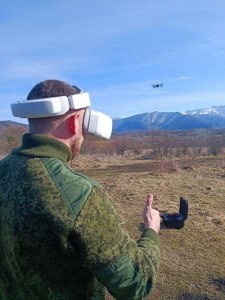
About the visuals – that is, about Sirin, Alkonost and Gamayun. Our counterparts on the other side took the aesthetics of Star Wars as a symbolic series – their “Army of Drones” is, in fact, the “Army of Clones” from Star Wars. This, in general, is logical – to take as a basis the top setting of Western cinema, even if inspired by the work of the Soviet science fiction writer Yefremov. Well, we, of course, will go the other way – we will have our own history, mythology, and visuals. The oldest of the images of Alkonost, by the way, is a miniature in the Ostromir Gospel, made for the Novgorod Yuriev Monastery … by Kyiv masters. Fortunately, Yuryev is just opposite the Rurik settlement – on the other side of the Volkhov. At the distance of the flight of the copter.
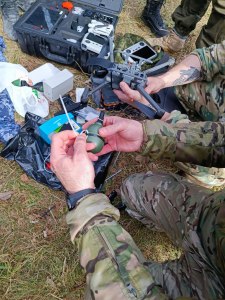



ANNOUNCEMENT!!! Event of the Coordinating Center for Assistance to Novorossia with the aid of the OPSB!
The first All-Russian Gathering of operators of combat quadrocopters “Dronnitsa” will be held from September 1 to 5 on the shores of Lake Ilmen, near Veliky Novgorod. The event is planned to be attended by over 100 drone pilots from all over Russia, the DPR and the LPR.
The goals of the event are: exchange of experience for specialists, basic training and competitions for beginners. A series of events is planned for both experienced UAV pilots and those who wish to become one.
Within three days, the rally participants will take part in piloting competitions in conditions as close as possible to combat ones. They will improve their skills and enrich themselves with new knowledge in a series of master classes from those who use copters in war. Participants in combat operations in the NVO zone will share their real combat experience and the nuances of using equipment in combat.
The name of the meeting and the choice of location are directly related to Russian history and folklore. “Sirin, Alkonost and Gamayun are magical birds of ancient legends and tales, which are mentioned in ancient chronicles.” (“Dronnitsa, A Conference for Russian Battle Drone Pilots”) Their images have been preserved among drawings for books and carvings of white-stone cathedrals from Vladimir-Suzdal to Galician lands.
Novgorod is a place that can be considered the birthplace of the Russian dream of conquering the sky. From Novgorod in the 11th century St. John made his miraculous journey to Jerusalem, saddling a demon and turning home from the Holy Land in one night. Princes Prophetic Oleg, Vladimir the Red Sun and Yaroslav the Wise set off from Novgorod on their victorious campaigns against Kyiv.
- Gathering point – Rurik’s Settlement. A new TRIP TO Kyiv is on the agenda!
- We are gathering those who will control the Russian fighting birds on this campaign!
- We invite both professionals and beginners to take part in the event.
- Those of you who have applied to CCPC with requests for training can get the basics of using quadcopters from our instructors.
- We invite connoisseurs of combat flights on copters to share their experience.
- The details of the Gathering are in the following posts in the channels of KCPN and “Dronnitsa” !
Now about the relevance of the meeting of drone pilots.
The key issue of the moment is the acute shortage of trained drone operators on the front lines. But to fix this, first of all, instructors are needed – those who can teach and train. KCPN has already held a whole series of training sessions with soldiers from various units – scouts, paratroopers, marines, the National Guard, and others. The request is great, and there are simply not enough personnel to satisfy it. We need scaling, and for this we need to “teach teachers”. That is, to create and fix alienable methods suitable for rapid dissemination throughout the country.
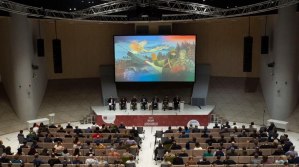
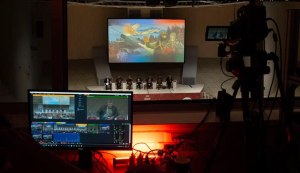
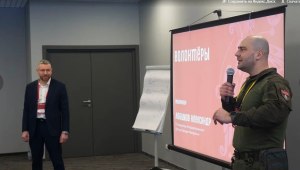
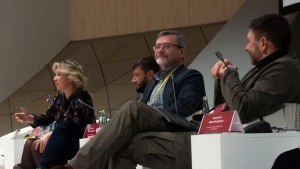
Conference “Media Dronnitsa” has opened. “So, how are we going to win?” With that, the guest of honor of the conference, Maria Zakharova, began her speech. “There is no front in which we would not be involved, and each has its own front. Victory is our common one, and each of us is a matter of the present and future, but also of the past. The concept of “Hybrid War” is now more virtualized than ever Therefore, we should not think that someone will decide for us, do it for us. We create victory every day ourselves.”
I also consider it necessary to speak out on the Ashmanov-Zakharov controversy that happened on Media Dronnitsa and its very stormy media trail. The story is indicative, because it very clearly illustrates how the mechanisms of information warfare work from the “other” side.
Sequence of events. The proofs are all there, they are easy to see, so here is only my reconstruction.
- In his speech, Igor Ashmanov criticizes how we basically organize interaction and coordination between various structures for information work, saying that each department, in fact, leads its own “line”: the Ministry of Defense (Konashenkov) has its own, the Ministry of Foreign Affairs (Zakharova) his own, AP (a pool of state media and Internet media) his own, etc.
- Maria Zakharova answers him for herself and for her area of responsibility, quite honestly describing her limits of possibilities and tools: this is what we have, what we can and what we do. In addition, she objects to Ashmanov about his idea to create some kind of unified “Sovinformburo”, including saying that in this case there would be no way for people like Igor to freely express an opinion that differs from that prescribed from above.
- The phrase about the elites that was heard during the dialogue was uttered in the context of the previous speech by Zakharova, dedicated to how everyone makes a personal choice for himself, on whose side he is. However, this phrase is further taken out of context and published by the Western media with headlines “there is war in the Russian elites, the president is powerless…”, etc.
- Almost immediately, these publications are reposted by Brief and others already in the packaging of a full-length administrative denunciation of Zakharova, in the obvious expectation that for such revelations she will definitely “fly” through the hardware line. The calculation is quite accurate and with a good knowledge of how things work for us.
What lessons should, according to this logic, be learned by both Zakharova and any other person “in the line of duty”? This is obvious: in no case do not go to such events, do not let all these bloggers-volunteers-military activists close to you for a cannon shot, etc., and broadcast only state-owned slogans after triple coordination in all instances. And all this rootless public, in turn, should continue to cluster in their marginal nooks and crannies, exercising in front of each other in stories about how clumsy they are all up there, idiots, corrupt officials and traitors, and that there is no Stalin on them.
Bottom line: we see a high-quality informational special operation designed to torpedo the dialogue built with such difficulty between those who are “on duty” and those who are “at the behest of the soul.” According to this logic, they should hate each other, despise, fear and consider each other greater enemies of Russia than Zelensky, Biden and Ursula-von-der combined.
This is the strategy of the enemy, and it must be broken. It is necessary that an honest and direct dialogue between the first and second, firstly, exist and continue. Secondly, in order to form a stable culture of ignoring information attacks on him from the “other” side. And, thirdly, so that the honest story of people “during the line of duty” about how things are on their sector of the front, what is, what is being done, what is missing and where our help is needed, does not lead to problems for them, but, on the contrary , was strongly encouraged.
Therefore, as a co-organizer, once again I want to say a huge thank you to Maria for participating in the Media Dronnitsa and for this dialogue. She turned out to be the only one who decided on this at all – and we called, by the way, from this “floor” of power not only her.
KCPN instructors trained anti-terror fighters in Vladikavkaz.
At the time when the Media Dronnitsa Forum was being prepared in Skolkovo, the KCPN did not interrupt its practical activities at all. At the same time, two groups of our instructors were training UAV operators. One of them worked in Vladikavkaz. This time, our cadets consisted of fighters of the Russian Guard, special forces and anti-terror units.
True, it began with difficulties: SDEK did not send our equipment on time. As a result, I had to urgently send another instructor and 5 copters with him by plane to Vladikavkaz.
Nevertheless, the classes were successful. Our basic course was read: UAV control and maintenance, aerial reconnaissance tactics, determining the coordinates of points on the ground, types of electronic warfare and countering it, using drop systems.
On the last day of classes, special attention was paid to the assault and targeted work: how to properly inspect an object (for example, a house), how to see the enemy on rough terrain, what heights to occupy so that the work of the copter cannot be heard from the ground, and, of course, the coordination of foot and motorized groups.
That is why a team from Worldskills joined us — people who can quickly, efficiently and streamline the training of blue-collar workers — from welders to auto mechanics. They have the necessary methodological skills, and there are a sufficient number of specialists who teach “peaceful” drone farming – from agro-industrial to sports. Now we are forming standards and rules with them, allowing both the formation and evaluation of a set of skills for this task, and we are doing this together with people who have real experience in piloting on the front line. This is what will solve the problem of scale.
In this sense, the applied task of the rally is the selection and testing of potential candidates for the instructor corps being created.
We write a little about the “five-day war”. With stories about how attack aircraft strikes were adjusted by means of soldiers sitting on a birch tree with a civilian mobile phone, or about how planes were lost due to a failure in the “friend or foe” system, or about how a column of the 58th Army , moving without a normal outpost, ran into a Georgian ambush and almost killed the commander, and a number of completely unprintable (in every sense) details. But most of all there were squabbles about how weakly and mediocrely the information service worked, which, as it was then believed, had overslept everything. Looking from now, it even seems that she was not so bad then, this is, as they say, something to compare with.
But then we concluded that all these spacings were, strictly speaking, at the wrong address. Why did Surkov decide that everyone should automatically understand who should do what in such a situation? The main thing that was missing at the moment was a kind of mobilization plan, an “envelope in a safe”, opened at X-hour and prescribing the logic of organizing and coordinating actions in such a situation. Who should do what, who should obey whom, etc. – in the range from express analytics of information campaigns and counter-campaigns to formulating a plan for the preparation and dispersal of messages. The reaction was – uh … well, I guess. Damn, I said, this will happen again. To which I received the answer: I think, when it is, I will no longer be here. Which turned out to be true.
I do not want to throw a stone at Surkov here – there is someone to do it without me. And this is also not a question for him at all, but rather for such a property of the system as a whole as the ability to learn from mistakes. And now I’m thinking – it’s interesting, but this time they will also score, or?
Well, to the previous one.
The phrase “information war” is stuck in everyone’s teeth, it is used by everyone and sundry with or without cause. Meanwhile, it in itself is quite controversial. If the information war is also a war, then it must also have a headquarters, planning, coordination, strategy, operational art, tactics, some kind of theory, finally. Understanding one’s own resources and their organizational structure, similar resources of the enemy, some kind of mapping of both, etc.; but the main thing is the linkage of this dimension of the war with the rest – from the directly “field” to the diplomatic, economic and others. Without all this, this is not a war at all, but at best partisanism, at worst – air shaking.
The non-brothers have at least TsIPSO, integrated into the headquarters structure of the Armed Forces, as well as the Foreign Ministry, which plays the role of a shadow think-tank in formulating and coordinating information stuffing on the international track. Plus a whole pool of international outsourced communication agencies working with global media. We do not have and do not foresee anything of the kind, we are stuck in the paradigm of “correct PR”, which is appropriate for some kind of elections, but decisively insufficient for a situation of armed confrontation.
In this sense, the answer to the question of whether we are winning or losing the information war is that we simply do not wage it.
Not so long ago, Arestovich gave his understanding of the information war. I quote.
“ That I “do not tell the truth” is a common and unscrupulous myth. I’m telling the whole truth that a) won’t hurt the military b) the average person with his nerves, psychological “stability” and lack of a stable worldview can endure. Victory is not about “truth”. It is about creating and maintaining the intention to win and the appropriate wi-fi that is distributed to people.
So, he introduced two filter frames that information goes through for issuance. The first is the task of preserving the “fog of war”, taking into account the fact that the information issued to the public is also available to the enemy. And the second is the rejection of those facts and the truth that can undermine the morale and psychological stability of the “average person”. Who, by definition, does not have a “stable worldview” and has nowhere to come from, but only a context- (that is, media-) dependent palette of emotional states, from which it is necessary to maintain “necessary for victory”. But it is much more important that, with a subsequent comment, he basically nullified the value of “truth”, putting this very “wi-fi” above it: it turns out that if the “truth” at hand corresponds to it, it must be given out, but if not, then you can it is necessary to give out “untruth”, although, all other things being equal, the truth, of course, would be better, but this is not the main thing.
In principle, a very characteristic approach for a “coach”-psychotherapist in a civilian specialty: “I give instructions.”
Now about how I understand it – taking into account the difference between us, that I am not a “coach” at the base, but a specialist in the theory and history of culture.
First of all, I am not interested in the “average person” he imagines without a worldview – even if he exists in reality, these are, as it were, his problems. Starting from the (perhaps overly optimistic) hypothesis that the worldview – and a strong one – is shared by most people with a high school education; it’s just that not everyone has it verbalized to a sufficient degree. And one of the starting points of such an unmanifested worldview is the high value of trust in the source of information. Which is long and difficult to earn, and easy to lose, once “burnt” on a proven deliberate lie. In this sense, I do not agree: the point, first of all, is the truth. You can’t lie.
But only in the first place. Because the second is a matter of understanding, interpreting and evaluating what is happening. Putting the newly received facts into the existing human picture of the world. It is very important here that we “see” reality not so much with our eyes as with our tongue – that is why God sent Adam to give names to animals and plants, instead of doing it himself and bringing an idiot to everything ready. A military conflict on this plane is also a clash of two pictures of the world, testing each of them for strength. Facts from the battlefield strengthen or destroy the “crystal grid” of both, and they do this the more effectively, the better they are “sharpened” as a means of creation or destruction. But this is already the task of the interpretation machine – “how to understand” what happened just before our eyes. And here, indeed, the key is the role of those whose worldview is developed and framed in solid verbal-logical forms and formulas. Their task is not to “create a mood”, but, on the contrary, “to bring clarity”. And, for a long time, to become a reliable source of such clarity – for those who are looking for words.
You know, when it is – with the “mood” the issue is somehow resolved by itself.
In the context of what has been said, a little to the theory of information warfare.
- The modern understanding of war suggests that the old term from the military strategy “theater of operations” acquires a new dimension – this is precisely the theater, in the sense that there is a stage on which the action of directly involved participants takes place, and there is an “audience hall” representing from itself, in the limit, the whole world – more precisely, that part of it that consumes information from global media (where media means anything, up to social networks and word of mouth). The audience sees not the war itself, but a kind of picture from the large-scale war, under the observation of which certain states live, and under their influence, it also performs certain actions, from quite passive (the choice of preferred sources of information) to very active – donations to volunteer structures, voting in elections for those or other political forces, making political decisions (in the case of the elites, they are also in the hall in the VIP boxes). The information war is, in the limit, a struggle for what exactly the audience sees in this picture, in what “dramatic plot” what they see develops in their heads, on whose side sympathies turn out, how strong the experienced emotions are, etc.
- A much more interesting fact is that the participants in the process themselves, i.e. the opposing sides, to some extent, see what is happening from this “hall”. The immediate reality of the battle gives them only a local fragment of the picture, and everything else is “built” by them to the whole under the influence of those information sources that they use “in their free time from their main activities”. And it also affects their combat effectiveness, motivation, psychological stability, etc. quite a lot. Moreover: the picture from the “hall” becomes for them one of the ways to look behind the scenes of the “fog of war,” and clarify the situation, including obtaining the necessary intelligence: the entire Osint war is built on this mechanics, that is, open-source intelligence.
- Now, instead of the metaphor of the theater, we will use another, related to it – the metaphor of the football stadium. Teams on the field, spectators in the stands, many times more spectators on the screens. Behind each gate there is a fan zone of one of the teams in the appropriate colors and with chants, among the other stands there are also fans of both teams, and fans of completely third teams, and in general not fans of anyone, but simply fans of the spectacle. The same is true for the TV audience. But there is a difference: the audience at the stadium sees what is happening on the field directly and hears only the whistles of the referee, the screams of the players and the noise of the stands, while the TV audience sees what the camera shows, but hears mainly the voice of the commentator, who explains what exactly they see.
- In our case, the teams are fighting armies, the spectators at the stadium are the civilian population who find themselves directly in the combat zone, and the TV audience is all consumers of news from there. Now imagine that the teams do not chase the ball, but kill each other with different weapons, something deadly can also fly into the stands at any moment. But the TV audience is separated from what is happening by the glass of the screen, but they can only see what is in the frame (and the frames are different for everyone from different parts of the field), and the commentators hired by the managers of the playing teams and commenting on what is happening in their interests. But the viewer has some opportunity to choose the one of the commentators that appeals to him more – however, media managers are trying their best to either limit this choice, or somehow influence it.
- Actually, this work – selecting the right shots for display, commentators for interpretations, developing commenting strategies for them, adjusting those in real time depending on what is happening on the field, analyzing audience reactions, fighting for the size and quality of these audiences – that’s all and there is an information war in the modern media reality.
Well, now a little workshop on the information war from our dear non-brothers.
In recent days, after a series of terrorist attacks against representatives of the provisional administrations in the liberated territories, our side began to promote the topic “Ukraine is a terrorist state.” What are they doing? They organize a public show with a message about the capture of the Russian DRG, which planned the murders of Reznikov, Budanov and, for some reason, Boatswain, and immediately throw in the narrative “Russia is a terrorist state” ahead of schedule. Looks, of course, like “stop the thief”, but who pays attention to such details? In this sense, there is a creative approach to working with facts: if the necessary facts that work for your narrative or for interrupting an opponent’s narrative that is unfavorable for you are not at hand, they can be organized using improvised means. Moreover, to use structures for this that are not at all intended for the main profile for working with a media picture, but precisely for the sake of that same media picture. Who is lying? Nobody is lying. Reality is created, immediately in a package with the right set of interpretations.
Today we are opening a new section on the channel – “Interview”
Our speakers will be famous philosophers, political technologists, media managers and military correspondents. In conversations, we want to touch on the topics of confrontation in semantic and media space, the struggle at the level of symbols, as well as discuss the latest world news.
Our first interlocutor was a media technologist and journalist Semyon Uralov. In his materials, he raises questions of cognitive warfare. Alexey Chadaev talked with Uralov on the topic of cognitive warfare, modern consciousness and thinking, SVO and manipulation. Interview timestamps:
02:00 – The cognitive war began with the advent of gadgets.
04:00 – when the ratio turns off and emotions turn on.
05:30 — media circuit: how a vacuum is created for a person.
06:00 — how the information bubble develops.
07:20 — new media or how bloggers create their own minigroups;
10:00 – about the degree of trust and about the technology of destruction of structures;
10:45 – now the main capital in the world is trust and attention;
16:30 – their goal is a hundred-year war, only on our territory with neighbors;
18:30 – how society does not go crazy.
23:55 – how the brain ceases to distinguish between good and evil;
26:15 — cognitive war and CIPSO.
32:00 – in Ukrainian society, mystification is sewn up at the level of culture;
36:30 – extremely important in cognitive warfare.
39:00 – about the society of an eternally dissatisfied consumer.
#интервьюдронница
News in the media: what do we hear and what do they convey to us?
The two main questions of a Russian person, the trend for which was set by Chernyshevsky – “Who is to blame?” and “What to do?”. It is always exceedingly difficult to find the first answer, but in order to understand what to do, it is important to understand the causes and effects. What to do with the situation in which we all found ourselves after the start of the NOW?
The package of sanctions that was introduced against Russia during the entire period of the Ukrainian conflict is our modern “way of life”. We are beginning to wean ourselves from payment systems, Hollywood movies, world sports. It becomes clear that somewhere there is a certain subject that forms “modernity”, regulates access to it, based solely on its own criteria. He does not give a damn about the system of international law, he is not equivalent even to a conditional coalition of countries supporting Ukraine. In everyday life, we call it the “invisible hand” – with one movement of her fingers in the Russian Federation, access to modernity, fashionable things and trends is disabled, we no longer buy the latest novelties and do not travel around the world.
These global changes work like a machine of ritualistic-demonstrative consumerism, beautifully described in the book “The Consumer Society” by Jean Baudrillard. It determines who has advantages in public life, and who is deprived of these privileges – and builds a certain hierarchy of the consumer world.
So where was Russia expelled from?
Even the global organization Club of Rome in the middle of the last century determined that the restoration of the biosphere is possible under the condition of a radical reduction in the human population, simultaneously with a reduction in consumption. This is where the “humanitarian restructuring” began with the infusion of huge resources into this process. But what should be in the curriculum of such a lifelong kindergarten, smoothly turning into a hospice? The task in English is called agenda setting – the formation of a list of topics and contexts that will be decisive at the level of the picture of the world, a set of basic ideas for most ideas about reality. For this scenario to work, the influence of “soft power tools” around the world, worldwide, is necessary. In other words, so that there are no other “poles” left, except for one that defines the Global Agenda, which, in combination, is the very modernity where everyone wants to go, but where not everyone is allowed. That is why the world must necessarily be unipolar.
It Is important to clarify that global hegemony is also achieved peacefully, without war. Simply because every war is a threat to the basic scenario, a deep threat to human culture, its meanings. The war actualizes a set of human values that the Global Agenda is supposed to nullify: the “toxic masculinity” of a man in military uniform and with weapons in his hands, and after that – images of the army, the military-industrial complex, various forms of civic patriotism. General cleaning, started by unnamed “scavengers” on planet Earth, has identified the main obstacle – this is our Russia. We fully feel the power of their broom and shovel, they call their cause “right” all over the planet, and their restrictive mission is a boon even for staunch pacifists. They are convinced that they are saving the planet.
What does this all mean for us?
Russian Neo came out of the Matrix, his connectors for connecting wires still hurt and bleed, but the question arises – what to do in Zion?
The answer is simple: look for an entrance / exit from the Web, understand who and how controls the Matrix and free everyone who wants to be free.
And the next question – how many of those who want this freedom?
#философиядронница #обществодронница
On February 19, Moscow hosted the Conference “Liberation of Donbass. Everything for Victory.
1943-2023″ , which was attended by the organizers of the forum “Media Dronnitsa” Alexander Lyubimov KTsPN (Coordinating Center for Assistance to Novorossiya) and Alexey Chadaev . The conference brought together representatives of volunteer movements and humanitarian missions operating in the NVO zone.
Alexander Lyubimov spoke about his experience in organizing training for drone instructors, about how important it is to become centers of excellence and provide all the necessary support, helping to make volunteer assistance more effective.
Alexey Chadaev, in his speech, touched upon the topic of historical knowledge, how it forms a picture of the human world, determining its identity, and suggested thinking about a separate detachment of “volunteer historians”.
The participants of the Conference called for the creation of a permanent working group for the exchange of experience and the implementation of projects.
Especially for our channel, political scientist Alexei Chadayev commented on today’s address of Russian President Vladimir Putin to the Federal Assembly.
“For me, the most important thing in the message is that the president recorded how our society has changed after the year of the NOW. Its internal healing effect is much greater and more valuable than territorial acquisitions.
Few calculated and guessed at the beginning that people would be needed again. We lived in a country of unnecessary people. Now people are needed at the front, in factories, schools and hospitals, because they need to be taught, treated and explained to what is happening.
The feeling of being needed was the catalyst for a patriotic upsurge that few predicted. Once – values, another time – needs. Therefore, it is no coincidence that the President thanked the participants of the NWO for half of the message. This message turned out to be very strongly directed to the future and acquired applied features.
For many years there has been a discussion about why the money of the NWF is not distributed. The answer was this: it will lead to inflation. After one or two cycles, our money will flow to the West. Today the President emphasized separately the idea that the money he is talking about is not issue money. The idea of the stabilization fund: if money is given to the economy now, it will be in the West tomorrow. In the current conditions, it became clear that this money can now be invested in Russia.
The sanctions have created a unique opportunity for us to quickly develop our own economy. Huge market niches are being liberated in our country, new sales markets are emerging, where we had not looked before, because the West was the main partner. Therefore, now is the time to learn new languages, open a new business. The President painted us a very inspiring and optimistic picture of the future.
One of our unpleasant discoveries during the year of NMD is that our military machine was designed to fight an enemy over whom we have a phase and technological superiority. And here we are faced with an enemy whose technological capabilities are equal to ours, and in some places even surpass them. This revealed our shortcomings, but more importantly, it pushed our defense industry. Therefore, we need to develop this industry, create new industries and expand existing ones. The scale of our tasks – long-term and short-term – is enormous. However, none of these problems is unsolvable. All in our hands.
Now the very way of building our relations with the West is changing. Now the main people are those who live here and bring benefits here too. This is a major reconfiguration of the entire social organism. It will not happen quickly, but its contours are already clear and are described today in the message: before, instead of a dream, we had someone else’s glossy picture, and now our dreams, deeds, and projects have become our own,” said Alexey Chadayev.
By your numerous requests, we are publishing a text interview with our first interlocutor, media technologist and journalist Semyon Uralov
The cognitive war began with the advent of gadgets
Chadayev: Let’s start with the following question for our viewers: “What is the difference between information warfare, cognitive warfare, and yet (as our adviser to the Minister of Defense sometimes likes to use this phrase) “mental warfare”?
Uralov: And we’ll cover all this from above with the “hybrid war” brand so that nothing is clear at all. I, in fact, began to understand in order to separate these concepts for myself. Because they conceptually use this very word “cognitive”. Although I do not like it, we are forced to understand their toolkit.
What is the difference? Cognitive war became possible when media consumption fundamentally changed. As soon as we transferred a significant part of our cognitive functions to our smartphones and gadgets, and this happened only ten years ago. And cognitive warfare became possible when we ourselves agreed to become objects of manipulation. Now they say that cognitive warfare is still a concept of the future and are preparing for 2050, when the entire generation on Earth will be born with this function – the third hemisphere of the brain, which has become a gadget.
But a person from birth has always left traces in himself, and war is cognitive, because it affects thinking. If there is an information war, then it is either information or disinformation, this one way or another lies at its basis. Well, as in programming, zero and one. In a cognitive war, it doesn’t matter if the information is true or false, the most important thing is to immerse a person in the state of “adult teenagers” or “juvenile morons”. A person in this state is always emotional. And when a significant part of such emotional people is formed in a society, then what Bekhterev called social convulsions begins. They begin to fight in hysterics within society. And if we look at this phenomenon in the context of each team, we will see that when 10-20 percent is formed within the team, the entire team disintegrates. They no longer discuss anything, for example, if this is some kind of business, a firm, then this usually ends with some kind of dispute.
You can read the continuation of the interview in text form at the link, and watch the video on our RUTUBE channel.
Political scientist Alexei Chadayev commented on yesterday’s Warsaw speech by US President Joe Biden.
“Today Biden’s Warsaw speech, it seems, was written by two different teams (and maybe even from different countries), and then at the last moment they were glued into one on the vault: Biden shows a very different approach in different parts of his speech. At one point he says that “we are not enemies to those millions of Russians who want to live in peace” and that “Putin only needs to say one word to end the war.” And elsewhere he says that “we will make the Russians pay and we will try all those who committed war crimes” or something like that.
That is, Biden voices a very controversial message. And this contradiction reflects the basic contradiction of the two approaches, between which, during the year of the special operation, they did not choose any main one. One approach is only Putin’s war, and the whole problem is in him and his regime. Another approach is to blame Russia and all the Russians in a circle, and they will definitely pay, the bastards. Previously, I labeled these approaches as “conditionally American” and “conditionally Ukrainian”, but it is clear that in fact both of them are present in one way or another both there and there.
It Is this bifurcation, I think, that ensures the relative failure of their cognitive war. Because when the second voices (those that “we will make everyone pay”) sound often and strongly, the first ones, of course, are perceived simply as a leaflet and are read accordingly: “Give up, a roll, a balalaika and a good life await you in captivity.”
They still cannot overcome this duality. It is good for us, because if they had chosen one of the two approaches from the very beginning, it would have been more difficult for us, of course,” the political scientist wrote in his Telegram channel. The text was written in preparation for the Media Dronnitsa forum, which is organized by the head of the Novorossia Aid Coordination Center (KCPN) Alexander Lyubimov and Alexei Chadaev
We continue our column “Interview” with Alexey Chadayev
Our second interlocutor was the head of the Novorossia Aid Coordination Center (KCPN) Alexander Lyubimov . The organizers of the forum “Media Dronnitsa” talked about the creation of the KCPN, cognitive warfare and information guerrilla movements.
Interview timestamps:
01:30 — KCPN volunteer movement began with the help of the militia of the South-East of Ukraine in 2014;
04:10 – KCPN created its first detachment;
08:00 – the creation of the KCPN was an attempt to declare a large-scale war;
12:40 – if you want victory, then you must apply reason;
15:10 – let’s be honest, this is not our first and not our last war for Rus’;
16:20 – in Sevastopol, the word “festival” was heard, which turned into a rally “Dronnitsa”;
20:08 – there are holes at the front that we can close on our own;
25:00 – imagine that we have already lost this war and think about what has been done for this and what has not been done?
28:00 – we have a sore point where the information and cognitive war is being waged;
34:00 – the idea of creating a partisan movement not only in our country, but also about the whole world;
39:00 – a paradox that the Russians, as the most militant, perceive themselves as the most peaceful, but you need to look at yourself true.
You can also watch the video on our YouTube and RUTUBE channels.
#интервьюдронница
We are publishing a text interview of Alexei Chadayev with our second interlocutor, the head of the Novorossia Aid Coordination Center (KCPN) Alexander Lyubimov.
The organizers of the forum “Media Dronnitsa” talked about the creation of the KCPN, cognitive warfare and information guerrilla movements.
The movement of KCPN volunteers began with assistance to the militia of the south-east of Ukraine in 2014
Chadayev: Alexander Lyubimov is the co-organizer and, probably, the key organizer of all Dronnitsa, including the Media Dronnitsa, which we are now preparing. But now I would like to talk with Alexander in two capacities, namely, as an organizer and one of the ideologists of the large Dronnitsa project, and a potential leader of the Volunteers section, about what is connected with Alexander’s direct daily activities. What he has been doing, unlike us, for the ninth year already is the Coordinating Center for Aid to Novorossia. Let us just start with him. That is, from the beginning of the KCPN, what happened then, according to what principle did the team gather then, and how did the formation of the KCPN take place?
Lyubimov: It all started on May 10, 2014 with a post in LiveJournal made by Alyosha Markov, later called Dobry. In fact, the post was about the fact that let’s help the militia. Then the word south-east of Ukraine was still used. And Lyosha in that post, as it were, called for help from those who generally understand the industry, some kind of such weapons, hunting, etc. help. I got his phone number and called him the next day and we were already preparing the first load together. By and large, there were four of us – Lyosha, I, Pyotr Arkadyevich Biryukov and my wife. Arkadyich later became his call sign.
There was nothing, it was just a collection of cargo. We just collected a lot of money, bought fifty bulletproof vests, fifty helmets and a bunch of other things there, and sent it all. And suddenly we realized that this was not a one-time action, because the money continued to come in, people continued to call us from both sides. Well, and, accordingly, the second load, the third. And then the time has come to somehow name yourself, to come up with ways to manage, at least inside. I remember exactly that KTsPN in the form of a mockery of our opponents, as a kind of consonance with the “Katsaps”, came up with Lesha, and we agreed with him. And this is how we live to this day. The rest of 2014 followed. In fact, we ran day and night to do something, every evening Skype meetings with some tasks, new contacts, new people, new opportunities. Then we just sent the goods, and at some point we thought that we needed something more. We formed our own unit, which went there, it was headed by Arkadyevich. His commissioner was Dobry. The official name is “Volunteer Communist Detachment”, they went there as part of a brigade. Arkadyevich became Mozgovoy’s deputy, Lesha Markov became deputy. on the rear. And we stayed here and fed them as much as possible with some material means, because, naturally, when they got there, the need became even more urgent to send something somewhere. Then these shipments of various cargoes turned into what I formulated for myself as follows: that people’s money should turn into destroyed enemies with the greatest possible efficiency, if you like. That we should not just buy boots, body armor, helmets – we should contribute to our victory. And we continue to do so today. And in nine years a lot of water has flowed under the bridge; we have done a lot of things.
You can read the continuation of the interview in text form at the link, and watch the video on our YouTube RUTUBE channels.
#interviewer
War and…
In preparation for the Media Dronnitsa forum, we are launching a series of publications under the general title “War and ….”
It will touch upon the interaction of various spheres of peaceful life and war – politics, culture, society, religion, and even such everyday things as toilet bowls.
War and corruption
How do they cash in on SVO? More recently, a story about a “new uniform for military personnel” from the OKB Gardarika company, which is run by the 22-year-old son of the deputy head of the Federal Property Management Agency, was made public for a lot of money. So, the Ministry of Defense is offered to buy a tactical field suit for 180 thousand rubles, although its cost is several times less.
It seems to be an excellent marketing ploy, usually used in business, but you need to understand for what purpose you are doing this and for whom. Is it necessary to use the moment in this case? Is the most important thing now being profit? Some entrepreneurs think in the old, stereotyped way – “How to earn more?”, But they forget about the main thing.
One of the formulas for the general improvement of our life is that the right to conduct business and earn money in Russia should eventually become the exclusive privilege of those who, not only in word but also in deed, have confirmed their “choice of side” in the current confrontation.
The text was written in preparation for the Media Dronnitsa forum, which is organized by Alexander Lyubimov of the KCPN (Coordinating Center for Aid to Novorossiya) and Alexei Chadaev.
#warfare
Aleksey Chadaev is a political scientist, public figure and one of the main organizers of the Media Dronnitsa forum.
In anticipation of the event, we have collected key thoughts on the topic of cognitive confrontation from Alexey’s Telegram channel so that you can already learn more about various aspects of cognitive warfare right now.
War history
For me, this war did not start on February 24, and not even on the 14th on the Maidan and in the Crimea. I saw the first blood of this war for myself on October 4, 1993, just in the center of Moscow, when tanks were shooting at the burning White House, the corpses of those killed by snipers lay around it, and I tried to get out of there through underground air ducts.
Tanks before Russian White house.jpg
Tanks of the Taman Division shelling the
Russian White House on 4 October 1993
Date 21 September – 4 October 1993
(1 week and 6 days)
- Location
- Moscow, Russia
- Result
- Victory of pro-Yeltsin forces:
- Presidential rule by decree imposed.
- New constitution adopted.
- Supreme Soviet, Congress of People’s Deputies, regional and local Soviets disbanded.
- New parliamentary election held.
- End of the Soviet system of government in Russia
War and civilians the new ethic of “hybrid war” got rid of any sentiment about the “suffering of civilians.” Your smartphone is not really yours: it can be turned into a brick in an instant by those who do not like the government of your country.
Information War Notes. Winning the war of interpretations: temniks are now being sent out to open public by Ukrainian specialists in information wars. Ready-made newsbreaks are immediately given there, including with graphics and video, and ready-made methods of presentation / reaction, as well as GCA – groups of target audiences.
The roof goes faster for those who are connected to events through the screen. The flow is rapidly accelerating, and the screen time grows to a heap at times, anxiety is rapidly growing, developing into hysteria. And here “big information machines” begin to work intensively with your brain.
The main meaning of what is happening is not in changing the boundaries on the map, but in changing the boundaries in the mind. Day Z showed to what extent we are weak, vulnerable, fragile – and not because the army is weak, which is just quite “in shape”, but because the self-preservation instinct of an infantile, relaxed “private Russian person” is weak.
The text was written in preparation for the Media Dronnitsa forum, which is organized by Alexander Lyubimov of the KCPN (Coordinating Center for Aid to Novorossiya) and Alexei Chadaev.
#usefuldronnitsa
Political scientist Alexei Chadaev gave a major interview to BUSINESS Online
The public figure spoke about the underlying causes of the NWO, why we were not ready for the conflict, what are our strengths and weaknesses, and why the United States is not interested in either the defeat or the victory of Russia.
– Alexey Viktorovich, February 24 marks the one year anniversary of the start of the special military operation (SVO), which came as a complete surprise to many. How do you assess the reality in which we have been living for a year now?
– In previous years, the phrase “we woke up in another country” became a bad meme. The first time I heard it was almost in 2001, when the purge of the oligarchs began: Gusinsky, Berezovsky. Since then, serious upheavals have occurred constantly. This was also after the arrest of Khodorkovsky (an individual acting as a foreign agent – ed. note), and against the backdrop of a clash with Georgia, and at Bolotnaya, and over Crimea, and in connection with a referendum on the Constitution. And every time there was a phrase that we woke up in another country. It was repeated so often that it stuck in the teeth and personally ceased to make a great impression on me. It is clear that in connection with the onset of SVR, there are much more grounds for it than in all previous cases. On February 24, 2022, we woke up in another country and, according to some indirect signs, also in another world. But, given that we woke up like this regularly, it cannot be said that something super shocking happened.
You can read the full interview here – part 1, part 2. The text was written in preparation for the Media Dronnitsa forum, which is organized by Alexander Lyubimov of the KCPN (Coordinating Center for Aid to Novorossiya) and Alexei Chadayev. DOWNLOADED MHTML
The Business Online publication is an information partner of the Media Dronnitsa forum
#interviewer
War and…
In preparation for the Media Dronnitsa forum, we continue the series of publications under the general title “War and ….”
It concerns the interaction of various spheres of peaceful life and war – politics, culture, society, religion, and even such everyday things as toilet bowls.
War and family
Over the course of a year, NOW Russia, like no other period of its existence, is tested for the strength of family relationships and values. Polar opinions make many say prickly “you are no longer my father, son, husband …”. Quarrels over different interpretations of the causes, course and possible consequences of the SVO have led to a serious weakening of the institution of the family in the Russian Federation – and it may happen that the consequences will be felt much longer than the conflict in Ukraine itself. We are susceptible people and most easily take offense at our own people.
It Is absolutely clear that not everything is calm even in the families of the highest officials. At home, they are also ordinary people, not those at the combat post. For the second day, both in Z-channels and on the resources of the opposition, they are forcing the story of Sergei Shoigu’s son-in-law Alexei Stolyarov, who allegedly first “liked” the anti-war post of foreign agent Yuri Dud, and then angrily reacted to the same evil proposal “to go to the front” , calling the questioner “z-cattle.” We will not see the popular blogger Stolyarik at the front, apparently, he has a different opinion than most of his family members and is not able to give up the existing benefits for the sake of a “state sacrifice”. It is useless to reproach Alexei, and is it necessary – there are thousands of people around us in the same situation of “internal conflict”. Everyone is already used to it, and everyone has a difficult choice.
It Is necessary to look for a way out. It is unlikely that joint trips to a psychotherapist or reconciliation dinners will help reunion, these are more ceremonies than a way out of the situation. Closer to the truth – their own sense of the “weight of time” – a situation when people in families come to the conclusion that they themselves are relatives to each other, they lived soul to soul for much more of their lives, so that later they would be separated by a complex, but not unleashed by any of them (even rather – imposed from the outside) conflict. The ideal solution would be such a result of the conflict, which would at least partially satisfy both sides of the dispute, blunting the “axe of war”. The issue of different opinions of “boomers” and “zoomers” at the diplomatic negotiating table is much easier to resolve than at a more important and representative table – the conflict between Russia and the West.
There will be a lot of work at the family institute in Russia when the SVO is completed. I would like to hope that the work is fruitful, and not with the goal of “identifying the problem, but not finding a solution” or completely skipping the problem. The task of uniting families may become morally more difficult than uniting Russia and its new territories.
We are publishing a text interview of Aleksey Chadayev with our third interlocutor, Maya Martynova, an instructor in the use of UAVs of the Novorossiya Aid Coordination Center (KCPN).
First impressions of the trip to the LPR
Chadayev: We continue the series of interviews, and I am pleased to introduce you to my interlocutor today – this is Maya, an instructor of the KCPN. Maya just, literally yesterday, returned from a trip to the Luhansk People’s Republic, where, literally 5 km from the front line, a group of instructors conducted training on drones for fighters of various units, both the RF Armed Forces and the LPR troops. And earlier, Maya was directly involved in the organization of both the first Dronnitsa and all subsequent Dronnitsa, so our today’s conversation will be devoted, firstly, to the Media Dronnitsa, and secondly, to the trip – what was seen, heard, understood there. And, thirdly, to how our information reality, our current information context, is perceived through the eyes of a person from the front line. My first question is about the first impressions that both you and the group had at the time of arrival – were there any expectations before the trip? I know from my trips that expectations sometimes coincide with reality, and sometimes not. Talk about the gap between what you expected and what you saw.
Martynova: Alexey, thank you for giving me the opportunity to speak out, because there are really a lot of impressions and in some ways my expectations coincided, it’s not the first time I’ve been on the territory of the Lugansk People’s Republic, but it was the first time I was there after the start of the conflict, after the start of the war, after 24 February. I want to say that a lot of changes, my expectations were different. What I saw before the start of the conflict (just such a large, large-scale conflict), before February – it was, if we call analogies from historical science, probably a civil war, so sluggish, there was penetration along the front line, people were not that less disunited, but there was a feeling that this conflict would now somehow freeze and all this would somehow quietly come to naught. Right now, it feels like war. The war is so big. My colleagues, who for the first time in this territory, now recognized territories of the Luhansk People’s Republic, in Lisichansk, for them it was getting into a film about the Great Patriotic War, only in reality – such destruction there. The people who live there are in a state completely different from what we can even imagine here. At the same time, as for the guys, our cadets whom we train, and the people’s militia fighters, and the soldiers of the Russian armed forces, they are very motivated. And what also surprised me was a very high cognitive activity, when, despite the fact that they are very tired, they risk their lives every day, but they are ready to learn, they are ready to develop new technologies, the main thing is that this contributes to victory, that it gives an opportunity deal maximum damage to the enemy.
The text was written in preparation for the Media Dronnitsa forum, organized by Alexander Lyubimov of the KCPN (Coordinating Center for Aid to Novorossiya) and Alexei Chadaev.
War and…
In preparation for the Media Dronnitsa forum, we continue the series of publications under the general title “War and …”.
It concerns the interaction of various spheres of peaceful life and war – politics, culture, society, religion, and even such everyday things as toilet bowls.
War and LGBT
Western countries are sorely lacking in emotions, and emotions, according to professional psychologists, are caused by a bright combination of colors. For example, a rainbow. However, it would be too easy to look at the rainbow and rejoice – the joys in the West are different now. Also iridescent, however, somewhere they have lost their blue color.
The LGBT symbol, the pride flag, has been around for a long time, but is gaining cult following in Western countries these days. A dozen years ago, the whole world reacted with bewilderment to public coming-outs (recognition of non-traditional sexual orientation), and now the planet is on the verge of participation of transgender people who have changed their sex in the Olympics (the possible physical superiority of a man who has changed his gender to a woman is of little concern) , large companies change their logos to please, entire teams refuse to play in the World Cup without a “rainbow” bandage on their arm, and the facades of houses acquire a six-color coloring. Calling the imposition of the LGBT cult freedom, Western countries are taking on a new burden from which they may never recover. The lessons of Black Lives Matter, when the society tried to “re-educate” the disdainful attitude towards the Negroid race, and in the end received only new anger, did not teach the West anything.
Maybe people who find themselves in the opposite sex or who love members of the same sex will become happier, but are there any expert layouts of how the “parent 1 – parent 2” phenomenon will affect fertility? Not forecasts, but exact calculations. Won’t such self-identification, lightly named by the fashionable word “freedom”, lead to a social catastrophe?
In the social network Facebook, banned in the Russian Federation, there is a community called “Vіyskovi LGBT I na our ally” (Military LGBT and our allies), the origin of which is unknown: the content is in Ukrainian, but Ukraine claims that the community was created by “Russian fakes”. Thus, separating themselves from the growing “rainbow” culture. Nevertheless, at anti-war actions in Kyiv, one can increasingly meet LGBT representatives who are convinced that their flag is akin to the famous international symbol of peace – the Pacific.
Guys, you are far from being hippies and far from being for the world. And you are not at all those doves of the world, although you are often called that way.
And yes – love, even if it is same-sex, loves silence, not propaganda.
The text was written in preparation for the Media Dronnitsa forum, which is organized by Alexander Lyubimov of the KCPN (Coordinating Center for Aid to Novorossiya) and Alexei Chadaev.
War and…
In preparation for the Media Dronnitsa forum, we continue the series of publications under the general title “War and …”.
It concerns the interaction of various spheres of peaceful life and war – politics, culture, society, religion, and even such everyday things as toilet bowls.
War and Lent
Today, for all Orthodox in Russia, Great Lent begins, it will last until April 15. We can confidently say that during this time serious events will take place in the NVO zone in Ukraine, which are quite capable of radically deciding the outcome of the conflict with the West. But are the concepts of a military conflict and a great church age compatible, when a person actually needs to reduce fuss, focus on the soul and study himself?
NWO has devalued a lot in our life, there is no feeling of the usual stability and satiety, we look anxiously into the future and hope, by the way, in God – even those who did not believe in him before.
The Church calls to enter the fast with heightened feelings – desire and jealousy, readiness for accomplishment and self-giving, faith and sincerity. The Church teaches that at all times the only time and measure was only today, or rather, even the present moment. Nothing that happens can change the present, but it is free to change the future, for which it is important to be prepared as soon as there are clear enough hints. In trials, it is important to seek repentance. Wrong feelings during Lent are considered to be fear, panic, despair and hatred, true ones are calmness, patience and faith.
There is no way on the battlefield without prayer and faith in God. Wars are allowed by God for the repentance of the nations. So, when else to sincerely fast and pray, if not in such a difficult period?
The text was written in preparation for the Media Dronnitsa forum, which is organized by Alexander Lyubimov of the KCPN (Coordinating Center for Aid to Novorossiya) and Alexei Chadaev.
We continue our column “Interview” with Alexey Chadayev
Our next interlocutor was the historian Vadim Zhuravlev. Alexey Chadaev talked to the guest about rewriting history, marginal doctrines and sects at the front, as well as about the cognitive war. Interview timestamps:
0:00 – The role of history in cognitive warfare.
5:30 – Thinking.
governs a person.
10:05 – Machine consciousness. What to rely on?
13:16 – Suppression of the will of man.
18:31 – Foundation. Past and future.
21:29 – History rewriting programs.
23:51 — Values of countries and peoples.
26:33 – Europeans
allowed to hate.
31:37 – Marginal teachings and sects at the front.
36:26 – Ukraine – the 90s that have not ended.
37:49 — Are we disconnected from modernity?
42:34 – “Classmates”, school friendship, development;
46:24 – The position of non-acceptance of the NWO;
56:18 – We need volunteer historians.
59:07 – Confrontation
destruction of history.
01:02:45 — “People will not feed two parties.”
01:06:10 – Fight against corruption.
01:08:16 – Humanitarian competition.
War and…
In preparation for the Media Dronnitsa forum, we continue the series of publications under the general title “War and …”.
It concerns the interaction of various spheres of peaceful life and war – politics, culture, society, religion, and even such everyday things as toilet bowls.
War and teenagers
The term PMC came to civilian life as well – during the past holidays, the youth group “Ryodan” gained sudden popularity, to the name of which a popular abbreviation was added with a light hand. “Spiders” attack defenseless young people in malls and on the streets, beat them up, and then run away. This is such a weird hobby.
Where did they come from, why now and why PMCs?
The answer to the first question is simple: weak young people united in groups to release the pairs of aggression, boredom, home misunderstanding of relatives who either quarreled or are always at work that have accumulated over the years of the coronavirus and the SVO that followed it. After reviewing all the anime, the guys went to implement scripts on the streets. The result – hundreds of detainees, beaten and injured.
Why now? Because the country has forgotten about working with youth, leaving only patriotic motives. Popular music leaves countries and disappears from services, games that are gaining popularity all over the world are blocked in the Russian Federation due to sanctions, football and other popular sports are locked up within the borders of the country. Yes, even the anime has become harder to get, although it seems that the direction is declared with a turn to Asia. In working with minors in the country, it is necessary to move from conversations and mastering the funds of grants to practice in order to interest young people not in lectures and stories about a better life, but in detail.
Well, why PMC? Because the youth began to perceive the term PMC as something fashionable, hype, meaning strength, symbolism and wealth. “Violence solves” – thinks a young guy, following the success of “Wagner” in Ukraine. Attention is diverted to foreign policy, and this allows young people to meekly gather in hooligan groups, create names for themselves, symbols and create chaos right in front of everyone. Adults will “swallow” – the guys have such thoughts.
The hour is not long when the activities of Ryodan will continue with a tragedy – no one yet knows what is in front of us: new skinheads or a dangerous one-day hobby. But all of us should be puzzled by the current situation: armed people in the legal field with the right to violence over the years can become very numerous …
The text was written in preparation for the Media Dronnitsa forum, which is organized by Alexander Lyubimov of the KCPN (Coordinating Center for Aid to Novorossiya) and Alexei Chadaev.
We continue our column “Interview” with Alexey Chadayev
Our next interlocutor was the organizer and head of the ZIRCON research group Igor Zadorin. Aleksey Chadayev talked to the guest about the attitude towards Russia from outside, anti-Western sentiments and public opinion. Interview timestamps:
0:00 — How has the attitude towards Russia changed from outside?;
5:21 — What happened in the Kazakh society for
this year?;
10:45 — Is it easier for Moldovans to integrate into Russia?;
13:05 – Fathers and sons;
15:33 — Citizens of Uzbekistan do not hate Russia?;
17:21 – Georgia and Azerbaijan;
20:20 – Information space of Turkey;
27:56 – Anti-Russian
Consensus in the West;
33:42 – Anti-Western sentiments of other countries;
37:43 – Public opinion is not always controllable?;
40:57 – Would there be funds, in what direction would they spend ?;
42:53 – “Wars in
defense is not won”
You can also watch the video on our YouTube and RUTUBE channels.
#интервьюдронница
War and …
In preparation for the Media Dronnitsa forum, we continue the series of publications under the general title “War and …”.
It concerns the interaction of various spheres of peaceful life and war – politics, culture, society, religion, and even such everyday things as toilet bowls.
War and traitors
What happened on March 2 in the Bryansk region made it clear to the masses of people a thing that many did not accept – yes, Russian citizens who moved abroad, received equipment, money and guarantees there, are fighting on the side of Ukraine. In Russian – traitors, the most dangerous mercenaries of all available in Ukraine. Because they speak pure Russian. Because, as everyone understood yesterday, they are capable of shooting at a child.
The main supporters of the Russian Volunteer Corps follow a direction that has its roots already since the time of the White emigration of the 20s of the last century, it was there that the foundations were formed first of hatred for everything Soviet, and then for everything Russian. A typical situation: a Russian offended by the country leaves Russia, becomes embittered and feels free in emigration, imbued with a pro-Western spirit, and then goes out to fight with his homeland. A real traitor. He says he hates the president, “loves the country, but hates the state,” but with his first bullet, he kills an unresisting man and injures a small child who is trying to protect his third-grader girlfriends.
It is difficult to imagine how many of these “sleeping” traitors are now abroad. They have many ways to become volunteers of the Armed Forces of Ukraine: someone, having out to the West, does not find himself there, and war becomes the only way to earn money. Someone long and hard helps volunteers in Poland, Germany, Latvia and Lithuania, and then, embittered and “having seen enough”, takes up arms. And someone finances all this business. The created network of Russian traitors abroad is one of the most dangerous cells that Russia will feel and hear for many years after the NWO.
If you do not start catching and eliminating them everywhere, starting from the Feldsher Obstetric Station in the small village of Lyubechan, then what happened yesterday in the Bryansk region may happen throughout the country.
The text was written in preparation for the Media Dronnitsa forum, which is organized by Alexander Lyubimov of the KCPN (Coordinating Center for Aid to Novorossiya) and Alexey Chadaev .
#войнаидронница
We continue our section “Interview”
This time, our interlocutor was the theater director and artistic director of the New Theater School Eduard Boyakov . Alexey Chadaev talked with the guest about how the NWO influenced the cultural transformation of Russian society and what cultural policy is like today. Interview timestamps:
0:00 – NWO as a point of cultural no return;
8:34 – Service to Creativity or service to the Fatherland?
10:53 – Excommunication of Russia from world culture;
15:50 – “The last 60 years of Russian culture are shameful pages of secondary and lack of cultural policy”;
16:27 – On the essence of the Russian cultural revolution;
18:14 – Absorption of “foreign” as the basis of the Russian cultural code;
20:00 – Why the USSR did not overcome the secondary nature of the “cultural project”;
21:15 – The era of modernity and “drug euphoria”;
25:02 — And what about Stalin and the Bolsheviks?
29:44 – About religion and not only;
30:44 – Anti-communist message of the Iranian Imam Khomeini to Mikhail Gorbachev;
33:59 – “There is no need to cross out those who 10 years ago determined the face of Russian culture”;
36:33 — About the “Culture” section: “It is the artist who plunges deeper into the space of the search for meaning”;
37:59 – Cultural genesis: art and parody;
39:38 — Why artists are not “higher”, but “deeper” than philosophers in the search for meanings;
41:56 — Why are we “waking up” so slowly and heavily now?
47:45 – We are all postmodernists;
49:55 — “A person who believes in Holy Rus’ must serve modern art”: about the pain of a modern artist;
51:51 – “On those who equated the pen with a bayonet”: modern culture within the country;
54:48 – February 24 – the beginning of the era of the new Russian Renaissance;
56:39 — What is “cultural policy” in simple terms.
You can also watch the video on our YouTube and RUTUBE channels.
We continue our section “Interview”
This time our interlocutor was Vladimir Grubnik, the author of the telegram channel ” PriZrak Novorossia “. Alexey Chadayev talked with the guest about the public perception of war, terrorist attacks and anti-drone warfare. Interview timestamps:
00:00 – about today’s guest;
03:17 – reporting to civil society;
04:22 — question of the media worker: do the reports go to people?;
05:10 – “from aesthetics to gender tolerance one step”;
06:17 – “we must continue this war in order to destroy the entire Ukronazi consensus”;
08:45 — how to understand the sincerity of the audience;
14:40 – undermining trust;
17:27 – “Graters” among the enemies between humanitarians;
21:21 – society and the perception of war;
31:31 – about terrorist attacks and not only;
36:28 – erase the enemy. What is the essence of anti-drone warfare;
39:25 – what good things happened during the year? Is there anything that grows and needs to be watered?
You can also watch the video on our YouTube and RUTUBE channels.
#интервьюдронница
NOW and problems inside
Often in society you can hear the wording “we are fighting with Ukraine, but what is happening inside is forgotten.” We have not forgotten – right now we are noticing an activation of the investigating authorities, unusual for the naked eye, which began to work as actively as possible in the regions: in Tver, suddenly, three years later, they decided to find out where the electric transport had gone, in a number of cities they actively took up the problems of equity holders, showdowns with utilities and enterprises that do not pay wages.
Everywhere, everywhere, the Chairman of the Investigative Committee of the Russian Federation Alexander Bastrykin is involved. There is a feeling that he suddenly spoke to his subordinates with double zeal, demanding to solve all the existing “hangs” and finally pay attention to what ordinary people are dealing with. At the recent meeting following the results of 2022, as eyewitnesses say, Alexander Ivanovich simply “destroyed” some, making a direct choice – either you are closely involved in people’s problems, or you leave your post. All understood and heard Bastrykin.
So definitely – what is inside, they have not forgotten. It’s just less noticeable with the current agenda, good deeds have not stopped and you shouldn’t look for chips in the eyes of your own country. There are and will be problems, as the same thieving officials and bosses will remain and will not go anywhere. But our task is to fight for justice and honesty both internally and externally. Therefore, remember – the Investigative Committee, the police, Dorfond and other departments are working, they must not work now. And in extreme cases, there is always an Internet reception. Including the President of Russia. They will help you for sure – and solve the problem for you and send those who ignored your requests to the right address.
The text was written In preparation for the Media Dronnitsa forum, which is organized by Alexander Lyubimov of the KCPN (Coordinating Center for Aid to Novorossiya) and Alexey Chadaev.
War and…
In preparation for the Media Dronnitsa forum, we continue the series of publications “War and …”.
It concerns the interaction of various spheres of peaceful life and war – politics, culture, society, religion.
War and neighbors
Fighting on the border shows who is who. This time we are not about people, we are about states. Which have just been partners, and now they are almost ready to build walls (although the Finns are already building).
Belarus. President Lukashenko visits Moscow almost once a month, and he also manages to travel to partner countries, he even got to China. Adheres to a pro-Russian position, chose the key timbre for himself the controversy “if Kyiv wanted it, everything would have ended in a couple of days.” He stubbornly keeps his soldiers on the borders, “feeds up with strain” both Ukraine and Poland, saying – “just try!”. Where the “attack was being prepared” on Belarus, he didn’t say exactly, but we believe in the word. We are sure that we will come to the Union State soon.
Moldova. It is felt that he is afraid of Russia, and this fear is rather internal than external. Sandu is afraid of a pro-Russian movement inside the country, while the parliament, meanwhile, “integrates into Europe” by renaming the Moldovan language into Romanian. The Minister of Foreign Affairs and European Integration of Moldova with the speaking surname Popescu speaks out loud about the “imminent expansion of sanctions against Russia, by analogy with Western Europe.” A whole series of unpopular decisions of the authorities, and here also in Pridnestrovie, the noise is rising …
Kazakhstan. He is a member of the CSTO – and a year ago he asked for help from the organization to suppress street protests. I received this help from Russia, but after the start of the NWO, there was a feeling of some coolness in relations – good-neighborliness, of course, was preserved, but Tokayev is far from helpful Nazarbayev. There are two ways to look at the complication of a residence permit in Kazakhstan, because after the start of the NWO and the announcement of mobilization, many Russians flee there, and the country, it turns out, seeks, if not to lock the door, then to slam it shut. At the same time, Tokayev insists on peace talks between the Russian Federation and Ukraine and does not recognize, as he put it, the “quasi-state” of the DPR and LPR.
After a year of NWO in Ukraine, we are trying to figure out who is the wolf in sheep’s clothing, and who will lend a reliable helping hand at the most difficult moment.
Armenia and Azerbaijan cannot sort out their protracted conflict: Nagorno-Karabakh remains another difficult point on the map of the former Soviet Union. Between the two heated countries are Russian peacekeepers, whom both sides complain about (Pashinyan – about the inaction of peacekeepers, Aliyev – about the increase in the contingent of Russian peacekeepers in Armenia). And so we live there, between two fires that are threatening to turn into a new fire. In Ukraine, neither one nor the other of the Russian Federation are assistants, they cannot decide at home …
Georgia is a country akin to Moldova from our post the day before, where internal searches for a “Russian hand” also continue. Due to the unwillingness to aggravate relations, Georgia did not send weapons to help Ukraine, escaping with general words about the “principles of diplomacy.” Ukraine dreams of a “second front” in the Caucasus, but Georgians are a smart nation. And reasonable. Therefore, we will no longer become brothers with the Georgians, but Georgia will not interfere with Russia in the conflict with Ukraine. And so – let them have fun with anti-Russian statements. “Color” revolutions bring together.
It is useless to talk about Estonia, Lithuania, and Latvia – in principle, they can already buy building materials for the wall, as Finland did. An abundance of rude, reckless statements, an anti-Russian policy that even concerns Russians who have been living there for a long time (constantly raising questions of eviction, deportation, etc.), destroyed tanks near Russian embassies and complete subordination to the West – you can simply forget about these countries, they become appendages of the pro-American world, yapping at the very borders in the hope that integration awaits them. No, they are in for a big disappointment and a sour feeling of uselessness on the world stage.
The text was written in preparation for the Media Dronnitsa forum, which is organized by Alexander Lyubimov of the KCPN (Coordinating Center for Aid to Novorossiya) and Alexey Chadaev .
#войнаидронница
We are pleased to introduce the third moderator of our forum. Aleshkovsky Aleksey Iosifovich, who will oversee the “Culture” section, became the winner.
Alexey Aleshkovsky, President of the Guild of Screenwriters of the Union of Cinematographers of Russia.
“For me, participation in the forum is an opportunity to discuss the problems of cognitive warfare with colleagues and present my thoughts on solving these problems,” Aleshkovsky said.
Culture is one of the main bastions of any country. We unite society with cultural codes. The task of cognitive warfare is to demoralize the enemy, to destroy the connection of time. Our task is not only to comprehend and annihilate the methods of destructive ideology, but also to make the cultural industry an instrument for the development and unification of society. It is impossible to plan for the emergence of national geniuses, but it is possible to create a cultural environment that will change the intellectual landscape of the country. In the work on the formation of cultural policy, the areas of responsibility of the state and cultural figures, who very often speak different languages, intersect. The work of the section “Culture” is devoted to how to cut the difficulties of translation and form a common agenda.
You can get acquainted with the materials of Alexei Aleshkovsky in his telegram channel.
#культурадронница
We are pleased to introduce the next moderator of our forum. Drabkin Artyom Vladimirovich, who will supervise the section “History,” became it.
“History” – a section that examines the history of Russian wars over the centuries, draws parallels with the current situation and the features of the info-war then and now.
“Firstly, for me, participation in the Media Dronnitsa forum is an opportunity to communicate with interesting people with whom my views on life largely coincide, including the organizers of the event – Alexander Lyubimov and Alexei Chadayev. Secondly, I think holding the forum will help form a new civil society, which will consider it its duty to help its Motherland. In our time, it is important to create a network of people supporting the country who can cooperate with the authorities and at the same time not keep a fig in their pocket, as the Soviet intelligentsia did. The highest award for me is to be useful at this historical stage, ”Drabkin said.
You can get acquainted with the materials of Artyom Drabkin in his telegram channel .
#историядронница
War and… In preparation for the Media Dronnitsa forum, we continue the series of publications “War and ….”
It concerns the interaction of various spheres of peaceful life and war – politics, culture, society, religion.
War and sports
The ongoing conflict in Ukraine has given rise to a new kind of rivalry in world sports – Western athletes in all sports, except, perhaps, tennis and martial arts, have begun to turn up their noses at athletes from the Russian Federation.
We were deprived of the opportunity to qualify for the World Cup in Qatar, missed the world championships in other team sports, do not participate in the winter season (Norwegians and Swedes simply enjoy the lack of competition on the track). The West rose to its full height in order to prevent Russia from participating in the 2024 Olympics in Paris (not giving a damn about public opinion in the host country, where more than 70% of the French supported the participation of Russians), we are excluded from European competitions and are considering a transition to the Asian Football Federation. And the chess federation has already “left” to Asia.
Biathlon competitions, Formula 1, NHL, the English Premier League have disappeared from the field of view of the viewer, soon we may not see the Champions League and national team tournaments – we are being torn apart and do not enter into new contracts for broadcasting.
Sports life is divided into “before” and “after” – Russia is being poisoned right during live broadcasts: on the British TV channel Setanta, which broadcasts the matches of the English Premier League in Ukraine, last week’s live host wished everyone to “burn on fire” Russians and their future generations. Personal opinion, relayed to a huge audience – this is how the last Russian is literally etched out of Ukraine. To the nationalist slogan “Glory to Ukraine!” We are no longer surprised.
But there are also glimpses of light and reason – in tennis. Russian tennis player Andrey Rublev wrote “Not war, make peace!” on cameras for months after his victories in the games. And the other day, one of the best Ukrainian tennis players Oleg Prikhodko spoke out – he opposed the condemnation of the Russians, because, in his opinion, “this only ignites the conflict and makes the athletes its instruments.” Prikhodko played and continues to play doubles tennis with his friend, Russian Yan Bondarevsky, and did not give up his opinion even after pressure from the Ukrainian Tennis Federation, where he was advised “not to play tennis with the Russians.”
He, like a few of his compatriots, understands that both nations will have to somehow get along after the conflict. And calls to burn Russians from the western side will then sound completely different.
The text was written in preparation for the Media Dronnitsa forum, which is organized by Alexander Lyubimov of the KCPN (Coordinating Center for Aid to Novorossiya) and Alexey Chadaev .
#войнаидронница
We are pleased to introduce the next moderator of our forum. Vyugin Mikhail Sergeevich, who will oversee the Media section, became the winner.
Mikhail Vyugin is the head of the editorial board of URA.RU.
“Media” is a conversation about the development of media activity in the era of streaming. In an era when everything that happens somewhere far away can be seen live by millions. Military correspondents and military bloggers will share their experience with media workers.
“Participation in the “Media” section for me is an opportunity to hear the assessments and forecasts of colleagues in the industry regarding what all of us should do to win. Over the past year, a lot has been done in our field, and many proposals were made regarding what should be done: to the market participants themselves, and to the state, and to compatriots. The agenda is blown up by proposals to block YouTube, nationalize the media, introduce censorship, or, conversely, change the practice of recognizing the media as foreign agents as it has devalued itself. Often we ourselves create informational noise about ourselves, in which we get confused, and begin to make mistakes. This circle must be broken. Thanks to the participation in the section of specialists from various types of media, we will first record in a voluminous, comprehensive way, but how did we – such cool ones – turn out to be losers in the information war on our own territory. Next, we will share our experience, who and what tried to do to win, what results they came up with, what problems they encountered. And then we will storm what to do to turn the tide of events, ”said Vyugin.
#медиадронница
We are pleased to introduce the next moderator of our forum. Lyubimov Alexander Sergeevich, who will supervise the section “Volunteers,” became it.
Alexander Lyubimov is the head of the Novorossiya Assistance Coordination Center (KCPN).
The key problem, which is indicated before the “Volunteers” section, is how to manage information in such a way that, on the one hand, maintain and increase the interest of the audience, and, on the other hand, not tell something that could harm you yourself.
“The current forum is about confrontation in semantic and media space. As the organizer of Media Dronnitsa, after the event, I really want to create a headquarters for all information partisans in Russia, ”said Lyubimov.
#волонтёрыронница


You must be logged in to post a comment.