


(22 July 2026)
The CENTCOM post is authentic in form and consistent with a documented, sustained @CENTCOM “CLAIM/FACT” counter-messaging campaign, but the IRGC statement it “fact-checks” is almost certainly a recycled ~18 July IRGC Navy statement re-presented as if current on 31 Tir 1405 (22 July 2026); the “900 ships since early May” figure is genuine CENTCOM messaging documented on 20–21 July, though it is a self-reported, unaudited tally that contradicts independent AIS/shipping data showing Hormuz traffic diverted by roughly 90–95%.
Both sides are making technically-framed, partially-true claims: Iran genuinely exercises coercive de-facto control over transit conditions (routing, vetting, attacks) without holding legal sovereignty over the strait; CENTCOM’s “remains open” is legally correct under UNCLOS transit-passage rights and true for a trickle of vessels, but misleading as to actual commercial flow.
This is a live cognitive-warfare exchange over the perception of control — Iran seeks to raise war-risk insurance and deter transits by asserting a zone of control; CENTCOM seeks to deny Iran that narrative victory and reassure markets. Neither claim should be taken at face value; the decisive ground truth is independent traffic and insurance data, which currently favors Iran’s coercive narrative more than CENTCOM’s “traffic is flowing” framing.
Key Findings
1. Authenticity of the CENTCOM post — HIGH confidence it is genuine in kind. @CENTCOM ran a well-documented, recurring “CLAIM/FACT” (also “CLAIM/TRUTH”) fact-check format throughout the 2026 war. Verified instances include a 9 July post (“CLAIM: Iranian state media claims that transit through the Strait of Hormuz is only permitted through routes designated by Iran… TRUTH: Iran does not control the Strait of Hormuz. Since early May, U.S. forces have helped facilitate the successful transit of more than 800 commercial vessels and 380 million barrels of crude oil”), (Global Security) (X) a 12 July post (“Iran does not control the strait. Traffic is flowing”), (RedState) (X) and a 12 July “CLAIM/FACT” card on the IRGC-Navy commander’s identify-track-monitor claim. The 22 July wording quoted by the user fits this template exactly. Confidence that a post of this content and format existed on/around 22 July: HIGH. Confidence in the exact 22 July dateline of a standalone fact-check graphic: MODERATE — the “≈900 vessels/450 million barrels” figure is primary-sourced to CENTCOM strike-announcement statements of 20–21 July, not confirmed as a discrete 22 July graphic.
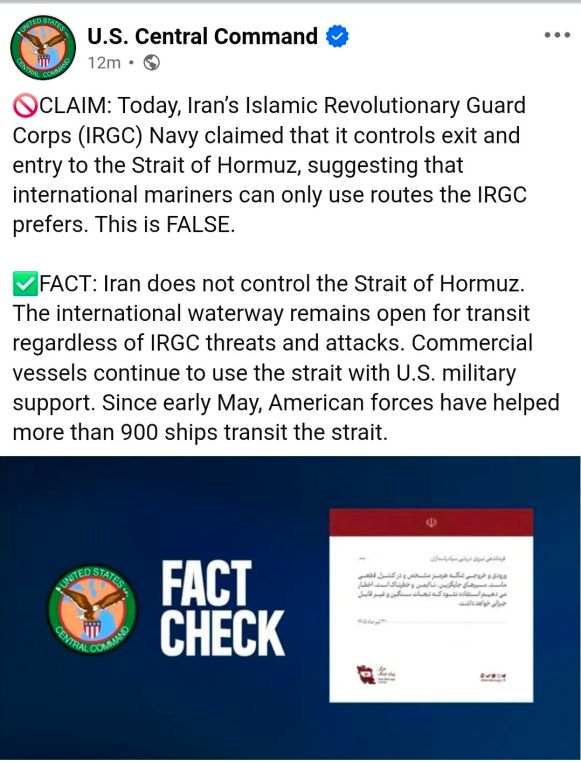
2. The underlying IRGC statement — the graphic recycles a ~18 July statement. The Persian text in the CENTCOM graphic (“entry and exit… under our definitive control; alternative routes unsafe and dangerous; heavy and irreparable consequences”) maps almost verbatim to an IRGC Navy statement documented around 18 July 2026: “The IRGC Navy said the entry and exit points of the Strait of Hormuz were under its firm control and warned vessels against using alternative routes, calling them unsafe and dangerous. ‘We warn against using them, as doing so will have severe and irreparable consequences.'” (Iran International) Sibling statements clustered 19–20 July (Press TV, 19 July: “control of the Strait of Hormuz is ‘fully’ in its hands… ‘not a single drop of oil, gas or chemical fertilizer’ would pass… vessels… entering unsafe routes ‘will certainly suffer an incident'”; and a Fars/SNN numbered communiqué on the “unsafe and accident-prone southern route”). No distinct, genuinely-new 31 Tir/22 July IRGC Navy statement with this wording could be located in Tasnim, Fars, IRNA, Mehr, SNN, or Press TV. Assessment: the IRGC wording is genuine but likely recycled/re-dated; treat the “31 Tir 1405” attribution on the graphic as unverified.
3. The IRGC’s claim of control is a genuine, sustained Iranian position — not a fabrication. Since Iran’s late-February closure, the IRGC Navy and Khatam al-Anbiya HQ repeatedly asserted “full/complete/smart control” of Hormuz, published a “control map” (4 May, distributed via Telegram), mandated coordination on VHF Channel 16, designated Iran-only routes, rejected the Oman/IMO southern route (25 June), (Al Jazeera) and enforced these claims kinetically. So CENTCOM’s characterization (“IRGC claimed that it controls exit and entry”) accurately reflects a real, repeated Iranian claim. HIGH confidence.
4. Strait-open status — CENTCOM’s “remains open” is legally true but operationally misleading. As of 21–22 July 2026, independent data showed a near-total diversion of traffic. Britannica summarizes: “Immediately after the outbreak of the 2026 Iran war, about 90 percent of traffic through the strait was diverted… When Iran threatened to attack ships days later, that number rose above 95 percent.” Live tracking (straits.live/IMF PortWatch) recorded “10 commercial vessels transited the Strait of Hormuz on JUL 12… 11% of the ~88/day pre-crisis typical,” and NY Post (citing Bloomberg) reported traffic “plummeted to an average of seven ships a day — just 5% of its regular traffic”; Kpler logged ~7–8 vessels on 16 July. IRGC attacks continued: three tankers hit near Oman on 20–21 July (two Greek-operated near Kumzar; a Kuwaiti state tanker near Limah), all transiting AIS-dark, per Windward and UKMTO. So while no recognized authority declared a legal closure and a designated southern lane technically remained usable, the practical reality was a contested, near-shut corridor — not “traffic is flowing” in any normal sense.
5. The “more than 900 ships since early May” figure — genuine but self-reported and contested. CENTCOM’s actual wording (20–21 July) was “approximately 900 commercial vessels and 450 million barrels of crude oil” (National Security Journal) since early May, (The Gateway Pundit) an escalating running tally (800/380M on 9 July → 800/400M on 12 July → 900/450M on 20–21 July). This is CENTCOM self-reporting with no published vessel-by-vessel methodology; it counts cumulative transits “helped facilitate” since early May, not current flow, and CENTCOM itself clarified (26 May) it was not escorting vessels (“Project Freedom has not resumed, and U.S. forces are not currently escorting commercial vessels through the Strait of Hormuz”) — the assistance is coordination/mine-information, not convoy escort. (JMIC’s own 6 March advisory noted it “has no indication that these vessels were escorted.”) The cumulative figure is not necessarily inconsistent with a current ~90% traffic diversion, but presenting it alongside “traffic is flowing” conflates a two-month cumulative total with present-day conditions. MODERATE-to-HIGH confidence the figure is authentically CENTCOM’s; LOW confidence it can be independently verified.
Details
Conflict context (why “since early May”). The 2026 Iran war began 28 February 2026 with US-Israeli strikes; Iran closed Hormuz in response. The US ran an air campaign (Operation Epic Fury) and a naval blockade of Iranian ports from 13 April. (Wikipedia) (Wikipedia) A ceasefire/MoU period in June briefly restored partial traffic before collapsing in early July, after which the US reinstated the blockade and resumed near-nightly strikes (the 22 July CENTCOM messaging coincided with the 11th consecutive night). “Since early May” corresponds to the start of US “Project Freedom” transit-assistance coordination (announced ~3–4 May) after the mid-April blockade. IRGC Navy commander Alireza Tangsiri was killed in an Israeli strike (26 March, confirmed by Iran 30 March); Rear Admiral Ali Azmaei succeeded him (announced ~4 July), so any current IRGC Navy statement is issued under Azmaei’s command.
Provenance of the graphic’s Telegram styling. The IRGC’s Hormuz messaging in this period was disseminated via Fars/Tasnim/SNN and IRGC-linked Telegram channels (the “control map” and numbered “اطلاعیه” [communiqué] statements appeared on SNN/Fars and Telegram). A Telegram-style logo/handle at the bottom-right of the CENTCOM graphic is consistent with CENTCOM screenshotting an Iranian war-messaging channel rather than an official IRGC Navy press page — which matters for provenance: the quoted text may be a channel’s rendering, not a verbatim official communiqué.
Independent data vs. CENTCOM framing. Lloyd’s List, Kpler, MarineTraffic, IMF PortWatch, and Windward all documented severe traffic diversion and repeated attacks through July. On the pre-crisis baseline, sources vary: IMF PortWatch uses ~88 vessels/day, Britannica cites “a historical daily average [of] 138 ships,” and Lloyd’s List “an average of more than 3,000 vessels transiting each month” — so the ~90–95% diversion holds against any of these baselines. War-risk pricing corroborated the collapse: per Xinhua (10 July 2026), quoting Lloyd’s Market Association’s Neil Roberts, “War-risk rates have moved as risk has moved… an uptick after three vessels were attacked this week,” with “shipowners now face[ing] hull war-risk premiums of around 5 percent of a vessel’s value” after having “fallen to about 2 percent following the U.S.-Iran MoU.” gCaptain reported premiums “surged to between three and ten percent of a vessel’s insured value” — meaning “for a $100 million tanker… a premium of roughly $250,000 [pre-crisis] and one running as high as $10 million for a single transit.” These are direct market measures that Hormuz was priced as a war zone, undercutting an unqualified “traffic is flowing.”
Analytic Verdicts (by discrete claim)
“IRGC Navy claimed it controls exit and entry to Hormuz” (CENTCOM’s characterization of Iran): TRUE. HIGH confidence. Iran repeatedly and explicitly made this claim. Source reliability: high (multiple independent outlets + Iranian state confirmation).
The specific Persian statement in the graphic is a genuine, new 22 July IRGC statement: UNVERIFIED / likely RECYCLED from ~18 July.
MODERATE-HIGH confidence it is not new. Flag: the “31 Tir 1405” dateline should not be reported as confirmed.
“Iran does not control the Strait of Hormuz”: PARTIALLY TRUE — true as to legal sovereignty (Iran has no right to bar transit passage under UNCLOS), FALSE-to-misleading as to de-facto operational control (Iran materially dictated routing and imposed costs via attacks).
MODERATE confidence; definitional.
“The international waterway remains open for transit”: PARTIALLY TRUE — no legal closure and a technically-usable southern lane existed, but commercial flow had collapsed ~90–95%. Presenting this as unqualified “open” is misleading. HIGH confidence on the collapse; MODERATE on interpretation.
“Commercial vessels continue to use the strait with U.S. military support”: TRUE but heavily qualified — a small, diminished number of vessels transited with US coordination (not escort).
MODERATE confidence.
“More than 900 ships since early May”: PLAUSIBLE / self-reported. Authentic CENTCOM messaging (actual phrasing “approximately 900… and 450 million barrels”); unverifiable independently; cumulative two-month figure, not current flow. MODERATE confidence in authenticity, LOW in independent verification.
Circular-reporting flags: (1) Many Western outlet reports of the “900 ships” and “traffic flowing” claims trace to a single CENTCOM statement — corroboration of what CENTCOM said, not of the underlying fact. (2) IRGC attack/”control” claims are frequently sourced only to Iranian state media (Tasnim/Fars/IRNA/Press TV), which are IRGC-affiliated; several IRGC claims (e.g., the “two tankers exploded on mines”) were disputed by CENTCOM and unverifiable independently. (3) UKMTO/JMIC advisories and Kpler/Lloyd’s/IMF PortWatch data are the most independent anchors and should be weighted above either belligerent’s messaging.
Recommendations
Treat the graphic’s “31 Tir/22 July” IRGC quote as unverified and probably recycled from ~18 July. Before citing it as a current statement, seek the original Persian communiqué (Fars/SNN numbered “اطلاعیه” or the IRGC Navy Telegram channel) and confirm its date. Threshold to revise: a primary Persian source with a 31 Tir 1405 dateline.
Do not report “900 ships” as verified fact. Attribute it precisely (“CENTCOM says… approximately 900… since early May”) and pair it with independent traffic data (Kpler/Lloyd’s List/IMF PortWatch/Windward) and war-risk premiums to convey actual conditions. Threshold to upgrade: a JMIC/Fifth Fleet published transit ledger with methodology.
Anchor any assessment on the independent triad — UKMTO/JMIC advisories, Kpler/MarineTraffic/IMF PortWatch AIS, and Lloyd’s war-risk pricing — rather than either belligerent’s messaging. These are the least circular indicators of ground truth.
Frame the exchange for consumers as an IO contest over perceived control, not a factual dispute with one right answer. Distinguish legal status (UNCLOS transit passage; Iran cannot lawfully close it) from operational reality (Iran coercively shaped transit and suppressed volume). Iran’s information objective is to sustain a deterrence/insurance-pressure narrative (“use only our route or suffer irreparable consequences”) that raises costs without continuous kinetic action; CENTCOM’s counter-objective is to deny that narrative and reassure markets and allies.
Watch these benchmarks to shift the assessment: a formal legal closure declaration; JMIC threat-level changes; sustained AIS traffic recovery above ~50/day; war-risk premiums falling back toward the pre-war ~0.2% (per Insurance Business, insuring a VLCC “cost roughly 0.2% of the vessel’s hull value” pre-crisis); or resumption/denial of US convoy escort (distinct from coordination).
Caveats
All events sit within the ongoing 2026 Iran war/Strait of Hormuz crisis timeline; figures are fluid and were changing daily around 20–22 July 2026.
X/Twitter and Facebook primary posts are largely gated; the CENTCOM wording is corroborated via multiple outlets quoting it, but the exact 22 July standalone-graphic dateline is not primary-source-confirmed.
Iranian state media (Press TV, Tasnim, Fars, SNN) present the IRGC’s framing and are IRGC-affiliated; their dates are useful, their characterizations are partisan. Western/US-government sources similarly carry the US framing.
Pre-crisis daily-traffic baselines differ by source (~88/day per IMF PortWatch; ~138/day per Britannica; ~3,000/month per Lloyd’s List); the ~90–95% diversion is robust to the choice of baseline.
Casualty/attack specifics (e.g., which tankers, crew status) are as reported by UKMTO/Windward/Reuters and may be revised. A claimed BBC Verify/NYT rebuttal of CENTCOM’s fact-checks could not be independently confirmed and is therefore not relied upon here.

You must be logged in to post a comment.