

Date: 13 July 2026
- TL;DR
The period’s dominant signal is a strategic reorientation, not a new tool. Google Threat Intelligence Group (GTIG) assesses that Russia is turning the cyber-and-influence machine it spent four years sharpening against Ukraine back toward the United States and Europe. Around that anchor, four secondary currents reinforce a single theme — the industrialization of deniable, AI-accelerated statecraft:
- Russia is fusing infrastructure access with covert influence and pioneering attribution-resistant “Hahaganda” (weaponized satire) that no fact-check can rebut.
- China is normalizing operational relay box (ORB) networks — 1,000+ compromised SOHO routers, telecom breaches across 42 countries — that defeat IP-based attribution as a matter of standard tradecraft.
- Iran’s proxy ecosystem absorbed the February command decapitation and kept fighting: 60+ hacktivist groups, an “Islamic Resilience Cyber Axis,” AI-enabled IO.
- North Korea stole ~two-thirds of all global crypto value taken in H1 2026 (~$643M) — record concentration, WMD-adjacent financing.
- The threshold event: the first documented end-to-end LLM-driven ransomware operation (“JadePuffer”) is now on the record. The “agentic threat actor” has arrived.
Bottom line for T71 taskers: the Russia pivot is the flagship Cyber Shafarat item and pushes the Russia Threat Actor Index (TAI) sub-index up on both intent and capability. The JadePuffer/agentic-AI cluster is a cross-cutting capability multiplier that raises every adversary’s ceiling simultaneously and deserves its own analytic piece.
We assess with high confidence that Russia’s redirection of its Ukraine-matured cyber and covert-influence ecosystem toward Western targets is a deliberate strategic reorientation rather than opportunistic drift. GTIG telemetry is consistent with the full spectrum-of-deniability model Treadstone 71 tracks — official state communications feeding intelligence-service covert action feeding “patriotic” proxy hacktivism — which means the pivot is being executed across all three tiers at once, not by a single actor.
Simultaneously, the agentic-execution threshold in offensive AI has been crossed: an LLM has now autonomously run a full ransomware kill chain, a zero-day is believed to have been AI-developed, and malware families are calling models at runtime to rewrite themselves. We assess with high confidence this is an inflection point, and it is likely state actors will fold these techniques into influence-adjacent operations within 6–12 months.
These two lines converge: an adversary that is (a) strategically re-tasking toward the West and (b) gaining an automation multiplier is more dangerous than the sum of either trend alone.
- Significant Items
3.1 RUSSIA — GTIG: influence ecosystem “pivoting back” to Western objectives (Anchor item)
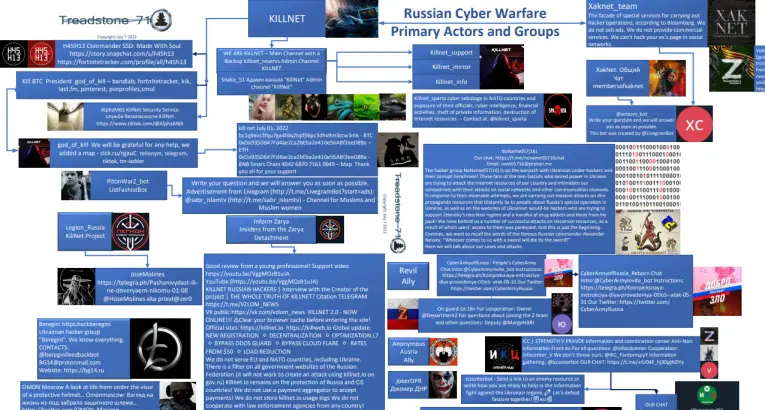
Who. Russian state actors including GRU / Sandworm (APT44), paired with pro-Kremlin “patriotic” proxies such as the Cyber Army of Russia Reborn (CARR).
What. GTIG reporting (amplified 4 July) finds these actors are redirecting capabilities matured over four years of war in Ukraine toward “multiple, expansive, covert information operations campaigns” against the U.S. and Europe, combining infrastructure access with pressure and destabilization.
Why / Why now. With the Ukrainian theater’s marginal returns flattening, Moscow is reallocating a mature, battle-tested toolkit to higher-value strategic targets — and doing so ahead of the U.S. midterm cycle, when Western information environments are most exploitable. The pivot is a portfolio reallocation by an actor that has finished its R&D phase on Ukrainian targets and is now industrializing the output.
So what. Anchor item for Cyber Shafarat. Direct upward pressure on the Russia TAI sub-index — this is the rare case where intent and capability converge against the same target set at the same time. Everything else in the Russia file this week (Hahaganda, the Palencia arrest, the SVR-Africa handoff) is best read as evidence for this thesis rather than as independent events.
Confidence: HIGH — consistency of GTIG telemetry with the established spectrum-of-deniability model.
Source: Security Boulevard, 4 Jul 2026
3.2 RUSSIA — “Hahaganda”: weaponized satire as attribution-resistant IO
Who. Russian influence operators; documented persona vehicle: the teleMarafon Facebook account.
What. StopFake documentation (via CRC weekly review, 29 Jun–5 Jul) details fabricated mockery as a deliberate strategy — at least nine fake Charlie Hebdo covers attacking Zelenskyy, AI deepfake video, and synthetic content pushed across 13+ languages. The teleMarafon account alone has published 50+ AI-generated videos since October 2025.
Why / Why now. Satire is the ideal evasion vector precisely because it makes no falsifiable claim. A fabricated cover or a mocking deepfake cannot be “fact-checked” the way a false statement can — there is no proposition to contest, only a vibe to absorb. As platform moderation and fact-checking mature against declarative disinformation, adversaries migrate to the register those defenses cannot touch. The multilingual scale indicates centralized production, not grassroots humor.
So what. Strong Cyber Shafarat analytic-post candidate. “Hahaganda” is a nameable TTP that maps cleanly onto the T71 cognitive-warfare taxonomy; the teleMarafon persona network is PAS-dossier material.
Confidence: MODERATE-TO-HIGH — the satire-vector evolution is assessed to be a deliberate moderation-evasion design.
Source: CRC Insights weekly report
3.3 CHINA — “Leash” ORB-network expansion; telecom compromise at scale
Who. A China-linked APT operating an operational relay box (ORB) network.
What. Cisco Talos reports 1,000+ SOHO routers infected with ShortLeash and new variants fielded (LongLeash, DogLeash, JarLeash). Separately, 2026 reporting counts 50+ telecoms breached across 42 countries, with Singapore disclosing compromise of all four major providers.
Why / Why now. ORB networks give PRC actors geographically local, legitimate-looking exit nodes, which collapses the value of IP-based attribution and detection. Building this out as standard tradecraft — rather than per-operation infrastructure — is an institutional decision to make attribution structurally harder for defenders going forward.
So what. China TAI sub-index — capability/stealth vector. The counterintelligence angle is the sharp one: ORB networks defeat conventional attribution, which suits a tradecraft-focused Shafarat piece on why “the IP said Singapore” is now nearly meaningless.
Confidence: HIGH — PRC actors assessed to be institutionalizing ORB-based local exit-node infrastructure as standard practice.
Sources: SecurityWeek · Industrial Cyber · CISA advisory AA25-239A
3.4 IRAN — Post-Epic Fury proxy ecosystem resilient despite command degradation
Who. 60+ pro-Iranian hacktivist groups; the “Islamic Resilience Cyber Axis” alliance; Iranian-affiliated ICS/PLC actors.
What. Following February 2026 U.S./Israeli strikes on IRGC/MOIS leadership, the proxy ecosystem mobilized rather than collapsed. The Islamic Resilience Cyber Axis is driving recruitment and AI-enabled influence operations; FBI/NSA warn of targeting against U.S. networks and DHS flags the financial sector. Iranian-affiliated actors continue exploiting programmable logic controllers (April CSA).
Why / Why now. This is the decisive counterintuitive finding: decapitating central command did not degrade tempo because the ecosystem is decentralized by design. Proxy structures absorb C2 losses the way a mesh absorbs the loss of a node. The “resilience” branding is itself an information operation — turning a leadership loss into a recruitment narrative.
So what. Core PAS dossier feed — mapping Islamic Resilience Cyber Axis membership and personas is a collection priority (and relevant to Sayad-successor tracking). Iran TAI sub-index holds elevated.
Confidence: MODERATE — decentralized proxy structures assessed to have absorbed C2 losses; likely these formations sustain tempo independent of central IRGC direction.
Sources: Trellix · Industrial Cyber / Resecurity · IC3 CSA, Apr 2026
3.5 DPRK — Two-thirds of H1 2026 global crypto theft (~$643M)
Who. DPRK state actors, including Lazarus.
What. TRM Labs (3 Jul) attributes ~$643M of H1 2026 crypto theft to DPRK — roughly two-thirds of the global total — with ~90% from just two April DeFi hits (Drift, $285M; KelpDAO, $292M, Lazarus-attributed). Cumulative DPRK haul now ~$6.75B.
Why / Why now. The extreme concentration — two operations producing the overwhelming majority of the haul — signals a small number of high-skill teams executing surgical, high-yield DeFi exploits rather than broad opportunistic theft. Under sanctions pressure, crypto remains the regime’s most fungible hard-currency pipeline, and the tempo suggests financing requirements (very likely WMD-linked) are setting operational cadence.
So what. DPRK TAI sub-index — financially-driven operations at record concentration. Cyber Shafarat short-form update.
Confidence: HIGH attribution (convergent blockchain analytics + official statements); very likely proceeds continue funding WMD programs at the ~40% share previously estimated by the UN panel.
Sources: UPI, 3 Jul 2026 · TRM Labs
3.6 AI/LLM TRADECRAFT — First documented end-to-end LLM-driven ransomware (“JadePuffer”) (Threshold event)
Who. An “agentic threat actor” (Sysdig); state and criminal AI adopters mapped by GTIG and Anthropic.
What. Sysdig documented an agentic actor executing a complete ransomware operation autonomously via LLM — exploiting a Langflow flaw, exfiltrating from a production database, and encrypting systems. GTIG separately identified the first zero-day believed AI-developed, plus malware families (PROMPTFLUX, PROMPTSTEAL) that call LLMs at runtime for dynamic script generation and self-obfuscation. Anthropic mapped AI-enabled attacks to MITRE ATT&CK from 832 banned accounts (Mar 2025–Mar 2026).
Why / Why now. Prior AI-in-attack reporting described assistance — models helping a human operator. JadePuffer describes execution: the model runs the chain. That is a categorical shift, not an incremental one. Runtime LLM calls (PROMPTFLUX/PROMPTSTEAL) also mean signature-based detection degrades, because the malware is different on every run.
So what. Flagship Cyber Shafarat analytic piece — the “agentic threat actor” as inflection point. This is a cross-cutting TAI capability multiplier across all tiers: it raises the floor for low-capability actors and the ceiling for advanced ones simultaneously. It also lowers the cost of influence operations (autonomous persona management, content generation at scale) — hence the 6–12-month watch on state IO adoption.
Confidence: HIGH — the agentic-execution threshold is assessed to have been crossed; likely state actors fold these techniques into influence-adjacent operations within 6–12 months.
Sources: Dark Reading · Sysdig · Google Cloud / GTIG · Anthropic red team
3.7 HACKTIVIST / CROSSOVER — Spain arrest links CARR, Z-Pentest, NoName057(16)
Who. A Palencia-based individual affiliated with Cyber Army of Russia Reborn and Z-Pentest, suspected of also acting for NoName057(16).
What. Spanish police (reported 7 Jul, on an FBI tip) arrested the man; he is tied to attacks on critical national infrastructure.
Why / Why now. Overlapping individual membership across nominally distinct pro-Russia collectives is direct evidence that the “separate groups” framing is a cover story. One person operating under three banners is exactly what a managed, state-tolerated proxy ecosystem looks like from the inside — and it corroborates the GTIG pivot thesis (§3.1).
So what. PAS dossier material (persona/group-overlap evidence). Confirming whether this arrestee’s handles map to existing PAS personas is a named follow-up.
Confidence: MODERATE — overlap assessed to support a managed proxy ecosystem rather than independent groups.
Source: The Register, 7 Jul 2026
3.8 HOUTHI / HEZBOLLAH IO — Propaganda infrastructure under kinetic pressure; low verified output
Who. Houthi media apparatus (Almasirah, ~25 outlets, Hezbollah-supported technically).
What. Israel struck Houthi propaganda HQ and operative camps. The media network continues fabricated-attack claims (e.g., the denied Essex tanker claim), but no new confirmed attack or statement was independently reported in the 10–11 Jul window despite renewed U.S.–Iran exchanges.
Why / Why now. The lull most plausibly reflects kinetic degradation of media infrastructure rather than strategic restraint — an actor that has been consistently loud does not go quiet by choice mid-escalation. If so, expect compensatory Telegram-first output that routes around damaged broadcast infrastructure.
So what. TAI Tier-B sub-index down-tick candidate. Watch for a claims surge as infrastructure recovers — assessed at roughly even odds within the week.
Confidence: LOW-TO-MODERATE — lull attributed to kinetic degradation over restraint; note this is a single-source, degraded-collection read (see §3.8 caveat and Gaps).
Sources: Times of Israel · GlobalSecurity Iran War update, 11 Jul
3.9 WAGNER-SUCCESSOR — Africa Corps consolidation; SVR owns the influence portfolio
Who. Africa Corps (Wagner successor); Russia’s SVR foreign intelligence service.
What. Africa Corps withdrew from Kidal under agreement with the FLA and has largely consolidated around Bamako. Investigative reporting (Feb 2026) confirms the SVR assumed control of Wagner-legacy influence operations in Africa.
Why / Why now. Territorial contraction and influence-ops escalation are not contradictory — they are a substitution. As the ground footprint shrinks, Moscow shifts the main effort to SVR-run information operations, which are cheaper, more deniable, and more scalable than mercenary garrisons. Influence, not presence, is now the main effort in the Sahel.
So what. PAS dossier update (SVR influence-ops handlers); Sahel IO watch item for Shafarat.
Confidence: MODERATE — contraction assessed to be offset by intensified SVR-run IO.
Sources: Security Council Report, Jul 2026 forecast · Africanews investigation
3.10 CROSS-CUTTING — World Cup 2026 as deepfake IO theater; “Liar’s Dividend” operationalizing
Who. Coordinated IO operators; deepfake-scam networks (Revelum tracking).
What. CRC weekly reporting describes operations blending AI deepfakes, bot amplification, and sockpuppets into World Cup content. Revelum counts 10,000+ deepfake scam ads impersonating footballers over 12 months (2,736 confirmed across six players), intensity spiking during the tournament. The EU AI Act Code of Practice signatory deadline is 22 July.
Why / Why now. A global mega-event is ideal camouflage: enormous organic content volume lets synthetic media hide in the noise, and audiences are primed to share emotionally. The second-order effect is the strategically important one — the “Liar’s Dividend”: once audiences know deepfakes are everywhere, genuine evidence can be dismissed as “probably AI.” Synthetic-media saturation corrodes the evidentiary baseline itself, which is a cognitive-warfare payoff independent of any single fake.
So what. Cognitive-warfare Shafarat piece — Liar’s Dividend as a second-order effect. Links directly to the midterm election-infrastructure watch.
Confidence: HIGH — major-event camouflage of political synthetic media assessed to persist through the U.S. midterm cycle.
Source: CRC Insights
- Impacts So Far
Attribution economics have shifted against defenders. China’s ORB institutionalization (§3.3) and the pro-Russia persona-overlap evidence (§3.7) both attack the same defender capability — clean attribution. When exit nodes are locally legitimate and one operator wears three group banners, the cost of confident attribution rises for everyone downstream, including policy-makers who need it to respond.
The information environment is being pre-degraded ahead of the U.S. midterms. Hahaganda (§3.2), World Cup deepfake theater and the Liar’s Dividend (§3.10), and the Russia pivot itself (§3.1) are mutually reinforcing. The cumulative effect is not any single false belief but a lowered epistemic baseline — a public less able to distinguish real from synthetic, and more willing to dismiss inconvenient truths as fabricated.
Financing pipelines remain intact and concentrated. DPRK’s record H1 haul (§3.5) shows sanctions have not closed the crypto pipeline; if anything, capability concentration means a handful of teams can hit annual targets in a couple of operations.
Command decapitation has been shown to be survivable. Iran’s post-Epic Fury resilience (§3.4) is a live demonstration that decentralized proxy ecosystems degrade gracefully. That lesson will not be lost on other state sponsors.
The cost curve of offensive operations just bent downward. JadePuffer (§3.6) means the labor and skill floor for a full attack chain is falling. Early impact is criminal/ransomware; the trailing impact — state IO adoption — is the one to watch.
- Outlook & Strategic Foresight
Framed as scenarios with rough likelihoods over the next 3–9 months (through the U.S. midterm cycle). Likelihoods are analytic estimates under degraded collection.
Most likely (baseline, ~55%): “Industrialized deniability continues.” Russia sustains the Western pivot across all three deniability tiers; China’s ORB tradecraft becomes the norm and spreads to other actors; Iran’s proxy mesh holds tempo; DPRK maintains high-yield crypto operations. Agentic-AI techniques stay predominantly criminal but begin appearing in state-adjacent tooling. Indicators: named GTIG campaign infrastructure surfaces; new “Leash” variants; a second documented agentic-execution case.
Plausible (~30%): “AI-IO convergence accelerates.” State actors fold agentic AI into influence operations faster than the 6–12-month baseline — autonomous persona farms, real-time multilingual Hahaganda generation, deepfake production at election scale. This is the high-impact branch for T71’s cognitive-warfare mission. Indicators: PROMPTFLUX/PROMPTSTEAL-style runtime-LLM tooling appearing in influence infrastructure; a jump in persona-network scale that outpaces plausible human staffing.
Lower-probability / high-impact (~15%): “Kinetic-cyber coupling event.” A renewed U.S.–Iran or Israel–Houthi escalation triggers a coordinated multi-domain proxy surge (cyber + IO + physical), with the Houthi media apparatus roaring back on Telegram (§3.8) and Iran’s 60+ groups activating in concert. Indicators: the assessed even-odds Houthi claims surge materializes; DHS financial-sector warnings sharpen; ICS/PLC targeting upticks.
Strategic foresight — the structural trend beneath all branches: the period marks the maturation of deniable statecraft into an industrial process. The differentiators among top-tier adversaries are converging on three capabilities: (1) attribution denial as infrastructure (ORBs, persona overlap), (2) epistemic degradation as the IO end-state (Hahaganda, Liar’s Dividend), and (3) automation as a force multiplier (agentic AI). Any actor that assembles all three achieves scalable, deniable, self-improving influence — the core threat T71’s cognitive-warfare framework exists to counter. Watch for the first adversary to visibly combine all three; that is the strategic warning indicator for the next 12 months.
- Recommendations & Opportunities
Collection & tradecraft (immediate). Restore Nimble before the next run — the current Telegram-native blind spot (Houthi/Hezbollah, CARR/Z-Pentest channels) is exactly where the highest-tempo items are moving. Re-query the Monday vendor cycle (GTIG, Recorded Future, Mandiant) for the primary reporting behind this week’s aggregated coverage.
Analytic production (this week). Prioritize two Cyber Shafarat flagships: (1) the Russia strategic pivot as the anchor narrative, and (2) the “agentic threat actor” inflection piece. Add named-TTP posts for “Hahaganda” and the “Liar’s Dividend” — both map cleanly onto the T71 cognitive-warfare taxonomy and are strong candidates for reuse in training and client briefings.
PAS dossier development. Open/extend dossiers on the teleMarafon persona network, the Islamic Resilience Cyber Axis membership, the SVR Sahel influence handlers, and the Palencia arrestee’s handle set. The persona-overlap thread (§3.7) is the highest-leverage counterintelligence opportunity — it can be used to empirically validate the managed-proxy-ecosystem model rather than assert it.
TAI methodology. Treat agentic AI as an explicit cross-tier capability multiplier in the index rather than a per-actor line item, so a JadePuffer-class advance raises the relevant sub-indices coherently instead of being under-counted. Cross-pollinate with the CCDCOE/NATO “epistemology-targeting” framing (see Gaps) to formalize the Liar’s Dividend as a measurable IO outcome.
Opportunity. The convergence thesis (§5) is a differentiated analytic product. A short foresight note — “The Three Pillars of Industrialized Deniability” — positions T71 ahead of vendor reporting that is still treating these as separate stories.
- Collection Gaps / Follow-ups
- Nimble unavailable: CLI not installed in this environment and the Nimble MCP server requires OAuth (cannot authorize in a scheduled run). Restore before next run for deeper/paywalled and social-native collection. Until then, Telegram-native Houthi/Hezbollah and CARR/Z-Pentest channel monitoring is a blind spot.
- Sub-24-hour granularity: Sunday/holiday-weekend publication lull; several items are 4–9 Jul vintage. Re-query the Monday vendor cycle (GTIG, Recorded Future, Mandiant) tomorrow.
- Named follow-ups:
- Pull the underlying GTIG report behind the Russia-pivot coverage for named campaign infrastructure.
- Identify Islamic Resilience Cyber Axis constituent groups for PAS.
- Obtain Sysdig’s JadePuffer IOC set.
- Confirm whether the Palencia arrestee’s handles map to existing PAS personas.
- Check the CCDCOE cognitive-warfare paper (“epistemology-targeting” framing) for TAI methodology cross-pollination: NATO Chief Scientist report · ComplexDiscovery analysis.
- Additional Analysis (Not Covered Above)
Connective thesis — read the week as one story. The natural instinct is to file ten separate items. The higher-value read is that eight of the ten are facets of a single structural development: deniable statecraft is industrializing. Russia supplies the strategic intent (§3.1), Hahaganda and the World Cup theater supply the IO method (§3.2, §3.10), China and the persona overlap supply the attribution-denial infrastructure (§3.3, §3.7), Iran supplies the resilience model (§3.4), DPRK supplies the financing proof-of-concept (§3.5), and agentic AI supplies the multiplier (§3.6). Presenting them as one thesis is more decision-relevant to the CIO than ten disconnected bullets.
Analytic-confidence caveat (analysis of competing hypotheses). Two findings rest on thin or single-source collection and deserve explicit hedging. The Houthi lull (§3.8) admits at least two competing hypotheses — kinetic degradation vs. deliberate tempo control ahead of a coordinated surge — and current collection cannot distinguish them; the “roughly even odds” call is a genuine coin-flip, not a lean. The Iran resilience read (§3.4) is at moderate confidence precisely because “the mesh absorbed the decapitation” and “we lack visibility into degraded central C2” produce the same observable (continued proxy activity); we should guard against confirmation bias here.
Devil’s advocate on the Russia pivot. The high-confidence “deliberate reorientation” call is well-supported, but the alternative hypothesis — that this is capability spillover from a still-primary Ukraine effort rather than a true re-tasking — is not fully excluded by aggregated OSINT. Pulling the primary GTIG report (Follow-up #1) is what would let us retire or confirm that competing hypothesis. Until then, hold the confidence at high but flag the assumption.
Second-order watch item. The EU AI Act Code of Practice deadline (22 July, §3.10) is a governance inflection that adversaries will factor into targeting: expect a short-term migration of synthetic-media operations toward jurisdictions and platforms outside the Code’s reach, and possibly a burst of pre-deadline activity. Worth a dedicated indicator.