



Moscow faces severe financial strain. The Institute of National Economic Forecasting of the Russian Academy of Sciences (INP RAS) recently proposed cutting pension spending. The state lacks the money to cover basic needs. War in the Middle East drove oil prices up temporarily. The temporary cash flow fails to cover systemic deficits (INP RAS, 2026).
Forensic linguistics and stylometrics applied to the INP RAS statement reveal panic hidden within bureaucratic language. Phrases like “significant change in the structure of spending” function as euphemisms for slashing citizen support. Adversary claims from state media project confidence. Verified financial data shows a shrinking treasury (Accounts Chamber, 2025). We evaluated the economic deterioration.
Pension Reductions and State Deficits
The government planned to allocate 4 trillion rubles to the Pension and Social Insurance Fund (SFR) last year. The Accounts Chamber reports the fund received only 3.2 trillion rubles. The transfer dropped 37.4 percent. The INP RAS demands further cuts. Forty million pensioners rely on the payments. Intelligence analysts assess a highly likely outcome where pension reductions increase domestic poverty.
Internal Revenue Collapse
Non-oil and gas revenues show severe instability. April corporate profit taxes fell one third compared to the previous year (INP RAS, 2026). A stronger ruble reduced import taxes, including VAT and customs duties. The state increased the domestic VAT rate. The VAT hike failed to offset collapsing oil and gas revenues. Anomaly analysis detects a widening gap between state financial obligations and actual tax receipts.
Link and technical analysis reveals direct connections between the military-industrial complex and the drained extra-budgetary funds. Evidence indicates a highly likely prospect of strict budget consolidation over the next three years.
Public Compliance and Threat Analysis
Citizens watch the economy fail. They offer no resistance. The Treadstone 71 Cultural Nexus Framework explains the passive compliance. The state operates a cognitive army. Cyber psychological operations influencing through strategy shape public perception. Infused with AI, state messaging frames poverty as a patriotic sacrifice. Integrated behavioral threat analysis shows citizens internalize state narratives. The population prioritizes national survival myths over personal financial security. The regime applies a strict formula to control the public: detect analyze expose counter and contain.
Semiotic analysis of state messaging reveals a shift. Early war propaganda promised quick victory without domestic cost. Current messaging demands endurance and sacrifice. Stylometric analysis of official broadcasts confirms an increase in survivalist vocabulary. The social contract between Vladimir Putin and the Russian people shattered. The state no longer guarantees rising living standards. Citizens remain complicit through silence and fear. Strategic intelligence confirms systemic failures.
Systemic Forecasts
The economic structure faces a collapse timeline. The adaptive cyber intelligence lifecycle built for disruption driven by foresight indicates structural failure requires drastic interventions. The state will extract more wealth from private citizens. Experts assess almost certain probabilities that the Kremlin will raise taxes again. Pension indexing will fail to match real inflation. Salaries for public sector workers will stagnate.
- Social: Rapidly declining living standards. Increased reliance on depleted savings (INP RAS, 2026).
- Technological: Decreased funding for domestic modernization (Accounts Chamber, 2025).
- Economic: Systemic revenue shortfalls. Corporate profit collapse.
- Military: Defense spending drains domestic budgets.
- Political: Bureaucratic infighting over shrinking resources. INP RAS challenges Kremlin promises.
- Legal: State mandates override individual financial rights.
- Environmental: Infrastructure decay accelerates due to funding cuts.
- Security: Internal police forces receive priority funding over pensioners.
The regime enforces budget cuts while hiding the true cost of the war. Citizens pay the price through slashed social services. The foundation of the Russian economy rots from within.
Pension Transfer Deficit
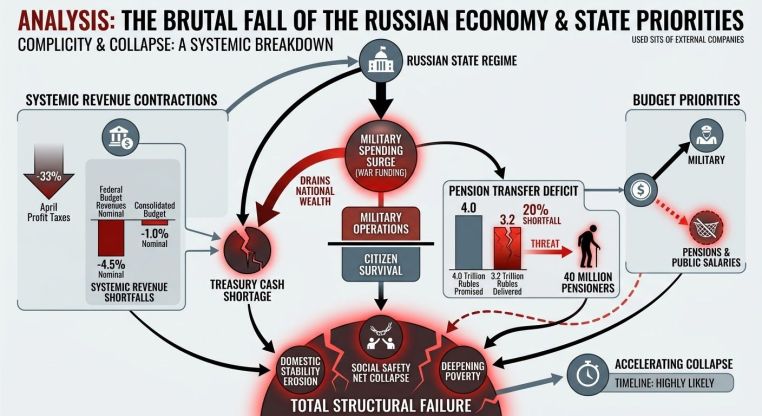
The state promised 4.0 trillion rubles to the Pension and Social Insurance Fund. The treasury delivered only 3.2 trillion. A 20 percent shortfall directly threatens 40 million pensioners. The missing funds reveal severe internal cash shortages. Intelligence analysts rank the probability of continued pension cuts as highly likely.
Systemic Revenue Contractions
Broad economic indicators show deep contraction. April profit taxes dropped 33 percent compared to the previous year. Federal budget revenues fell 4.5 percent nominally. The consolidated budget shrank 1.0 percent. The data confirms the VAT hikes failed to rescue the treasury. The numbers indicate a highly likely scenario of further tax increases.
Crisis Structure Analysis
Link and aggregation analysis maps the structural breakdown. Military spending surges drain national wealth. The state cuts public salaries and pensions to fund the war. Shrinking corporate taxes and a drop in import duties compound the deficit. The network visualization proves the regime prioritizes military operations over citizen survival. The timeline for total structural failure accelerates.

You must be logged in to post a comment.