


The Paradigm Shift in Identity-Centric Defensive Cyber Operations and Threat Intelligence
The evolution of enterprise cyber defense has increasingly recognized a fundamental truth regarding modern adversarial tradecraft: threat actors do not merely exploit network perimeters; they exploit enterprise identities. Within complex Active Directory and Microsoft Entra ID environments, privilege escalation and lateral movement are typically achieved by navigating an intricate, graph-theoretical web of access rights, group memberships, and object relationships. This sequence of exploitation is foundational to the identity snowball attack model, a conceptual framework initially introduced by researchers such as Dunagan et al., which maps the precise network sequences allowing adversaries to gain access to higher-privilege nodes starting from a low-privilege entry point.
Traditionally, defensive deception technologies relied on structural and network-based honeypots—heavyweight, isolated decoy servers or synthetically generated network segments designed to lure attackers. While conceptually sound in legacy environments, these traditional implementations frequently suffer from exceptionally high resource overhead, continuous patching and maintenance requirements, and, most critically, a high probability of evasion. Sophisticated threat actors utilizing advanced intelligence analysis methods and heuristic profiling can readily differentiate between isolated network honeypots and deeply integrated production assets. An isolated decoy server often fails to intersect the organic attack paths of least resistance that adversaries map out using modern telemetry tools. In modern intrusion scenarios, attackers often achieve their objectives with as few steps as possible, leveraging existing paths such as a HasSession link from a compromised SharePoint administrator directly to a Domain Controller. In such a scenario, searching for a synthetic password file on an isolated honeypot share represents an illogical deviation from the attacker’s optimal path.
F4keH0und, an open-source PowerShell security framework developed by the Czech Republic-based DEF-CON Group 420 (specifically authored by researchers Ondrej Nekovar and m3c4n1sm0), represents a structural paradigm shift in this domain. Rather than constructing isolated fake infrastructure, F4keH0und operationalizes deception as code, deploying lightweight, highly believable identity lures directly onto the established attack paths within live production environments. By ingesting and analyzing telemetry from BloodHound—an influential industry-standard adversarial graph visualization tool that utilizes graph theory to reveal hidden privilege relationships—F4keH0und conceptually reverse-engineers the attacker’s reconnaissance methodology. It strategically places decoys where they are mathematically and operationally most likely to be engaged, effectively poisoning the very intelligence that threat actors rely upon for lateral movement.
This comprehensive report applies critical thinking and intelligence analysis methodologies to evaluate F4keH0und. It provides an exhaustive technical and strategic assessment of the framework, evaluating its core specifications, functions, capabilities, threat modeling implications, use cases, and its position within the broader ecosystem of Active Directory deception, threat intelligence, and adversary emulation.
Intelligence Analysis Methodologies Applied to Active Directory Deception
To fully understand the tactical value of F4keH0und, its capabilities must be analyzed through the lens of formal intelligence analysis methods, specifically analyzing adversarial collection capabilities and the analysis of competing hypotheses. When an advanced persistent threat establishes an initial foothold within an enterprise network, their immediate operational priority shifts from exploitation to internal reconnaissance and intelligence gathering. The standard operating procedure for modern adversaries involves the execution of LDAP enumeration tools, most notably the SharpHound data collector, which runs a multitude of LDAP queries to collect comprehensive structural information regarding Active Directory objects, sessions, and access control lists.
From an intelligence perspective, this reconnaissance phase is historically difficult for defenders to detect with high fidelity. Active Directory is designed to be queried; any authenticated domain user possesses the inherent right to interrogate the directory structure to locate resources. Consequently, traditional Security Information and Event Management platforms often struggle with the signal-to-noise ratio during LDAP enumeration, as the malicious queries closely resemble legitimate administrative or application-driven directory searches.
F4keH0und applies counter-intelligence principles to this dynamic. Instead of attempting to block the reconnaissance—which is architecturally unfeasible without breaking enterprise functionality—the framework focuses on intelligence pollution. F4keH0und ingests the exact same graph data that an attacker would collect using SharpHound or AzureHound. It then analyzes this data to identify the highly specific misconfigurations, dormant accounts, and privilege chains that an adversary is mathematically guaranteed to target based on their operational doctrines. By placing deceptive artifacts directly within these high-probability attack vectors, defenders transition from passive monitoring to active deception, forcing the adversary to consume poisoned intelligence. When the attacker subsequently attempts to operationalize this intelligence by requesting a service ticket or modifying a group membership, they trigger a high-fidelity tripwire. Because there is absolutely no legitimate operational reason for any user to interact with these strategically placed, dormant identity lures, the resulting alert is devoid of false positives, providing immediate, actionable intelligence to the defending security operations center.
Architectural Specifications and the Defeat of the RID Anomaly
The architecture of F4keH0und is meticulously engineered to solve two of the most persistent technical challenges in identity-based deception technology: deployment friction and algorithmic decoy believability. The framework achieves this through a novel algorithmic mechanism known as the recycling-first engine, coupled with a robust system of programmatic safety controls designed to protect the integrity of the production directory.
The Recycling-First Engine and Heuristic Evasion
A critical vulnerability in traditional identity deception deployments is the Relative Identifier Increment Anomaly. In a Microsoft Windows Active Directory environment, every user, group, and computer object is assigned a unique Security Identifier. The final segment of this identifier is the Relative Identifier, which the domain controller issues in a strict, chronological, sequential order. When security teams attempt to create a brand-new decoy account but manually configure its attributes to masquerade as an old, stale, or legacy account—a common tactic to make the account appear vulnerable, unmonitored, or forgotten—the newly generated, highly sequential Relative Identifier fundamentally contradicts the account’s purported age.
Advanced threat actors, as well as automated adversarial reconnaissance platforms, are programmed to algorithmically identify this chronological discrepancy. Security research into domain identifiers, such as the insights pioneered by practitioners like JD Crandell, highlights this specific mismatch as a primary indicator of compromise for red teams evaluating defensive network topologies. An account that presents a creation date from a decade ago but possesses a Relative Identifier that was issued mere hours ago immediately flags the asset as a synthetic honeypot, compromising the entire deception operation.
F4keH0und bypasses the Relative Identifier increment anomaly entirely through its proprietary recycling-first engine. Rather than synthesizing net-new objects that generate fresh identifiers, the framework utilizes PowerShell to parse the existing Active Directory structure for genuine, deeply stale, disabled, or abandoned objects. It then procedurally reconfigures these genuine legacy objects into active deception lures. By repurposing existing Active Directory entities, F4keH0und inherently preserves the object’s original, historically accurate Relative Identifier alongside its authentic creation timestamp and security history. This technique, formally referred to in advanced tradecraft as Active Directory object recycling, preserves absolute operational realism. The resulting decoy is algorithmically and heuristically indistinguishable from legitimate organizational detritus, successfully neutralizing adversarial detection mechanisms.
http://googleusercontent.com/assisted_ui_content/1
The Algorithmic Staleness Scoring Matrix
To systematically identify the most optimal candidates for object recycling, F4keH0und utilizes a proprietary mathematical algorithm known as the staleness scoring matrix, which evaluates objects and assigns a rank from zero to one hundred. This heuristic scoring evaluates multiple organizational vectors simultaneously to ensure that the selected object can be safely repurposed without disrupting hidden enterprise dependencies. The algorithm parses timestamp-prefixed JSON outputs from the SharpHound collector and evaluates the age and inactivity of the object, measuring the precise duration since the account’s last successful authentication event or password reset.
Furthermore, the matrix assesses group isolation parameters. It maps the object’s current integration into functional business units and directory structures; objects that exhibit high degrees of isolation are mathematically preferred, as they are significantly less likely to disrupt automated production processes or legacy application authentications if their attributes are modified. Additionally, the algorithm evaluates directory object metadata, specifically focusing on description emptiness. Accounts featuring extensive, well-documented description fields are frequently active service accounts or deliberately tracked administrative assets, whereas completely empty metadata fields strongly suggest abandoned, orphaned, or unmanaged objects that are prime candidates for deceptive repurposing.
By executing the provided PowerShell cmdlets—specifically the Find-F4keH0undRecyclableObject and Find-F4keH0undOpportunity functions—defenders query the graph collector output to aggregate this data. The framework then processes this telemetry to emit highly structured opportunity objects, explicitly ranked by their calculated staleness score and their contextual placement within the directory hierarchy. In the event that the framework’s baseline filters fail to identify adequate recycling candidates, security administrators possess the capability to manually tune the algorithmic parameters. By modifying the primary JSON configuration file, operators can adjust variables such as the minimum object age in days or the maximum object age in days to carefully widen the acceptable age window and expand the candidate pool.
Technical Configuration, Safety Safeguards, and Deployment Controls
Modifying production Active Directory objects intrinsically introduces significant operational risks. Unintended modifications to critical accounts can precipitate cascading authentication failures, service outages, or the inadvertent severing of trust relationships. Recognizing these severe implications, the authors of F4keH0und engineered the framework to be safe by default, incorporating an extensive architecture of strict programmatic blocklists and interactive consent gates to prevent catastrophic enterprise misconfigurations.
Robust Exclusion Methodologies and Configuration Specifications
The F4keH0und deployment architecture is governed by a highly configurable central JSON file, which allows security operations teams to establish immutable safety boundaries before the framework executes any write operations against the domain controller. The framework utilizes a built-in regular expression blocklist, specifically governed by the protected user patterns array, which categorically prevents the recycling engine from analyzing, scoring, or interacting with highly sensitive network entities.
By default, these unalterable blocked targets include the built-in domain Administrator account, the crucial Key Distribution Center Service account, Microsoft Online synchronization accounts, and Azure Active Directory integration service accounts. Attempting to modify or recycle these specific accounts could catastrophically sever cloud synchronization pathways or invalidate the fundamental Kerberos ticketing structures across the entire enterprise.
Beyond explicit pattern matching, the framework implements structural exclusions through the excluded organizational units array. This allows administrators to define wide-ranging, wildcard-based exclusion zones within the directory tree, ensuring that organizational units housing executive profiles, highly privileged users, or the domain controllers themselves remain strictly untouched by the automated recycling engine. The safety mechanisms also evaluate longitudinal password chronologies; any accounts exhibiting recent password changes within a defined timeframe are immediately excluded from the candidate pool to provide an operational safety buffer against repurposing an account that may be undergoing active provisioning or recovery. Furthermore, accounts that already reside within designated privileged groups are automatically skipped to eliminate the risk of inadvertently weaponizing an already potent identity by exposing it as a decoy.
To provide maximum oversight over the deployment lifecycle, F4keH0und mandates explicit, interactive user consent. The primary deployment cmdlet—New-F4keH0undDecoy—features comprehensive support for the standard PowerShell safety parameters, ensuring that the tool adheres to best practices for enterprise script execution. The framework provides a guided workflow allowing operators to manually review, select, and explicitly confirm all proposed decoys before a single byte of directory data is altered; the documentation emphasizes that absolutely nothing changes without explicit administrative approval. Following a successful deployment cycle, the framework automatically generates a structured comma-separated values handover report directly to a specified output path, ensuring all newly established deceptive tripwires are properly documented, cataloged, and integrated into the incident response correlation engines utilized by the security operations center. Additionally, the architecture includes a clean removal function, allowing defenders to cleanly reverse all implemented changes and safely strip any modified group memberships when a decoy is no longer operationally required.
Configuration Parameter
Functionality and Operational Impact
Default Application
PreferRecycling
Instructs the framework to prioritize existing stale objects over creating net-new objects, preserving the integrity of the Relative Identifier to evade heuristic adversarial detection.
True
MinimumObjectAgeDays
Establishes the baseline age threshold an Active Directory object must meet before it can be considered a valid candidate for the staleness scoring matrix.
365 Days
ProtectedUserPatterns
A regular expression array that categorically blocks the framework from interacting with highly sensitive entities, such as the Key Distribution Center Service or cloud synchronization accounts.
ExcludedOUs
Defines structural exclusion zones within the directory tree, ensuring that specific organizational units housing critical infrastructure or executive accounts are never analyzed or modified.
RequireDisabledAccounts
Enforces a strict safety policy requiring that any potential recycling candidate must already be in a disabled state within the directory before it can be repurposed into a deceptive lure.
True
Deep Dive into Tactical Decoy Capabilities and Counter-Reconnaissance
F4keH0und categorizes its deployable deceptive artifacts into highly specific tactical classes, with each class meticulously mapped to intercept the most prevalent adversarial techniques utilized during post-breach directory enumeration and lateral movement. By analyzing the JSON outputs generated by the BloodHound collector, the framework identifies the exact structural misconfigurations an adversary actively seeks and subsequently creates lures that perfectly match those specific profiles. The framework currently supports five established tactical decoy types for on-premises Active Directory environments, alongside a dedicated extension module designed specifically for cloud identity infrastructure.
The Stale Administrative Lure
The primary decoy deployed by the framework is the stale administrative lure, which carries a critical threat ranking. This particular decoy is engineered to target adversaries conducting broad reconnaissance for abandoned, historically privileged accounts that possess residual access rights. The F4keH0und engine locates a disabled, formerly privileged user account—for example, an object residing in a legacy organizational unit—and executes its recycling protocols.
Following the recycling process, the account is physically positioned near highly sensitive security groups within the directory hierarchy to serve as a high-value honey account. Because the recycled account is inherently dormant and possesses no legitimate ongoing business function, it should never generate network traffic. Therefore, any authentication attempt, password spraying activity, or targeted Kerberos ticket request directed at this specific object serves as a high-fidelity indicator of malicious intent, virtually eliminating the false-positive noise that plagues standard security information and event management alerting platforms.
Countering Offline Cryptographic Attacks
Kerberoasting is an advanced, offline password cracking technique frequently utilized by threat actors targeting Active Directory service accounts. In this attack methodology, adversaries request a Kerberos Ticket Granting Service ticket for any domain account that has a registered Service Principal Name. Because parts of the ticket are encrypted using the target account’s password hash, the attacker can extract the ticket and subject it to offline brute-force cracking to recover the plaintext credentials.
F4keH0und automates the defense against this pervasive technique through the deployment of the kerberoastable user decoy, designated with a high threat ranking. The framework recycles a stale user object and intentionally appends a highly tempting, synthetically generated Service Principal Name, such as a localized Microsoft SQL server service designation. The moment an adversary utilizes standardized offensive tooling, such as Impacket or Rubeus, to blindly request a service ticket for this specific synthetic principal name, an immediate cryptographic alert is generated. This creates an invisible, highly effective tripwire wrapped entirely around the cryptographic mechanisms of the domain environment.
Mitigating Delegation Abuse and Privilege Escalation Vectors
Adversaries mapping internal networks frequently hunt for computer objects configured with unconstrained delegation. If a threat actor successfully compromises a machine holding this specific configuration, they gain the ability to extract the Kerberos Ticket Granting Tickets of any user who subsequently authenticates to that compromised system, facilitating rapid and devastating privilege escalation. F4keH0und counters this by deploying the unconstrained delegation computer decoy. The framework recycles a deeply stale computer object and explicitly modifies its attributes to set the trusted for delegation flag to an active state. When automated adversarial scanners query the lightweight directory access protocol for user account control attributes matching this specific delegation profile, this decoy will surface as a highly attractive pivot point, seamlessly drawing the attacker into a heavily monitored operational dead-end.
Similarly, membership in the internal DNS administrators group is a widely known and highly desirable vector for immediate privilege escalation. Adversaries who gain control of an account within this group can exploit this access to load arbitrary, malicious dynamic link libraries directly into the DNS service running on a primary domain controller using built-in administrative command-line tools. To trap this specific behavioral pattern, F4keH0und deploys the DNS administrative user decoy, which carries a critical threat ranking. The framework takes a recycled stale user and forcefully injects it into the appropriate users group. Consequently, any subsequent external enumeration of this specific group’s membership roster, or any attempt to authenticate using this specific deceptive user context to manipulate domain name system records, serves as an immediate, critical-severity alarm for defending security teams.
Advanced Attack Path Manipulation and Graph Exploitation
Unlike the previously detailed isolated identity lures, the access control list attack path decoy manipulates the fundamental graph architecture that modern adversaries actively rely upon for operational navigation. This high-ranking capability establishes a synthetic, multi-hop access control list attack chain directly between multiple recycled objects within the directory.
By executing specific relationship commands within the framework—such as establishing a generic write relationship originating from a deceptive source user and targeting a deceptive destination group—defenders deliberately and systematically engineer a false pathway that will populate prominently within an attacker’s localized BloodHound interface. As the adversary sequentially compromises each node to traverse the synthetic generic write chain toward their perceived administrative objective, they are forced to interact with fully monitored tripwires at every single node. This capability allows defending intelligence analysts to track the adversary’s lateral movement and operational pacing with unprecedented precision.
Cloud-Native Deception Capabilities
Reflecting the modern enterprise transition toward complex, hybrid identity fabrics, the operational scope of F4keH0und is not strictly limited to legacy on-premises deployments. The framework explicitly interacts with AzureHound collection data to support Microsoft Entra ID environments. The privileged Entra service principal decoy deploys a specialized service principal directly within the cloud environment, intentionally assigned an enticing, high-privilege administrative role assignment. This specific decoy is designed to lure cloud-focused threat actors who rely heavily on automated programmatic tooling to rapidly map and exploit Azure role-based access control misconfigurations across distributed cloud infrastructure.
http://googleusercontent.com/assisted_ui_content/2
Strategic Integration: OpenGraph Modeling and Cross-Platform Extensibility
A critical, foundational aspect of F4keH0und’s overarching operational efficacy is its deeply symbiotic relationship with BloodHound and specialized graph modeling technologies, specifically the OpenGraph framework. Developed by SpecterOps, the creators of the original BloodHound application, OpenGraph serves as a highly extensible library designed to map, model, and visually render complex deception attack paths utilizing advanced graph theory principles. While the F4keH0und framework is responsible for the physical, material alteration of the Active Directory schema to deploy live decoys, OpenGraph functions as the indispensable logical overlay. This overlay allows enterprise defenders to comprehensively visualize, rigorously map, and safely simulate these deeply integrated deception nodes directly within the familiar BloodHound graphical user interface.
In advanced, globally distributed enterprise network environments, the haphazard deployment of active deception technologies introduces unacceptable levels of operational risk. OpenGraph neutralizes this risk by enabling a sophisticated capability formally known as modeling without deployment. Prior to executing any F4keH0und cmdlets that would physically write changes to the Active Directory database, security architects can leverage OpenGraph to manually inject hypothetical, simulated nodes and relationship edges directly into an offline copy of the BloodHound graph. This advanced simulation capability empowers defenders to accurately predict how an adversary traversing the physical network would interact with proposed geographical choke points, rigorously verifying the theoretical and mathematical efficacy of a deceptive pathway before committing resources to its production deployment.
To actively facilitate this complex visualization process, security practitioners frequently utilize deceptionClone, a highly specialized programmatic utility developed by threat researchers for managing and manipulating OpenGraph data structures. This utility allows defenders to intercept existing, standard nodes within the BloodHound dataset and programmatically convert them into explicitly labeled deception nodes, complete with customized visual metadata and font-awesome iconography. When the F4keH0und engine subsequently generates active, physical decoys within the directory, defenders seamlessly map these newly created real-world assets into the OpenGraph overlay. This critical synchronization ensures that internal red teams, hunt teams, and tier-one analysts are completely aware of the established tripwire topology, preventing the disastrous phenomenon of internal fratricide wherein defending teams accidentally waste extensive resources investigating their own synthetically generated traps.
Furthermore, the extensible architecture of OpenGraph permits the sophisticated merging of highly diverse intelligence collection datasets. By unifying localized SharpHound active directory data with external collections derived from GitHound targeting GitHub repositories or AnsibleHound targeting configuration management infrastructure, defenders gain the unprecedented ability to orchestrate highly complex, multi-stage, cross-technology deception narratives. For example, an intelligence architect could strategically plant fabricated, honey-laced credential sets deep inside an exposed GitHub artifact. If an advanced persistent threat successfully extracts these specific credentials and attempts to authenticate, they are granted restricted access to a highly deceptive Ansible Tower job template. The execution of this specific template subsequently triggers a script that interacts directly with a localized F4keH0und stale administrative lure embedded within the internal Active Directory environment. This unified visual modeling of complex, multi-stage, cross-platform attack paths fundamentally elevates enterprise deception from a disparate series of isolated network traps into a highly cohesive, environment-wide defense-in-depth strategy.
To ensure the framework remains adaptable to emerging threats, F4keH0und functions as deception as code, offering a modular extensibility architecture that allows defending teams to rapidly define and deploy entirely new variations of custom decoys. The process for extending the framework follows a strictly standardized four-step engineering pattern: Analysis, Ranking, Deployment, and Integration. Defenders begin by defining the specific BloodHound data logic they intend to target, editing the foundational analysis block to identify newly discovered vulnerability patterns. They subsequently introduce custom ranking logic to integrate the new decoy type into the established mathematical priority matrix. Finally, engineers write custom deployment logic and specialized helper functions to safely handle the precise programmatic alterations required to write the new configuration to the Active Directory database. This deep modularity ensures that the F4keH0und framework can be rapidly adapted to neutralize highly specific, localized tactics, techniques, and procedures observed during active incident response engagements.
Comparative Threat Modeling: Path Manipulation Versus Structural Honeypots
To thoroughly and objectively evaluate the strategic viability of F4keH0und, the framework must be contextualized alongside parallel technological innovations in the broader identity deception market. By comparing F4keH0und to alternative open-source and commercial solutions, intelligence analysts can identify a fundamental epistemological divide in how modern cyber deception is engineered and deployed: the philosophy of active attack path manipulation versus the philosophy of controlled vulnerability presentation.
Historically, organizations relied heavily on credential honeypot and honeytoken solutions, such as the widely utilized Canarytokens platform or Dell SecureWorks’ DCEPT implementation, which specialized in placing deceptive, static credentials across disparate systems. While effective for rudimentary detection, these legacy tools generally functioned as passive tripwires rather than active components embedded within complex, multi-stage attack paths. Modern signature-based detection tools written in languages like Golang, such as honeydet, are explicitly designed to identify these legacy honeypots through crafted request analysis, highlighting the fragility of relying solely on isolated, static network anomalies.
A far more robust modern comparison exists between F4keH0und and Certiception, a highly sophisticated open-source internal honeypot developed by the Red Team at Security Research Labs. The Certiception framework utilizes the philosophy of controlled vulnerability presentation. In modern environments, Active Directory Certificate Services are frequently and aggressively targeted by threat actors because specific implementation misconfigurations—most notably the ESC1 vulnerability—allow an attacker to request a digital certificate that immediately grants full, unmitigated domain dominance. Certiception establishes a highly attractive internal honeypot by automatically deploying a brand-new, fully functional Certificate Authority and attaching a specialized certificate template that appears highly vulnerable to a standard ESC1 attack sequence.
However, the Certiception architecture relies entirely on strict, technologically enforced isolation at the policy level. It utilizes the open-source TameMyCerts policy module to actively intercept, analyze, and categorically deny any malicious Certificate Signing Request that attempts to successfully exploit the template via the injection of a Subject Alternative Name. In this architecture, the deception is deeply structural and purely binary. From the adversary’s localized perspective, the template looks inherently vulnerable, but the final exploitation sequence ultimately fails. The attacker triggers the elaborate trap, a critical Windows event log fires indicating a policy violation, but absolutely no actual lateral movement or privilege escalation occurs because the cryptographic request is forcefully blocked at the deepest level of the Certificate Authority.
Conversely, the F4keH0und framework operates almost entirely via active attack path manipulation. When the framework successfully deploys an access control list attack path decoy or a DNS administrative user decoy, it is not creating an isolated, policy-blocked sandbox; it is physically modifying actual, highly integrated Active Directory objects. By default, the recycled accounts generated by the framework are disabled and systematically stripped of their system access control lists to mitigate immediate risk. However, to make these specific accounts mathematically enticing within the BloodHound graph, defending engineers must manually orchestrate the active attack path—for instance, intentionally granting the deeply disabled honey account genuine generic write permissions over a non-production development domain controller.
This fundamental architectural difference introduces a material, calculable operational risk. Unlike Certiception, where the potential exploit is technologically neutered by a rigorous policy module before it can execute, the complex relational paths synthesized by F4keH0und are technically and operationally valid. If a highly advanced threat actor manages to compromise a legitimate user account that possesses delegated rights over the specific F4keH0und decoy, and subsequently utilizes that decoy’s established generic write permission to alter a critical system before human defenders or automated systems can react to the incoming telemetry, actual, devastating privilege escalation can occur.
Therefore, the successful deployment of F4keH0und requires an exceptionally mature and highly responsive security operations pipeline. The framework excels at providing the high-fidelity tripwire, acting as an invisible, silent alarm system that constantly listens for the quietest unauthorized footsteps in the most sensitive directory environments where absolutely no legitimate user should ever operate. However, the ultimate responsibility for the rapid quarantine, isolation, and containment of the triggering threat actor relies entirely on the organization’s existing endpoint detection and response capabilities and their automated security orchestration platforms.
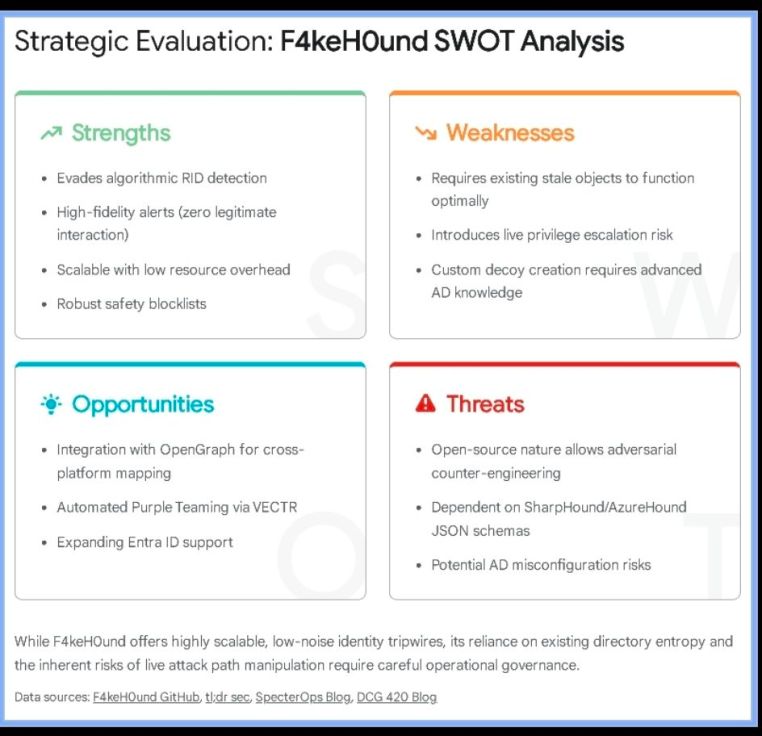
Comprehensive SWOT Analysis of the F4keH0und Framework
Analyzing the F4keH0und framework through a structured Strengths, Weaknesses, Opportunities, and Threats methodology provides a balanced, highly objective intelligence evaluation of its long-term operational viability within complex enterprise environments.
Core Architectural Strengths
The primary strength of the framework is its uncompromising dedication to signal fidelity over volume. By exclusively utilizing deeply dormant, non-production identities that have been systematically removed from all legitimate business processes, any interaction with a deployed F4keH0und decoy produces an operational alert with unparalleled confidence. Legitimate enterprise users and automated service accounts have absolutely no operational reason or valid technical pathway to attempt Kerberoasting against a fabricated SQL service account or request tickets from a disabled legacy administrator. Consequently, the resulting alerts possess a near-zero false positive rate, directly addressing one of the most significant pain points in modern security operations centers.
Furthermore, the framework exhibits exceptional resilience against algorithmic evasion. The proprietary recycling-first engine brilliantly neutralizes the relative identifier increment anomaly, ensuring that the generated decoys can successfully withstand the deep, heuristic timeline scrutiny routinely employed by advanced persistent threats who cross-reference account creation dates with sequential security identifier issuance. From an infrastructure perspective, identity-based decoys consume strictly zero additional compute resources, require absolutely no operating system patching or maintenance windows, and generate zero ambient network overhead. This low-friction architecture allows defenders to deploy hundreds of highly effective traps globally at virtually zero material cost. Finally, the deep integration of rigorous operational safety designs—including complex regular expression blocklists, structural organizational unit exclusions, and mandatory interactive evaluation gates—ensures that the tool is highly resilient against accidental, self-inflicted enterprise outages.
Operational Weaknesses and Limitations
The most prominent weakness of the F4keH0und framework is its absolute, inherent dependency on existing directory entropy. Because the framework heavily prioritizes the recycling of existing objects over the creation of new ones to maintain heuristic stealth, its fundamental effectiveness is intrinsically tied to the current state of the host directory environment. If an organization maintains pristine, highly audited directory hygiene with virtually zero stale, disabled, or abandoned accounts, the framework will consistently fail to locate optimal recycling opportunities. In such pristine environments, administrators are forced to actively degrade the framework’s mathematical safety thresholds—such as drastically lowering the minimum object age parameter—to force the engine to execute deployments, thereby increasing the risk of operational interference.
Additionally, the framework introduces a localized, live privilege escalation risk. Because F4keH0und constructs mechanically viable, technically functional attack paths—such as granting a decoy genuine modification permissions to make it appear highly enticing within the BloodHound graphical interface—any localized failure in alerting pipelines or any significant delay in incident response procedures could theoretically allow a rapid adversary to successfully leverage the decoy to compromise a legitimate, adjacent enterprise asset. Finally, while the concept of deception as code offers exceptional modularity, writing entirely new, custom decoy modules requires highly advanced PowerShell proficiency, deep architectural knowledge of the Active Directory schema, and a thorough understanding of the framework’s complex four-step extension pattern, significantly steepening the learning curve for standard security analysts.
Strategic Opportunities for Expansion
The framework’s current capacity to deeply integrate with the OpenGraph library presents immense, largely untapped opportunities to unify isolated Active Directory deception strategies with complex cloud infrastructure, continuous integration pipelines, and external network perimeters. As the enterprise landscape continues to fracture across multi-cloud deployments, the ability to visualize cross-platform intelligence pollution will become increasingly critical.
Furthermore, F4keH0und provides highly standardized, mathematically predictable targets for automated adversary emulation and structured purple team exercises. By utilizing advanced orchestration platforms like VECTR—an adversary emulation tracking tool heavily favored by the framework’s developers at DCG420—organizations can continuously, aggressively test their internal detection engineering pipelines by safely simulating complex attacks against F4keH0und’s synthetic access control lists. Finally, as enterprise environments increasingly deprecate legacy on-premises Active Directory infrastructure in favor of zero-trust cloud architectures, the module’s nascent but growing support for privileged Entra service principal decoys perfectly positions the framework to capture the rapidly expanding market of cloud-native identity deception.
Anticipated Threat Vectors and Vulnerabilities
As an inherently open-source tool hosted publicly on GitHub, F4keH0und faces the persistent threat of adversarial adaptation. Highly sophisticated threat actors, specifically state-sponsored intelligence units, will inevitably deconstruct the framework’s source code. These adversaries may actively develop custom heuristic models specifically designed to identify the exact default naming conventions, the precise synthetic service principal structures, or the highly specific access rights combinations that default, untuned F4keH0und deployments frequently utilize.
Moreover, the framework is architecturally entirely dependent on the specific JSON output structures generated by the SharpHound and AzureHound data collectors. If the developers of BloodHound significantly alter their underlying data schemas, object typologies, or the complex mathematics governing their edge-calculation logic in future software iterations, F4keH0und’s parsing engines will break, requiring immediate and extensive algorithmic refactoring to restore functionality. Lastly, despite the extensive array of programmatic safety checks, Active Directory remains a highly fragile, tightly coupled system. A simple logic error introduced by a defending engineer during the development of a custom, experimental decoy could inadvertently strip crucial permissions from a critical enterprise service group, leading to severe, self-inflicted denial-of-service conditions across the network.
Strategic Implementation, Post-Breach Containment, and Active Defense
Given its highly specialized capabilities and inherent operational requirements, the F4keH0und framework is exclusively positioned for integration within highly mature, well-resourced cybersecurity environments that maintain dedicated internal detection engineering pipelines, threat intelligence analysis units, and rapid incident response functions.
The developers behind F4keH0und are deeply integrated into the intelligence and active defense community, actively contributing to platforms that manage the lifecycle of adversary engagement. By updating taxonomy protocols and introducing specialized galaxy clusters for the MITRE Engage framework directly into malware information sharing platforms, the creators have positioned this deceptive tooling not merely as a standalone script, but as a core component of a holistic active defense posture. Within this paradigm, F4keH0und is exceptionally valuable for intelligence teams executing continuous adversary emulation. By predictably deploying well-documented, intentionally vulnerable attack paths—such as the unconstrained delegation computer decoy—an internal offensive emulation team can safely simulate a devastating directory breach, actively utilizing standard offensive toolkits to target the specific F4keH0und decoys.
Concurrently, defending intelligence analysts continuously monitor the enterprise logging infrastructure to rigorously verify that the specific interaction with the deployed F4keH0und decoy rapidly triggers the appropriate, high-severity operational alerts. This continuous, structured feedback loop validates and hardens the organization’s overarching detection posture and alert routing efficiency without exposing actual, sensitive production assets to the dangers of a live, unmitigated emulation exercise.
In highly critical scenarios where a targeted organization must fundamentally assume a state of persistent, advanced compromise, F4keH0und transitions from a preventative measure into an active internal intelligence gathering mechanism. When a sophisticated threat actor successfully breaches the external perimeter and establishes an initial foothold on a low-level network asset, their immediate operational doctrine dictates the commencement of aggressive internal directory enumeration. Because F4keH0und decoys are explicitly, algorithmically designed to perfectly mirror the highly attractive directory misconfigurations that tools like SharpHound are actively programmed to search for, the attacker will inevitably ingest the F4keH0und lures directly into their localized tactical map.
When the adversary subsequently attempts to pivot their operation using one of the synthetic, carefully monitored access control list relationships, defending intelligence analysts instantly and silently pinpoint the exact network location of the attacker, their current level of compromised privilege, and their ultimate intended target. This critical intelligence allows for the orchestration of a surgical, overwhelming eviction procedure before the actual domain controller or primary data repository is ever credibly threatened.
Furthermore, as global organizations undertake the complex architectural migration from legacy on-premises Active Directory infrastructure to modern Microsoft Entra ID deployments, they face unique, unprecedented visibility challenges that span across both distinct environments simultaneously. F4keH0und’s dual compatibility, seamlessly ingesting data from both localized SharpHound collections and cloud-native AzureHound collections, empowers defending intelligence teams to deploy a unified, continuous deception fabric. By simultaneously deploying a high-value privileged Entra service principal decoy in the cloud architecture alongside a strategically placed stale administrative lure within the on-premises directory, security operations centers can actively monitor for advanced threat actors attempting complex, cross-domain lateral movement or exploiting the intricate trust boundaries of synchronized, hybrid identities.
Final Intelligence Assessment
The F4keH0und framework represents a mature, highly sophisticated, and strategically vital evolution in Active Directory counter-reconnaissance and identity deception technology. By systematically abandoning the resource-heavy, easily evaded paradigm of isolated structural honeypots in favor of lightweight, mathematically placed identity tripwires, the open-source framework directly aligns defensive enterprise strategies with the realities of modern adversarial tactics.
Its most significant technical and conceptual contribution—the algorithmic recycling-first engine—brilliantly resolves the long-standing, critical epistemological flaw of the relative identifier increment anomaly. This innovation ensures that deceptive lures can successfully withstand the deep, heuristic timeline scrutiny routinely employed by advanced persistent threats during the reconnaissance phase of an intrusion. Furthermore, its deep architectural integration with complex graph visualization platforms and the OpenGraph modeling library fundamentally bridges the operational gap between physical network deployment and strategic, theoretical simulation. This provides security architects and intelligence analysts with unprecedented visibility and total command over their internal deception topologies.
However, the immense tactical power of active attack path manipulation must be wielded with extreme caution and rigorous oversight. By deliberately engineering technically viable, functional escalation paths designed to lure attackers, F4keH0und introduces a material, real-world operational risk that unequivocally demands a highly responsive, automated incident containment infrastructure to mitigate. It cannot be treated as a passive, set-and-forget security appliance; rather, it is a dynamic, active engineering framework requiring continuous algorithmic tuning, rigorous oversight, and disciplined deployment protocols.
For organizations that possess the requisite operational maturity, advanced intelligence analysis capabilities, and rapid response pipelines, F4keH0und fundamentally transforms the Active Directory environment. It transitions the directory from a passive, highly vulnerable repository of identities into a proactively hostile environment for adversaries. By polluting the precise reconnaissance telemetry that attackers rely upon for their operational success, F4keH0und significantly shifts the established asymmetry of cyber conflict, ultimately forcing the adversary to question the fundamental validity of every single attack path they discover.
Works cited
1. Optimizing Cyber Response Time on Temporal Active Directory Networks Using Decoys (Extended Version) – arXiv, https://arxiv.org/html/2403.18162v2 2. Detection Through Deception: Making F4keH0und Work | by …, https://blog.dcg420.org/detection-through-deception-making-f4keh0und-work-445bb8d7617c 3. Mapping Deception Solutions With BloodHound OpenGraph – Configuration Manager, https://specterops.io/blog/2026/02/19/mapping-deception-solutions-with-bloodhound-opengraph-configuration-manager/ 4. [ENG] Oh Bother – We got hacked again – KN White Hats, https://whitehats.pwr.edu.pl/blog/2026-03-29-deception-technologies/ 5. Evolving Detection: Why We’re Moving Beyond ADS to a New Engineering Template, https://blog.dcg420.org/evolving-detection-why-were-moving-beyond-ads-to-a-new-engineering-template-5454e5e92596 6. BloodHound & Other AD Enum Tools – HackTricks, https://hacktricks.wiki/en/windows-hardening/active-directory-methodology/bloodhound.html 7. Detecting LDAP enumeration and Bloodhound’s Sharphound collector using AD Decoys, https://medium.com/securonix-tech-blog/detecting-ldap-enumeration-and-bloodhound-s-sharphound-collector-using-active-directory-decoys-dfc840f2f644 8. DEF-CON-Group-420/F4keH0und: Deception implementation through analysis of BloodHound data – GitHub, https://github.com/DEF-CON-Group-420/F4keH0und 9. Mapping Deception with BloodHound OpenGraph – SpecterOps, https://specterops.io/blog/2025/12/23/mapping-deception-with-bloodhound-opengraph/ 10. [tl;dr sec] #317 – 100+ Kernel Bugs in 30 Days, Secret Scanning, Threat Actors Stealing Your PoC, https://tldrsec.com/p/tldr-sec-317 11. dafloofer/deceptionClone – GitHub, https://github.com/dafloofer/deceptionClone 12. Open Source Honeypots That Detect Threats For Free | Smokescreen, https://www.smokescreen.io/practical-honeypots-a-list-of-open-source-deception-tools-that-detect-threats-for-free/ 13. AD Tripwires vs honeydet (2026) | Compare Honeypots & Deception Tools – CybersecTools, https://cybersectools.com/compare/ad-tripwires-vs-honeydet 14. srlabs/Certiception: An ADCS honeypot to catch attackers in your internal network. – GitHub, https://github.com/srlabs/Certiception/ 15. Certiception: The ADCS honeypot we always wanted – SRLabs Research, https://srlabs.de/blog/certiception-the-adcs-honeypot-we-always-wanted 16. How to setup VECTR for Purple teaming (Adversary emulation) – DCG420’s Blog, https://blog.dcg420.org/how-to-setup-vectr-for-purple-teaming-adversary-emulation-ba62c7b821f2 17. Custom methodology for DEM and ADS with ACD elements use – DCG420’s Blog, https://blog.dcg420.org/custom-methodology-for-dem-and-ads-with-active-cyber-defense-elements-use-f37ca460d166 18. DCG420 ☠️ – Medium, https://medium.com/@DCG420 19. The other side (not the dark side) of CTI — our contribution to MISP 2.4.167, https://blog.dcg420.org/the-other-side-not-the-dark-side-of-cti-our-contribution-to-misp-2-4-167-34c96f58e9b9 20. Active Cyber Defense Gray Zone v3.0 by DCG420, https://blog.dcg420.org/active-cyber-defense-gray-zone-v3-0-by-dcg420-b1db7620c3b6

You must be logged in to post a comment.